
At the crossroads of Switzerland, France and Germany, Basel has long been a city of exchange — between languages, disciplines and histories. Its centuries-old traditions of collecting, publishing and patronage created the intellectual landscape for an art fair that would eventually redefine the global conversation.

For one extraordinary week each June, Basel becomes the gravitational centre of the international art world — a confluence where curatorial intelligence, artistic emotion and historical inquiry attain intensity. Following this year’s edition of the fair, we prepared a selection of gallery presentations that demonstrate enduring intellectual and aesthetic resonance. Spanning Europe, Asia and both Americas, they reveal the breadth of artistic approaches on view: from explorations of memory, ecology and identity to reflections on history, materiality and collective experience.
The Breeder, Athens
Contemporary art, in its most profound manifestations, serves as a conduit for the echoes of human experience: a realm where vulnerability and memory intertwine to challenge the very scaffolding of traditional expression. This assemblage unpicks the threads of conventional permanence, inviting the onlooker into a space where the ephemeral acquires enduring presence.

The Breeder’s presentation brought together Andreas Lolis, Georgia Sagri, Kostis Velonis and Alexandra Christou. By translating fragile, transient forms into marble sculptures, Lolis’s Army of Scarecrows (2026) overturns the material’s longstanding association with monumentality and heroic remembrance, investing it instead with a profound sensitivity to vulnerability, everyday life and impermanence. Working across performance, sculpture and sound, Sagri investigates the politics of embodiment, foregrounding endurance and collective agency against the atomising conditions of contemporary consumer culture. Meanwhile, through sculpture, painting and installation, Velonis stages precarious architectures that inhabit the space between theatre and experience, where the collapse of modernist certainties gives rise to new modes of perception through failure, flux and persistence.
A notable discovery was Christou, whose paintings revealed an extraordinary sensitivity to the psychological complexities of everyday life. Working largely outside institutional visibility during the 1980s and 1990s, the self-taught Greek artist developed a distinctive figurative language in which portraiture, mythology and quotidian encounters dissolve into emotionally charged narratives. Her elongated figures, compressed spaces, and muted yet expressive palette prioritise inner experience over descriptive realism.

Within one canvas, men converge around a cafe table. The vitality of the scene rejects the easy drama of locked eyes; instead, it comes alive through the sublimity of muted choreography. In the arcs of fingers, the slow-burning punctuation of cigarettes, and the crystalline stillness of water and espresso, an alchemy occurs. The work possesses a rare luminosity — spinning the ephemeral threads of a social encounter into a reflection on the human condition.
‘Alexandra Christou’s historic works from the 90s were a true case study in our presentation in the way they touched upon and had an effect on every single viewer from a deep emotional standpoint. This self-taught artist breaks the rules and speaks in a language far from academia but so close to human emotion. From Otto Dix to Toulouse-Lautrec, it compels the viewer to categorise a work that speaks to the psyche’, shares George Vamvakidis, co-founder of The Breeder.
Pippy Houldsworth Gallery, London
Art history is a palimpsest, where forgotten voices return with renewed resonance. Rooted in this continuum, Pippy Houldsworth Gallery has created an exacting programme that bridges historical and contemporary practices through curatorial rigour and sustained institutional advocacy. Its inaugural presentation in the Galleries sector brought together new and previously unseen works by Jennifer Bartlett, Jacqueline de Jong, Mary Kelly, Katy Moran, Nengi Omuku and Shaqúelle Whyte, tracing an intergenerational dialogue of remarkable breadth.
A particular highlight was a recently rediscovered painting from Jong’s iconoclastic La vie privée des Cosmonautes (1966–67), unveiled publicly for the first time since its Paris debut. Equally significant was the inclusion of Bartlett, whose singular practice dissolved the boundaries between Minimalism, Conceptualism and painting, cementing her place among the defining figures of post-war American art.

Within this constellation, Omuku’s work offered a personal exploration of belonging, memory and the evolving relationship between humanity and the natural world. Her practice explores the intersections of nature, cultural inheritance and the inner psyche. Painting on sanyan — the handwoven Aso-oke textile of the Yoruba people — she creates dreamlike compositions in which ambiguous figures dissolve into verdant landscapes, inviting reflections on spirituality, identity and collective belonging. Influenced by European Impressionism, her mother’s botanical drawings, and her own training as a horticulturist and florist, Omuku renders nature as a living presence rather than a passive backdrop, dissolving the boundaries between figure and landscape.

The ancestral sanyan textile embeds each work within the cultural memory of Yoruba tradition. Through this union of material inheritance and delicate painterly gesture, her works become lyrical meditations on ecology, spirituality, belonging and Nigerian social memory, where portraiture, landscape and history coalesce into a singular, resonant visual language.
Experimenter, Kolkata and Mumbai
History seldom arrives intact. At Experimenter’s booth, it surfaced through the tactile, the embodied and the remembered, suggesting that cultural inheritance is carried as much by cloth, gesture and past experience as by institutional archives or enduring monuments. Across works by Ayesha Sultana, Aziz Hazara, Bani Abidi, Bhasha Chakrabarti, the Chanakya School, Christopher Kulendran Thomas, Prabhakar Pachpute, Radhika Khimji, Sohrab Hura, Soumya Sankar Bose, T. Vinoja and Vikrant Bhise, the gallery composed a nuanced conversation spanning painting, textiles, photography, moving image and installation. Migration, labour, conflict, ecology and identity emerged as interwoven histories, each work tracing the fragile yet persistent ways in which memory is continually carried, contested and renewed.

T. Vinoja’s Converging Landscapes (2026) distilled many of the exhibition’s central concerns into a monumental woven textile. Drawing upon contemporary art, Tamil literary traditions and the lived experience of the Sri Lankan civil war, Vinoja employs weaving as a conceptual framework through which land, identity and loss become inseparable. Felt, cotton, thread, lace and bandage coalesce into a surface poised between geological strata and scar tissue, where the landscape retains the enduring marks of geopolitical violence.

As the founders of Experimenter observed, Converging Landscapes examines landscape as a constructed field through which borders are imposed rather than inherited. Despite political fragmentation, the work insists upon the material and ecological continuity of the land, tracing the tension between the Earth’s inherent indivisibility and the human histories of division, displacement and territorial conflict etched across its surface. It is a work of remarkable poetic restraint, reminding us that separation is never natural, but continually produced.
Galerie Frank Elbaz, Paris
Material became a site of continual transformation within Galerie Frank Elbaz’s presentation, where the conventional boundaries separating medium, process and perception dissolved. Across a selection of works by Sheila Hicks, Kunié Sugiura, Ketuta Alexi-Meskhishvili, Kenjiro Okazaki, Chloé Delarue, Mungo Thomson, Yoan Mudry and Machiko Ogawa, textiles assumed sculptural presence, photography relinquished its documentary certainty in favour of painterly ambiguity, ceramics evoked deep geological time, and the familiar was reconfigured into unexpected acts of seeing. Despite the diversity of practices and generations represented, the presentation was bound by a shared sensitivity to material as an unstable, generative force.
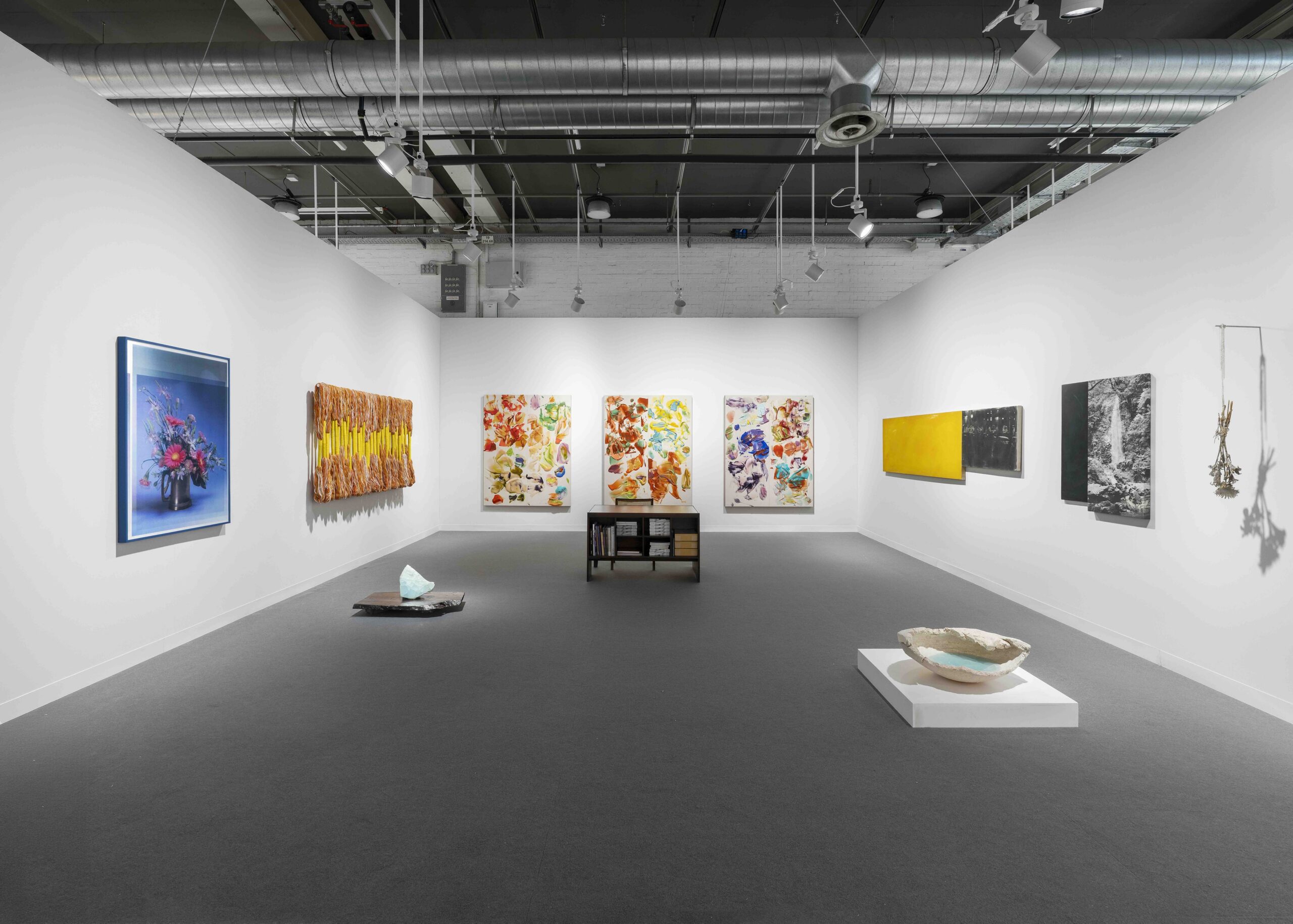
Within this broader inquiry into the mutable nature of materials, Ogawa’s practice stands out for its evocation of geological time, transforming porcelain into a medium through which the Earth’s ancient processes are reconsidered. Informed by primordial mineral formations, volcanic landscapes and the elemental alchemy of heat and pressure, her vessels appear to have accrued across time, their glazes and stratified surfaces recalling the slow crystallisation of matter. The works occupy the liminal threshold between ceramic object and geological artefact, where porcelain assumes the authority of stone, mineral and fossil alike. While underpinned by extraordinary technical discipline, Ogawa’s practice ultimately transcends virtuosity, giving form to a profound exploration of the elemental forces that shape both the natural world and our perception of permanence.

LC Queisser, Tbilisi
LC Queisser’s booth explored the idea of transmutation through a striking constellation of artists whose practices move between material experimentation and deeper questions of vulnerability and existence. Within this space, Ser Serpas, Tolia Astakhishvili and Karlo Kacharava exhibited in a symphonic dialogue, deploying installation, painting, and collage to interrogate how memory, space and identity remain in a state of perpetual, restless becoming rather than static resolution.

Serpas’ precarious, poetic assemblages of found ephemera and fragmented figures beautifully reflected the instability of our physical world, whilst Kacharava’s canvases, steeped in the tumultuous cultural shifts of post-Soviet Georgia, eloquently reaffirmed art’s enduring capacity for social reflection and historical witness. Together, this distinguished triumvirate eschewed mere ostentatious spectacle to propose fragility not as a harbinger of collapse, but as a sublime, generative force wherein personal narratives and collective histories continually reshape and enrich one another.
Astakhishvili’s work focuses on architecture, which he treats as an unstable syntax. Working across collage, installation and painting, she layers drawing, photography, found iconography and text into densely stratified compositions poised between construction and erasure. Her spaces linger in the ambiguous territory between inhabitation and abandonment. Within her collages, these concerns are distilled into intimate architectural fragments, each bearing the accumulated weight of lived experience, temporal dislocation and psychic intensity.
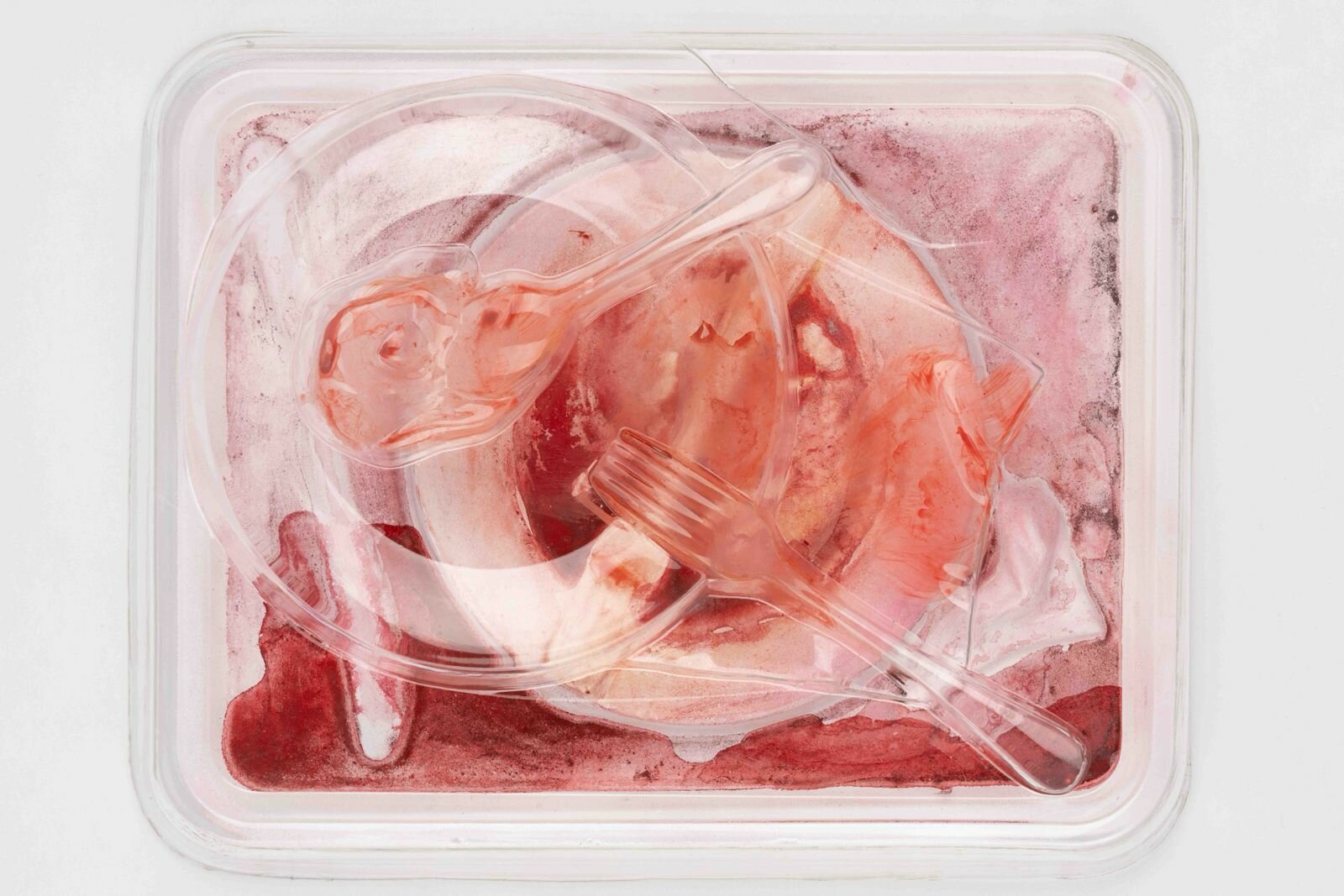
This evocative methodology was beautifully contextualised by Lisa Offermann, founder of LC Queisser, who shared: ‘Tolia Astakhishvili transforms architecture into environments that evoke familiarity and uncanniness, revealing the emotional residues of memory, absence, and survival embedded within them. Her collages render instability not as rupture, but as a condition of inhabiting the world.’
Blank Projects, Cape Town
Blank Projects’ presentation brought together works of Igshaan Adams, Annabelle Agbo Godeau, Jared Ginsburg, Asemahle Ntlonti, Gregory Olympio, Kemang Wa Lehulere and Kresiah Mukwazhi, dissolving distinctions between painting, sculpture and installation, allowing each medium to register the enduring imprint of identity, spirituality, displacement and political memory.

The Harare-born artist Mukwazhi emerged as one of the presentation’s most transcendental voices, utilising her practice to confront the visceral politics of the female body and the enduring, harrowing realities of gender-based violence in Southern Africa. Meticulously incorporating women’s undergarments — objects historically burdened with oppressive cultural expectations surrounding purity, sexuality and patriarchal control — she creates layered works that carry the intimate, ghostly traces of their former wearers, thereby transforming domestic ephemera into powerful, tactile testimonies of vulnerability and survival. Her majestic Tanganyika (2026) series extends this evocative inquiry through an abstracted landscape vernacular inspired by a journey to Lake Tanganyika, wherein the fluid contours of the earth become sublime metaphors for healing, grief, and restorative resilience.

For Mukwazhi, the works gesture at the countless women who have lost their lives due to the ongoing pandemic of gender-based violence in Southern Africa. She states, ‘Tanganyika, meaning “where the world begins”, is also where this body of work begins. It marks a journey I took to the lake of the same name, to realise the answers to some profound questions about land and death. In this process, I allowed myself to enter the terrain of mortality, to examine where the body is “cut”, where it remains sacred and intimate, and where it calls for healing. From this inquiry, the contoured landscape technique emerges as both method and metaphor, mapping a passage through grief toward self-understanding.’
Bortolami, New York
In Bortolami’s booth, what remained unsaid proved as consequential as what was made visible. Painting, sculpture and installation converged in an exploration of memory, perception and the elusive residue of human presence, where absence assumed the density of material rather than emptiness. The works attended to the fragile persistence of what survives — through surface, form and gesture — allowing time to register not as chronology but as accumulation. Held together by remarkable curatorial precision, the presentation proposed remembrance as something neither monumental nor fixed, but embedded within the physical world.

Claudio Parmiggiani’s celebrated Delocazione series formed one of the presentation’s most compelling conceptual anchors. Developed in 1970, the works are created by exposing objects to dense smoke before removing them, leaving only their soot-blackened silhouettes impressed upon the wall. What remains is neither image nor object, but the trace of an absence — a visual register of time, disappearance and memory. Libraries, clocks, windows and human figures linger as spectral impressions, recalling the negative logic of early photography while evoking the indelible marks left by historical catastrophe. In Delocazione, absence is not an emptiness to be lamented but a tangible presence, compelling viewers to consider how memory persists through what has vanished as much as through what endures.

By rejecting traditional representation, Parmiggiani sublimely elevates the residual mark over the physical object itself, delivering an oeuvre wherein destruction becomes an act of poetic creation, and the invisible acquires an extraordinary, visceral physical presence — ultimately proposing memory not as a static archive, but as something fragile, elusive and perpetually sculpted by what has been lost.
Casas Riegner, Bogotá
Casas Riegner showcased a presentation that traced the many ways Colombian artists have negotiated history through image and material. Bringing together works by Beatriz González, Bernardo Ortiz, Leyla Cárdenas, Luz Lizarazo, Carlos Alfonso, Carlos Rojas and Camila Rodríguez Triana, the booth revealed practices separated by generation and medium yet united by an acute sensitivity to memory, political violence, corporeality, gender and cultural inheritance. Each work occupied its own conceptual territory while contributing to a wider reflection on how private histories and collective experience continually shape one another. The result was a presentation of exceptional curatorial coherence, where the specificity of the Colombian context resonated far beyond its geographical origins.

The curation offered a portrait of Colombia’s artistic landscape, balancing acute historical consciousness with avant-garde formal innovation, spanning González’s enduring meditations on violence, Ortiz’s calligraphic investigations into drawing and text, Lizarazo’s radical feminist practice, Rojas’ foundational abstractions, Alfonso’s anthropological still life, and Rodríguez Triana’s cosmological reflections rooted deeply in Indigenous ontology. Reflecting upon the weight of this curatorial endeavour, Paula Bossa, Director of Casas Riegner, observed: ‘Based in Bogotá, Colombia — a context as rich as it is complex — Casas Riegner has always found in Art Basel a crucial platform to give visibility to our artists and their bold voices, connecting them with the international art world. Despite the enormous challenges of participating in a fair so far away from home, we are deeply committed to showcasing our artists to the world.’

Amidst this, Cárdenas’ Interwoven Structure (2026) emerged as one of the presentation’s most interesting masterpieces, reflecting her sustained, archaeological investigation into absence, memory, and the relentless passage of epochal time. Inspired by ancient buildings concealed beneath printed façades during structural restoration, she painstakingly cuts, unravels and reweaves photographic images, allowing rigid architecture to dissolve into delicate, ethereal threads that reveal multiple temporal layers simultaneously.
Her work inhabits the fragile, liminal space where erosion meets repair, proposing memory as an ongoing, active deed of poetic reconstruction rather than a static, immutable record. Evoking Gordon Matta-Clark’s enduring, seminal interrogation — ‘Why hang things on the wall when the wall itself is already a much more challenging medium?’ — Cárdenas similarly transmutes architecture into both subject and tactile surface, fashioning woven landscapes wherein material reality, history and remembrance become entirely and irrevocably inseparable.
David Zwirner, New York, Los Angeles, London, Hong Kong and Paris
A survey of post-war and contemporary art, David Zwirner’s presentation navigated an expansive spectrum of artistic vocabularies, from Sasha Gordon’s psychologically charged figurations and Victor Man’s enigmatic meditations on mortality and rebirth to Chris Ofili’s decade-long mythopoetic canvas, Neo Rauch’s surreal theatricality, Amy Sillman’s richly layered abstractions and Liu Ye’s exquisitely magnified floral portraiture. Historic masterpieces by figures such as Ruth Asawa, On Kawara, Joan Mitchell, Alice Neel, Rose Wylie and Gerhard Richter deepened the presentation, underscoring the gallery’s enduring commitment to intergenerational dialogue and reaffirming its exceptional stewardship of some of the most consequential artistic practices of the past century.
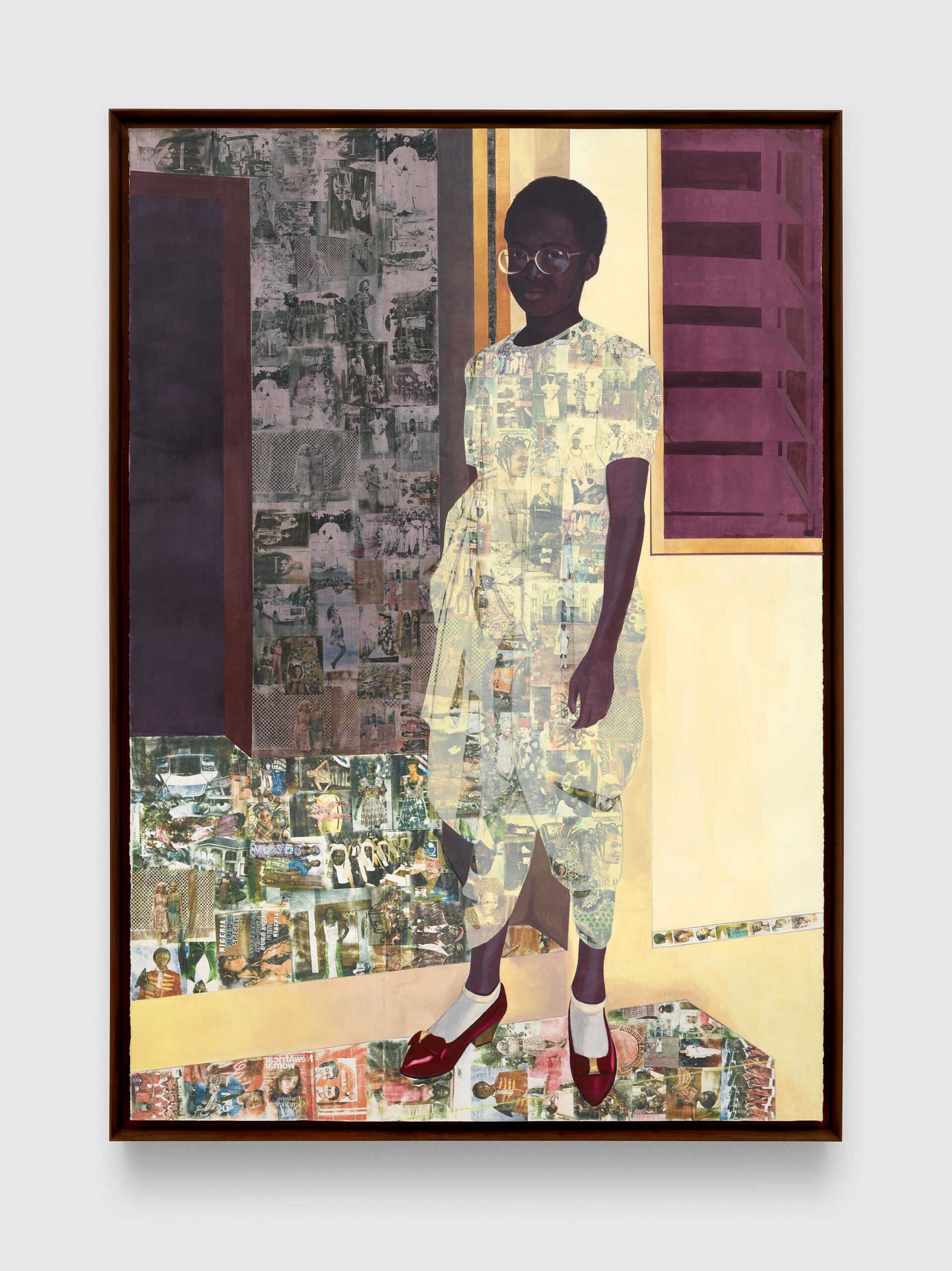
At the very core of this intergenerational constellation was Njideka Akunyili Crosby’s The Beautyful Ones (2012), a magisterial piece that epitomises the artist’s inimitable synthesis of portraiture, autobiography and postcolonial consciousness. The inaugural and most monumental canvas within her celebrated cycle of familial portraits, it immortalises her elder sister, Ijeoma, whilst entering into an eloquent dialogue with Diego Velázquez’s portrait of Prince Baltasar Carlos, deftly reconciling the august legacy of European portraiture with the intricacies of Nigerian cultural memory.
Realised through Crosby’s interplay of acrylic, coloured pencil and photographic transfer, the painting incorporates imagery from family photographs, magazine ephemera and archival fragments, meticulously subsumed into the garments and the surrounding milieu. The surface becomes an archive in which personal remembrance, inherited histories and diasporic consciousness coalesce with extraordinary poetic resonance. Conceived from visual material gathered during the artist’s return journeys to Nigeria, the work considers identity as an ever-evolving constellation of memory, displacement, kinship and belonging. At once monumental in ambition and profoundly intimate in sentiment, The Beautyful Ones endures as one of Crosby’s defining masterworks, its enduring cultural significance further affirmed by its role as the conceptual genesis for her first permanent public mural, inaugurated in Philadelphia’s Africatown neighbourhood in 2025.
Petzel, New York
Petzel’s presentation was a testament to the gallery’s enduring devotion to an avant-garde cohort whose intergenerational practices continuously dissolve the conventional boundaries of contemporary art. Orchestrating a constellation of newly minted creations by Ross Bleckner, Cosima von Bonin, Derek Fordjour, Sean Landers, Pieter Schoolwerth, Tschabalala Self, Emily Mae Smith, Emma Webster, Nicola Tyson, Seth Price and Isabella Ducrot, alongside historically momentous masterworks by Maria Lassnig, Joyce Pensato and Charline von Heyl, the booth deftly navigated the complex, stratified intersections of perception, embodiment, memory, labour and representation. The presentation was a mix of distinct voices, where unexpected connections across generations emerged alongside the gallery’s dedication to the evolving visions of its artists.

Amidst this, Derek Fordjour’s Veranda (2026) revealed a constructed world in which the rituals of leisure become entangled with deeper histories of race, class and systemic labour. Inspired by the artist’s personal, poignant encounters with the microaggressions of being mistaken for service staff whilst travelling, the composition masterfully averts the eye from its picturesque, waterfront vista, training its focus instead upon two uniformed figures whose silent presence subtly destabilises the scene’s atmosphere of unearned privilege and aristocratic ease.

Fabricated from Fordjour’s signature, tactile accumulation of paper, cardboard, fabric and heavily impastoed paint, the canvas possesses a sculptural materiality that perfectly echoes the complex social dynamics it seeks to dissect. Subtle, clever nods to Wayne Thiebaud’s iconic imagery of mid-century abundance further heighten the exquisite friction between hedonistic pleasure and exclusionary bias, transforming a seemingly mundane architectural veranda into a powerful, universal meditation on visibility, human dignity and the invisible, structural demarcations that dictate who is embraced and who remains tragically unseen.