

The status of ceramics within contemporary art is still widely debated. Despite its well-documented presence — notably in Phaidon’s Vitamin C: Clay and Ceramic in Contemporary Art by Claire Lilley — market and institutional realities offer no definitive resolution. Artists, however, cherish the medium, ignoring its convoluted theoretical standing. They use clay to produce sculptures, collages, installations, performances, and mechanical objects, expanding the field through formal experimentation and, more importantly, by seeking new meanings in this ancient medium and subverting its traditional uses and contexts.
The Latin American artists highlighted in this selection extend the field of ceramics beyond utility and craft into the corporal, organic, economic, and political spheres. By linking clay’s earthy provenance to the body, they surface a deep synchronicity between the forces of nature and the forces that shape human beings. They think through and with the material, following or exposing the medium’s essence to the public.
In their practice, ceramics become multifunctional vessels that inspire relational aesthetics, in which the artwork becomes an interactive site for bonding. They foreground the ancient connections between humans and the earth, forging pathways that bring us closer to our ancestors as well as contemporaries. Moreover, ceramics’ long-standing cultural and social impact allows the artists to explore how class and gender hierarchies have changed or persisted.
Finally, these creators rework the meaning of territory in our personal and national stories. Clay stays in an immediate relation to the land it’s taken from — a movable, malleable site once used as a vessel for resources or burial, crucial in sustaining ecosystems, sacred time, and communities. Their situated practice taps this reservoir of meaning. By redirecting attention to the costs of extractivism and the devastation of soil as sacred ground, they confront the social inequalities, discrimination, and neocolonialism that destroy human and non-human life alike.
Héctor Zamora
Héctor Zamora is a Mexican artist whose practice has steadily and cleverly intervened in public spaces. He explores inequalities and power relations in contemporary societies and questions the roots of collective meaning-making, revealing how we base organizations, values, and symbols on pretenses and shared mirages. Zamora reshapes the way ceramics operate as a medium within the visual and cultural landscape, turning them into elements of actions, installations, and interventions in gallery or museum spaces.
The artist instigates creative conflicts in which ceramics — specifically terracotta — serve as a metaphor for ancient instincts and the body’s primordial, inherent powers in action. He twists and shakes up traditional artisanal items like clay pots and bricks to rearticulate questions about social justice in racialized and patriarchal societies, wanting us to return to the body as the source of power, strength, and, eventually, actual change. This turn began early in his career, fueled by ethnographic research on vernacular construction technologies and extended stays in India, Brazil, Colombia, and Spain.
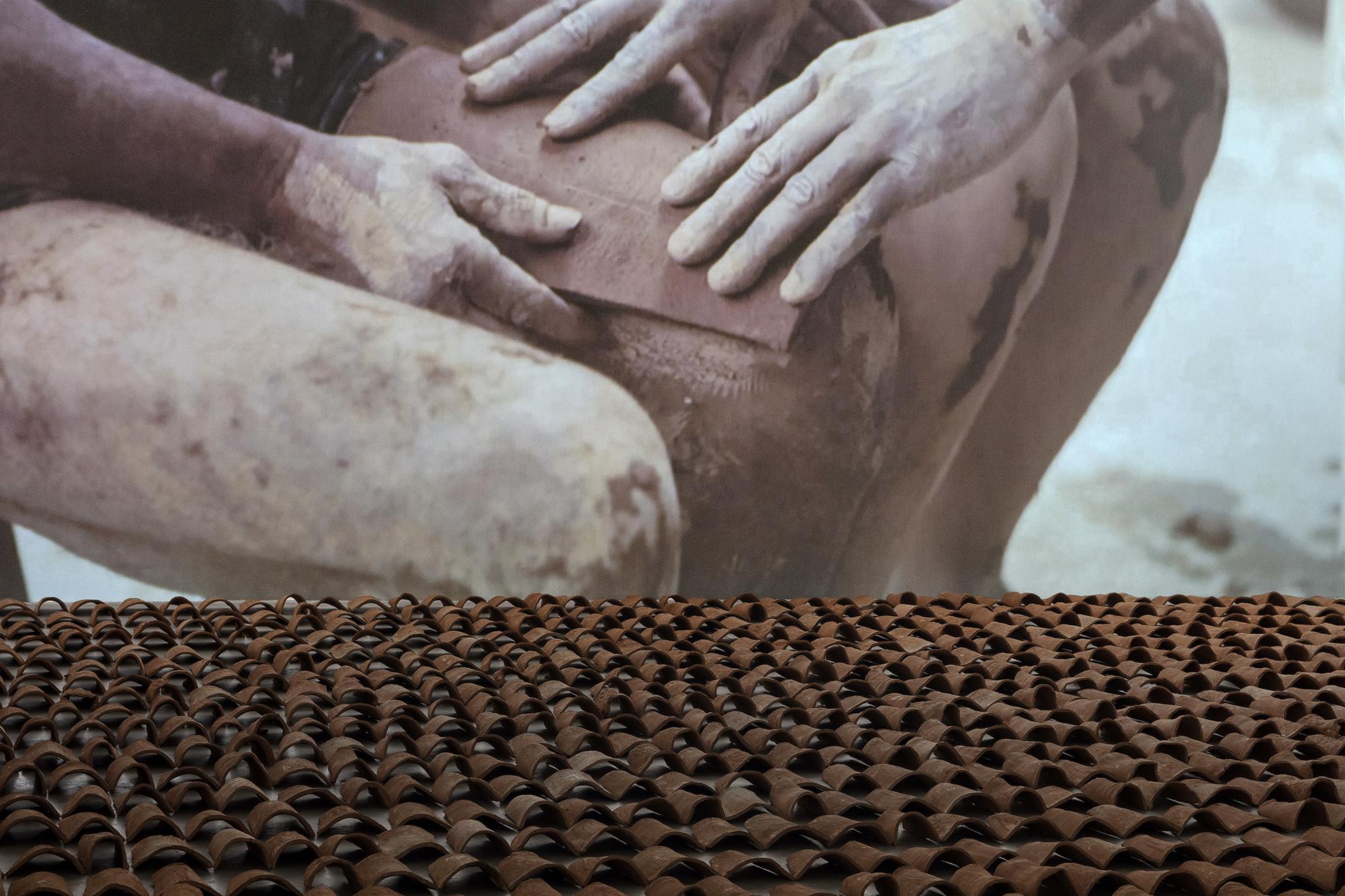


In the piece Nas Coxas (On the Thighs), staged at the Luciana Brito Galería in São Paulo and at the Mercosur Biennial in 2018, Zamora directed an action in which invited performers were asked to make “ridge and channel” roof tiles on their own thighs. It referenced the Brazilian expression fazer nas coxas, which captures the harmful stereotype that enslaved people lacked the skill to make roof tiles and used their own bodies as molds. Each produced tile was different and unusable, exposing the racial prejudice hidden in the language, inaccurate at that, given that the tiles on actual historical buildings are evenly shaped. “In this gesture, in this action, you can see very clearly that the body is a seat of power, of creation, but also, in some way, of this brute force.”
Another of Zamora’s works that pokes at our political and capitalist sensitivities is Material Inconstancy, first made at the Luciana Brito Gallery in São Paulo in 2011 and restaged as Emergencia at the Madrid gallery Albarrán Bourdais in 2025. “I made a performance with a choreography involving 22 bricklayers, who completely took over the gallery space, with the original architecture, and what they do is throw the bricks to each other” — a synchronized re-enactment of the real cooperative method construction workers use to pass material along a circuit. Constrained by the gallery architecture, many units were dropped and destroyed. In Madrid, terracotta vases replaced bricks, and the circuit flowed out of the gallery into the street.
Meanwhile, Existence-Emitting Movements from 2019 engages with the cultural image of women carrying heavy clay vessels with ease and grace. Zamora removes the vessel from the head, places it — still wet — on the ground, and invites local women to walk over the fresh pots and smash them underfoot: “When you have fresh clay or fresh mud, it still has the potential to be transformed.” Re-enacted multiple times around the globe, the piece turns an instrument of domestic and communal labor into a means of protest against the gendered injustice of how women’s and men’s labor are valued.
Lucía Pizzani
Although clay is not the only medium the Venezuelan artist Lucía Pizzani works with, it constantly reappears and transforms in her practice. Curiosity and care permeate Pizzani’s investigation of issues such as identity and change, migration and belonging, human and non-human systems. She finds visual and symbolic references in nature, choosing plants, seeds, insects, and reptiles as sources of meaning or form. She also draws on the vernacular cultures and cosmologies of her own history, weaving these threads together.
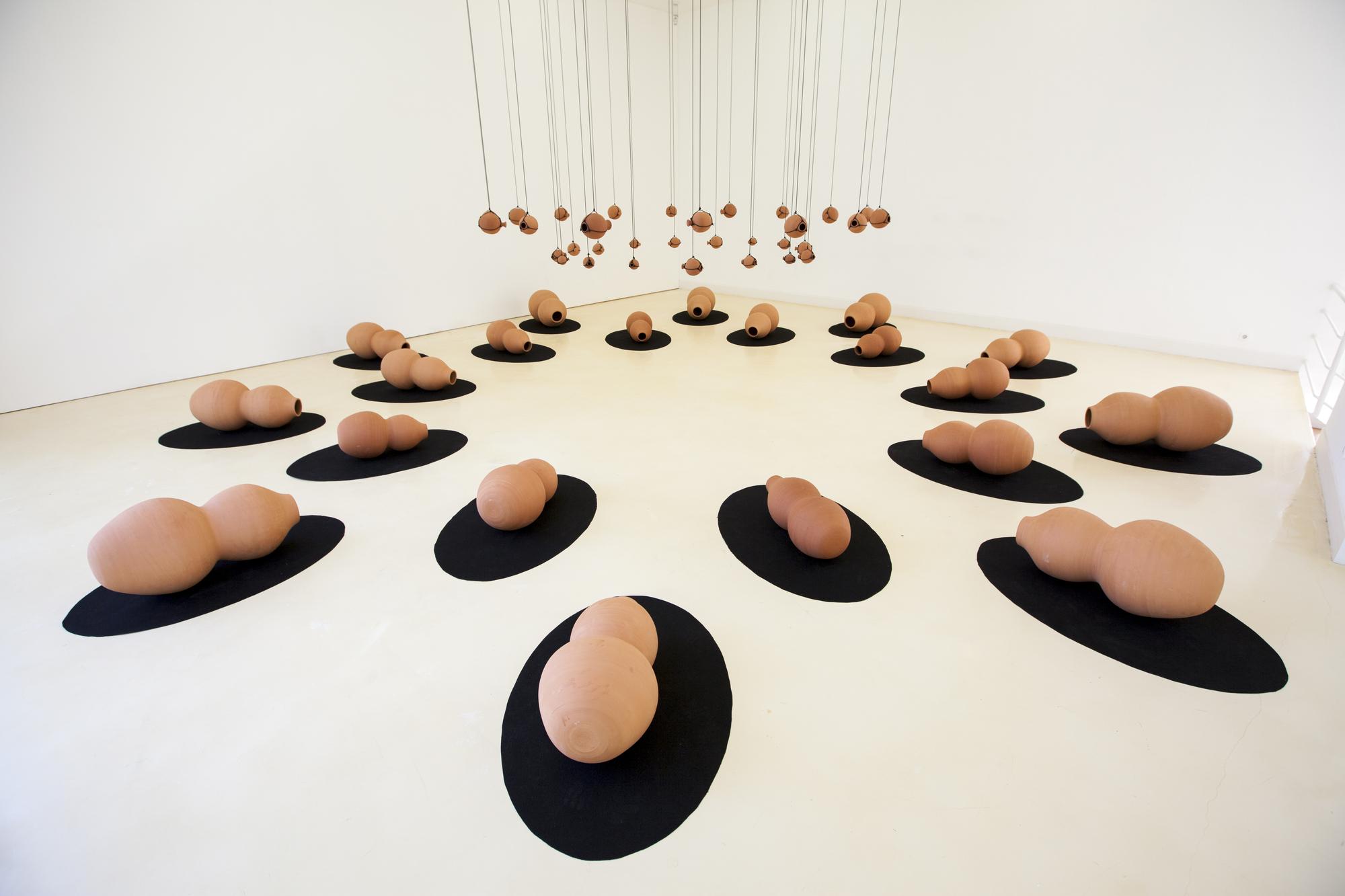
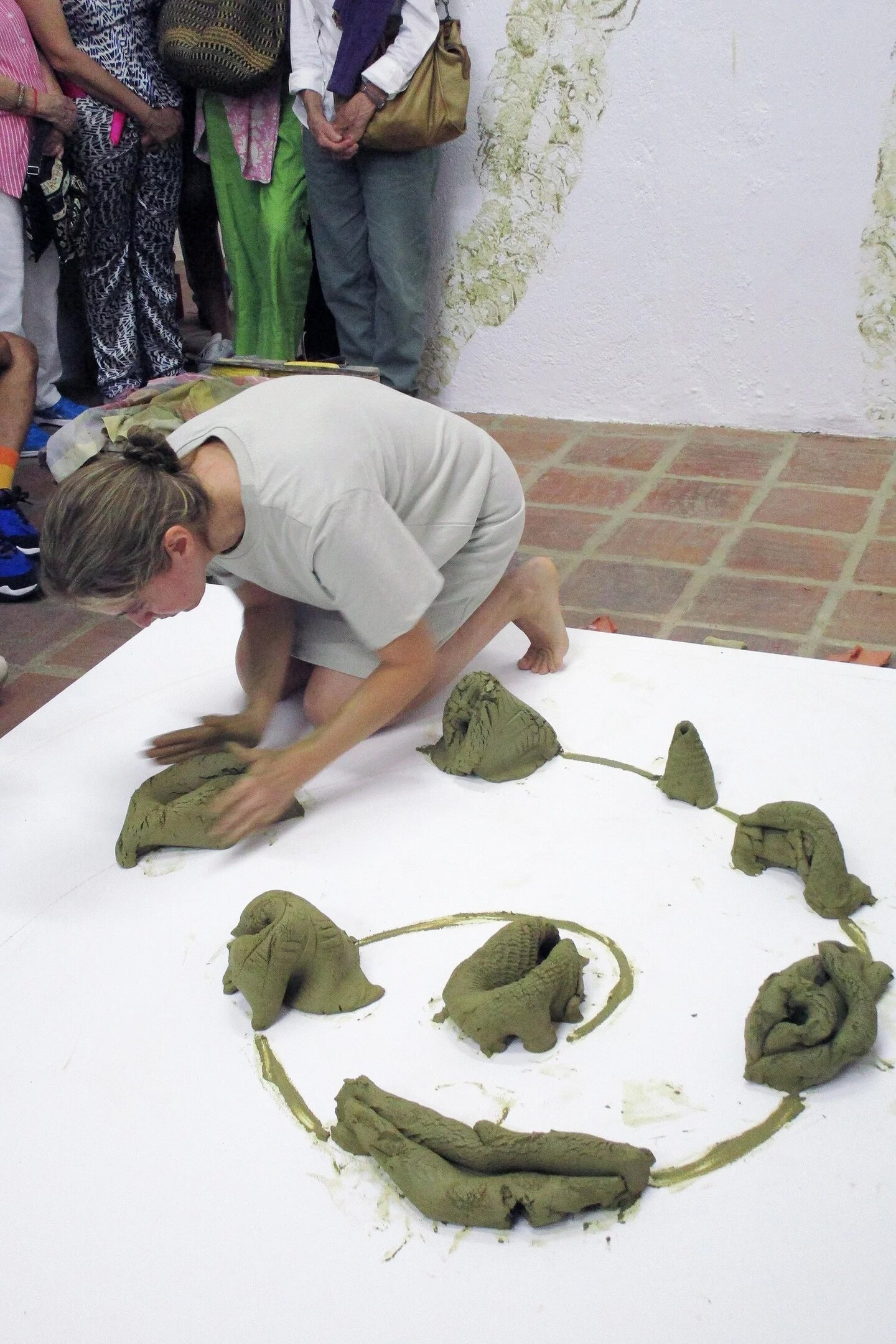
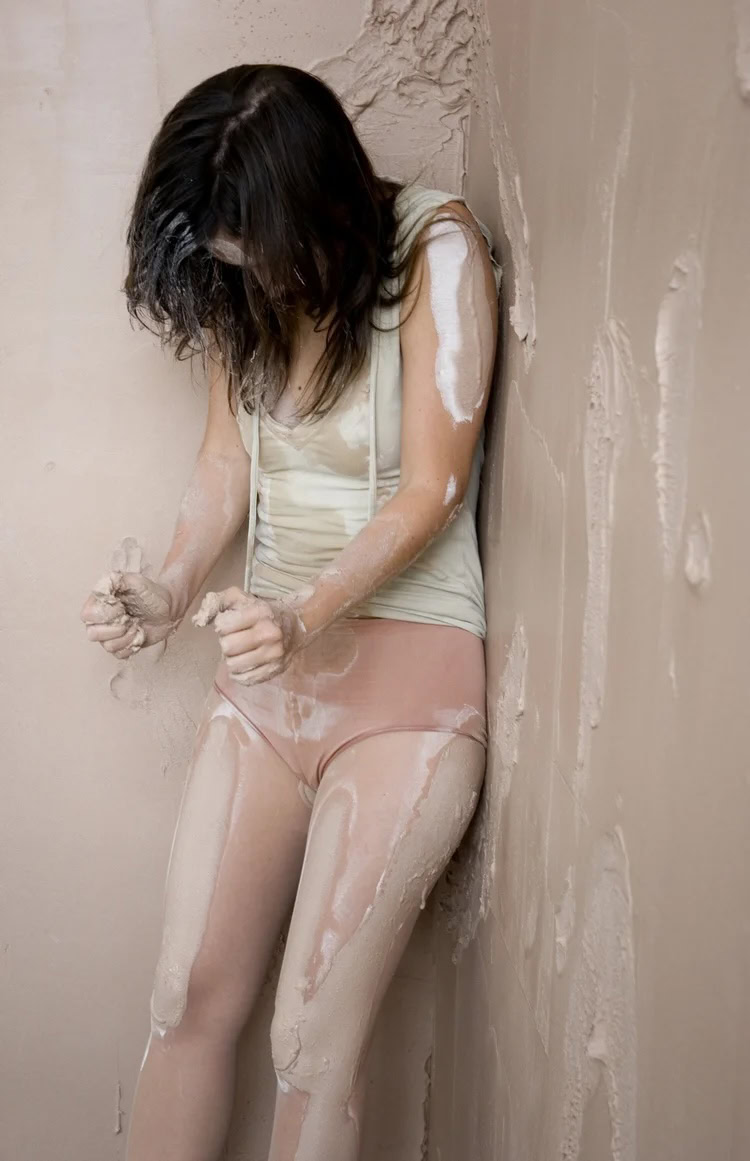
Her diploma work, Vessel (2009), was a radical performance that situated the whole body and the material in a twisted, reversed relation to traditional ceramic practice, in which only hands interact with the clay. Pizzani covered the walls of a room with plaster, then touched and marked them with her body, leaving traces of her limbs. These corporal imprints stood as proof of a democratic interaction between matter and human physicality. They served as a metaphor for the primordial, organic nature of human embodied existence as earthly beings in constant mutation. The performance re-enacted a metamorphosis, with the room and the body functioning as a cocoon and a vessel for potentialized life.
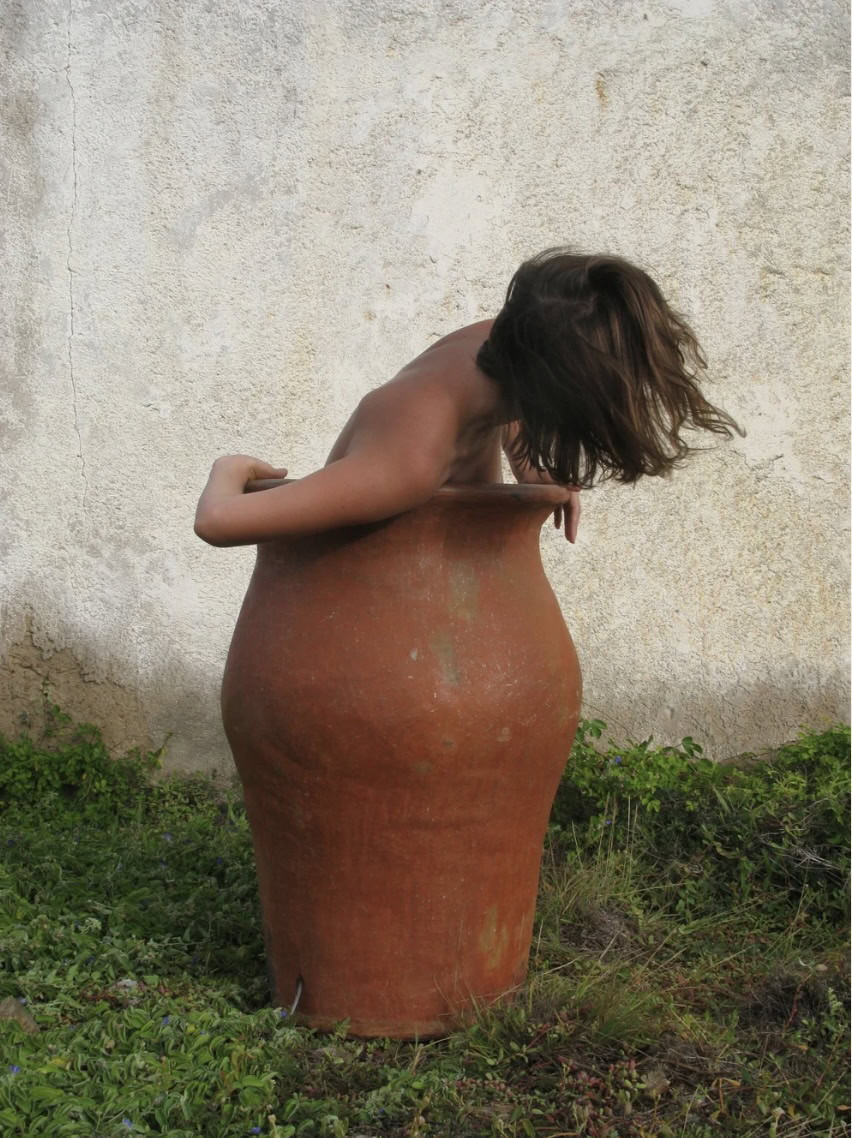
In Cuenca 1, 2, 3, 4, she reactivates this body-clay encounter by entering a terracotta amphora to stage a caterpillar’s arrested metamorphosis. While in Coraza (2019), she preserves highly symbolic objects from ancestral Indigenous cultures in ceramic form — a snake’s skin, a corn cob — condensing contemporary, linear time with the sacred and cyclical one.
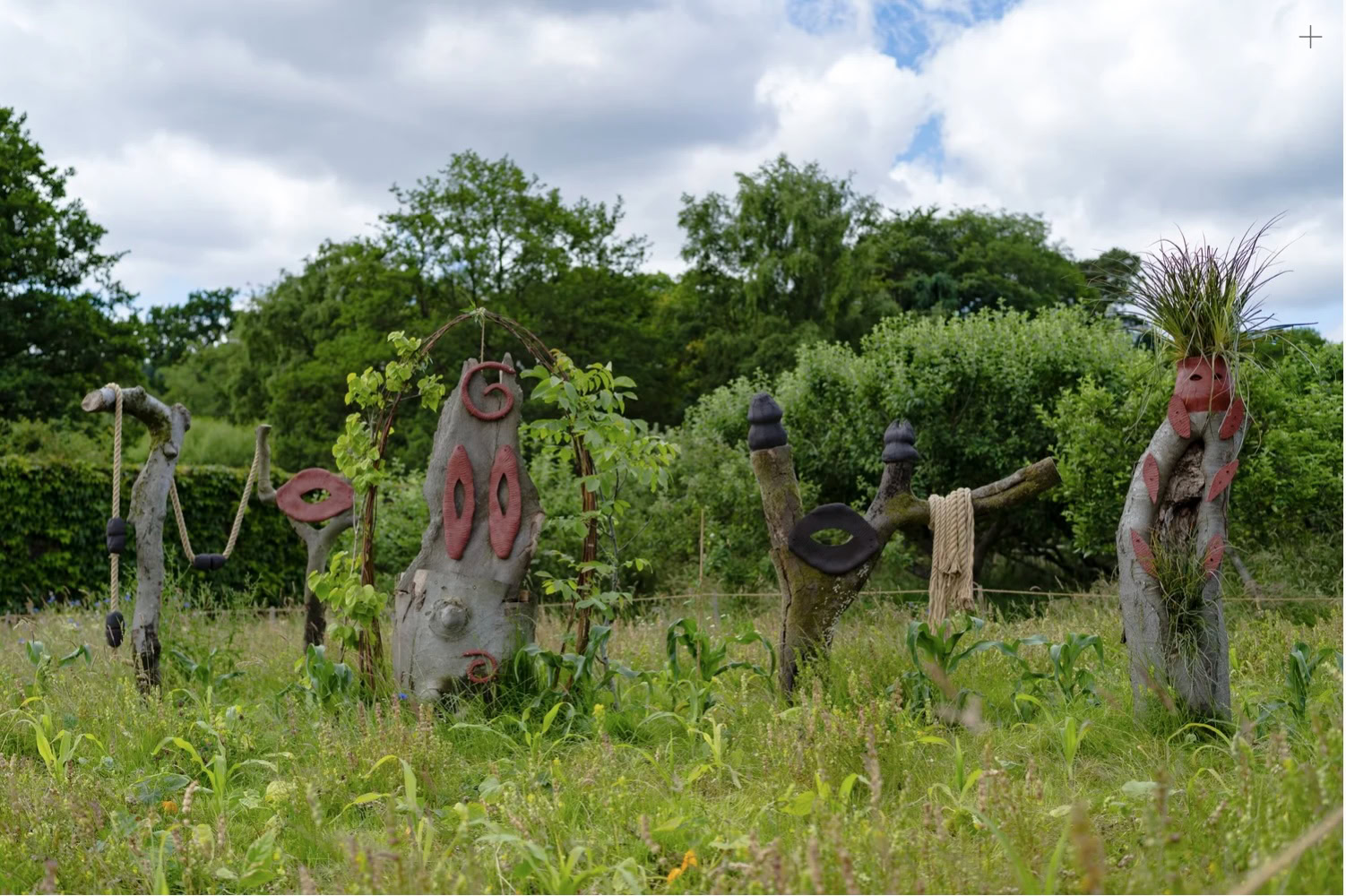
In another recognizable gesture with clay, Pizzani makes faces, masks, or simply seeds with open eyes. She creates site-specific installations (indoor or outdoor) in which photocollages become three-dimensional through incorporated ceramic elements. An example of that is the work Crop and Memory (2024), displayed at Harewood House Garden. The installation combined plants, arboreal elements, and face- or eye-shaped ceramic pieces, referencing the ancient Indigenous three-sister crop system. Maize, climbing beans, and squash are planted together in a symbiotic triad: corn provides a natural trellis for the beans, the beans fix nitrogen in the soil, and the wide squash leaves act as living mulch, suppressing weeds. The work points us toward the realization that there are harmonious, self-sustaining, and purposeful circuits of biological and human time — that nature holds memories, stored in the images captured through clay eyes.
Florencia Sadir
In the visual poetry of the Argentine artist Florencia Sadir, we encounter vernacular techniques and gestures through which she brings the elements — wind, sun, fire, earth — into dialogue with the landscape. In the 2023 conceptual art installation Donde nace el viento. Dibujos a cielo abierto (Where the Wind Is Born. Drawings in the Open Air), made in the Quebrada de las Conchas near the town of Cafayate (where the artist is from), she reorganizes the site with engraved clay shingles and blocks. These elements are exposed to the zone’s harsh, extreme climate; wind and sun constantly weather them. Does the landscape need art? Does the sky want to look at the drawings? Does nature crave poems? This constellation of simple, rustic, petroglyph-like objects wants us to answer affirmatively. Sadir aims “to convey or create a situation in which we feel tiny, small, mere part of this world but not its rulers.” This land art piece celebrates the territory — the protagonist and material foundation of the installation.
In her process, Sadir reapplies local ceramic and construction traditions to harmonize art with organic forces. She is not beautifying or adorning; rather, she synchronizes and orchestrates her artistic practice with the surroundings and vernacular culture. In the installation Mud Rain, she sought to replicate the “brown rain” effect caused by the Zonda winds in the desert. Working alongside master artisan Mabel López — who guided her in the practice of reduction firing using sheep manure — Sadir and the team of artisans created 18,000 handmade clay beads. Ceaselessly making small spheres of clay with other women — sharing stories, killing time, creating common space — gave this moment the air of a collective, meditative ritual.

The firing technique also added gravitas: the process was carried out inside an airtight underground vessel, allowing smoke to penetrate the clay’s pores and impart a dark hue to both its interior and exterior surfaces. The beads were strung on multiple threads hanging from above, densely filling the space; below them lay a muddy, earthy rectangle, giving shape to a processual, cyclical phenomenon that marks life and territory. Sadir’s ceramic constellation of beads reminds us that we all belong to the soil. It evokes a feeling of groundedness in existence, in a body, which will one day return to earth and reappear as muddy rain.
Each elaborate installation necessitates an extensive process, at the heart of which lies an interaction with clay: “Wet mud, wet earth, is very heavy. So working with mud puts you in a bodily situation where you have to exert a particular kind of force — that’s one thing. When you make bricks or clay plates, everything happens on the ground. The mud is mixed in a circle, which later gets transferred into mudar el rumbo [changing course]. The horse enters a circle and goes around, mixing the mud as it turns. And then the mud is loaded into a wheelbarrow and carried to where the bricks are made. And all of that happens on the ground, with them stacked one next to the other in a very neat way, building up in layers.” This ground-level perspective and direct connection with the soil influence the setups of her installations, as many decisive elements are displayed on the floor or on land.
Beyond clay, Sadir also works with fibers. This deliberate, though intuitive decision, enriches her narration with direct quotations from vernacular culture. This way, she reformulates the contemporary Argentine art vocabulary and grammar to express her country’s cultural patchwork.


Constanza Alarcón Tennen
The Chilean artist Constanza Alarcón Tennen combines science and archival material with embodied experience. Her ceramic pieces double as sound devices, the result of a long process of experimentation and testing. She claims that art allows her to speculate and to address the void that quantified or qualified methods cannot capture. In her multimedia performance series Nazca/Sudamericana I and II, she reinterprets the movements of the Nazca and the South American tectonic plates, which put Chile among the most seismically active regions in the world. The Nazca oceanic plate is constantly being pushed beneath the South American continental plate. This movement, though invisible to the naked eye, builds up immense stress in the Earth’s crust, which, once it reaches a critical point, is released as a powerful earthquake. The country experiences minor, unnoticeable tremors daily, and larger, structural earthquakes frequently — one of which the artist experienced firsthand as a child.
The project is an ongoing endeavor — the first chapter (the prologue) sets up and develops the idea of a sexual encounter. The second chapter, dedicated to the South American plate, is based on the idea that the tectonic mass retains a memory of the air. Having supported the Andes — formed through the interaction between the Nazca and South American plates — it conveyed this memory of the air down into the plate’s subterranean universe. The artist is now developing the Nazca episode of the trilogy.

Constanza Alarcón Tennen reimagines tectonic friction as a love affair advancing between the plates, narrating a visual and material poem about the erotic relationship behind their movements. Performers use the ceramic sculptures to map out and enact the sexual tension and release that comes from touch, caress, kisses, and intercourse. They blow into the hand-shaped sound devices, emitting whistles that add density to the sensual choreography.
In the first chapter, sculpted hands stand for specific orgasmic spasms or erotic stimulation between two women, lying on the floor on stone plates overlapping one another. In the second episode, the ceramic hands hang from the ceiling on ropes, receiving caresses from the female performers; they also appear in the video that forms part of the multimedia installation, where they are similarly blown and kissed, their images overlapping and followed by photographs of the Chilean landscape — as if the landmass were both the body and the ceramic sculpture. A recited poem and an audio piece tie the installation together.
A related poetics appears in 2023 Coro (Chorus), co-created with Nicole L’Huillier, which orchestrates a sensuous, carnal encounter between two performers mediated through ceramic-sculpted hands hanging in the installation and surrounded by spontaneous audio compositions. This time, the artist proposed attunement to a chorus of frequencies in the air and beneath our feet — vibrations that sound softly and deeply through matter, bodies, and terrain. Through video, audio, sculpture, and graphic works, the installation was designed and directed to cross two dimensions of embodied existence: intimacy and collectivity.


![Nicole L’Hullier + Constanza Alarcón Tennen, Choir [Coro], installation view. PS122 Gallery NY, 2023. Courtesy of the artist.](https://contemporarylynx.co.uk/wp-content/uploads/2026/07/Nicole-LHullier-Constanza-Alarcon-Tennen-Choir-Coro-installation-view.-PS122-Gallery-NY-2023.-Courtesy-of-the-artist-scaled.jpg)
Gianine Tabja
Gianine Tabja connects ceramics with vulnerability, fragility, and plasticity. She translates the cultural and natural contexts into poetic questions and provocations, leveraging the symbolic meanings and physical characteristics of earthy materials, including clay. She recognizes its metamorphic nature and uses it in her performances, installations, and actions, pursuing a particular aesthetic effect shaped by the material’s own agency. This very effect is captured in the processual installation Materiality and Impermanence (2018), composed of rudimentary elements: a metal mesh elevated above the ground, on which flat pieces of terracotta and cement plates were laid, with plastic bags of water dripping onto them from above.
The result was a gradual dissolution from a solid state into muddy clay. Tabja wanted to expose the historical and political processes of colonization and modernization as non-linear, like clay that can shift from solid to liquid and back. Nothing is permanent, even though at a given moment it may appear so. Social and political structures mutate, and territories and their borders — like the plates on the metal support — shrink in one dimension while spilling out into larger, muddy sites with irregular, naturally formed boundaries. She repeated the experiment from a different angle with the outdoor installation Who Colonizes Who?, this time placing clay and cement plates directly on land. Exposed to natural processes of entropy, facilitated by meteorological conditions in Scotland, she used the materials’ features as metaphors for colonization — a process of dominance, but also of cultural appropriation that runs both ways, impacting all parties involved in the political process that shaped Latin American societies.
Tabja displays a similar line of inquiry and provocation in Geography vs Politics (2017), an installation consisting of three objects: a terrain map of South America transferred onto concrete; a blank white page in the shape of an overturned or erased map, made from paper covered in clay and fired in the kiln; and a political map of the region showing through the outer layer of white ceramic laid on top of paper, cracked to reveal a unified Latin America. These three materialities offer a powerful reading of the work. The concrete geographical map is solid, coherent, and stable, while the clay image on the paper piece disappeared during production, conveying the erasure of knowledge or the conquest of territory and political divisions.
Overall, the installation stages three gestures — disappearance or erasure, preservation of scientific discourse, and the imposition of symbolic meanings on structures generated by political will. It introduces two tensions: first, the contestation of nature and politically imposed human realities; second, the conflict between erasure and preservation as an act of will that impacts lived realities. With no map image preserved, we are left only with clay, with earth, of equal characteristics to us all. Whether in the concrete geographical map or the political map peeking through the cracks of the South American region, the work reveals the powers inherent to knowledge systems, normative-symbolic systems, and politics.
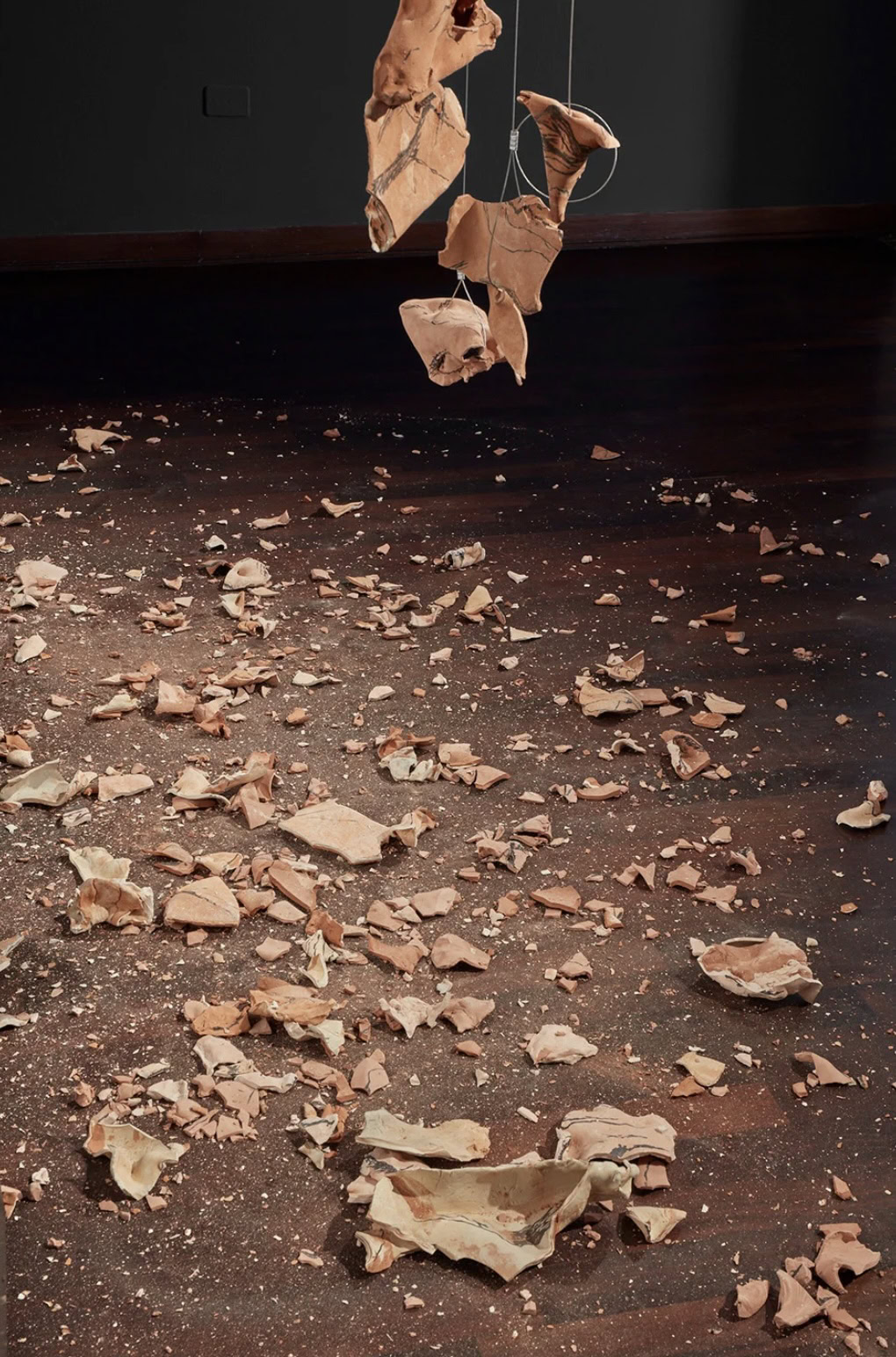
Tabja has also made more disruptive use of ceramics in her practice. She has moved from subtle, below-the-radar visual narratives toward more dramatic choreographies. In the 2020 piece Mechanics of Reaction, she sought to capture at once the tragedy, trauma, and perseverance of Máxima Acuña, an Indigenous agrarian leader who stood up to a mining corporation attempting to evict her from her land in Tragadero Grande, Cajamarca. She has ultimately succeeded — while some legal cases remain pending, she has won several and remains on her land. To capture this struggle, Tabja designed an automated work in which ceramic objects shaped like body parts banged against a metal wall; the kinetic energy of the moving elements crashed against the aluminum barrier, breaking into pieces that covered the floor and formed a bodily landscape. The clay was conceived to represent both Máxima Acuña’s and the earth’s body. The material’s physical properties allowed Tabja to render the brutal mistreatment of the land itself and the people to whom it belongs.


Sallisa Rosa
The Brazilian artist Sallisa Rosa works with earth using various materialities and techniques — ceramics, rammed earth, wattle and daub, adobe, hyperadobe. She typically sources clay from lands belonging to the Landless Rural Workers’ Movement (MST), noting that living soil contains plenty of organic matter, small stones, and even trash.
Her practice gravitates toward the process of memory — constructed and imposed versus natural, lived, and embodied — and recuperating pasts lost or forgotten for lack of personal or historical records. In her immersive, large-scale installations, she aims to record events, affirm identities, and craft fictions about natural phenomena and social relations. Her practice asserts an ethical and aesthetic commitment to collective creation, exploring a realm of experience that transcends individual agency. Different soil materials serve as both a raw medium for new visual references and a recurring metaphor for earth beings, the body, memory, and natural forces.
Sallisa Rosa considers the corresponding social, cultural, and religious dimensions of the materials she uses. Formally, she has extended her practice from intimate artisanal objects made with traditional methods, fired at low temperatures in a wood kiln, to dramatic, all-encompassing environments made of multiple ceramic or adobe elements During her creative process she discovers stories — actual and invented — and weaves them into a complex cosmogony in which fiction serves to reveal the violence of past struggles and current conflicts over political, economic, mnemonic and bodily autonomy of ethnic minorities. She shares a special connection with the earth, perceived as both the beginning and the ultimate future. This certainty allows her to formulate and materialize powerful, tangible metaphors between the body of the earth and the human body, illustrating the parallels between the damage done to the soil and the harm done to people.
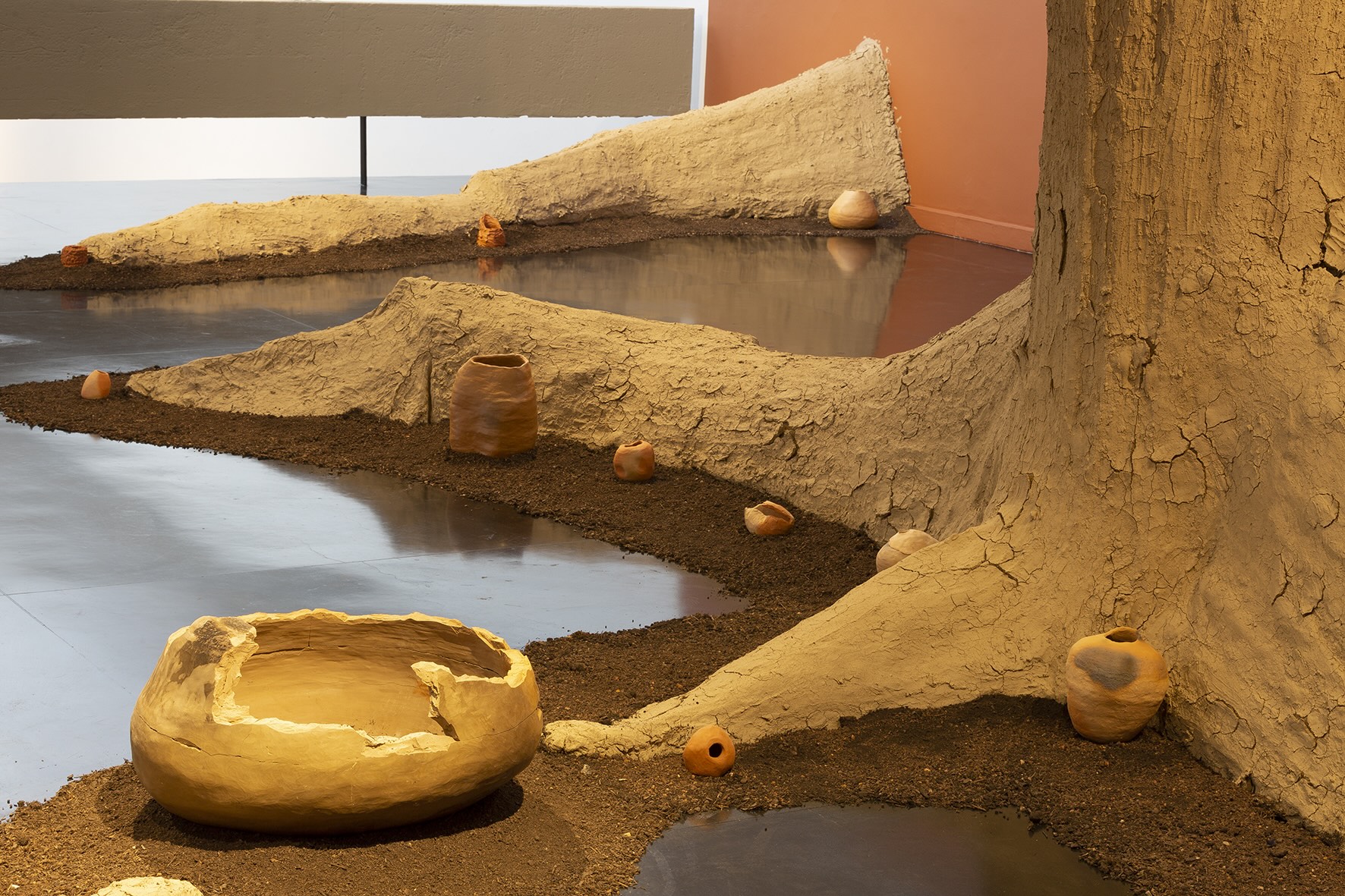
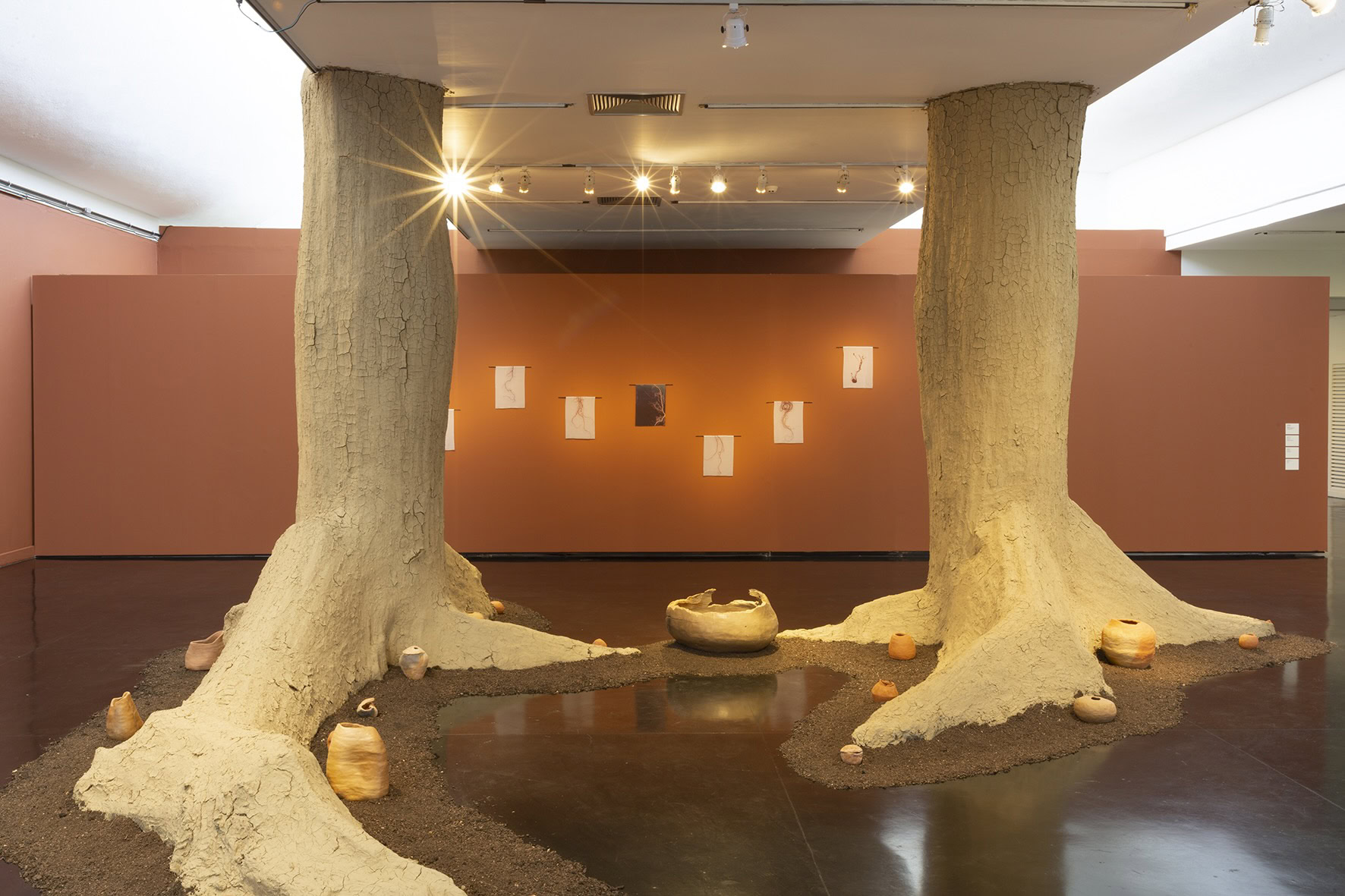
This idea is realized in América, an installation composed of adobe-made roots whose imposing presence transformed the museum space into a territory. Sallisa Rosa explained the origin and purpose of the work: “It was when I ate clay that I remembered: memories can fade. Swallowing earth was the catalyst that unleashed a latent legacy. I followed the command to step onto the earth and gaze at the sky. Earth is a magical dust that safeguards memories in monuments and preserves the traces and fragments buried beneath the surface. Earth is where we plant our feet to lift our bodies. It is beneath our feet that memories transform into riches; extracting wealth from the earth is nothing more than unearthing memories. To honor my heritage, I celebrate memory — and celebrate it with my body.”
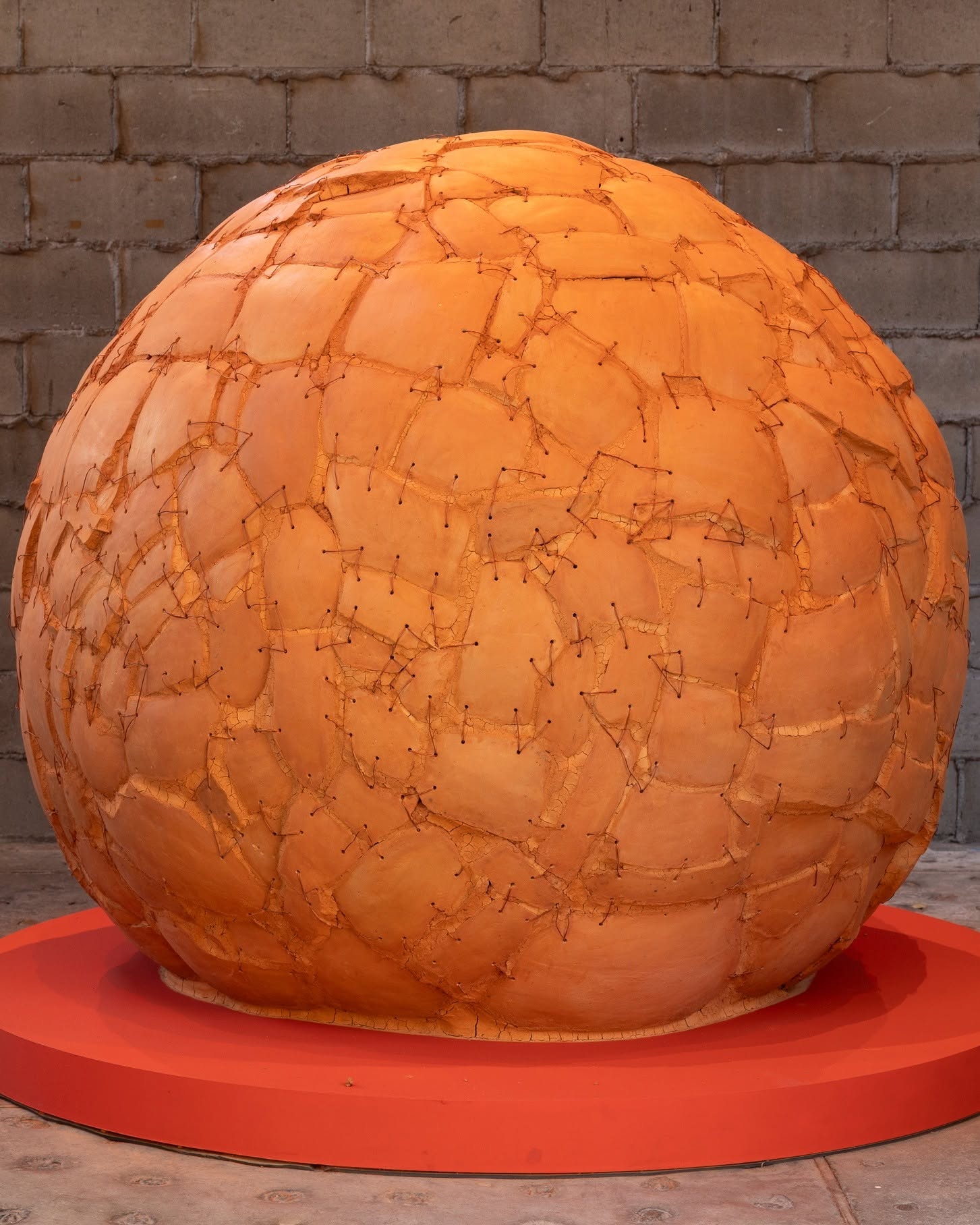
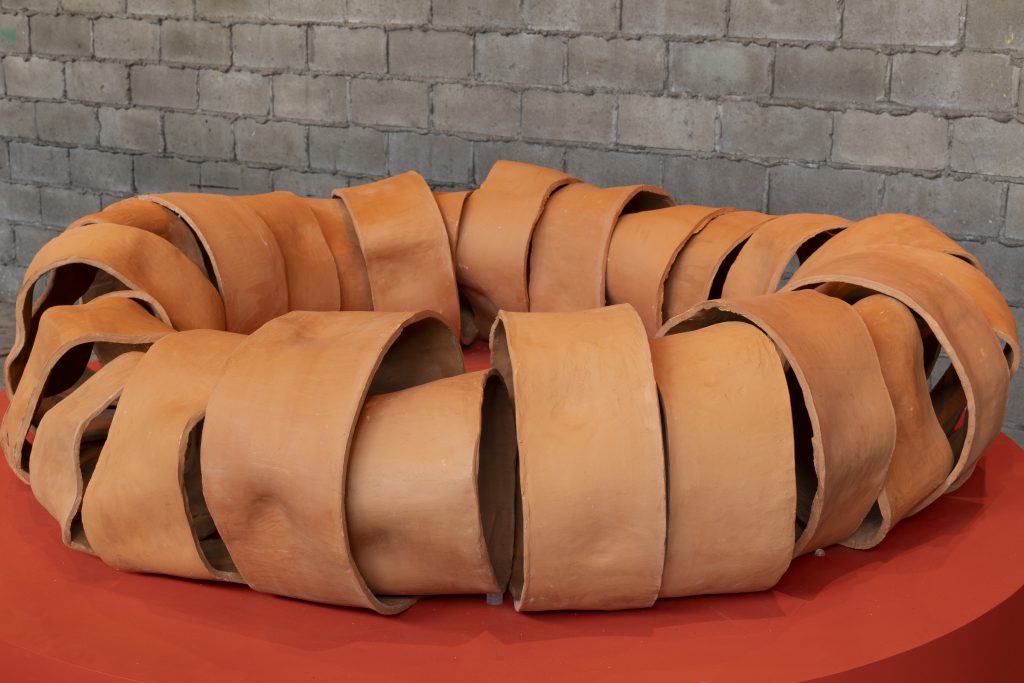
For her other large production, Earth’s Axis, commissioned by Sesc Pompeia in São Paulo in 2025, Sallisa Rosa explores a new direction. Though still constructed with clay, sand, and traditional ceramic-making techniques, the work challenges our sense of omnipotence, omnipresence, and false eternity. The exhibition opens with a clay sphere representing the Earth, composed of small terracotta puzzle pieces stitched with wire. The work’s title announces the claim around which the artist develops the narrative: Nature will have its revenge. Working with clay, the artist has come to know two fundamental components of life — earth and water — both endangered by civilization’s pursuit of progress. Through her work, Sallisa Rosa asserts that nature will prevail; humans, with their ideologies, systems, and technologies, are doomed. In Earth’s Axis, Rosa illuminates the debate over environmental protection and conservation and builds a monument to communal living and multi-layered craftsmanship, evident both in the collective effort behind the works themselves and in the strictly manual preparation of the organic materials that compose them. It is also an ode to the material — to clay as it was at the beginning, and as it will be forever.
Tania Bello
The Mexican artist Tania Bello categorizes her creative process by the methods she uses for 1050- and 1280-degree ceramics – her works are not individually titled, but belong only to a particular group made with low- or high-fire techniques.
Depending on the firing temperature, ceramics have different properties. Earthenware fired at 900–1,050°C has a porous finish that can still absorb water and resembles the clay’s original state. These pieces are left unglazed. Stoneware and porcelain require much higher temperatures, at least 1,200°C, offering smooth surfaces with stable glaze tones.
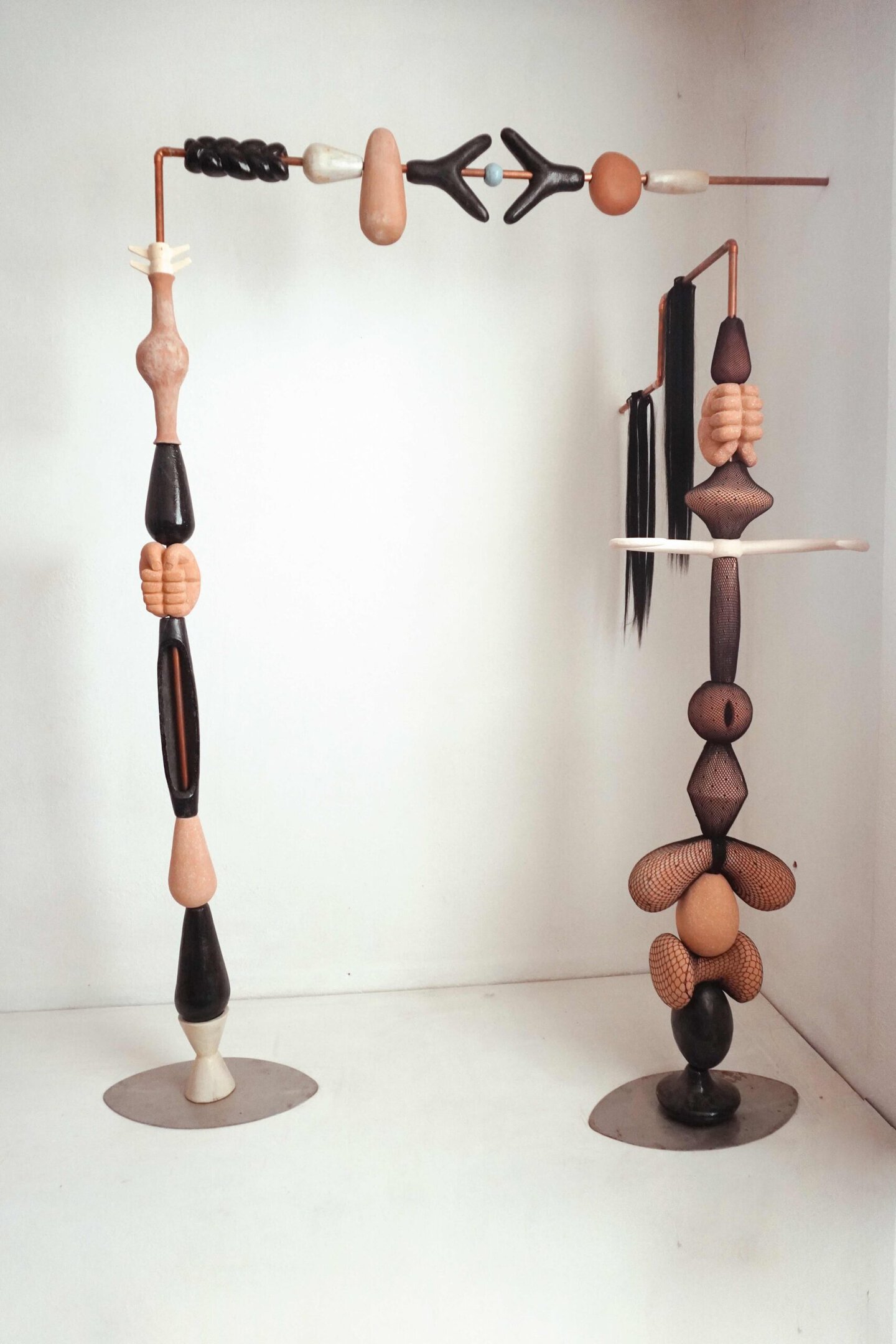
Bello finds similarities between human skin and the Earth’s outer layer. Terracotta allows her to convey how bodies autonomously learn, self-cure, regenerate, and affect other bodies. The method she employs shapes the path she takes in developing her projects. Objects in the 1050-degree category, with a reddish terracotta finish, resemble body-part shapes and hybrid animal-human forms, merging earthy material with flesh and suggesting a shared nature or ontological relationship between clay and the human. This sensation intensifies in the 1280-degree works, where Bello creates erotic fantasies, highly visceral and explicit. Sex exemplifies the body’s power and agency. The artist invites us to reconsider this idea through contact with clay, creating moments of interaction with the material as a substitute for the body.

Since 2020, she has worked solely with lower temperatures. She justifies this turn as a need to investigate earthy materials more closely. Her explorations guided her towards seeking answers, forms, and constructions that could house a human body. In her works, she maps a single continuous body — one that heals, desires, and never fully separates from the ground it came from. Her situated and grounded practice searches for meaning in carnal knowledge and peripheral visions.
Through series such as Habitamos estructuras (We live in structures), she integrates characteristic building blocks and bodies of pre-Hispanic or vernacular architecture into her sculptures, framing the human body as a construction, built from blocks of rooms connected into a single edifice. The clay highlights the connection to the earth and the fragility of the corporeal structure, as the load-bearing forces to which buildings are exposed, both internally and externally, would be too heavy for a skeleton to withstand. The works are hollow because of the technology of ceramics. The void labyrinths thus reveal another mystery about bodies’ overflowing inner energies that transcend reasonable external constructions, “forming part of a spectrum of sensations where a different language is discovered,” as the artist explains.


Ximena Garrido-Lecca
Ximena Garrido-Lecca, a Peruvian artist currently based in Mexico, has developed an epic scale of multifaceted, layered work. She relies on interdisciplinary research methods typical of modernity, combining them with the prehispanic Peruvian cosmologies and premodern ways of understanding the external world. She incorporates artisanal media like ceramics, textiles, and metal shaping, used thousands of years ago by people who populated the territory nowadays considered Peru. The result of her practice can be grasped as a form of speculation that projects the past into utopian futures where moral values like reciprocity permeate human and non-human relations. It can also be understood as the collapse of linear time into one material object or installation that reveals fundamental reality.
In Heliomorphism, shown for example at the Sharjah Biennial in 2025, Garrido-Lecca performs a triple operation around the index, icon, and symbol aspects of a very simple installation composed of ceramic-looking objects made from silicon extracted from solar panels. The artist merges ancestral solar cosmology with contemporary energy infrastructures, captured in the form of material traces of extraction, solar exposure, energy absorption, and conversion, using the vessel as an icon. The vessels are literal formal copies, resembling the archaeological originals from the Pachacámac Temple of the Sun, now stored in Penn University Museum in the US. This work stems from the artist’s need to manifest the Andean value of reciprocity in a contemporary context. The work argues that Peruvian vernacular customs that demand giving back, rebalancing, and caring for the relationship between nature and humans are an antidote to the imbalance in the world caused by rampant extractivism.
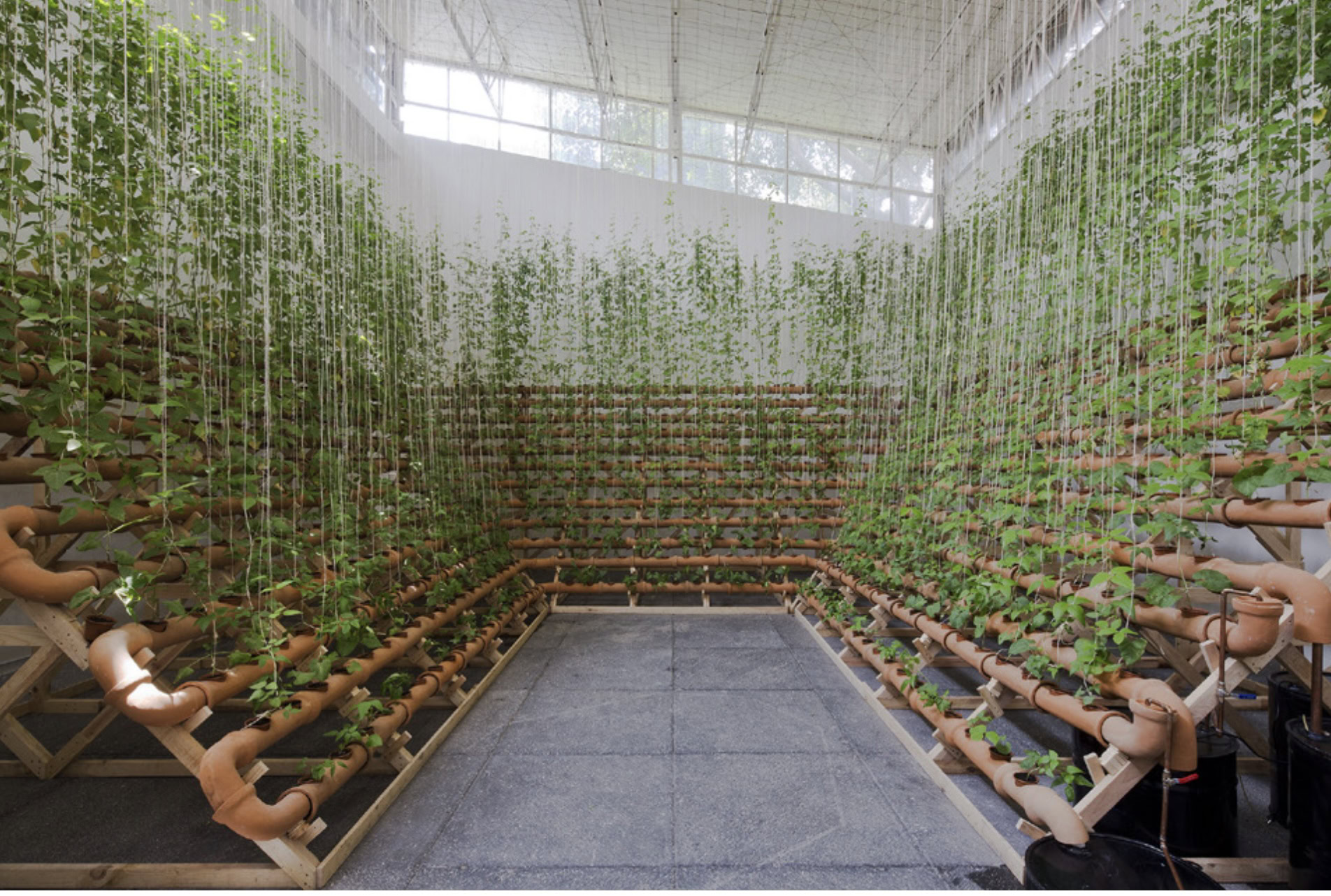
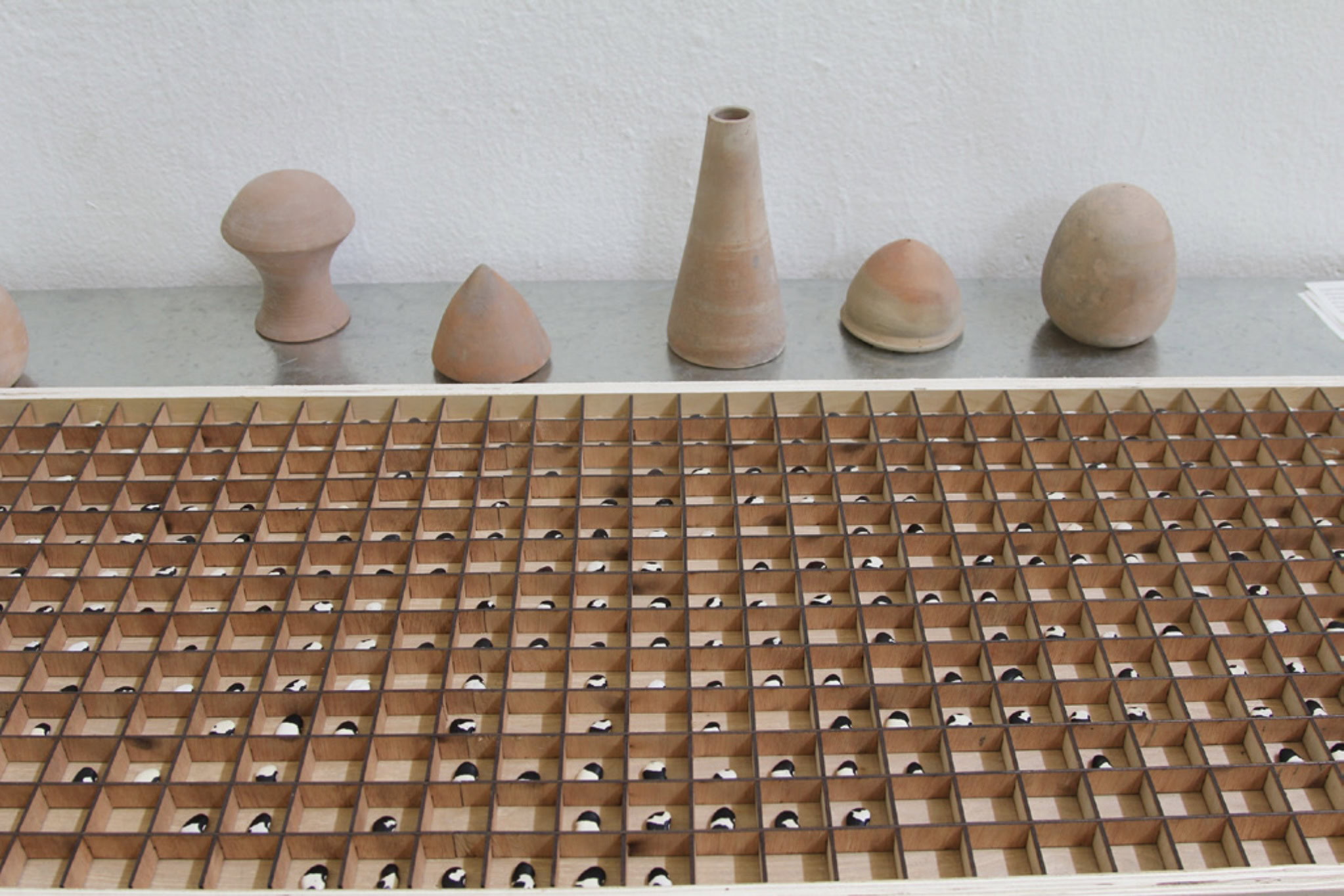
In Insurgencias Botánicas: Phaseolus lunatus (Botanical Insurgencies), Garrido-Lecca formulates another strong case for the adoption of ancient Andean technologies of the Moche civilization, used to organize sustainable production of plants and to create alternative communication. First shown in Mexico City at the Sala de Arte Público Siqueiros in 2017, this installation was also exhibited at the São Paulo Biennale in 2020 and at the International Biennale of Art in Bogotá in 2025. The artists built a hydroponic cultivation system from terracotta containers, allowing the Peruvian pallar bean to germinate, grow, and be harvested in a laboratory-like environment. Ceramics are excellent for such structures because the porous clay provides structural support while retaining moisture, absorbing excess minerals, and allowing oxygen to reach delicate root systems.
The piece can be read in a couple of ways, corresponding to its political, critical, and material aspects. The substantial composition, the beans, the growing plants, the ceramics, the graphics, and the pictorial speculative language form narrative threads woven into a rebellious visual fight against the neocolonial system, where vernacular technologies and values are constantly in danger from state and corporate actors. They put forward a vision of a better, more just society that relies on the restoration and activation of historical patterns.
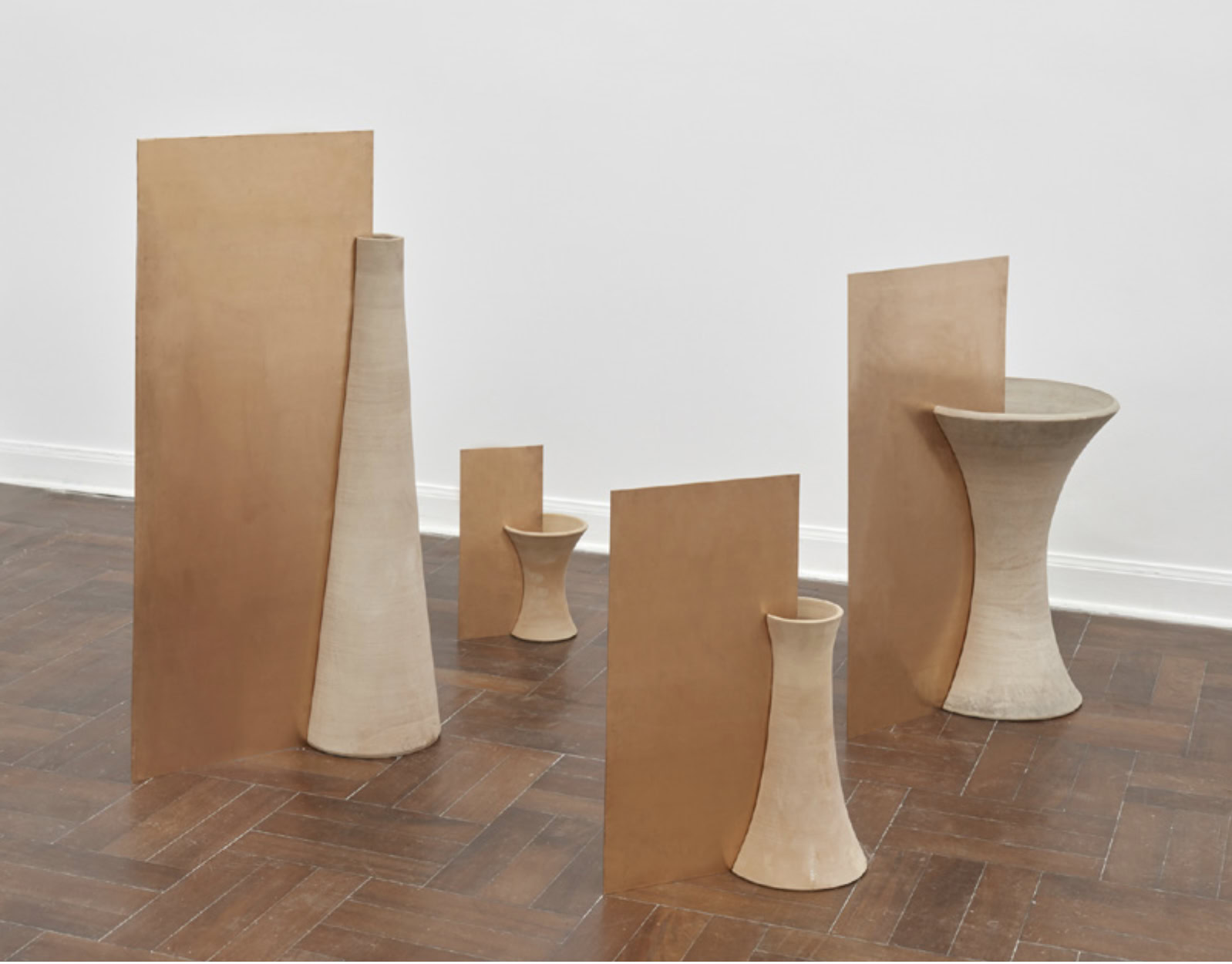
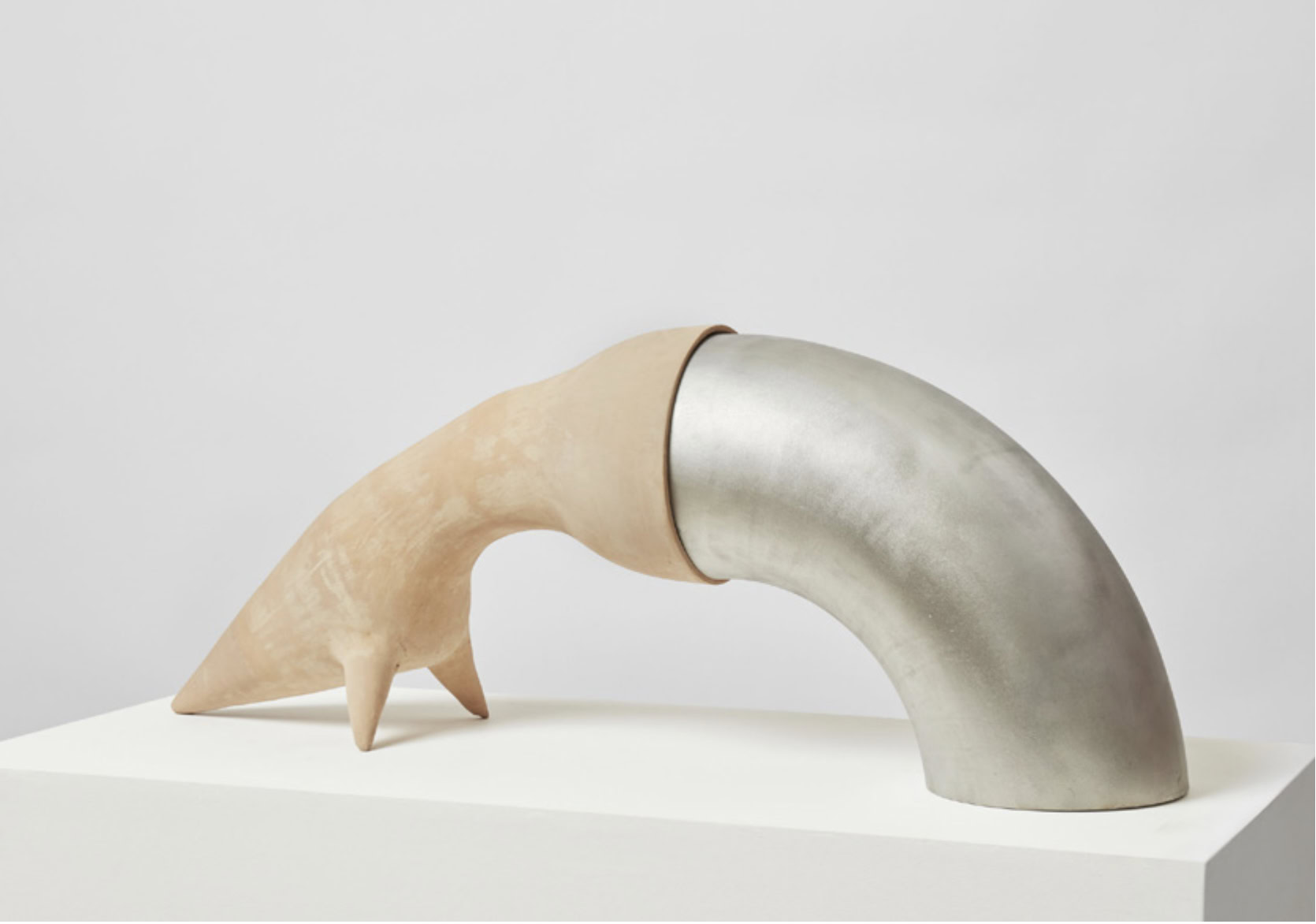
Garrido-Lecca exhibits similar ideas in a sculptural series of works titled Reverberations, Intersections, Transmutations (2018–2019), in which she combines non-glazed ceramics of differently shaped amphoras with steel and copper. They play with the tension between preservation and innovation in vernacular aesthetics, resolving this tension in favor of the Andean moral proposition that binary reality is a complementary relationship, not opposition or conflict. The dualism of these objects insists on the tangible possibility of overcoming this supposed tension when the differences are accepted as interdependent and reciprocal. Ceramics are insulators; metals are conductors — we need both to sustain the energy circuits of the universal system of beings and to be grounded in the presence.
Pamela Cevallos
The Ecuadorian artist Pamela Cevallos engages with ceramics from the perspective of institutional critique, using museum collections of clay-made antiques and replicas as her point of departure. In her artistic interventions, she questions, subverts, and counters powerful nationalist, economic, and political interests.
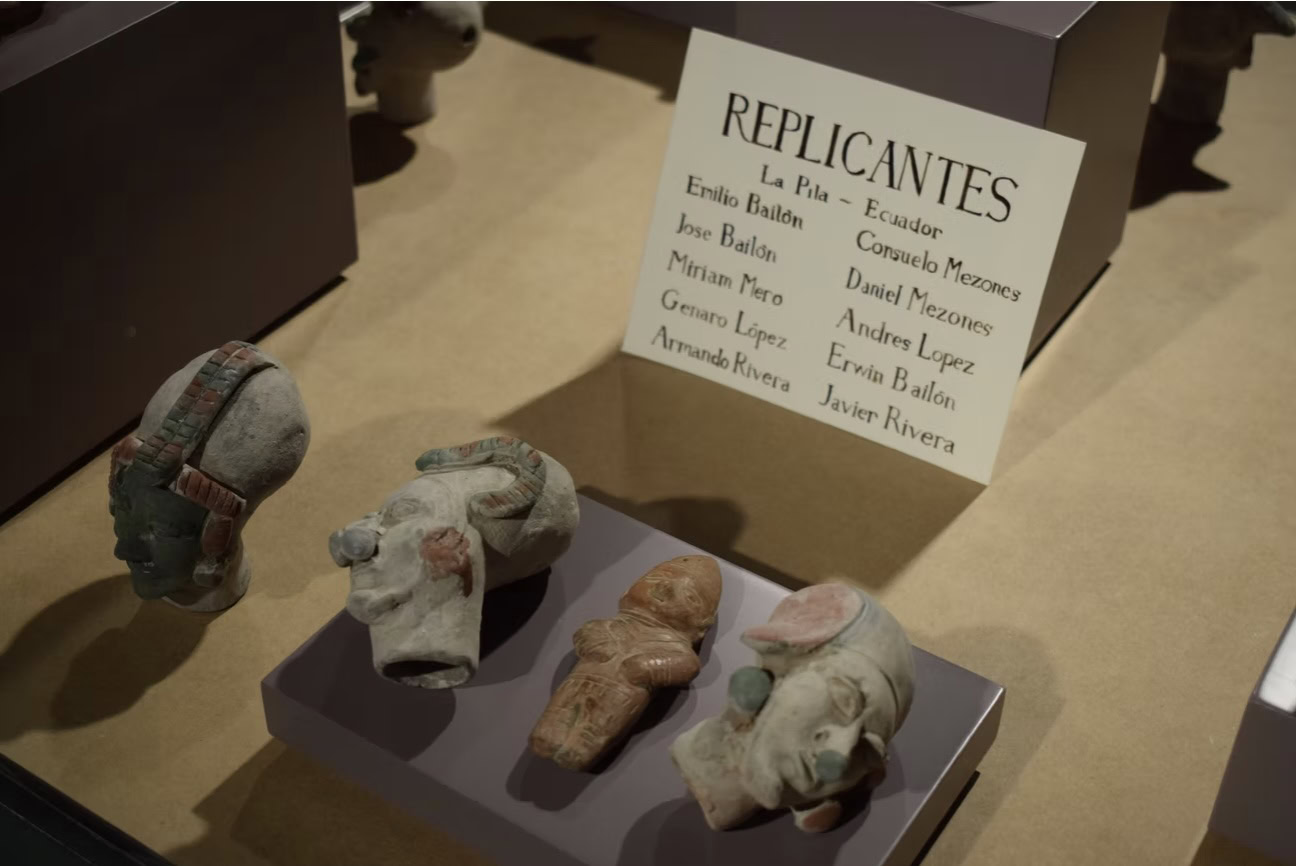
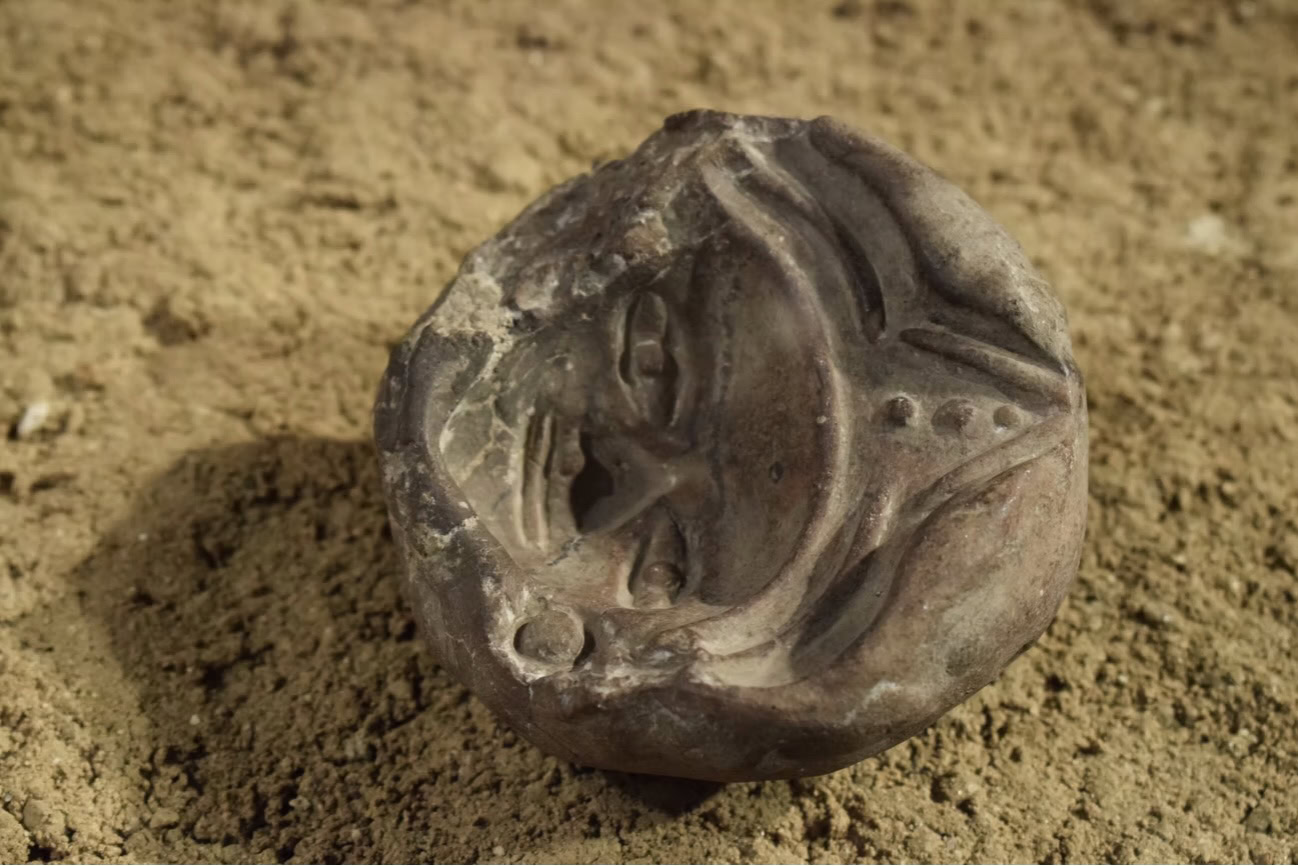
Cevallos exposes how ceramics, as a field of creative production, were held hostage by archeological, historical, and nationalistic expert communities, but at the same time, were ignored as an outlier by the art elitist circles, who consider this kind of artistic production as popular and repetitive. In the daring exhibition Replicantes at the Museo de América in Madrid in 2018, Cevallos challenged human nerves and institutional boundaries by displaying original pieces from the museum’s collection, arranged on soil, alongside their replicas, displayed in a separate glass case, with the names of the artisans who created them.
The gesture of naming the artisans involved in the show sends a strong message about who makes art and contributes to Ecuador’s visual culture. Cevallos interprets this as a continuation of ancient modes of making art. Yet, she adds somberly that “Artisans have incorporated romantic discourses of the imagined nation as a strategy for their survival, while simultaneously undermining the authenticity of their objects.” The historical ceramic figurines and the contemporary works lived in the same space and time at the Museo de América, academically separated but artistically and curatorially united as objects of a single core. Their materiality and connection to the earth and technologies united them.
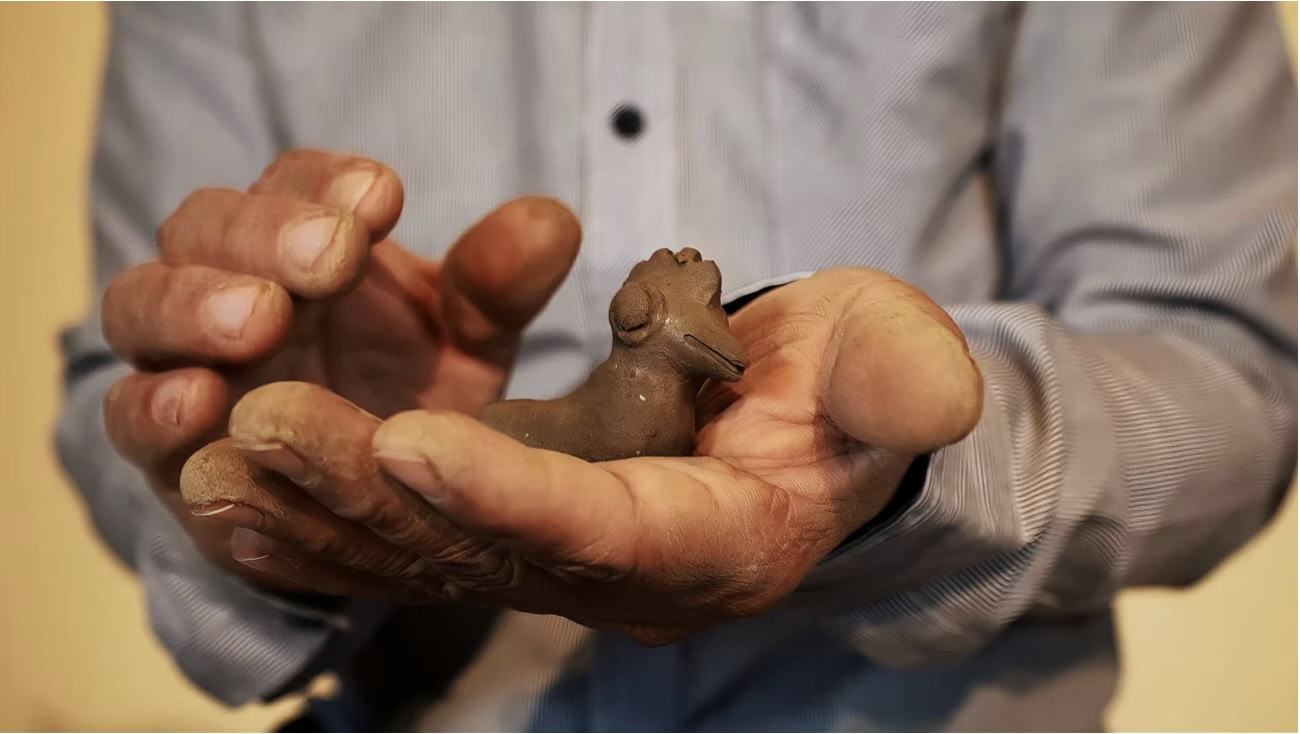
In another touching intervention, titled How to Liberate a Bird (2025), Cevallos exposes the bureaucratic obstacles that prevent the return of stolen heritage objects stored in Western scientific or museological institutions. To impel the critique, the artist asked Javier Rivera — an artisan from La Pila, Ecuador — to model a clay bird inspired by an archaeological piece held at the Museum of Archaeology and Anthropology in Cambridge. It was a ceramic sonic vessel. Because it was a replica, it could be used as an instrument, as originally intended, and returned to the community. Blowing into it liberated the bird. The breath required to activate it, however, was insignificant compared to its symbolic power. Although fragile and ephemeral, it interrupts the museum’s rhetoric and proposes a resistance grounded in knowledge embodied and passed through practice within the community. The installation was presented as a workshop space, where dozens of replicas (dry, broken, still wet) were on display and accessible to audiences. Metaphorically, they get to fly free — used by the people and not hidden away in the storage of the university library.
In Cevallos’s interventions in museums and public spaces, we can trace her commitment to naming the problems that colonization introduced and that neoliberal, modernist states maintain. She demonstrates that the same power structures that dictate the taste and legitimacy of art or heritage also intervene in and affect access to public goods and the satisfaction of basic needs. This paradox similarly underlies unjust and discriminatory relations within larger society. What Cevallos accesses through ceramics is a sophisticated institutional and social critique of the status quo in elitist, postcolonial countries.

Edited by Zuzanna Sarlej and Pola Folwarczny