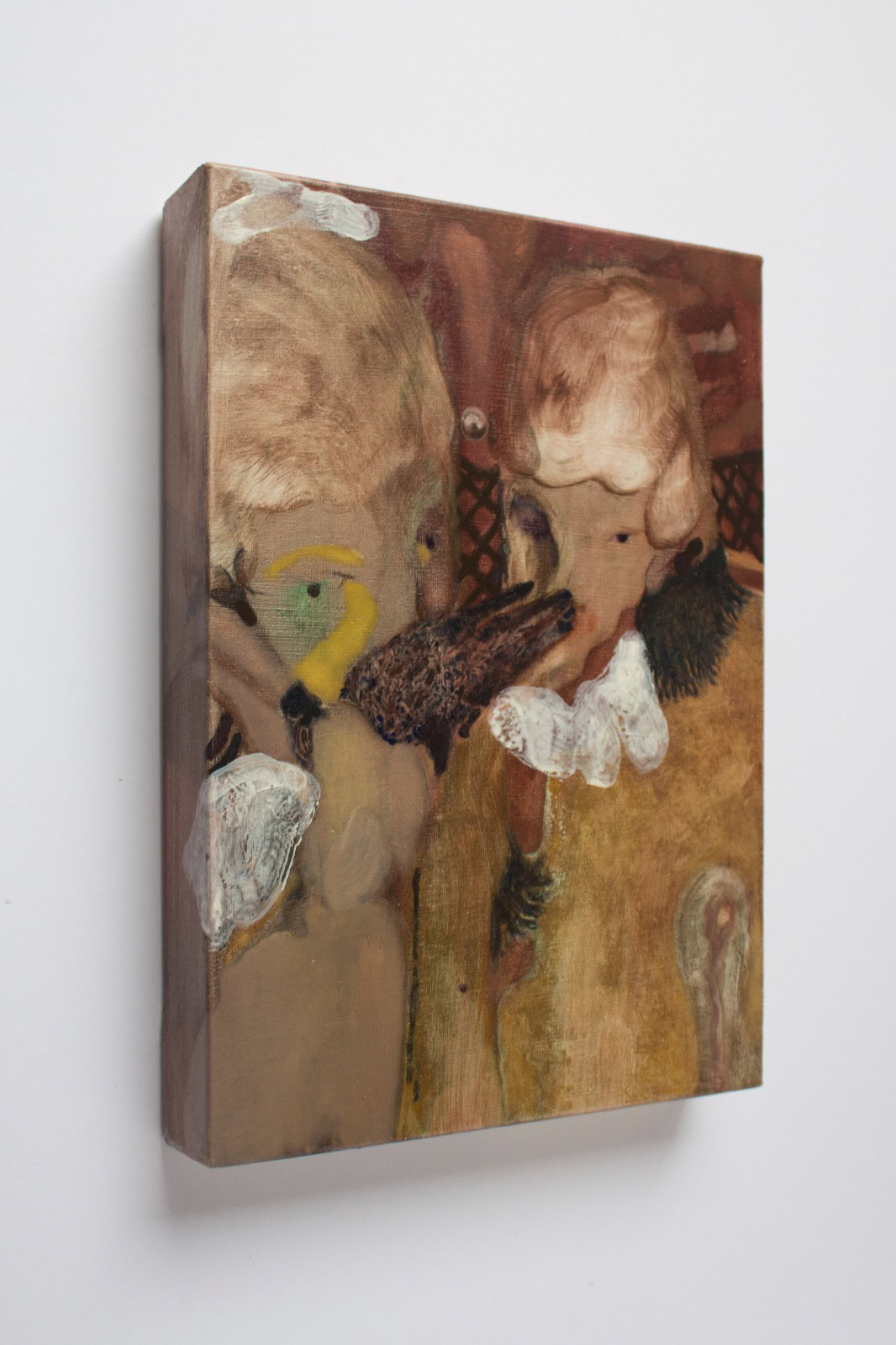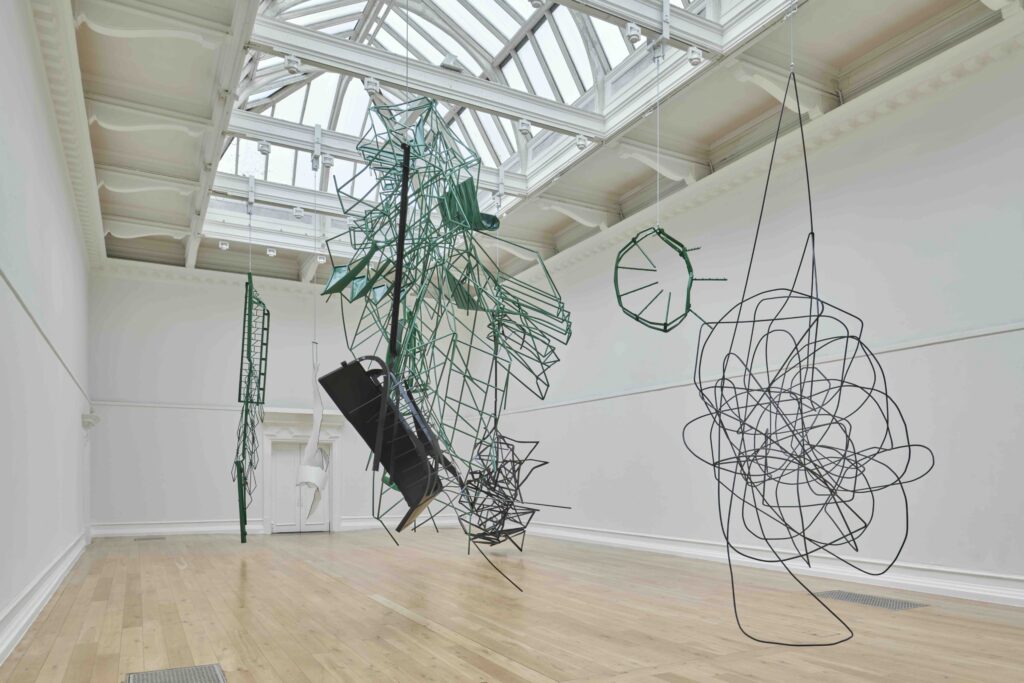




For over a decade, Fabio Frasca, born in Naples in 1987, has been steadily building his collection focused primarily on Italian and international contemporary art. His collecting sensitivity was shaped by the rich and versatile cultural context of his hometown, including the active presence of prominent private galleries that facilitated the development of local collecting traditions.

Looking at the inventory that includes the more historical works of Giorgio de Chirico to the experimental present-day art by Ser Serpas, Frasca defines his choices as ‘bold and ironic’, at the same time remaining true to his understanding of art as a space for reflection, contamination, discovery and the exploration of boundaries. We sat down with Fabio Frasca to discuss his approach to collecting and the ideas that shape his practice.
Marta Wróblewska: Could you give us a brief recap of your collection?
Fabio Frasca: Twelve years ago, I started collecting contemporary art — it was a completely new world for me. In my family, there was no tradition of collecting anything, nor any involvement in contemporary art, even though my father dabbled a bit in painting when he was younger, making copies of famous paintings by Picasso or van Gogh and signing them with his own name.
Contemporary art was always something that intrigued me, and there’s always been a desire in me to explore it further. First, I started buying magazines like Flash Art or Arte Mondadori. Yet the turning point was visiting the famous art fair in Bologna, where a whole new world opened up to me. Back then, when I started popping into galleries and asking about prices, nobody took me seriously. But it didn’t put me off. When I came back home, I started contacting galleries I liked to gather information, and soon after, I bought my first artwork. It was a lithograph by Giorgio de Chirico called L’arcobaleno, purchased from a gallery near Naples. I was actually negotiating the purchase of a work by the Neapolitan artist, Bruno Donzelli, when the gallery owner pointed out the print by de Chirico, whose metaphysical art I had already studied at school. The very idea of being able to own a piece signed by his hand was absolutely mind-blowing to me. I offered to pay in instalments, as the price was too high for me at the time. From there on, my curiosity really began to grow. Along the way, I met many people who helped me, explaining how the art world worked, which made my initiation into collecting a truly wonderful adventure.
As of today, I reckon my collection comprises between 110 and 120 works, including sculptures, a few videos, paintings and some graphic works. I’d say about 30 per cent of the works are by Italian artists, whilst the rest is quite varied, with no particular country dominating. I’ve never really attached any real importance to nationality or gender. I guess this distinction is rather important to the galleries and their selling strategies. When it comes to techniques, I value installations because I consider them to be a more complete form of artistic expression.

MW: What is your method for selecting works?
FF: Of course, these days, there’s no point in hiding the fact that you often come across artists online, but mainly, I have a circle of galleries that I follow. I really enjoy visiting exhibitions; it piques my curiosity. When I spot that a gallery I like is hosting an art show, I’ll go and see it, and maybe end up buying something.
It’s important to be able to see the quality of the work in person, especially when it comes to young artists, whom I collect most. I like to see how they perform at their first and then at their second exhibition, and study their progress. I don’t really have any strict rules. In the past, it happened to me to buy a piece straight away without knowing much about the artist.
I’ve never really attached any real importance to nationality or gender. I guess this distinction is rather important to the galleries and their selling strategies. When it comes to techniques, I value installations because I consider them to be a more complete form of artistic expression.
MW: In your interview with Alessandro Calvanese, you described your collection as ‘bold’ and ‘ironic’.
FF: Yes, it is a bit like me — I’m both very ironic and self-deprecating, and I wish my collection were like that in a way. I want it to spark curiosity and even a sense of surprise in the eyes of the onlooker.
Both amusing and bold was the fact that I’ve bought some incredible pieces that I wasn’t even able to accommodate. One of the examples might be a painting by Fabian Herkenhoener, measuring 2.20m by 2.20m, which I had to hoist up from the balcony using ropes because it wouldn’t fit through the door of my house.
Another example of a daring acquisition is the painted door by Sol Calero for the so-called Museo Apparente — a sort of ‘domestic museum’ set up in a gallery owner’s garden in Naples. I bought this piece, even though it is by no means domestic, and I could never have put it in any house.
Though I do make bold purchases, I always think things through. Recently, I bought a professed ‘sculpture’ by Ser Serpas called little talks by the highway, which is a piece made from a scrap of farm machinery she picked up on the motorway. In her practice, Serpas collects found objects in her area and then reassembles them in the exhibition space during a performance.
I’m both very ironic and self-deprecating, and I wish my collection were like that in a way. I want it to spark curiosity and even a sense of surprise in the eyes of the onlooker.

MW: Did the fact that your collecting originated in Italy make a difference in your approach to art?
FF: In my view, it is not so much Italy itself, but the fact that I’m from Naples. Thanks to the vast cultural heritage of the city, I’ve developed a sensitivity to both ancient and contemporary art, as well as music and theatre. Naples is also a very open city, and perhaps that helped me to get closer to contemporary art, as did the activities of many prominent local galleries.
MW: Can collecting be taught or learnt?
FF: It’s not something that can be learnt at school or at a university. If there’s anyone who can introduce people to collecting contemporary art — apart from museums or art fairs — it’s gallery owners. Sometimes other collectors are helpful too, but gallery owners are the ones who can make you fall in love with artworks. My personal experience in the art world was supported by gallerists like Nicola Pedana from Caserta and, later, Umberto di Marino from Naples.

MW: You are often cited among the young collectors on the Neapolitan art scene.
FF: I’ll be turning 40 next year – in my view, calling me a young collector was more accurate ten years ago when I took my first steps side by side with other more experienced collectors like Fabio Agovino, or the then-director of the Madre Museum of contemporary art in Naples, Andrea Viliani. Of course, these days it is quite challenging to find young collectors who are in their thirties — personally, I don’t know any. And it’s a shame because I’d love to exchange ideas with other young people. Perhaps it’s partly due to the present historical context and the economic climate.

MW: The statement on your website reads that art gives space for: reflection, contamination, discovery, and the exploration of the boundaries between nature, matter and time. Can you illustrate these four aspects with examples of works from your collection?
FF: As for ‘reflection’, I would think of the work Nema Problema by vedovamazzei, the Neapolitan duo of absolutely brilliant artists. It’s an installation consisting of two ‘soldier’s gloves’ affixed to a wooden board. It refers to the massacre in Srebrenica in 1995, and contains phrases and drawings found at the site and reproduced on these gloves. They include the insults directed at Muslim women, and a sort of diagram showing how many soldiers had killed how many people.
When I think of ‘contamination’, a very powerful video installation by Daniela Ortiz called Jus Sanguinis from 2016 springs to my mind. In it, she’s on stage in Spain giving a speech. While delivering it — she was pregnant at the time — Ortiz undergoes a blood transfusion from a Spanish man, because it is required by the Spanish law to have Spanish blood in order to become a Spanish citizen. The installation is completed with a print from a passport with a depiction of a foetus.
Talking about ‘discovery’, one of the first works I bought by a truly great Italian artist, Luca Francesconi, definitely comes to my mind. I first saw his sculpture Caporale at Umberto di Marino’s gallery. Its central piece was a bronze figure with a cabbage in place of its head. It stood there with a sort of bronze arm, like a ‘commander’ supervising other smaller sculptures, some of which also contained a vegetable, others something else. It seemed funny when you think about this cabbage-head who could still rule over the others. I ended up buying it and then lending it out to numerous exhibitions. An organic element is needed to complete it. So, whenever I showed this piece, I had to replace the cabbage when it went off.
Then, exploring the boundaries between nature, matter and time — again at Umberto di Marino’s — I found the work of Isadora Neves Marques, who was still a very young artist at the time and then known as Pedro Neves Marques. She presented this giant installation consisting of three screen prints with Monsanto contracts [regulating the ownership of GMO seeds, MW] superimposed on them. The exhibition touched on themes of colonialism, economy and nature.

MW: What are your ideas for sharing your collection?
FF: Quite recently, I set up a website dedicated to the works and artists in my collection, partly because it was becoming more and more visible in various contexts. A few years ago, I started organising exhibitions, such as the one of Luca Petti’s works in 2025 at La Santissima Community Hub, in the former military hospital in Naples. In December, there was a screening of a film by Bertille Bak, which was also a huge success. Every year, I participate in Napoli Art Days, and, of course, I support a great many young artists, even through small acquisitions. We mustn’t underestimate the fact that collectors often fill the gap where calls for entries, institutions, schools and galleries do not apply.
I have to admit that collecting, understood as simply acquiring and storing artworks, didn’t really satisfy me. At the same time, I realised that individual organisation of events is a very costly and demanding undertaking. Yet, sharing one’s collection is incredibly important; in fact, I appreciate many collectors’ initiatives and exhibitions because they allow me to truly observe the journey that they have taken.

MW: What is a collector’s dream and a nightmare?
FF: The collector’s dream is to acquire precisely that thing which they don’t have, being able to own something that seems out of reach. I personally would love to have a David Hockney at home, a painting by Giorgio de Chirico, or a Lucio Fontana. It’s the work of art that encourages you to carry on, even without endless funds to buy everything you want.
I don’t have a real nightmare because I collect first and foremost for myself. I make my own choices, enjoy myself, and meet lots of wonderful people on my way. The nightmare might be that one day my collection could be scattered or perhaps sold, but that’s not really that important. What matters is that collecting done on my own terms gives me a lot of satisfaction.
The collector’s dream is to acquire precisely that thing which they don’t have, being able to own something that seems out of reach.
MW: Thank you very much for this conversation, and good luck with further collecting!
FF: Thank you, too.