Those who are denied a voice often find other ways to be heard. London’s Latinx community, excluded from documented recognition, burst through a bureaucracy of neglect to leave the hues of their culture on the city’s paved canvas. Spaces of belonging, in basements and dancefloors, markets and church halls, absorb the endless stories of a diaspora, through shared language and rhythm. Entire histories, beneath the surface, are transposed according to the unstoppable discs and turns of another kind of record keeping. Through Cumbia, Boogaloo, MPB or Samba, one grasps the reins of a population denied visibility on paper, insisting on being heard if unseen, through petition, protest and sound.
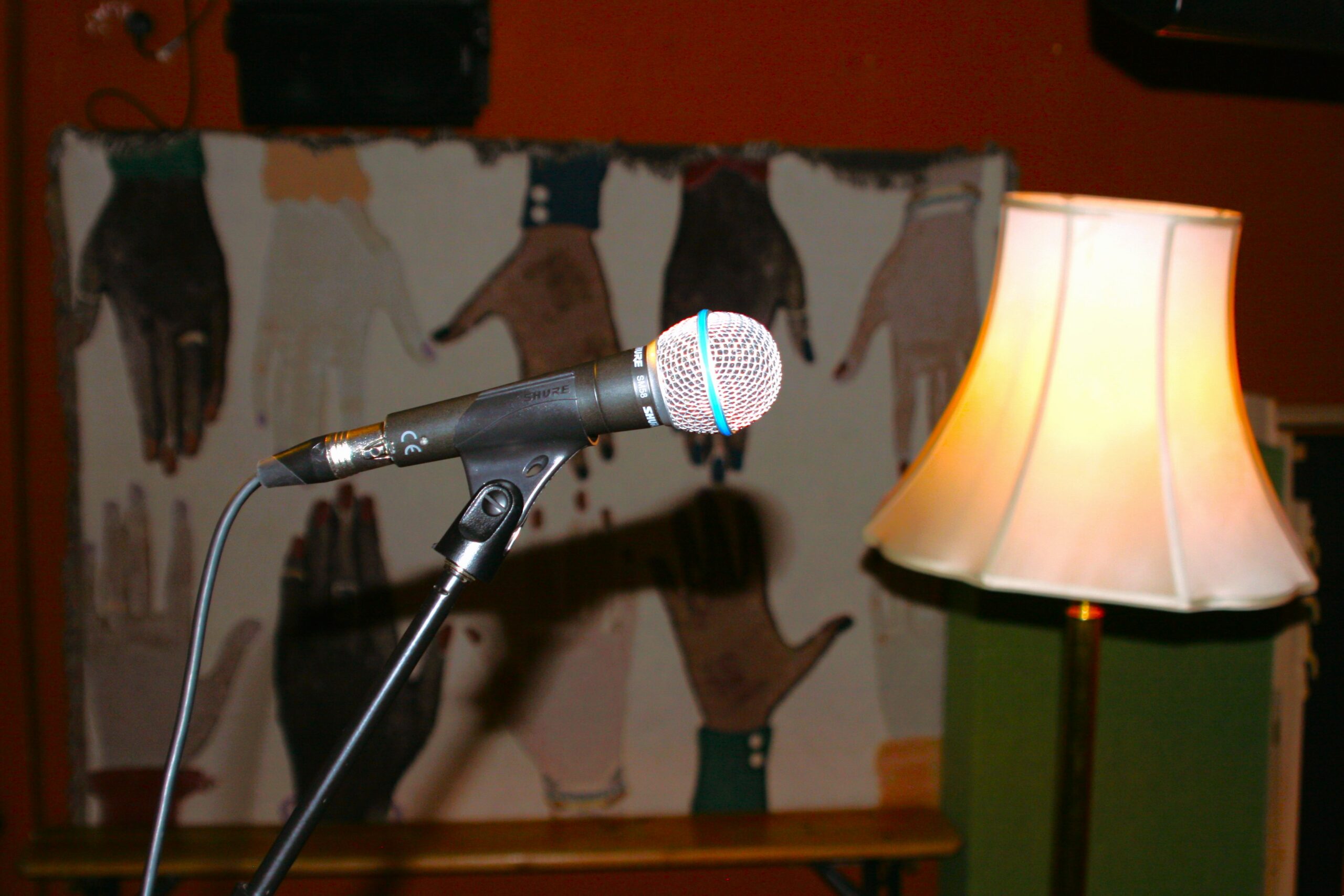
On 4 April 2026, The Muddy Puddle raised its floodgates, splashing its colours over the awakened streets of North-East London. Cero a la Izquierda — a musical spectacle organised by the cultural platform Mugre — was held at the café, sharing resonant sounds from the New World. Dj Junín, Las Chanchas and Chico Majara took to the stage, their music creating an excited and sacred atmosphere of unity and freedom. Rugs hung on walls, and ornaments and jewels surrounded an air of anticipation contained within the squeezebox on the shelf downstairs. Above the dais, a billowing drape announced: ‘El future es Latino América’.

With this event, Junín — formally known as Tomás Restrepo Garcés and head of Mugre — intended to shine a light on the vibrant culture of London’s neglected Latinx diaspora. In spite of everyday hardships — administrative negligence or overlooked contributions — members of the community could find themselves here seen in proud resilience and celebration.
Invisibility
It is estimated that nearly half a million Latin Americans reside in the UK today, most of whom live in London. In May 2011, Queen Mary University and LAWRS (Latin American Women’s Rights Service) released No Longer Invisible — a report uncovering the harsh and unspoken reality of the Latinx experience in the capital. The paper’s title aligns with Let’s Talk Latinx’s 2023 Trafalgar Square protests, which brandished appeals to ‘stand up to invisibility’. The anonymity derives from the lack of a dropdown tick-box on the UK census and other application forms, which relegates whole peoples to ‘other’ and, ironically, overlooks an already broad category of identification.
Campaigns for recognition have existed since before the 2001, 2011 and 2021 enumerations, yet only a selection of Latin-centric boroughs in London (such as Southwark, Lambeth, Hackney and recently Harrogate) have turned their attention to previously unheard Spanish-speaking residents. As for 2031, despite efforts from CLAUK (Coalition of Latin Americans in the UK), it is currently expected that insufficient data collection will continue to leave this population unacknowledged within wider socio-political conversations. ‘You’ve got to water the garden without just extracting’, justly observes Chico Majara’s Enrico, who perceives that the unique Latinx contribution to British society is wholly unconveyed in mainstream media, and absent from other central means of deserved appreciation.
Mugre
Translating to muck or grease, Mugre is a direct reference to the tribulation and adversity faced by migrants rebuilding their lives from the soil up. Tomás, who founded the organisation in October 2025, seeks to reclaim stereotypes and take ownership of a cultural narrative through artistic momentum: ‘We all start from dirt somehow’, he professes.
Having moved to London from Medellín, Colombia, Tomás advocates for resistance and empowerment, whilst reaffirming that his community is only invisible in a bureaucratic sense. He draws back red curtains to unveil vivacious exhibitions whereby Latinx identity and expression prosper. In basements, such as the one below the Muddy Puddle, the value of Latinx art beyond mere entertainment becomes apparent. It encourages young people to be politically outspoken, and counter the attitudes identified by Tomás: ‘They are enjoying our music, our paintings, our sculptures, but somehow they don’t really care if we are here or if we are counted’.
Music in particular articulates a shared culture in a way that data and censuses never will — art transcends linguistic boundaries, and melodies speak to the universal. Latin music — being the most-streamed globally — brings together locals and immigrants alike, in the crowds of festivals, concerts and reggaeton club nights all over the world. In this manner, Tomás proudly aspires to be ‘impossible to ignore’ if enough noise is made and enough feet hit the floor. Where anger and resentment certainly wouldn’t go amiss, Gian from Las Chanchas notices instead: ‘We share the same happiness [within] the same culture’. And, whilst music and art sit at the forefront of his mission, Tomás highlights other Latinx foundations and charities (e.g. LARC, Latin Elephant, Latin American House) that continue to exhibit just passion and irrepressible fortitude within London and the UK. Mugre hopes only to nurture and continue this ongoing mission earnestly, ‘step-by-step’, yet surely with the liveliest approach.
Music in particular articulates a shared culture in a way that data and censuses never will — art transcends linguistic boundaries, and melodies speak to the universal. Latin music — being the most-streamed globally — brings together locals and immigrants alike, in the crowds of festivals, concerts and reggaeton club nights all over the world.
Identity
For now, a central aim persists to expand the British census’s mode of categorisation to be more inclusive of overlooked ethnic groups. One hurdle in navigating the change is the complexity surrounding precise definitions of continental American identity. A large proportion of South America (compared to North America) rejects the Latinx label. And when crossing categories and differing systems of identification, the question arises: who is included and who is not?

Enrico recalls a friend thinking out loud: ‘I’m not quite sure if I’m Latin American’, and Tomás imagines his parents saying: ‘What is Latinx? – I’m just South American’. This is perhaps because the modern term was born out of a demand for gender inclusivity within the LGBTQ+ community (subverting the Latino/Latina binary) and has been predominantly adopted by first-, second-, and third-generation immigrants with a more progressive attitude. From a Western European perspective, a standard hyperfocus on individuality and the idiosyncrasies that make cultures unique might rather impede a push for Latinx usage, given the risk of diluting that. Nevertheless, it is evidently not a simple endeavour to summarise a multitude of identities across such a vast geographical span into one.
It could be said that in London, this mentality of rejecting a shared Latinx usage manifests detrimentally within a segmented sense of identity and belonging. Tomás’s impressions are that ‘it’s a massive city [that] can get quite lonely’, and that ‘you need to learn to live with it’. It seems to be a common struggle for the Latinx diaspora in the city: without municipal support, migrant groups often rely on community gatherings to alleviate pressure. Many Latin Americans turn to churches, for example, such as St. Anne’s Roman Catholic Church in Vauxhall, taking it upon themselves to form the social networks so vital to urban existence. In this respect, sheltering under umbrella terms and congregating on dance floors provides an elevated understanding of what Mugre, CLAUK, LAWRS and many others strive for.
It seems to be a common struggle for the Latinx diaspora in the city: without municipal support, migrant groups often rely on community gatherings to alleviate pressure.
Unity
Las Chanchas — literally meaning ‘the piggies’ — take their name from a shared South American idiom referring to the act of cooperatively pooling together money to provide for a payee short on change. It seems the music they play and the feelings they convey mirror just this ethos, uniting listeners across genres and borders to unify and reap the collective fortunes of the Latin American spirit. At The Muddy Puddle, Tomás’ hopes were to ‘bring people together to participate and be proud of where they’re from’, and to highlight ‘that we are in the UK, in the same situation’, providing the kinship for which many surely yearn.

It occurs in that basement, when listening to a set that blends and flows seamlessly along and over itself, the futility of being overconcerned with when each song begins and another ends. Dani Fitzgerald’s heralded radio show Rum Punch Sounds exhibits an eclectic mix of music from Panama, Colombia and Haiti, to name a few; Peter Tosh sings of Mama Africa in his hit reggae single released and recorded in Kingston, Jamaica; and Puerto Ricans (or ‘Nuyoricans’) indiscriminately drew from Soul and Motown alongside traditional Cuban music to concoct Boogaloo in 1960s New York. So, whilst Brazilians may speak Portuguese, and an ocean separates Spain, Latin America, with its outstretched arms and infectious soundtrack, alleviates many such differences.
Nobody encounters this truer than Enrico and Cedric of Chico Majara, who hail as ‘allies’ from Italy and Switzerland, respectively. ‘It’s an open space’, Tomás beams, ‘cultural sharings and spaces should be inclusive […] we reach the Latin American people of London but also embrace everyone’. True to this word, he hopes to expand Mugre to British cities like Edinburgh, Liverpool, Birmingham and Bristol — all destinations where Las Chanchas have toured with unfaltering success. Between the success of Mugre and the artistic endeavours of its champions, one finds an affecting hope and chance to embrace undeniable cultural intersections through the commanding impact of art and music.

Looking Forward
Finding freedom in these spaces in between, perhaps the crowd shouldn’t be pushed to construct their own place of belonging. No doubt authenticity follows — a rarity within a late-stage capitalist landscape and a product of ‘doing-it-on-your-own’ as a mode of resistance. Despite this, unquestionably, the British government ought to do better when devising and implementing employment rights, social benefits and aid to immigrant groups, whom they first and foremost need to formally recognise. Diversity, art and culture have always been the pride of London, and it is bittersweet to see creativity thrive radically beneath street level in a time when the arts are underfunded and migrants are undervalued.

Franco, bassist and singer of Las Chanchas, describes these gatherings as ‘sacred’. The word feels apt. Performing creates a profound connection between bodies and minds, something almost eruptive in its intensity. Watching a crowd move together, caught in that same rhythm, reveals the connections that run deeper than sound, felt viscerally in how it energises a room. For many South Americans in London, who left home not by choice but by necessity, that connection carries particular weight. In the space of an hour, or perhaps a little longer, the music offers something rare: a brief passage back to a feeling of home.
Diversity, art and culture have always been the pride of London, and it is bittersweet to see creativity thrive radically beneath street level in a time when the arts are underfunded and migrants are undervalued.