






The third-largest of the seven emirates and the only one overlooking both the Persian Gulf and the Gulf of Oman, Sharjah, unlike Dubai and Abu Dhabi – temples of exclusive shopping and kitsch tourism – is a normal place, where there is no apparent imitation of the West, but, despite a sound vision of tourism and commercial development, strong cultural roots are maintained. Ancient buildings, museums, and the Biennale are the pieces of a vibrant cultural mosaic, the cornerstone of a development policy that seeks revenues other than oil, with a view to preserving its heritage and identity.

Artistically speaking, the Biennale run by Sharjah Art Foundation is the most important event of the contemporary scene, along with many other exhibitions. The Foundation delivers year-round exhibitions, performances, screenings and education programmes across the Emirate, often in repurposed historic buildings, and maintains a growing collection supporting new work and recognising pioneering modern artists. The 2026 programme also marks the reopening of Al Majarrah Park, redesigned by the SUPERFLEX collective in collaboration with landscape architecture firms. The park becomes a hybrid urban space, where the memory of the historic neighbourhood, the desert landscape, and the participation of the local community are translated into undulating paths and monumental sculptures inspired by everyday objects.
It is within this framework of cultural preservation and reinvention that the exhibitions of Ahaad Alamoudi and Jorge Tacla take form, each approaching transformation from a different vantage point.
Different Progresses
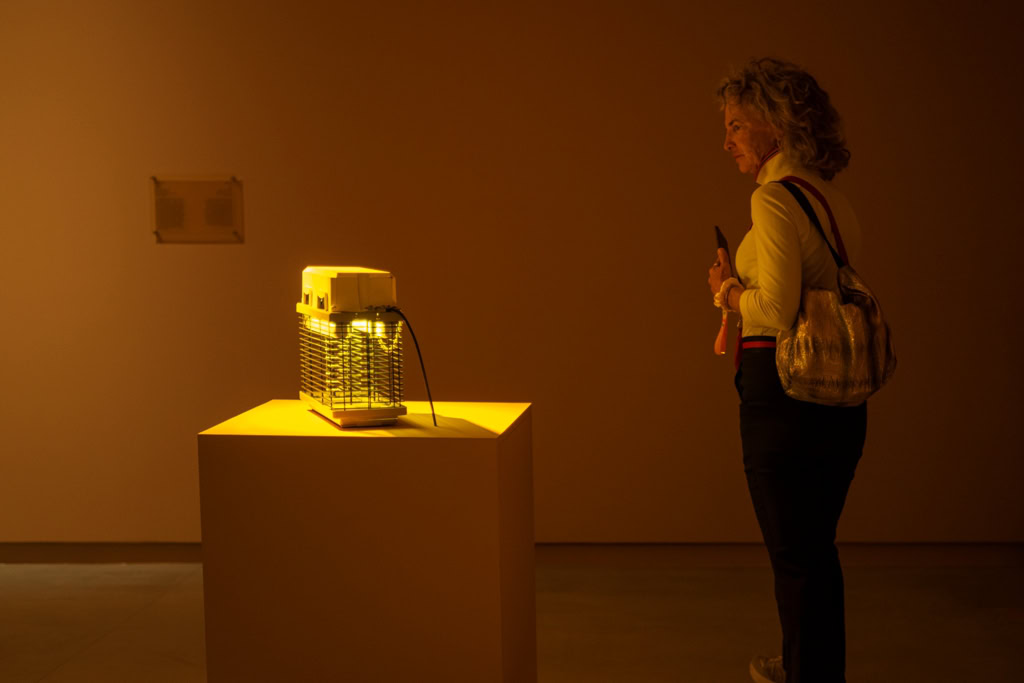
Ahaad Alamoudi’s Sunkissed, presented at Sharjah Art Foundation until May 3rd, unites recent works and six newly commissioned ones, probing how collective identity and visual expression evolve amid rapid transformation in the Gulf.
In Gallery 6 at Al Mureijah Square, the exhibition deploys everyday imagery of development – motifs of sun, sand, technology, and spectacle – to analyse how participants create, change, and root ideas of progress in cultural life. Sunkissed forms part of the Foundation’s spring programme and contributes to ongoing institutional conversations around visual culture, representation and the politics of development.
The exhibition builds on Alamoudi’s sustained inquiry into history and representation within Saudi Arabia’s changing social landscape, extending themes explored in earlier solo presentations in Jeddah. Alamoudi is a multidisciplinary artist traversing video, photography, print installation, performance, and sculpture. Drawing on ethnographic research and vernacular digital modes, she engages the languages of representation to deconstruct clichés, visual tropes, and conventional narratives to question how culture is continually reimagined and reformed.
Her work reanimates national symbols, such as falcons, folk music, and dance, by shifting them from original contexts into new, multilayered planes of meaning. In her research about Saudi Arabia’s reforming ethnography, her photography, video and print installations aim at altering the local historical rendition.
Speculative Futures And Inherited Histories
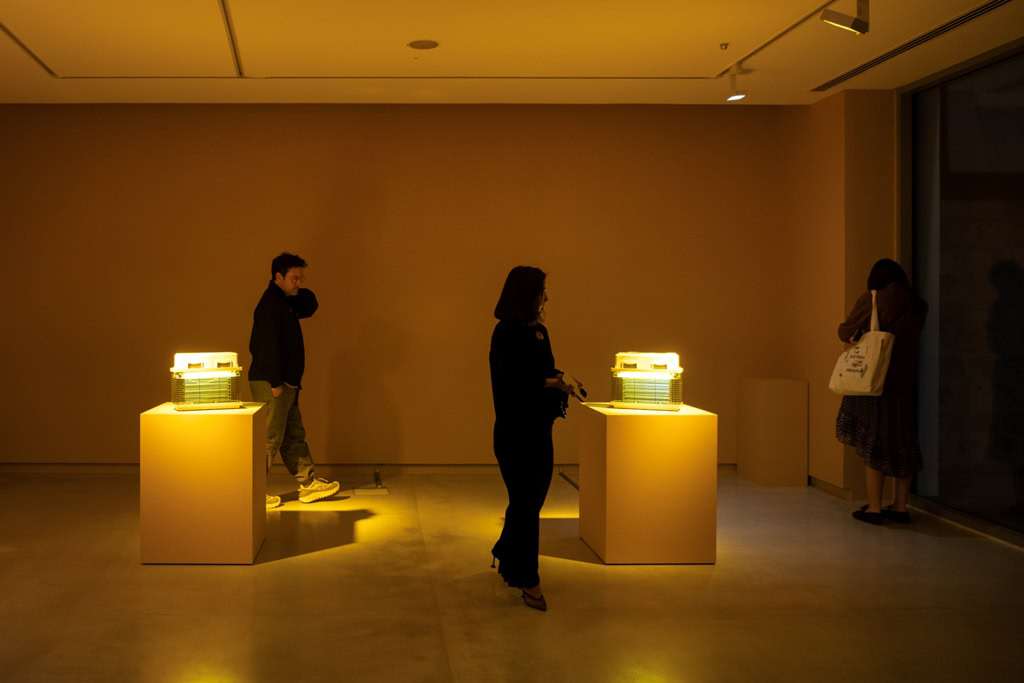
Working across photography, video, and print-based installation, Alamoudi approaches the contemporary Khaleeji landscape through a visual language shaped by humour, appropriation, and critical distance. Rather than positioning development as an abstract policy framework, the exhibition attends to its manifestations in popular culture, digital media and shared environments, where aspiration and contradiction often coexist. Her vivid snapshots of contemporary Khaleeji aesthetics blend humour with pop-cultural fluency – viral memes, talking falcons, toy cars, and insect light traps become tools through which she navigates social and cultural change.
Central to this project is Alamoudi’s engagement with the imagery that saturates everyday life in the region. Viral memes, talking falcons, automated toy cars and insect light traps recur across the exhibition as both subjects and devices. These elements function as tools for processing rapid change, reflecting how technological novelty, entertainment and tradition intersect within contemporary visual culture. Alamoudi’s works capture how symbols of progress are absorbed, mimicked, and rearticulated in daily experience. By foregrounding humour and pop-cultural fluency, the exhibition resists singular or authoritative narratives of development.
Alamoudi’s works capture how symbols of progress are absorbed, mimicked, and rearticulated in daily experience. By foregrounding humour and pop-cultural fluency, the exhibition resists singular or authoritative narratives of development.
Instead, it reveals how ideas of advancement are continually negotiated through repetition, exaggeration and play, producing meanings that are at once familiar and unstable. While the exhibition is rooted in present-day imagery, it also engages with longer temporal frameworks. Sunkissed moves between speculative futures and venerated histories, examining how inherited cultural forms are reimagined within contemporary conditions. This oscillation underscores the tension between continuity and disruption that characterises the region’s social and spatial transformation. Alamoudi’s practice does not seek to resolve these tensions.
Rather, it holds them in suspension, allowing moments of ambiguity, irony and excess to surface. Through this approach, the exhibition reflects on how collective identity is shaped not only by official narratives of growth but also by the informal, often contradictory processes through which images circulate and acquire meaning.

The Aftermath Of Destruction
Where Alamoudi explores the spectacle of progress, Jorge Tacla confronts what remains when progress collapses into ruin. Tacla’s retrospective Time the destroyer is time the preserver (on display until June 7th) brings together over 70 paintings and more than 100 works on paper from the mid-1980s to the present. A third-generation Chilean of Palestinian and Syrian descent, the artist has been working between Santiago and New York since 1981, unravelling the intricate geopolitical causalities binding Latin America, West Asia, and the United States.
Over the last four decades, Tacla’s practice has unfolded alongside major transformations in visual politics around human rights. The world has seen satellite imagery increasingly supplant personal testimony as the dominant form of historicizing and adjudicating mass atrocities. Far removed from politics on-the-ground, this mode of witnessing has further amplified a geopolitical order in which certain human lives are valued more than others.

Titled after a line from a T.S. Eliot poem, Time the destroyer is time the preserver examines how enduring truths can be excavated in the aftermath of destruction. Structured as eight chapters, Tacla’s largest solo presentation to date confronts hierarchies of human suffering; the false binaries of victim and perpetrator; and the structural violence connecting seemingly disparate incidents. Amid a visual culture dominated by machine vision, Tacla’s paintings reassert the urgency of human memory in navigating the complexities of representation and interpretation. Rather than painting a building or landscape directly, he depicts it ‘in negative’, defining the subject through the absence of colour. In this way, these works operate as meta-images that probe how events are inscribed within individual and collective consciousness.
The exhibition looks back at Tacla’s work from the 1980s in New York, a time when news media were becoming increasingly more common, and people were seeing more and more pictures of war and calamity. The visiting path is divided into eight sections, each of which looks at a different theme instead of following a traditional chronological order. Tacla asks viewers to think about how geography and history overlap, how memory builds on image, and how political events affect people over time.
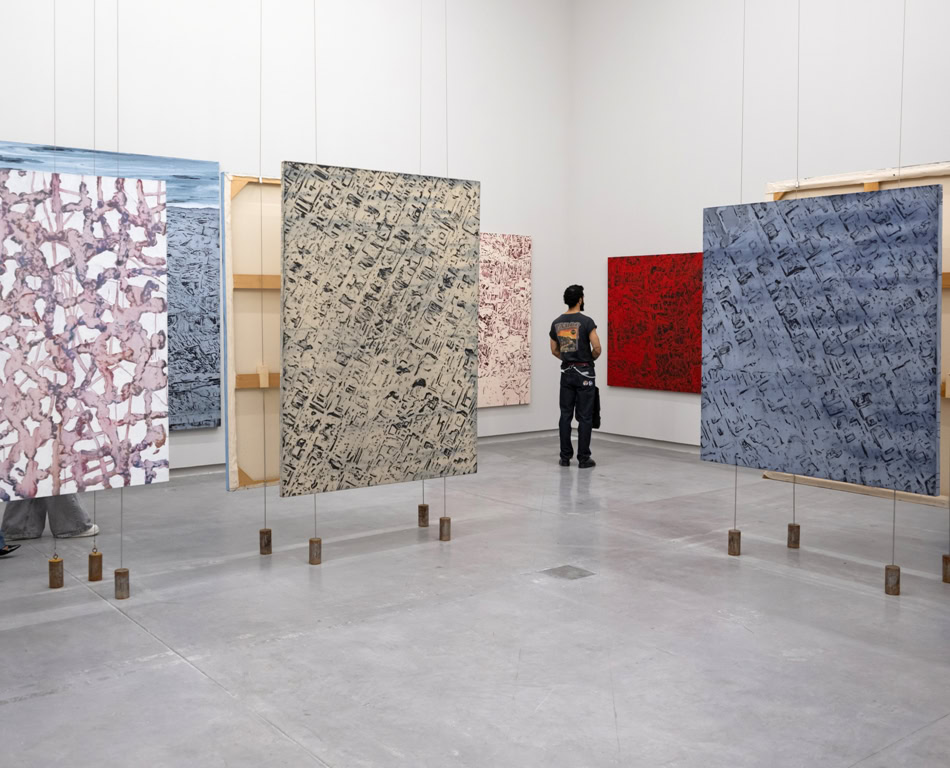
The pieces challenge the audience to step beyond simplistic concepts of victim and offender, exposing how violence may reach across generations and societies. One of the most important parts of Tacla’s work is what he terms “negative imagery.” Instead of painting landscapes or buildings in a usual fashion, he often hints at their presence by leaving off shapes that come from empty space. This method makes people think about how trauma is stored, remembered, and internalised, which makes his canvases more like places to think than just places to write down what happened.
Resilience And Recovery
The show concludes with cityscapes devastated by political and natural disasters, showing how people can bounce back from calamity. Jorge Tacla’s ‘negatives’ dislodge viewers from these positions, overturning simplified tropes of how catastrophes are mediated and historicised. Following his earliest depictions of Santiago’s La Moneda under attack, the artist has consistently recorded the visual effects of major political and natural incidents on built environments worldwide.
The selection in this gallery juxtaposes such aftermaths on the urban fabrics of Aleppo, Beirut, Gaza, Homs, Oklahoma City, and Santiago, along with similarly devastating consequences of the 2010 earthquakes in Haiti and Japan. The resulting visual field of modern catastrophes is punctuated with compositions that suggest a microscopic analysis of trauma within the human body.

Tacla’s message is that while facing a catastrophe, after you have lost everything, there’s no difference between human beings, sufferance is the same at every latitude, ethically speaking. Sadly, politically speaking, some sufferings seem to be more important than others, and for the media, make “more audience” than others. Tacla’s works are a call not to forget the many tragedies (natural or caused by human beings) which still affect many parts of the world, and where people are hardly fighting to survive. Together, the two exhibitions suggest that whether through humour or negation, the image remains the site where futures are imagined and histories preserved.
Tacla’s works are a call not to forget the many tragedies (natural or caused by human beings) which still affect many parts of the world, and where people are hardly fighting to survive.
This article was written in mid-February 2026. In line with current recommendations, Sharjah Art Foundation has cancelled its upcoming events.


