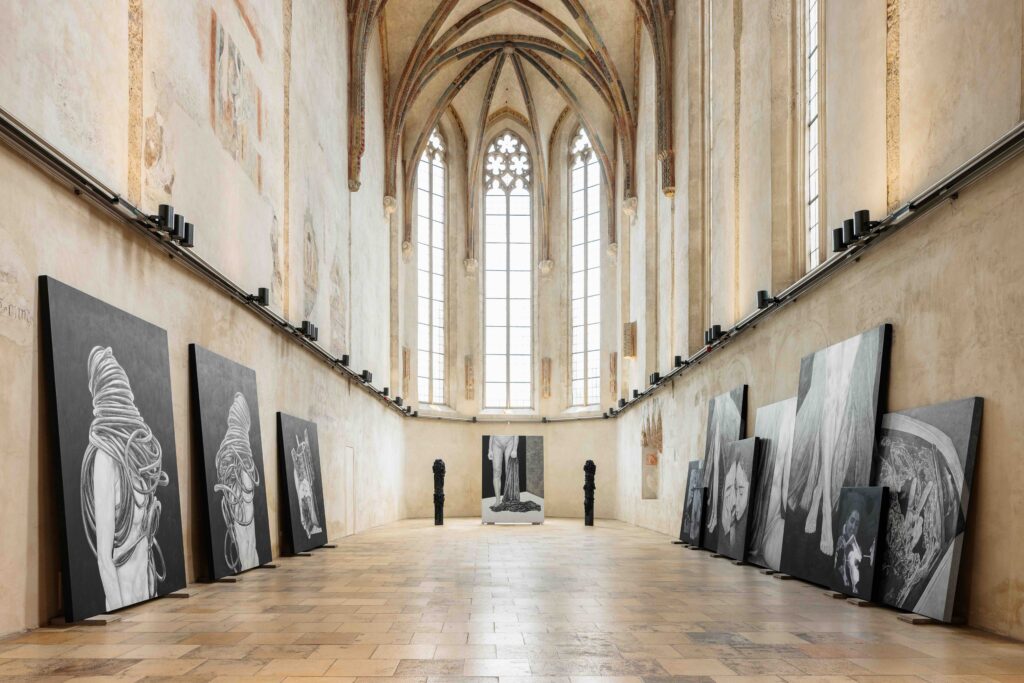
Adolfo Bimer (b. 1985) is a Chilean artist creating cross painting, sculpture, and installation, and moving between the pictorial and the sculptural – the abstract and figurative – to unsettle health sciences’ representations of the human body. Drawing on his experience as a long-term companion to a chronically ill family member, Bimer’s work examines how medical institutions can erode individuals’ sense of personhood.

The artist reflects on how medicine shapes our perceptions of identity, illness, wellness, as well as human corporeality itself. His integration of medical tools and technologies (like bloodwork microscope slides) into the artistic practice strives to refigure the cold, clinical sphere as affective and sensorial. In these creative changes of contexts, Bimer reclaims the personal within the often bureaucratic, dehumanising healthcare system – or, conversely, creates a visual language for the detachment of the medical field.

Life between, life within
Bimer’s latest exhibition, Life Between at the Rodriguez Foundation in Poznań, Poland. transformed the gallery interior into a doctor’s waiting room; a space suspended between uncertainty and diagnosis, illness and recovery – or even life and death. The artist expands this inherent liminality by endowing his work with a quality equally as strange as familiar, reflecting on the alienating dimension of the medical experience.

At first glance, the exhibition space is not too far away from what one might remember from their latest doctor’s appointment: clean, bright, clinical, with rows of seats and an array of pictures on the wall. Upon further inspection, however, this feeling of familiarity crumbles. In Bimer’s world, ordinary textures and materials arrange themselves into strange configurations. They not only puzzle in their severance from the proper medical context; they surprise in their shapes and forms – from pill-filled handrails to the corroded, bone-like chairs.
This troubling effect mirrors the confusion and alienation that accompany many in their attempts to decode medical images and language. In the process of interpreting health documentation and experiencing Bimer’s art alike, disorientation goes parallel to self-discovery. He believes that “art has the ability to capture the shape of mystery, to be an ambiguous yet highly precise spokesperson”, allowing the viewers to recognise themselves in “something strange … that gives little or no concrete information”. His merging of the odd and ordinary thus illuminates the estrangement that stems from how medical institutions permit and prevent one’s understanding of their own physicality.

Internal clocks
The marriage of conflicting affects gives rise to another tension present in Bimer’s work: one between the personal and the detached. Like his other works, Life Between draws from the years he spent accompanying his ill mother through different medical institutions. This biographical, subjective impulse stands in contrast to the general perception of medical spaces as sterile and impersonal – as well as the audience’s own commonplace recollections of doctor visits. The seemingly impersonal space is then revealed to possess a deeply intimate aura for the artist and the audience alike.

In Las voces (2024) exhibited in Madrid’s La Papelaría, Bimer invites his audience to become part of yet another waiting-room space, nuancing the relationship between people and medical institutions. Again, he embraces the liaison’s many tensions. The room is both empty and crowded, abundant in spots and gasp akin to those from damaged film negatives. It is at once out of time and full of time. A heightened awareness of time, after all, constitutes the core of a clinic reception. There, the clock ticks louder than ever, counting the minutes that elapse before the appointment as well as the years, months, or weeks before one’s death. In Bimer’s speculative health facilities, liminal temporality coexists with this overarching sense of passage of time, one nearly as tangible as the presence of surrounding objects.

Illness in micro- and macrovision
Bimer treats time as material across his oeuvre, from in-between milieu to long-term artistic projects. One example is his Microscopic Painting series. Started in 2014, it treats scientific data as the starting point of the artistic process. The artist translates a microscope image of the blood of a patient with schizophrenia into a painting, experimenting with different varnishes, oil quantities, and paint thickness to allow for the movement of material and, in turn, a whole spectrum of results. As the paint shifts and dries, the works get to live a life of their own. New meanings emerge once they enter the exhibition space; evoking stained glass windows, they refigure scientific material as an aesthetic experience.

In a similar vein, Bimer’s Blood Line and Blood Mountain Range use the same microscope slides from a Santiago psychiatric facility to give shape to the dehumanisation and bureaucracy of many medical institutions. The artist compresses data from multiple patients into one block, where singular images become indistinguishable. While each sample belongs to a singular body – a singular human being – their organisation into larger shapes alerts the viewers to the clinical tendency to collapse lived experiences into abstract data. The shape of resultant sculptures evokes both statistical graphs and the ridges of the Andes, the patient’s living environment. This dual imagery allows Bimer to chart the tensions between the individual and the collective in the diagnostic lens, visualising how it might obscure the patients’ sense of self, especially in the case of psychiatric patients as a marginalised group.
On the whole, his work embraces nuance and in-betweenness in the face of medicine’s seeming scientific certainty. He explores the system’s effect on one’s sense of bodily and intellectual autonomy – or, indeed, their perceptions of time and space. By crafting imaginary spaces where the clinical, creative, and personal can freely meet and mingle, he ultimately reclaims the personal within the clinical; for, as he states, “there is an inherent subjective weight associated with illness, a heaviness in every/any medical image”.

Bimer lives and works in his hometown of Santiago, Chile. He graduated with a BFA in Visual Arts from the University of Chile and a background in Art History from the University of Utrecht. Since 2014, he has been the co-director of Sagrada Mercancía, an art collective and creative space, where he champions the organisation’s aim to promote novel practices and perspectives in art production, critical thinking, and education across (and beyond) Latin America.
His works have been showcased widely in- and outside the Spanish-speaking world, appearing in group and solo exhibitions in South America, the United States, Germany, Spain and – most recently – Poland. Bimer’s creations have also been featured in various publications like NYC’s New Museum’s Younger than Jesus: Artist Directory (2010) or Remains-Tomorrow: Themes in Contemporary Latin American Abstraction (2020). The coming year is set to bring him new creative opportunities thanks to the Swiss ProHelvetia South America Grant as well as the NAVE Escobar Residency in Buenos Aires.