




Agata Jarosławiec (b. 1991) is a Krakow-based visual artist working across media such as sculpture, installation, performance and handicraft. Her works weave historical references with modern narratives. She treats art as a vital force of encountering — or even reclaiming — the past. Drawing on regional practices and stories, the artist creates an aesthetic world centred on the body, identity and community.

Although diverse in technique, Jarosławiec’s oeuvre is conceptually coherent and convincing. Born in a small town in south-eastern Poland, she engages with the idea of intergenerational trauma, exhibiting stories of displacement and political violence, deep-rooted and persistent in the country’s past. Still, she does not reproduce the narratives full of pathos so common in many patriotic retellings, but rather looks at individual manifestations of the collective past, especially in the body, which acts like a somatic archive.
Born in a small town in south-eastern Poland, she engages with the idea of intergenerational trauma, exhibiting stories of displacement and political violence, deep-rooted and persistent in the country’s past.

Whichever is true, the echo or you?
In her most recent exhibition at Piana Gallery, We speak in Echoes (2026), the artist tells the story through the acoustic lens of echo, understood not as repetition, but as a distortion, a perceptive shift.

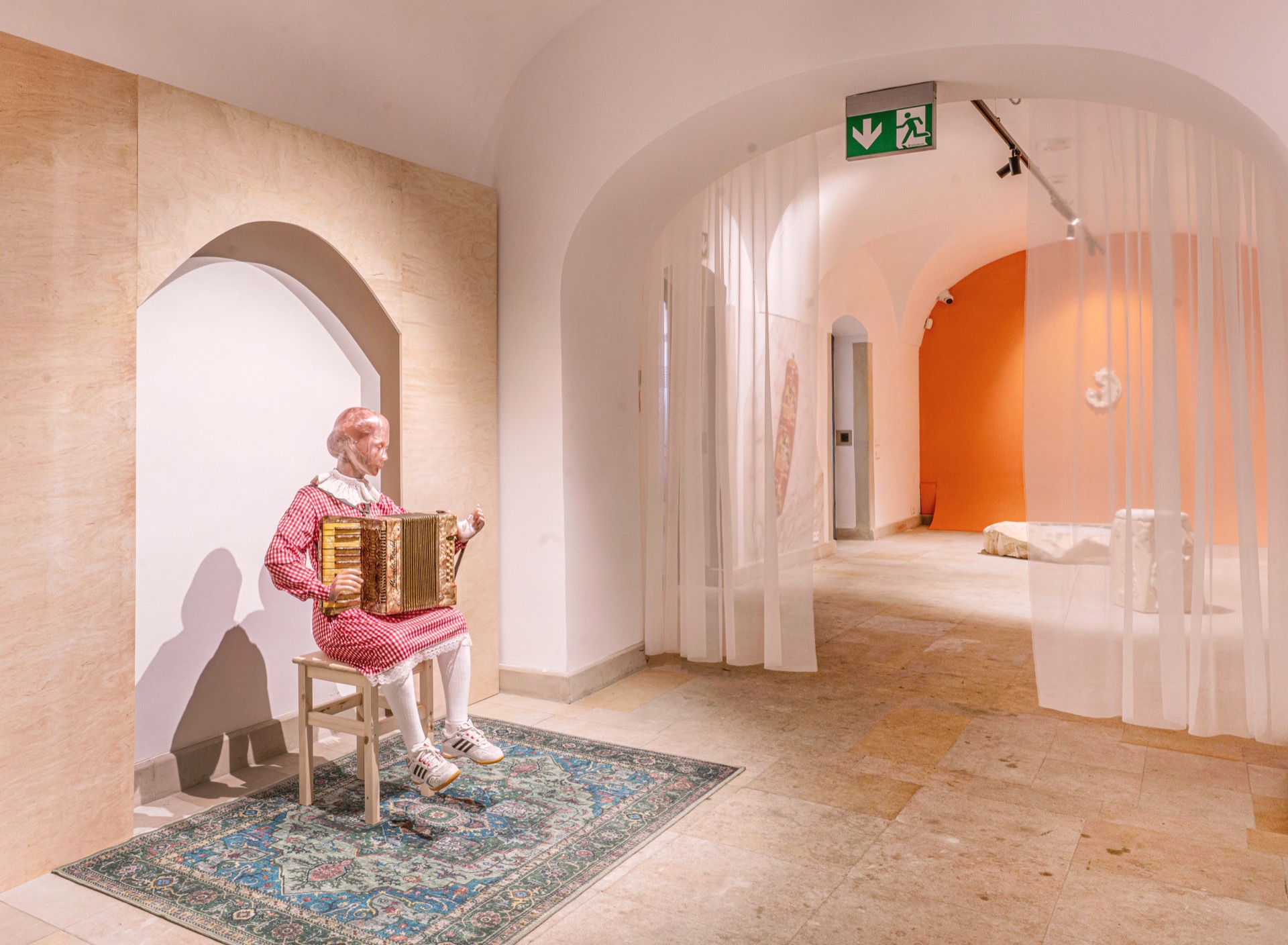
Enclosed Garden (2026) is a sizable textile piece that sets the tone of the space as gated, constrained and largely feminine. Embroidered on a large piece of pastel fabric are abstract floral shapes, which, together with sparse crochet doilies, position the work within a folk context. Dispersed among the ornaments are silicone masks of sleeping women, their almost identical, idle faces framed by chains in place of braids. The shackles are mirrored at the centre of the piece, hanging from a dark red circle all the way to the ground in the form of crochet chains and a ball of yarn.
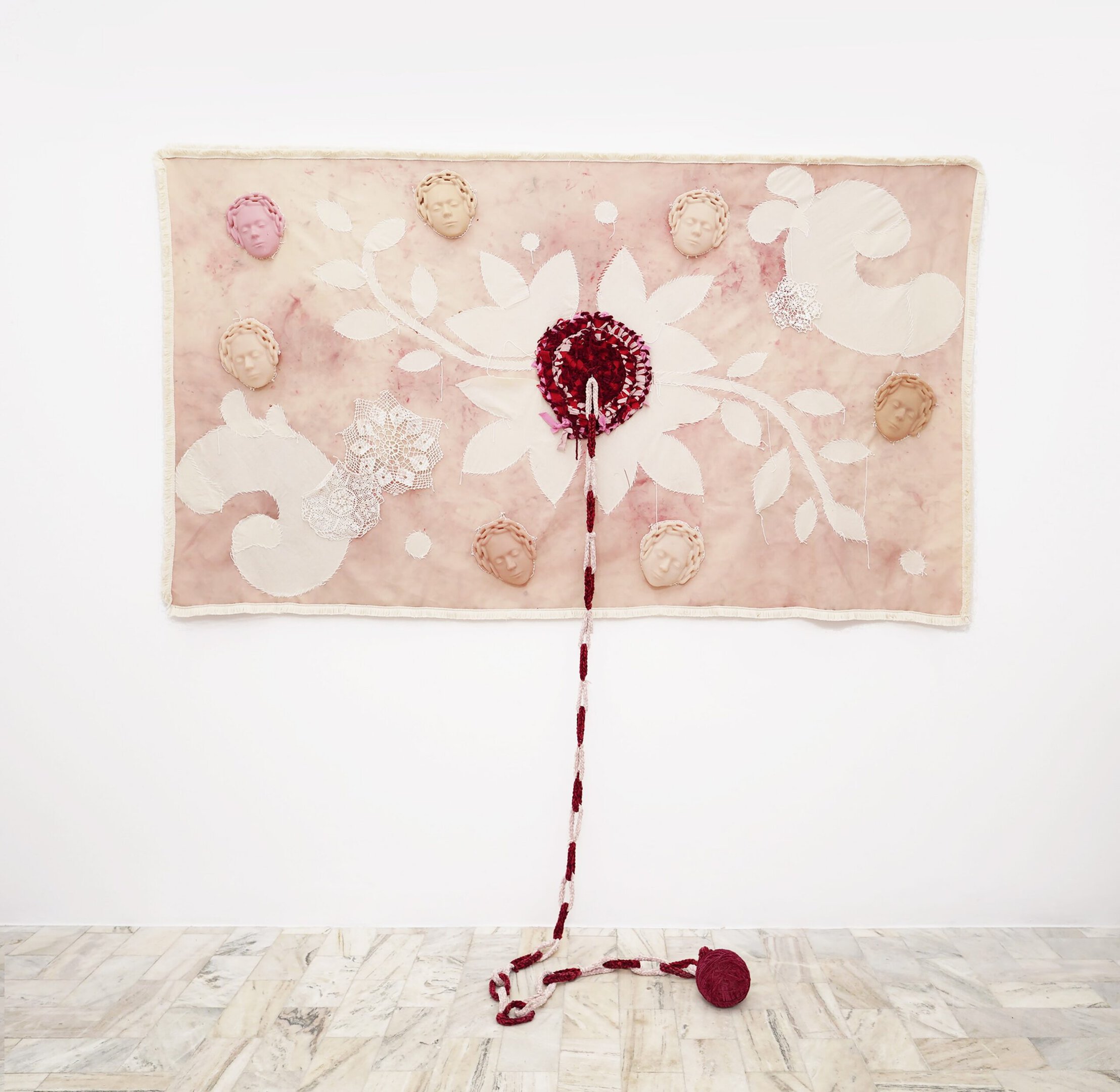
The soft background and gentle shapes are outweighed by the dark and heavy anchor. The custom of handicraft, or even more broadly, cultural legacy, appears to be bestowed upon the women involuntarily, despite their closed eyes. Thought of as female labour, crochet became a way to preserve and transmit craft across generations; in a way, it tied cultural heritage to the work of women’s hands. The artist evokes the theme of cultural mimicry, a tactic of survival through assimilation, “echoing” the thoughts and actions of others. The women attached to the textile, dreaming, seem suspended in time and space, stuck in a loop of referencing.
Thought of as female labour, crochet became a way to preserve and transmit craft across generations; in a way, it tied cultural heritage to the work of women’s hands.
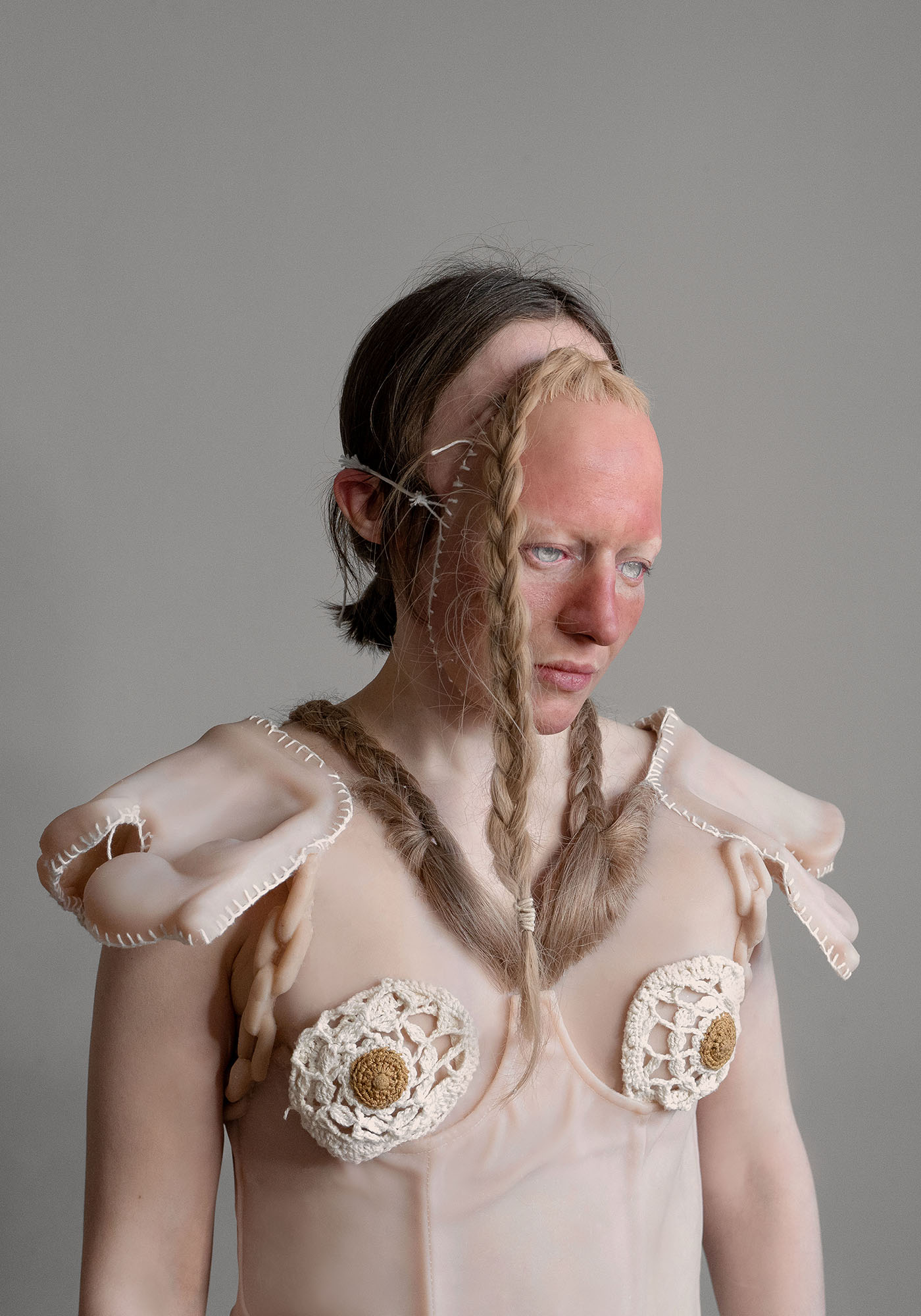
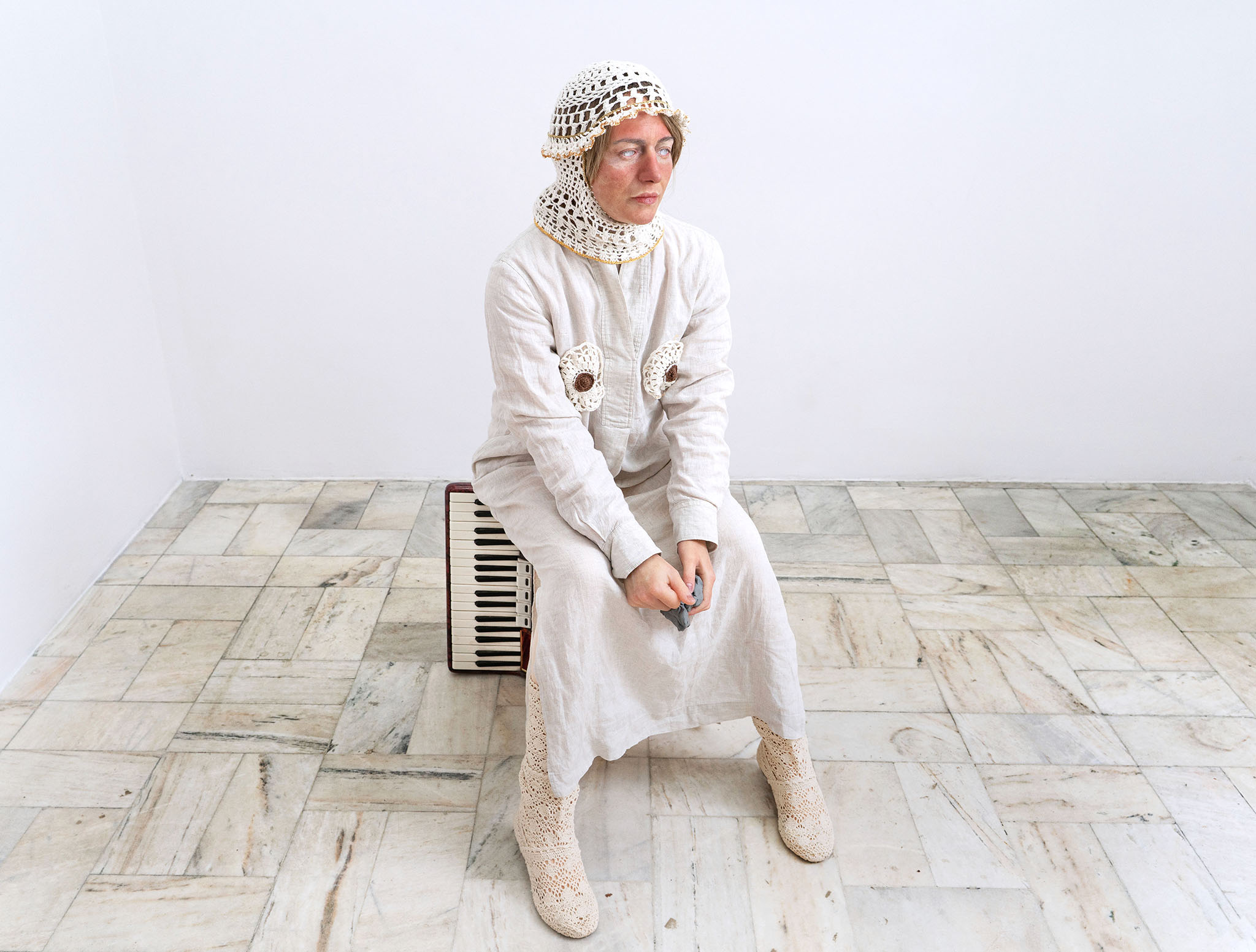
Throughout the exhibition, echoes can be heard in both the narration and the materials used. Silicone becomes the Second Skin (2026), a soft and elastic shell, though one void of memory, merely echoing what it imitates. The wearable piece evokes armour, with heavy shoulder pads and beads going around the waist, albeit clearly designed for a woman. The silicone breastplate leaves space for actual breasts, marked with crochet dollies that visualise nipples. The neckline is lined with hair, with a long braid falling along the torso, mirrored by silicone chains sewn beneath the armholes. The thick white skirt features traditional embroidery, with an outer layer of decorative crochet cloth.
The object is both ancestral and modern. The silicone, shaped to resemble organic matter, is juxtaposed with hair and fibre. The braid and crochet stitching, delicate and domestic, are attached to chains and spaulders. What emerges is a reconstructed take on a heritage of trauma. Jarosławiec’s practice probes regional histories, but also familial narratives — new perspectives emerge through crocheting with her mother. The body that materialises echoes all these experiences of submission, tradition and the thirst for freedom, but in a distorted, almost fierce way. Memory is ongoing, not set.

All the stories held in flesh
The somatic records and layered traumas surface in Mothers carried the yoke, and daughters bent their backs (2022), another wearable sculpture disguised as chainmail. The piece is made of small clay tiles, each bearing a unique cross-like shape, some of which are gold-plated. Connected with metal hoops, they take the form of armour, which remains distinctly feminine in its dress-like shape.
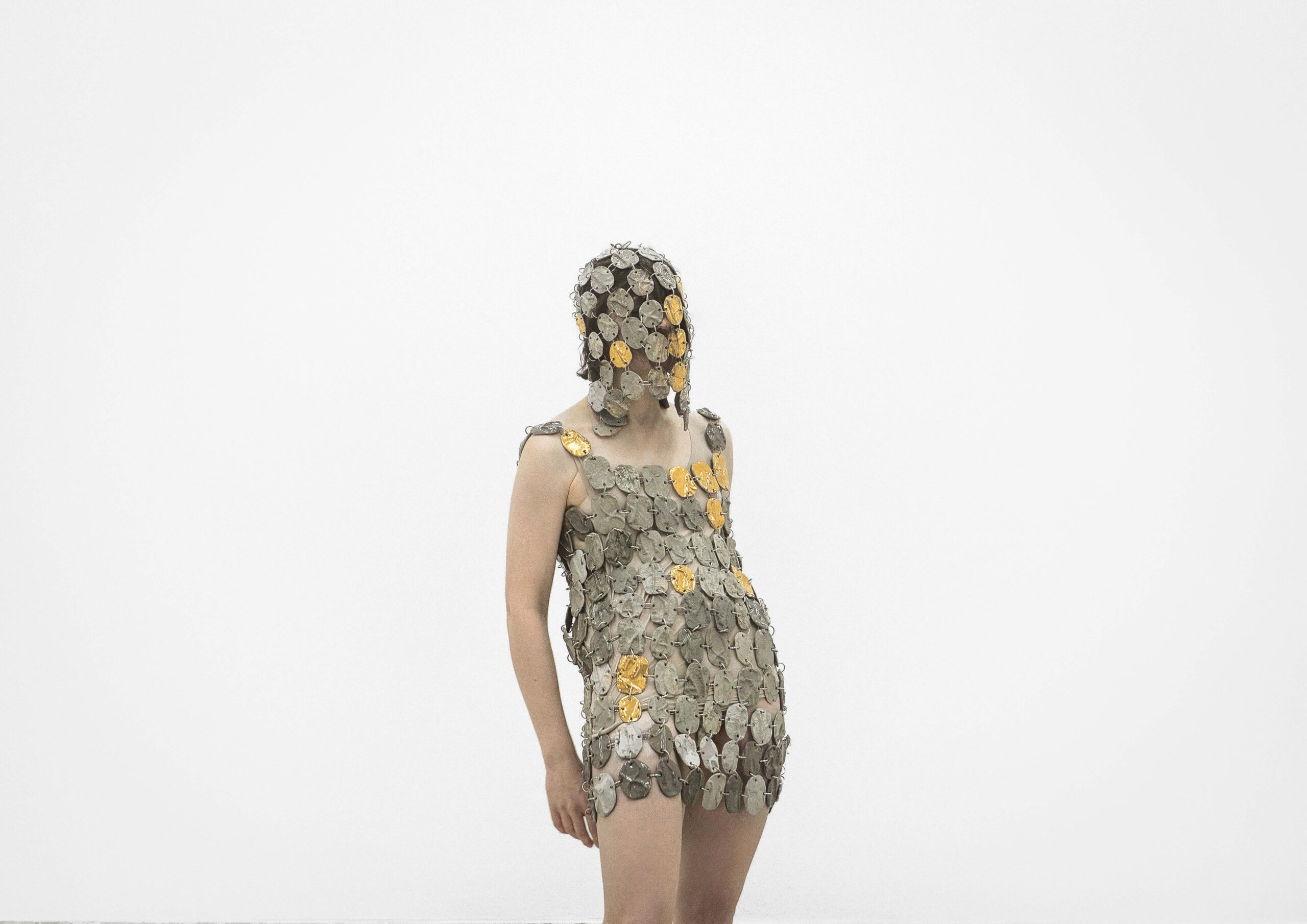
In her doctoral research, Jarosławiec delves into the abolition of serfdom in nineteenth-century Poland. Freed peasants used to erect crosses to mark their newfound autonomy, imprints of which can be found on the chainmail’s tiles. The title’s reference to the yoke further complicates this image of emancipation. A device used to harness animals to a load is placed upon the mothers, and even though their daughters are free from the physical burden, the weight remains on their shoulders. The garment, sturdy and heavy, tellingly portrays the collective, intergenerational experience carried in an individual body, which bends under the heaviness of symbolic emancipation. In a way, the wearer reclaims this scarred collective identity, but not without cost.
This idea — the burden of collective, intergenerational traumas shaping the mind, body and identity of the individual — was further explored in Whip instead of the Sun, a 2024 exhibition at the Museum of Warsaw. Its narrative zoomed in on how the loaded identities shape or disorient contemporary Polish culture. In the capital’s microcosm, people who have migrated to settle there are often considered to be lesser-than, despite the fact that fewer than fifty per cent of its residents were actually born in Warsaw — a statistic that holds true both today and a hundred years ago.
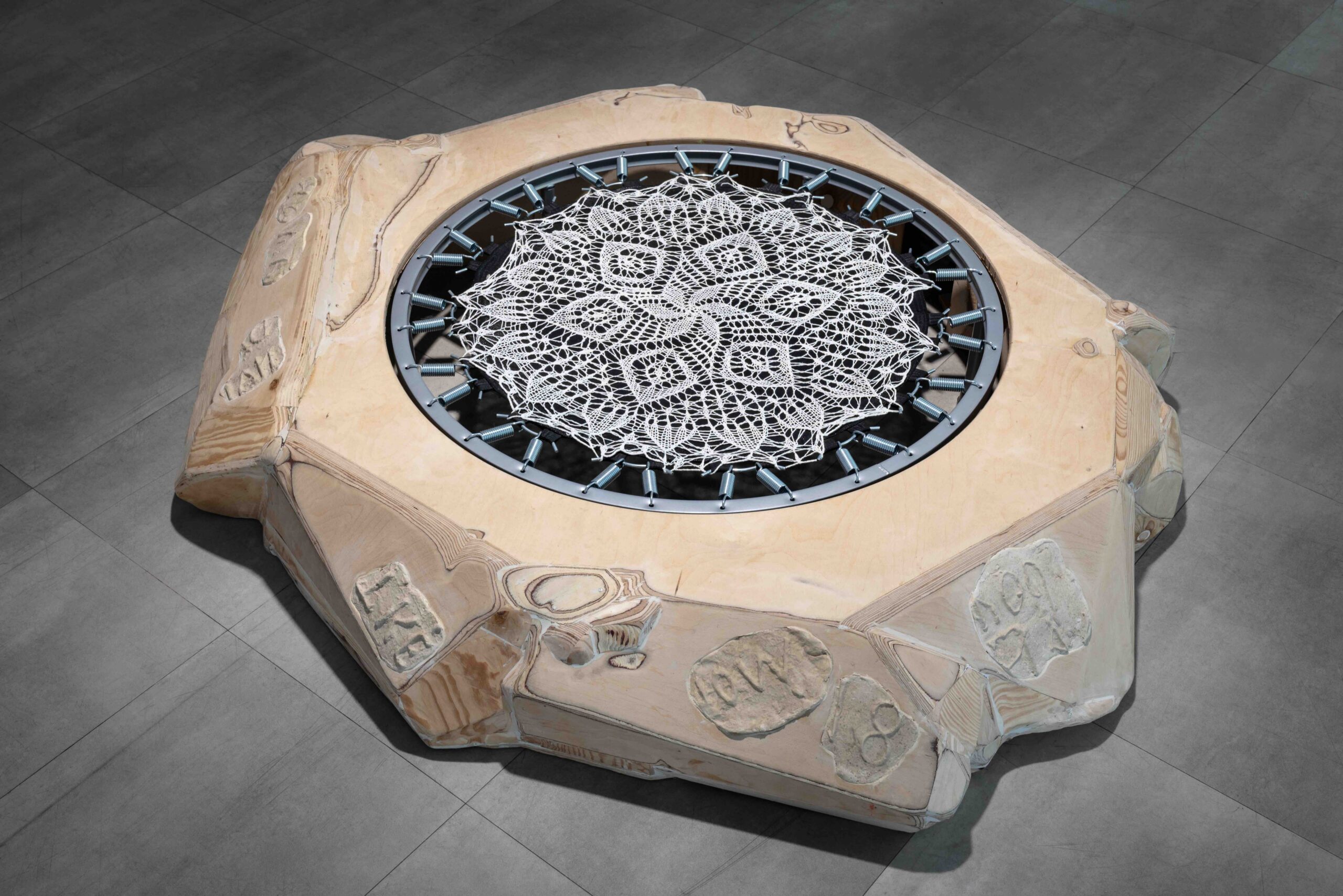
Trampoline (2024), presented at the exhibition, alludes to the idea of social advancement, expected to follow after resettling in the capital. The object is a large, irregular piece of wood, with a crochet doily stretched in the middle, held taut by metal springs. Its visual language corresponds with many other works by the artist — the sides of the wooden block are covered with carvings of crosses and other symbols, while fabric handicraft remains central to the work. Trampoline, designed to put the body in motion, joyful and agile, bears traces of serfdom and tradition that inhibit the social leap.
In the capital’s microcosm, people who have migrated to settle there are often considered to be lesser-than, despite the fact that fewer than fifty per cent of its residents were actually born in Warsaw — a statistic that holds true both today and a hundred years ago.
The cohesiveness of Jarosławiec’s body of work makes its key ideas stand firm. She neither glorifies, fetishises nor pathologises their cultural heritage. They draw connections, tie loose threads to the body, which knows the truth of the stories it holds. Art becomes vital in the process of becoming, embracing or simply reckoning with the identities bestowed upon us.
BIO
Agata Jarosławiec is a multimedia visual artist, born in Lubaczów, Poland. She studied Art History at the Jagiellonian University in Krakow, and Art Education at the Academy of Fine Arts in Krakow, Faculty of Painting, where she is currently pursuing a doctoral degree. Her solo exhibitions have been presented in Warsaw and Krakow, and she has participated in multiple group exhibitions across Poland. In 2025, she was awarded a scholarship from the Ministry of Culture and National Heritage and the city of Krakow, where she lives and works.