

Bubbling pools of anger well in the bloodshot eyes of a redheaded partygoer. Is she a loner? A social outcast taking tentative sips from her craft-beer bottle, one leg crossed over the other, an indie queen in moccasins, frozen in solitary content? Smudged mascara and black eyeliner underscore her calling eyes, beckoning the viewer to acknowledge her presence. Like the warning signals of ships lost at sea, the flecks on her black sequin mini dress blink rhythmically.
“I’m fine”, she murmurs. We know that she is, or rather say she is, because it’s the name given to this large 180 x 140cm oil painting. I’m Fine (2024) is a snapshot in time that has never existed anywhere yet has existed everywhere. “I’m fine” sends me dizzy — how many times have we all uttered that phrase, even when our faces betrayed us? With bubbling tears and streams of fluid beyond our control. Smeared thick strokes of paint over a white minidress and black slip-on sandals signal minor characters in the background. Captured out of focus, they heighten the sensations of a cramped kitchen interior and overstimulating house party.

While mid-twentieth-century painters Pauline Boty and Richard Hamilton used these techniques to capture the buzz of the swinging London, Agata Kus employs them to capture the existential dread of our times. Kus’s girl could be any one of us. Following in the tradition of metapainting — paintings which self-consciously reflect on their invention and fabrication — Kus takes us to new worlds of the make-believe.
Oh, you pretty things
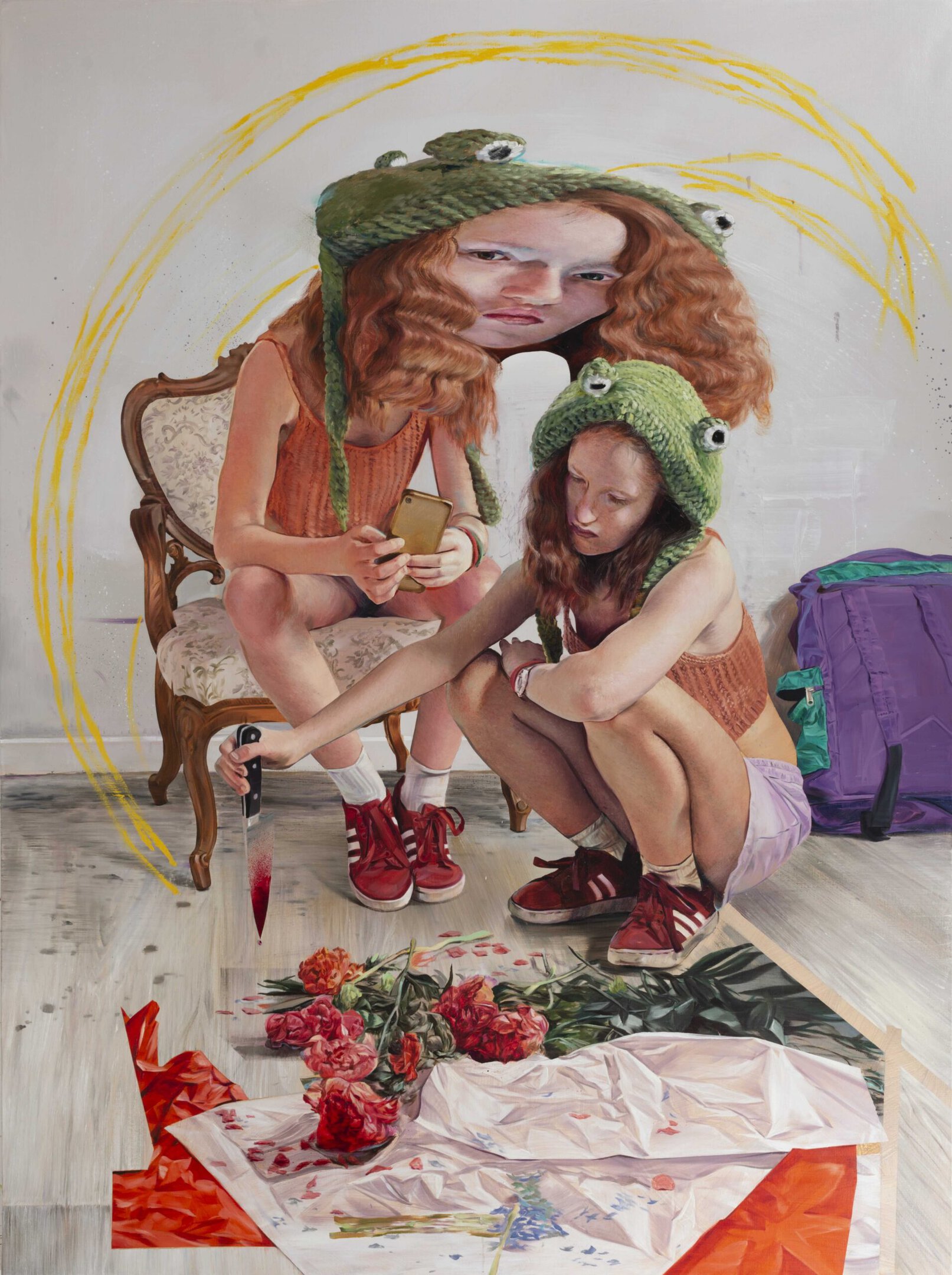
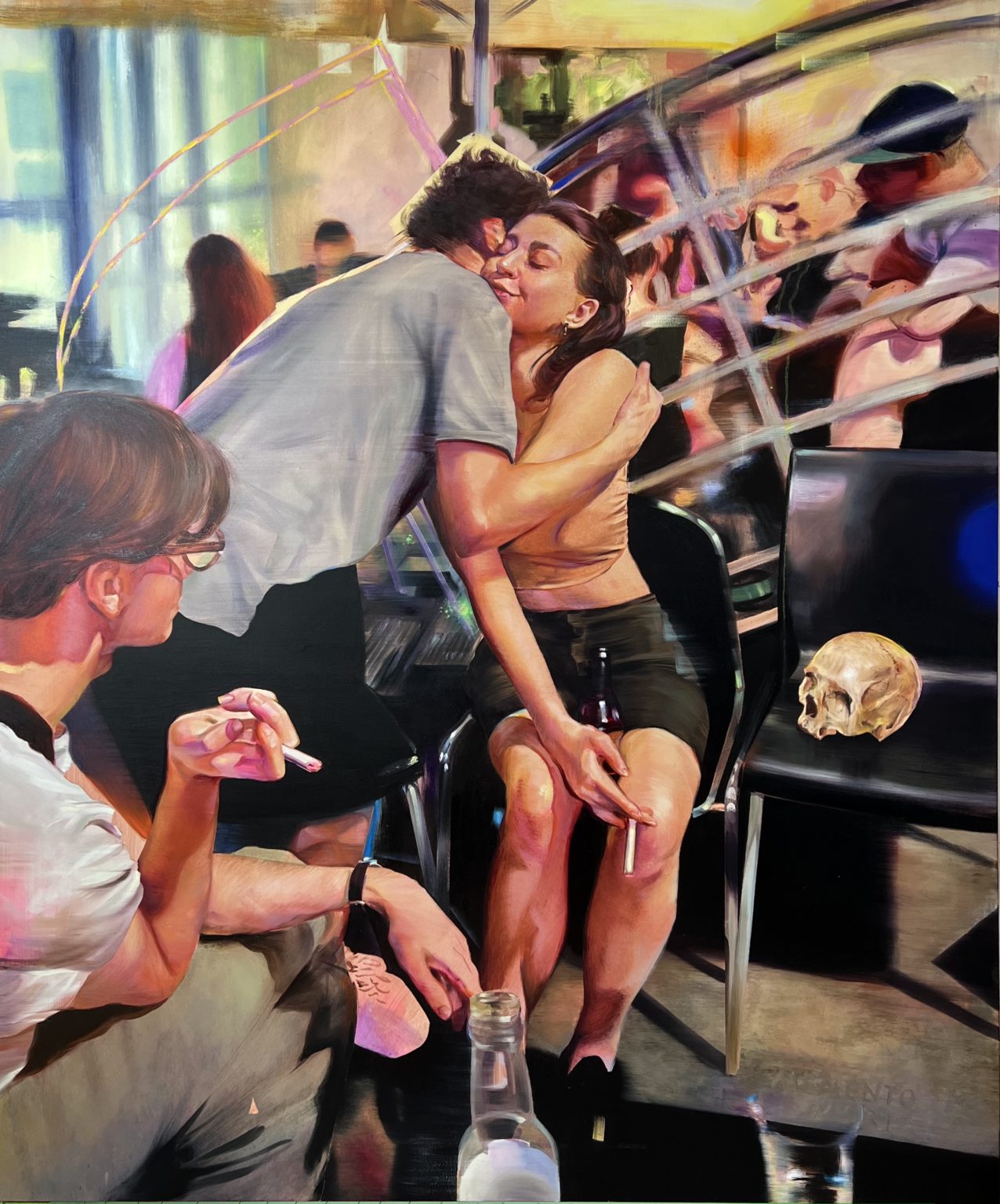
Agata Kus lives and works in Kraków, Poland, taking inspiration from her immediate social circle and surroundings. Her family and friends, fellow creative artists and musicians, become the figurative subjects of her work, inhabiting Kus’s dream worlds of uncanny forests and sticky dancefloors. But dreams can be dark, too. A girl in an oversized knitted frog hat stabs a garland of red roses in About Such Two (2022), and an anamorphic skull, reminiscent of Holbein’s famous 16th-century painting, cradles a dolled-up party girl checking her phone in Ambassador (2022). Like the philosophy of Jean Baudrillard’s simulacra, where contemporary aesthetics can be summed as images that no longer bear traces of their originals, Kus cuts, splices and rearranges art-historical iconography, mixing it with mass-circulated internet memes, the kitsch with the sublime, into a dazzling new effect.
Her family and friends, fellow creative artists and musicians, become the figurative subjects of her work, inhabiting Kus’s dream worlds of uncanny forests and sticky dancefloors.

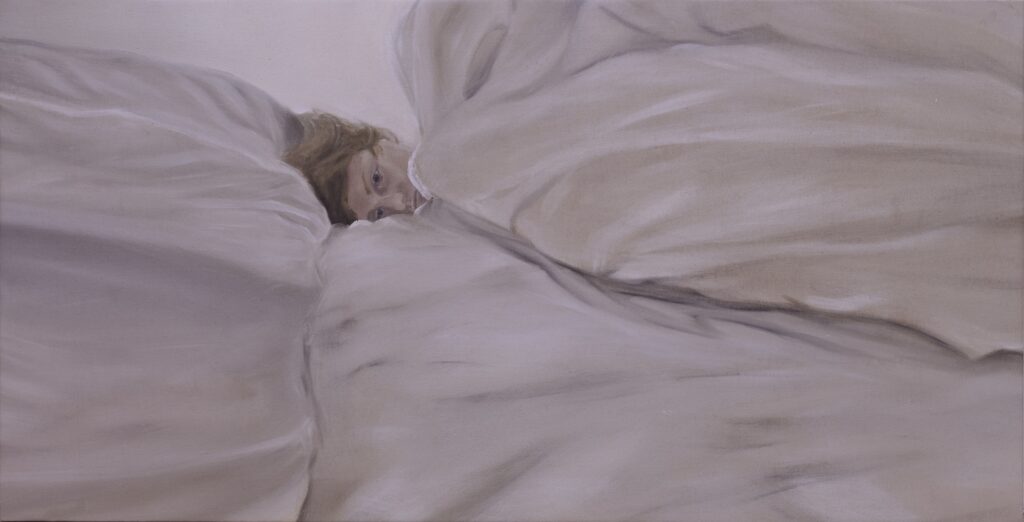
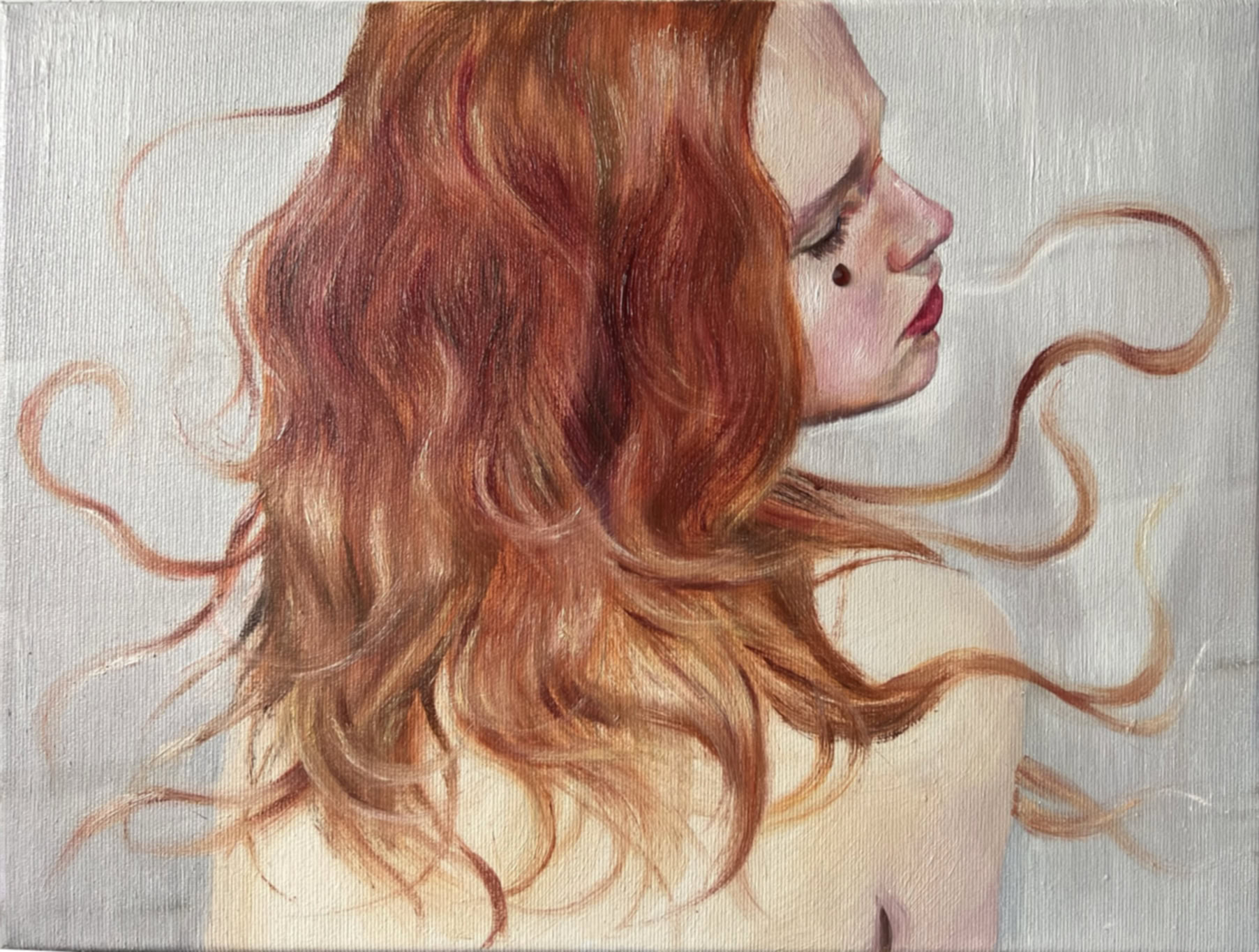
In Kus’ fantasy realms of young girls and feline creatures, Madonnas and witches, archetypes resurface. Medusa, the symbol of feared female sexual prowess, appears in several iterations. With her back to the viewer and extending her head with her gaze down, there is an ambivalence to the young and nude Medusa III (2023). But perhaps, in Kus’ eyes, she is not only a fixed archetype but also a moment in time — the heady transitional period of puberty, as girls edge from childhood towards womanhood. Like the snakes in Medusa’s crown of hair, we undergo a shedding, a loss of playfulness and naivety, symbolised in the one set jewelled tear beneath the girl’s thick fanned lashes.
A sad voluptuousness
Indeed, Kus’ paintings seem to pour out with “a sad voluptuousness”, to use the words of feminist French philosopher Julie Kristeva. In her book, Black Sun: Depression and Melancholia (2024), Kristeva argues our contemporary worldview is enveloped by this tempting melancholia. In Kus’ compositions, darkness and innocence intermingle, divergent players on a chessboard, jarring a coherent narrative.
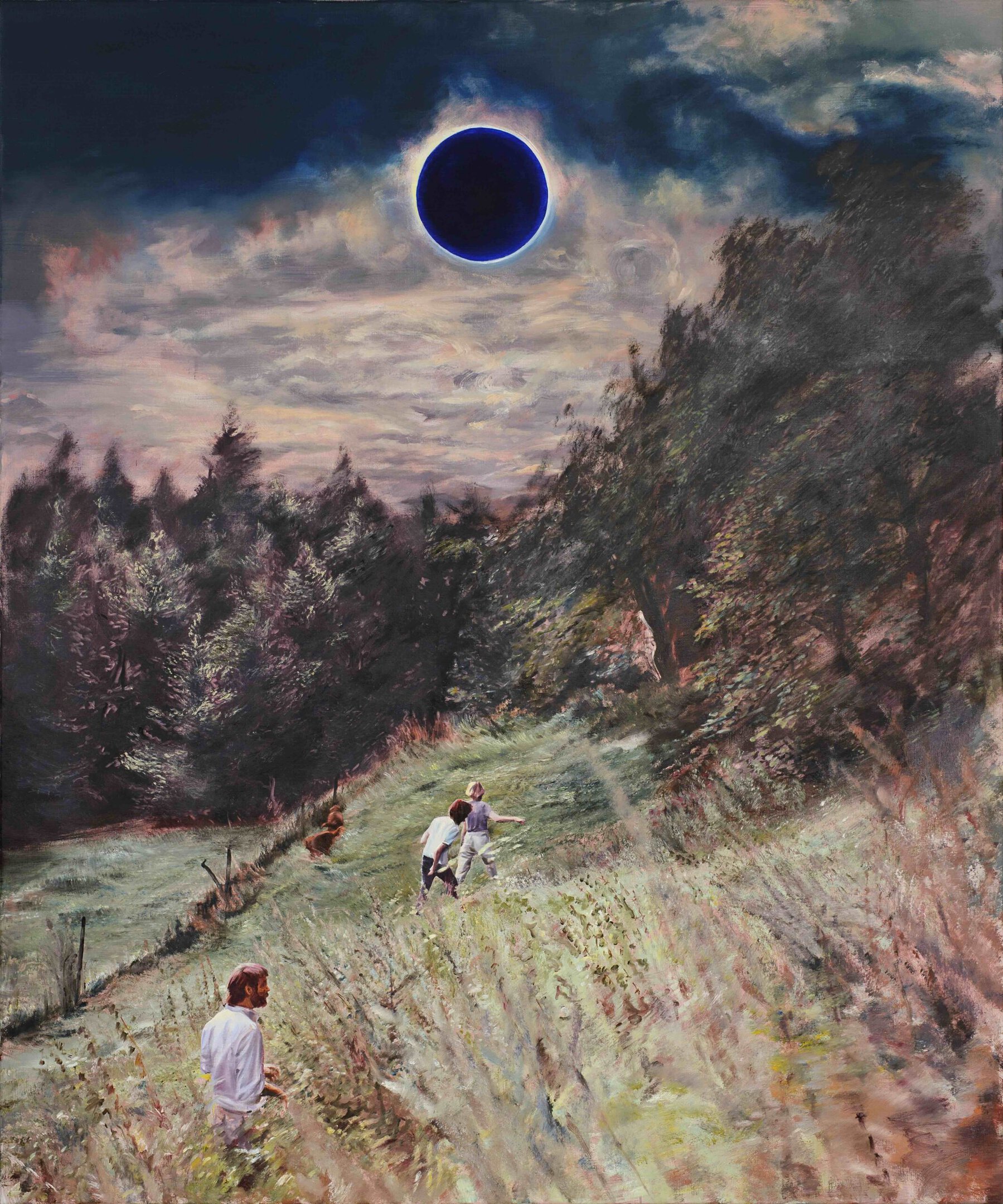
The artist has spoken about the horizontal reading of her paintings: how, unlike the spoken word, which is delivered in a linear form, within painting different elements, textures, planes and surfaces barricade you at once. In Blue Sun (2020), this unravels as a tale of two acts. Disrupting the bucolic countryside scene, a deep indigo sun hangs over a vengeful sky, scarring the landscape with foreboding. The carefree spirit of the two children chasing after two dogs in the meadow coalesces with the ominous dark woods — the result is both alluring and repugnant, tranquil and tumultuous. Juxtaposing elements that would not normally be seen together, the artist likens her paintings to contemporary poetry, where a “non-obvious arrangement of words…suggests meanings more than it defines them.”
The artist has spoken about the horizontal reading of her paintings: how, unlike the spoken word, which is delivered in a linear form, within painting different elements, textures, planes and surfaces barricade you at once.
Surveying the swelling eclipsed sun, the viewer can’t help but ponder over the sacrilegious composition as a portal and vehicle for their own psychological landscape. Rather than dictating and depicting reality, Blue Sun functions as a site of projection for the audience, who ruminate over the irresistible void as an agent of their own dreams, fears and desires.

Though painting comes as Kus’ primary language, the artist has also extended her hand into the materiality and bodily dimensions of sculpture. Amidst the lovers and partygoers, feral scythe-holding heroines and levitating mermaids in Kus’ 2024 solo exhibition, First Time at the Elektrownia in Radom, Poland, stands a melting, decrepit dollhouse. Property is a storehouse for the artist’s fears and unprocessed memories, and a gateway in the exhibition for viewers navigating the following rooms. It nods to the artist’s subconscious, the storage space “inhabited by what is invisible but palpable and disturbing”, as she explains.
An enduring trick of the eye
For a while, painting had been cast aside in contemporary art discourse in favour of more conceptual projects and performance works, but Kus’ trompe l’œil, surreal photomontage compositions and pictorial distortions reveal the power and potential of the medium. Upon viewing Hans Holbein the Younger’s controversial painting of The Body of Dead Christ in the Tomb (1520-1522), one of the greatest examples of metapainting, Dostoevsky remarked: “One can lose his faith from a painting like that.” Such is the enduring force and power of the medium. With Kus receiving the no. 1 artist ranking in the Young Art Compass award by Rzeczpospolita in 2021, she is a formidable metapainter of our times.

For a while, painting had been cast aside in contemporary art discourse in favour of more conceptual projects and performance works, but Kus’ trompe l’œil, surreal photomontage compositions and pictorial distortions reveal the power and potential of the medium.
I look upon I’m Fine (2024) once again, and a flood of mediocre nights out and gnawing millennial melancholia sets in. Perhaps what is most compelling about Kus’ work is just how relatable her characters and scenes are. Memories recycle, old feelings resurface, and “sentimental journeys” begin in the milky alchemy of glaze on pigment.

BIO
Agata Kus, born in 1987 in Krosno, Poland, graduated from the Faculty of Painting at the Academy of Fine Arts in Kraków with an MA in Painting in 2012 and completed her Doctorate in Fine Arts in 2018. She’s a recipient of numerous awards and scholarships, including the first prize at the 2015 WRO International Media Art Biennale in Wrocław. In 2017, she was nominated for the “Spojrzenia” Award presented by Deutsche Bank and Zachęta – National Gallery of Art in Warsaw. Kus participated in several group exhibitions in Poland and presented her works in solo exhibitions in galleries in Germany, Austria and France.