






[polska wersja językowa poniżej]
Based in Barcelona, Magdalena Hart and Natalia Gima’s collaborative practice is rooted in installation and performance. Active since 2019 as a duo under the name Akyute, they utilise technology as a means to reestablish the connection between people and nature by integrating interaction design, generative sound, and audiovisual arts and experiences. With this approach, they integrate nature into the digital age, in a way (re)situating the human experience within the natural world. Founded on their collective vision, Akyute stands for the idea that interaction is organic, lively, and dynamic, while communication amongst species is fluid.

Gima and Hart, as well as their co-founder Miriam Felici, found each other by chance in 2019 whilst pursuing their Master’s Degree in electronic prototyping at the Audiovisual Innovation & Interactive Environment at Bau, Centre Universitari de Disseny de Barcelona. Noticing their common area of research, they decided to develop a musical circuit board, which became the initial impulse to their investigation into the concept of non-human types of perception and intelligence, and methods of biodata visualisation. Since then, they have been researching and creating together as Akyute.
Connecting the concept of art to fun and experience, Akyute disengages from the position of culture in its traditional sense – sterile, fragile, and on a pedestal. Emerging from their co-creative practice, each piece becomes a playground for their audience: experimenting and implementing participation values communal and contextual creativity, and in turn crafting together a powerful tool for innovation, transformation and ultimately, a common ground.


One of their first collaborative pieces, Cyclius (2019), is a biodesign sculpture that changes along with the growth of the Salvia-Hispanica seeds. It metamorphoses cyclically in relation to the environmental conditions around it, making its growth unpredictable. Created together with
Estudio del Espacio and commissioned by CCD, the sculpture is in constant transition: simultaneously static and dynamic, inert, and alive.
During their research, they found that the idea of Nature/Culture figures as focal, with the notion of both these elements as interconnected. To understand one, the other must be taken into consideration. Drawing from Donna Haraway’s concept of Natureculture – defined as a synthesis of nature and culture that recognises their inseparability in both biophysically and socially formed relationships, Akyute provokes hierarchies and power structures in people’s idea of nature. Ultimately, they consider the environment as a conjunction of interconnected ecosystems, in which all species nourish one another – a garden of relationality.


Photo Microbial Fuel Cell is a piece they created during their artistic residency at the Centre for Creative Solutions in Lovinac, Croatia, in August 2020. They began by exploring the appropriation of electricity on behalf of nature to enhance its network. From there, they dived into the relationship between nature and electrical energy, looking into developing a permanent and sustainable installation that wouldn’t require a source of electricity or internet access. Researching the use of photosynthesis as a source of energy, they created a photo-microbial fuel cell (P-MFC): a device that converts light into electricity. By closing the circuit, they effectively create a path leading the current into an LED, creating a self-sufficient, living source of electrical energy.
By using technology, they’re able to materialise and present what is otherwise invisible or easily overlooked; further focusing on the human senses, they harness sound as a tool for embodied connection. Carrying a symbolic cultural value, music has historically demonstrated its ritualistic power, bringing people together in an aural unity – connecting with our senses on a profound level, and shifting our perception, behaviour, and complete perspective on our experiences.

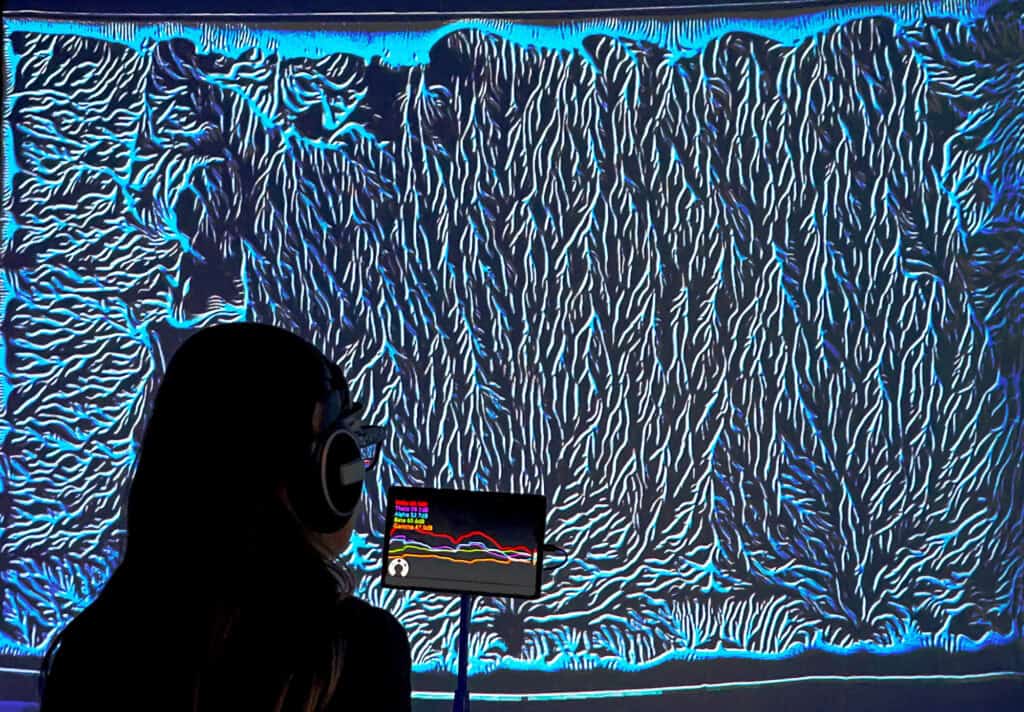
In their performance and installation series Paisaje Sonoro, or “soundscape”, which began at the Performative Arts residency at PAR-Uruguay, sound as music is central. Over 30 minutes, the audience can observe the artist interacting with space, time, and a technological environment, resulting in a live soundscape and generative visuals stemming from a biodata visualisation system that is emitted from the plants. By nurturing pause and reflection in such a biophilic environment, questions of what it means to be human inhabiting nature arise.
In their most recent piece, Skin of Soil, Akyute explores resurrection: both ecological and human. Collaborating with astrologer Alice Sparkly Kat, whose astrology practice focuses on reconstructing history, interpreting the present and nurturing the future, Akyute developed an audiovisual and audioreactive narrative to their written work alongside sound artist Lechuga Zafiro. This series of narratives, stories, and speculations dives into the colonial disconnection from the earth, which in turn has generated a search for rebirth. Culminating in a live reading and A/V performance, they share a navigation of the year of the snake to embody new skins, rooted in intimacy, decay, and collective regeneration.


Taking the scope of their work into account, it is clear that connecting to nature today must be done in an unconventional manner – falling out of touch with the natural environment has brought about artistic and design practices that (re)incorporate such gardens into the quotidian. Crossing the borders people have defined between outside and inside, organic and synthetic, this rupture also gives way to the subversion of the idea of human dominion or power over the natural world, teaching us to live in harmony with our environment instead.

Artist in Focus: Akyute.
Tworzenie naturalnych powiązań.
Magdalena Hart i Natalia Gima, mieszkające w Barcelonie, współpracują ze sobą w zakresie instalacji i performansów. Od 2019 roku działają jako duet pod nazwą Akyute, wykorzystując technologię jako narzędzie do odbudowywania więzi między ludźmi a naturą poprzez połączenie projektowania interakcji, dźwięku generatywnego oraz sztuki i doświadczeń audiowizualnych. Dzięki takiemu podejściu wkomponowują naturę w erę cyfrową, w pewien sposób (ponownie) umieszczając ludzkie doświadczenie w świecie przyrody. Opierając się na swojej wspólnej wizji, Akyute reprezentuje ideę, że interakcja jest organiczna, żywa i dynamiczna, a komunikacja między gatunkami płynna.
Gima i Hart, a także Miriam Felici, współzałożycielka kolektywu, poznały się przypadkowo w 2019 roku podczas studiów magisterskich z prototypowania elektronicznego na kierunku Audiovisual Innovation & Interactive Environment w Bau, Centre Universitari de Disseny de Barcelona. Zauważając wspólny obszar badań, postanowili opracować muzyczną płytkę obwodu drukowanego, która stała się początkowym impulsem do ich badań nad koncepcją nie-ludzkich rodzajów percepcji i inteligencji oraz metodami wizualizacji danych biologicznych. Od tego czasu prowadzą badania i tworzą razem jako Akyute.
Łącząc koncepcję sztuki z zabawą i doświadczeniem, Akyute odchodzi od tradycyjnego postrzegania kultury jako czegoś sterylnego, kruchego i umieszczonego na piedestale. Dzięki wspólnej twórczości każda praca staje się placem zabaw dla odbiorców: eksperymentują i wdrażają idee uczestnictwa, wspólnej i kontekstowej kreatywności, tworząc razem potężne narzędzie innowacji, transformacji i ostatecznie płaszczyzny porozumienia.
Jednym z ich pierwszych wspólnych dzieł jest Cyclius (2019), rzeźba biodesignowa, która zmienia się wraz z kiełkowaniem nasion Salvia-Hispanica. Przechodzi cykliczne metamorfozy w zależności od warunków środowiskowych, co sprawia, że jej wzrost jest nieprzewidywalny. Rzeźba, stworzona wspólnie z Estudio del Espacio na zlecenie CCD, podlega ciągłym przemianom: jest jednocześnie statyczna i dynamiczna, nieożywiona i żywa.
W trakcie badań odkryły, że idea natury/kultury ma kluczowe znaczenie, a oba te elementy są ze sobą powiązane. Aby zrozumieć jeden z nich, należy wziąć pod uwagę drugi. Opierając się na koncepcji natury-kultury Donny Haraway, definiowanej jako synteza tych dwóch, uznającej ich nierozerwalność zarówno w relacjach biofizycznych, jak i społecznych, Akyute podważa hierarchie i struktury władzy w ludzkim postrzeganiu natury. Ostatecznie traktują środowisko jako połączenie powiązanych ze sobą ekosystemów, w których wszystkie gatunki wzajemnie się odżywiają – ogród relacji.
Photo Microbial Fuel Cell to dzieło, które stworzyły podczas rezydencji artystycznej w Centre for Creative Solutions w Lovinacu w Chorwacji w sierpniu 2020 roku. Zaczęły od zbadania wykorzystania energii elektrycznej w służbie naturze w celu wzmocnienia jej ekosystemu. Następnie zagłębiły się w relacje między naturą a energią elektryczną, poszukując sposobu na stworzenie trwałej i zrównoważonej instalacji, która nie wymagałaby źródła zasilania ani dostępu do internetu. Badając wykorzystanie fotosyntezy jako źródła energii, stworzyli fotomikrobiologiczne ogniwo paliwowe (P-MFC): urządzenie, które przekształca światło w energię elektryczną. Zamykając obwód, skutecznie tworzą ścieżkę prowadzącą prąd do diody LED, tworząc samowystarczalne, żywe źródło energii.
Wykorzystując technologię, są w stanie zmaterializować i zaprezentować to, co w innym przypadku byłoby niewidoczne lub łatwo przeoczone; skupiając się dodatkowo na ludzkich zmysłach, wykorzystują dźwięk jako narzędzie do nawiązania więzi. Muzyka, niosąca symboliczną wartość kulturową, od dawna wykazuje swoją rytualną moc, łącząc ludzi w dźwiękowej jedności – oddziałując na nasze zmysły na głębokim poziomie i zmieniając nasze postrzeganie, zachowanie oraz całkowitą perspektywę naszych doświadczeń.
W serii performansów i instalacji Paisaje Sonoro, czyli „krajobraz dźwiękowy”, która rozpoczęła się podczas rezydencji artystycznej Performative Arts w PAR-Uruguay, centralną rolę odgrywa muzyka. Przez 30 minut widzowie mogą obserwować artystki wchodzącego w interakcję z przestrzenią, czasem i środowiskiem technologicznym, co skutkuje powstaniem dźwiękowej przestrzeni i generatywnych obrazów pochodzących z systemu wizualizacji danych biologicznych emitowanych przez rośliny. Poprzez pielęgnowanie pauzy i refleksji w takim biofilicznym środowisku pojawiają się pytania o to, co oznacza bycie człowiekiem żyjącym w naturze.
W swoim najnowszym utworze, zatytułowanym „Skin of Soil”, Akyute zgłębia temat zmartwychwstania – zarówno ekologicznego, jak i ludzkiego. We współpracy z astrolog Alice Sparkly Kat, której praktyka koncentruje się na rekonstrukcji historii, interpretacji teraźniejszości i pielęgnowaniu przyszłości, Akyute opracował audiowizualną i audioreaktywną narrację do swojego utworu literackiego we współpracy z artystą dźwiękowym Lechuga Zafiro. Ta seria narracji, opowieści i spekulacji zagłębia się w kolonialne odcięcie od ziemi, które z kolei spowodowało potrzebę poszukiwania odrodzenia. Kulminacją jest czytanie na żywo i performans audiowizualny, w którym dzielą się oni swoją podróżą przez rok węża, aby ucieleśnić nową skórę, zakorzenioną w intymności, rozkładzie i zbiorowej regeneracji.
Biorąc pod uwagę zakres ich pracy, jasne jest, że dzisiejsze łączenie się z naturą musi odbywać się w niekonwencjonalny sposób – utrata kontaktu ze środowiskiem naturalnym doprowadziła do powstania praktyk artystycznych i projektowych, które (ponownie) włączają takie ogrody do codziennego życia. Przekraczając granice wyznaczone przez ludzi między tym, co zewnętrzne i wewnętrzne, organiczne i syntetyczne, rozdźwięk ten prowadzi również do podważenia idei dominacji lub władzy człowieka nad światem przyrody, ucząc nas zamiast tego życia w harmonii ze środowiskiem.