
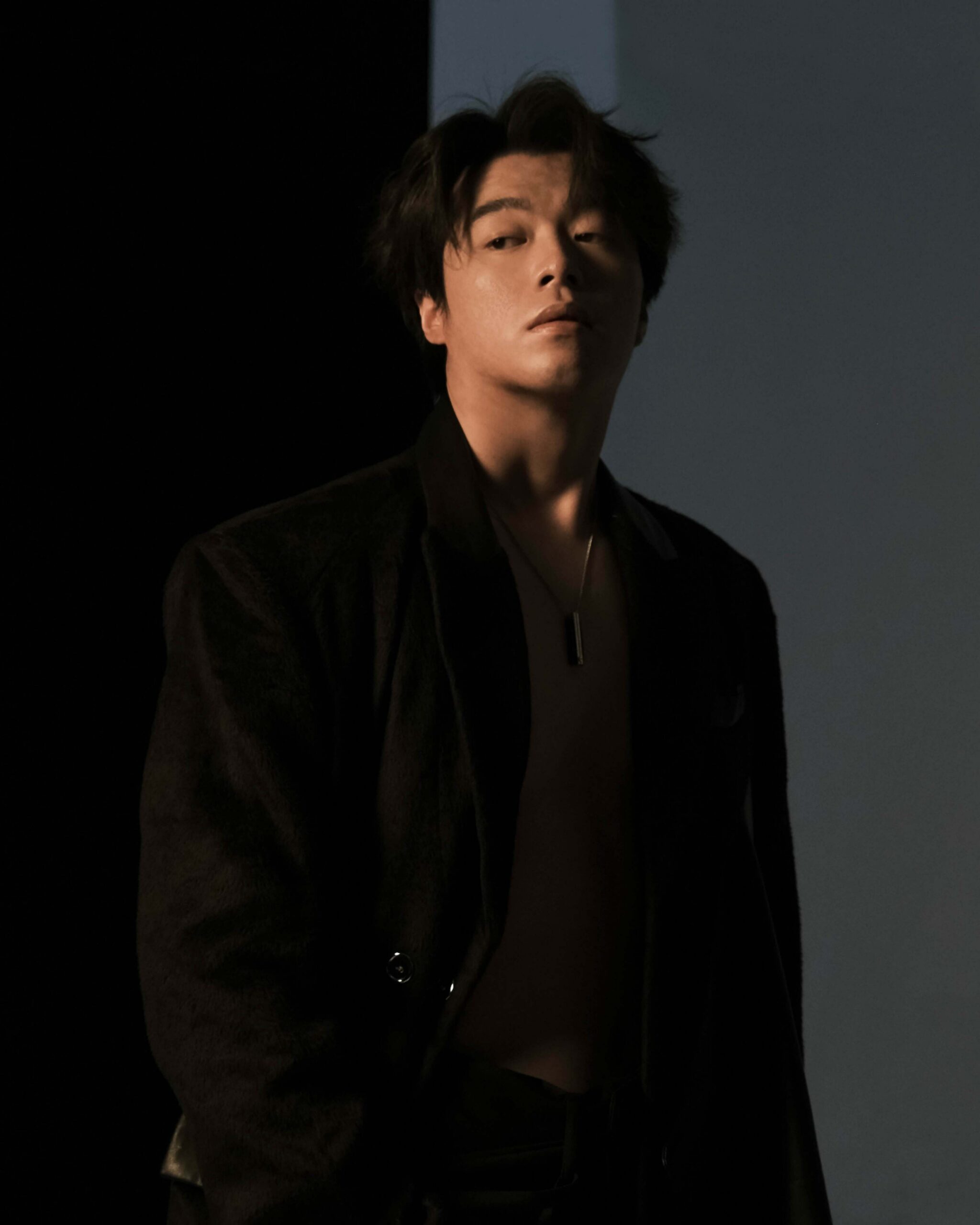
Ash Xu is a digital artist and curator based in London working across BCI (brain-computer interface) art, participatory media and generative environments. His practice operates in tension with the technologies it employs, resisting their use as tools of distance. Instead, they are used to produce something more immediate: something intensely human. In Xu’s projects, they become a medium that reveals how relations already operate.
Technologies often associated with individualisation are reoriented towards reciprocity and shared experience. The individual does not dissolve into the collective, nor does the collective erase the individual; each becomes legible through the other. Xu challenges how relationships are structured in digital environments. Rather than reinforcing divisions — user and interface, observer and object, self and other — his works render these relations as something produced through participation.
The work returns to a central question of contemporary life: how we are with one another in environments that mediate perception, attention and presence, unfolding as a study of shared human conditions.
Relational States
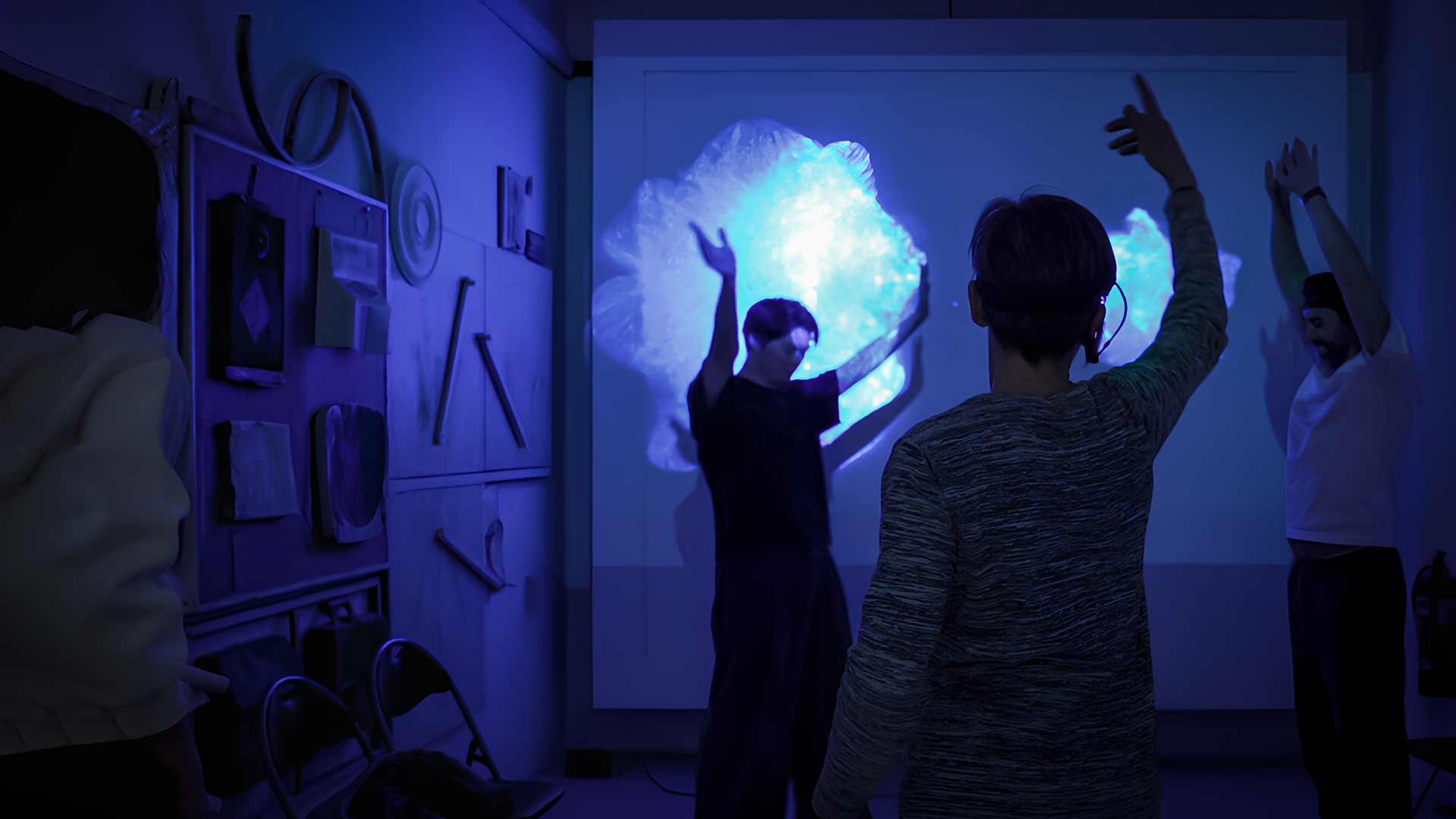
As brainwaves take visual form, meditation shifts from a private act to a shared encounter. What begins as inward attention gradually reveals our capacity to align with one another. Participatory Meditation Lab (2026), a project that was part of The London Group Annual 2026 workshop, uses brain-computer interaction to turn meditation into a collective experience. By bringing into contemporary art Chinese Qigong and Japanese Butoh, alongside seated and other somatic and embodied forms, the work shifts focus away from spectacle toward shared presence. It affirms embodied knowledge and relational awareness as methodologies in their own right, while challenging Western traditions of mind–body dualism and technological rationality through alternative epistemologies.
By bringing into contemporary art Chinese Qigong and Japanese Butoh, alongside seated and other somatic and embodied forms, the work shifts focus away from spectacle toward shared presence.
The mechanics of the work are deceptively simple. Two participants wear EEG headsets as they meditate, with their brainwave activity translated into fields of digital particles projected onto a shared screen. The visualisation externalises a process of mutual alignment: as each participant enters a sustained meditative state, their respective particle fields gradually converge. When both maintain this state, the visual fields coalesce into a shared formation; a digital vortex emerges as an invitation for others to join.

The process extends the encounter beyond a dyadic exchange into an expanding field of participation. Rather than using technology to quantify or individualise, the installation reverses the logic of much digital media by making relational processes perceptible, bringing people together, attending to one another, and cultivating co-presence within what Xu describes as ‘a digitally hyperconnected yet emotionally fragmented society’. In this sense, the Lab resonates with Eastern philosophies that understand subjectivity as arising through interdependence (from Buddhist notions of dependent origination to concepts of qi as a continuous flow between bodies and environments), reframing meditation as a co-experienced state rather than a private psychological one.
Beyond the Default User
Across digital platforms, interfaces are built around an implicitly able-bodied, cognitively normative and economically productive user. Xu interrogates this “default user” as a foundational yet often invisible bias within digital systems. He challenges this assumption by turning to two subjects excluded from computational userhood — the animal and the elderly — not as comparable figures, but as distinct ways of exposing the limits of who technology is designed for.

A Tuber (2025) is a speculative project that imagines a future in which animal life is integrated into media ecologies and asks what it would mean to construct a social media system grounded in animal biological signals in 2065. Lonely Aged Planet (2022) is, on the other hand, situated in the present, responding to conditions in which elderly people in China are increasingly isolated and constrained by expressive channels. Together, they show how “user” is never neutral, but produced through assumptions about cognition, expressivity and legibility — raising questions not only about who is included, but also about what kinds of perception and emotional articulation digital systems are able to register.

In Lonely Aged Planet, this is approached through affective avatars rendered as colour, shape, and diffused form, which decentre linguistic and cognitive primacy by translating emotional states into non-verbal computational aesthetics. A Tuber, by contrast, shifts the method from representation to infrastructural integration. It asks what it means for animal life to be embedded within media systems not as metaphor or content, but as data-generating, responsive agents. This produces a shared informational field in which agency is distributed across species, suggesting a hybrid ecology where biological and artificial intelligences are entangled within the same media space. In doing so, the work tests whether the logic of social media can remain stable once “the user” is no longer exclusively human.
This produces a shared informational field in which agency is distributed across species, suggesting a hybrid ecology where biological and artificial intelligences are entangled within the same media space. In doing so, the work tests whether the logic of social media can remain stable once “the user” is no longer exclusively human.
Although materially and conceptually distinct, read alongside each other, the projects illuminate one another and reveal a contrast between projected interspecies futurity and contemporary human marginalisation.
Collective Field
Cosmic in the Brain (2025) was exhibited across Europe and Asia, for example, at Atom Space in Shenzhen, China, or at the Scottish National Gallery. The project sits within philosophical conceptions of consciousness that resist a strict division between self and universe, instead framing both as interdependent. The idea that the microcosm reflects the macrocosm positions the mind as an echo of a larger order. Xu does not literalise this lineage, but reworks it through generative and brain–computer interfaces, translating metaphysical correspondence into computational form.
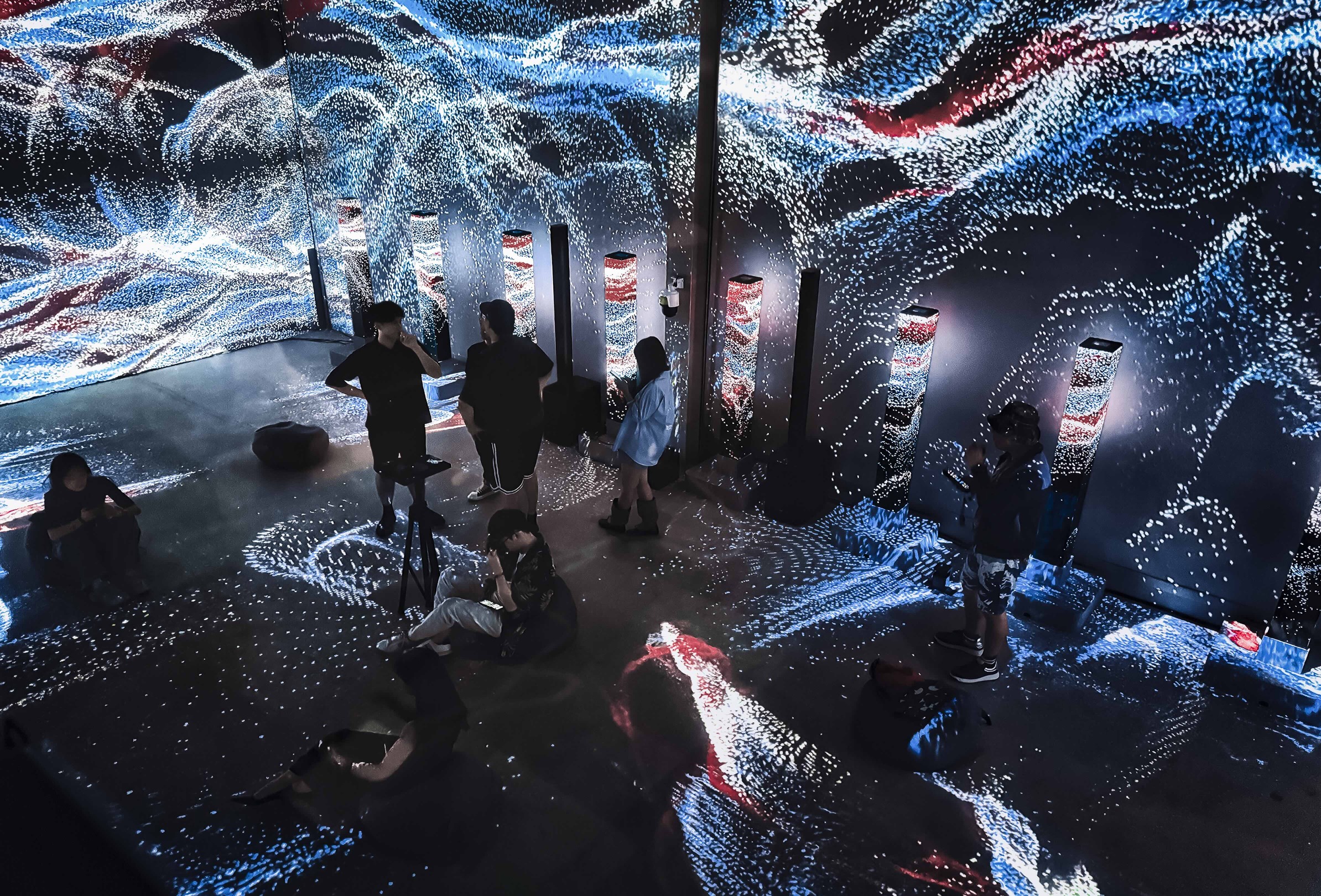
Rather than representing this relation, the work renders it operative. Inner states and cosmic structures are placed within a shared visual logic, where each can be read as a trace of the other. The audience is not positioned as observers, but as the condition of its emergence. The installation exists only through bodily presence and ongoing mental activity, shifting authorship from a singular origin to a distributed field of co-production. Xu establishes a framework within which the work unfolds, while participants inscribe its form through their neurophysiological states.
Participation is therefore reframed not as an isolated expression, but as a shared perceptual field in which collective reality is assembled from the aggregation of interior experience.
With EEG neural sensors placed on the body, the mind is externalised as a fluctuating visual form. Although each trace originates in an individual cognitive stream, these inputs accumulate into a shared, planetary-scale environment. Participation is therefore reframed not as an isolated expression, but as a shared perceptual field in which collective reality is assembled from the aggregation of interior experience.

There is a refreshing discipline to Ash Xu’s practice. While the work moves easily between technological innovation and a philosophical inquiry that spans from the biases of the digital “default user” to the limits of shared human consciousness and interspecies coexistence, Xu maintains a rare equilibrium — ensuring every moving part holds its own weight without crashing into the other. The pivot here is conceptual: instead of allowing brain-computer interfaces to further atomise the individual, Xu reorients them into instruments of profound reciprocity.

His worldview isn’t siloed too; he brings Western computing and Eastern epistemologies together not as opposing forces, but as a single, fluid vocabulary. Physically, the work is an exercise in translation. Xu takes volatile neurophysiological data — something that could easily devolve into visual noise — and tames it into gallery spaces that feel remarkably coherent. Ultimately, his originality lies not simply in his use of the complex interfaces but in his sustained, necessary rethinking of what these technologies can actually be for.

BIO
Ash Xu lives and works in London. He holds a Master’s degree from the Royal College of Art, where his practice was shaped by speculative design and posthuman thought. His work and research have been presented at Milan Design Week, London Design Festival, Berlin Art Week, New York Design Week, Shanghai International Arts Festival and The London Group Annual. His works have also been exhibited at the Scottish National Gallery, CVPR Art Gallery, Copeland Gallery, Theatr Clwyd, Andrea Ingenito Contemporary Art, Tsinghua University, and Shanghai Jiao Tong University, among others.