






Claudia Revidat (b. 1992) is a French photographer and film director based in Paris. She situates her work at an intersection of art and anthropology, combining an experimental creative impulse with a documentary commitment to truth. Over the last ten years, the artist has travelled widely, immersing herself in various communities across Africa, Asia, and South America to capture how locals find strength and solidarity despite – or, indeed, alongside – struggle. Revidat presents a double exposure of pain and persistence, bringing into focus the affective dimension of living in the world’s disprivileged territories.

What underlies Revidat’s practice is a genuine desire to get to know other people and their stories. The artist’s works emerge as a site of connection between the photographer and the subject, unsettling the typical dynamics of portraiture. All throughout, intimate histories mingle with stories of broader groups, unveiling the multifaceted relationships between people, their cultures, and their immediate surroundings. Revidat’s photography is one of extraordinary humanity, capturing the light in the darkness, the personal in the collective – all in the spirit of fostering inclusivity and intercultural understanding.

A Journey Beyond the Personal
Revidat found refuge in photography at an early age – and though it has now been decades since she first picked up a camera to forge personal challenges into art, her present practice still follows that initial, intimate thread. This is not to say that the artist concerns herself purely with private matters; on the contrary, she is deeply committed to illuminating the struggles of others. What interests her is the interaction between individuals and groups. While translating others’ stories to images, she then considers how they might resonate with her own wounds. In her signature commingling of public and personal, the final product of Women of Fire – an ongoing project focusing on Mursi women of Ethiopia – is set to be a book combining photographs and stories of locals with her own travel account.


Such an interaction between individual experience and greater social narrative lies at the very core of Revidat’s work. Attempts to identify one formative moment in her current practice take the artist back to early adulthood, when she embarked on a trip to Mongolia. It was then that she started Youth of Land, a creative celebration of youth across the world. This self-proclaimed “humanitarian and social experiment” spanned multiple years, culminating in a publication, Youth of Mongolia (2022). What started as a private quest for meaning and belonging turned into a public-spirited endeavour, laying a foundation for a body of work that prioritises human connection and solidarity.
On the whole, social consciousness constitutes an important dimension of Revidat’s work. Through her photographs, she wants to encourage understanding towards different cultures; as she remarks in a PhotoVogue interview, “by visually highlighting the voices of the marginalised in this way, I hope to contribute to creating a more inclusive and empathetic world”. In the context of Women of Fire, specifically, the artist is interested in the gendered experience. The project’s very aim, she notes, is raising awareness about everyday challenges women face across various cultural contexts.

A Double Exposure of Pain and Persistence
As Revidat equips her socially sensitive narratives with a personal touch, her portrayals of struggle exist alongside – or even within – images of resilience and community. This merging of different sensibilities is as thematic as formal, most evident in the artist’s use of colour and double exposure.
Drenched in warm hues, Women of Fire presents an overlay of human figures and floral motifs that compel the viewer to consider the lived emotional intricacy behind the stills. Such an added value is both affective and cultural – in Revidat’s work, double exposure likewise serves as a haunting reminder of how violence and oppression prevail despite broader progress. The artist’s use of overlaying images speaks to the complexity of lived experience: the co-existence of violence and resilience, progress and prevailing practices of oppression. Revidat then stays true to her claim that “exploring humanity through photography is about capturing emotional layers that live beneath the surface”.


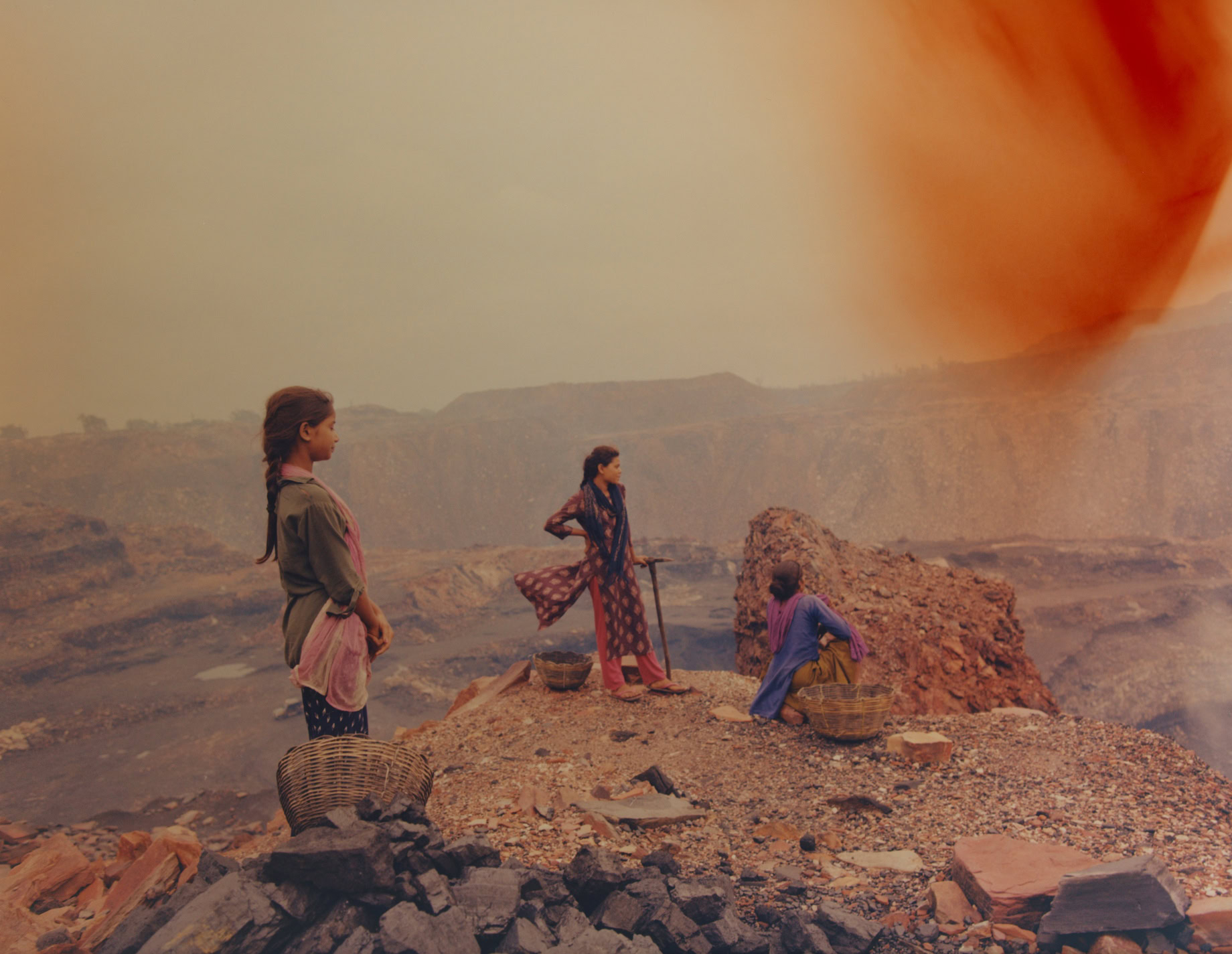
A similar approach permeates Dancing to Resist, a recent project comprising a series of photos and a short film. Supported by Carmencita Film Lab and Kodak, it focuses on young girls in India who find freedom in dance amongst the crude reality of coal mines. Steeped in warm, cosy tones, Revidat’s images juxtapose struggle with images of solidarity. The importance of movement reappears in The Monster of Gazipur – yet another video-image merger, capturing local women against a backdrop of a waste mountain on the outskirts of Delhi. Clad in brightly coloured clothes, they move synchronously in a dance that seems to diffuse the surrounding dullness and disorder.
“Amid the chaos,” says Revidat in the film’s narration, “they revealed to me a powerful sisterhood, transforming survival into resistance.” Here, formal measures once again underscore thematic juxtapositions. A tension is present not merely in the artist’s merging of order and chaos, slow environmental violence and joyous moments of conviviality – but also in the temporospatial disjoint that comes from the video’s use of non-diegetic sound. As the viewer hears Revidat’s muffled voice from off-screen, they are prompted to consider the co-existence of different planes of existence, and, with them, different emotional realities.
Similarly, in From Dusk Till Dawn (2024), affective marriages see their reflection in formal juxtapositions. The project has Revidat turn her lens to the salt mines of Uganda’s Lake Katwe, seeking to capture the struggle as well as the collective strength among its workers. There, the photographer intermingles documentary realism with symbolic vision, speaking to the inherent tensions of the lived experience, the invisible marks of a life sustained and maimed by salt. The artist’s works, regardless of the technical means, always present a double exposure of affect; they focus on the light that endures within the darkness, the poetry within the everyday, as well as mundane cruelty, the darkness in the light.
Revidat studied Photography at École de Condé, an applied arts college in Paris. She has extended her education at École du Louvre, where she pursued a course in Art History. She is active beyond documentary photography, working with top brands and publications like i-D, Vogue Italia, Dior, Chanel, and Armani.

Her works have been acclaimed across different competitions and festivals. The From Dusk Till Dawn project received the Prix du Public (Audience Award) at 2025’s Rencontres Photographiques Boulogne-Billancourt. The artist was a finalist of Belfast Photofestival (2024), The Farago Projects Prize for Emerging Talents (2023), Prix Picto de la Mode (2023) and, most recently, the 5th Edition of Les Rencontres de la Photographie in Marrakech.
The Monster of Ghazipur is presented for the first time, exclusively by Contemporary Lynx.


