






Éva Szombat (b. 1987, Kaposvár, Hungary) is a Budapest-based photographer whose work revolves around happiness – a subject which, despite its frequent flattening by the mainstream discourse, she pursues with intent. A lover of all things kitsch, she infuses scenes of joy with glitz and glamour, producing dreamlike images that evoke as much happiness as they look good.

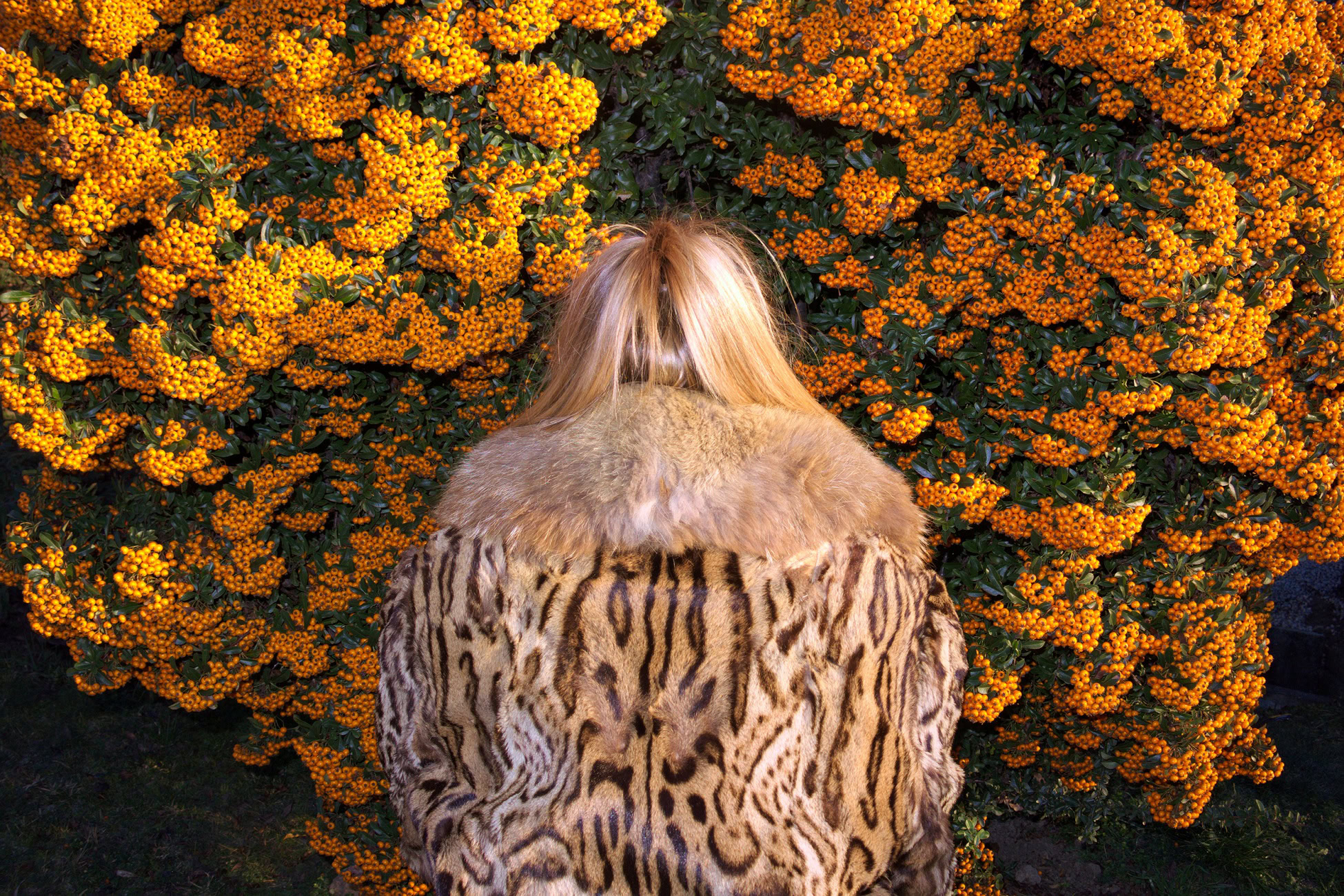
“Being entertaining and thrilling is always the main focus for me”, Szombat says, and the (at times guilty-) pleasure of looking is never in doubt. Her photographs are lush with visual richness, thanks to elaborate, bombastic mise-en-scènes, fabulous costumes, and shimmering light accents. Kitsch plays a central role, not ironically, but as a sensory conduit, bypassing intellectual and moral judgment and directing perception straight to sensation. Though carefully staged, the images never feel artificial. The sets function as self-contained microcosms, suspending the outside world and allowing subjects to inhabit emotion fully. In Szombat’s work, camp sensibilities emerge through the artist’s eye, turning everyday gestures into performance – a reminder that happiness is not simply acquired, but actively practised.

In Drain Me, kitsch turns from playful excess to a vehicle for grotesque juxtapositions. Mosquitos recur – dead and glittering under disco-ball lighting, or trapped in resin with star-shaped sparkles: “death in glamour”. A woman’s backside bears traces of life’s irritations, from swollen insect bites to small imperfections, heightened against colour lights. A torn vertical slit of orange‑pink netting (echoing the colours of the lesbian flag) evokes the abjection inherent in the body. Phantom-shaped statues and blank-eyed figures suggest decay and mortality. Yet even here, beauty persists: neon-pink mosquitoes hover against a night indigo sky, fleeting and mesmerising, reminding us that life and death, pleasure and imperfection, are cyclical – themes that run throughout Szombat’s work.
“Life is not so terrible”
Beneath the glitter, each project is grounded in social examination: a persistent interest in how people carve out happiness within the constraints of their circumstances. According to the latest IPSOS Happiness Index, only 45% of Hungarians (like Szombat herself and many of her subjects) report feeling happy, compared with an average of 71% across 30 countries. Rather than dwelling on dissatisfaction or despair, Szombat turns her attention to those who manage, against this backdrop, to simply feel good, although in a conversation with Contemporary Lynx, she once admitted showing Hungary as a happy place wasn’t an easy task. “My mission is to make people realise that life is not so terrible”, she explains. “And if it is, that terribleness can be overcome”.

This ethos finds its expression in the Happiness Book (2014) and Practitioners (2016) series, though neither project resembles a self-help manual, nor do they trade in platitudes. Szombat resists comparison, careful not to elevate her subjects into symbols of resilience or reduce them to objects of “inspiration porn”. Instead, the portraits attend to the practical, often precarious ways people sustain a sense of wellbeing – through significant transformations, such as gender-affirming procedures, or through modest, everyday pleasures, like collecting frog-themed items. Joy appears here not as a triumphant endpoint but as a practice: fragile, uneven, and deeply personal, and it is precisely this ordinariness that gives the work its emotional proximity.

Democratising Pleasure
If happiness sits at the core of Szombat’s practice, pleasure emerges as its more radical counterpart. I Want Orgasms, Not Roses (2017–2022) depicts women both in the comfort of their inhabited spaces and in staged scenarios: posing with sex toys, resting, pregnant, clothed or nude. Together, the images form a study of inhabiting a female body without guilt, articulated through the female gaze. Accompanying texts trace trauma, discovery, and unlearning, rooting the work in lived realities rather than fantasy or provocation. Sensuality is present but resists pornography, insisting on intimacy, vulnerability, and self-possession. In a cultural context where sexual shame lingers – particularly in Eastern Europe – Szombat foregrounds desire as profoundly human.

A related feminist thread runs through Beyond the Curve (2017), where body image and self-acceptance take centre stage. The title’s play on “behind the curve” positions the work against conventional depictions of the female nude while acknowledging the misogyny still shaping public discourse on women’s bodies. Yet Szombat’s images are not antagonistic to women who engage with those conventions on their own terms. Kitsch becomes a useful strategy here: her photographs operate on their own aesthetic logic, resisting comparison with visual economies like Playboy.

Modern Medicine
Szombat’s studies of happiness neatly fold into an obsession with nostalgia – a desire to return to moments softened and mythologised by memory. Echo in Delirium (2017-2024) is a collection of photographs taken with analogue cameras from the 1990s, lending the images their characteristic grainy texture and high-contrast, saturated colour palette. These formal cues signal the past, yet contemporary self-awareness enters through the deliberate performance of “vintage-ness”. Szombat’s models wear nostalgia: exaggerated, kitsch stylisations that position them closer to costume than fashion. This heightened artificiality aligns the figures with relics of a past we now find faintly ridiculous – objects such as Furbys or troll dolls – which appear as subjects in their own right, gazing into the lens in intimate close-up portraits.

Nostalgia, Szombat suggests, is a kind of madness: a force that distorts reality through the rose-coloured lens of memory and the illusion of the “good old days”, offering escapism from the pressures of the present. Yet, modernity quietly intrudes upon these scenes through a gaze that fetishises what was once mundane; it is this intrusion that produces the work’s central tension, revealing an ever-cyclical logic, a nostalgia within nostalgia. What appears modern here is already destined to become outdated, and nothing, least of all sentiment, is safe from sliding into kitsch.

Éva Szombat holds a Master’s degree in Photography from the Moholy-Nagy University of Art and Design (MOME). She is currently a PhD candidate and works as an assistant lecturer and supervisor at the university’s Department of Photography. Her work has been exhibited internationally, including nine solo exhibitions. In 2021, her series I Want Orgasms, Not Roses was awarded the Robert Capa Grand Prize, and in 2023, it was a joint winner of the Belfast Photo Festival PhotoBook Award. While Echo In Delirium was shortlisted for the Rencontres d’Arles Book Awards and Paris Photo – Aperture PhotoBook Awards. She is represented by Longtermhandstand.


