Ivy Chilelli (b. 1997) is an Italian multimedia artist based in Milan. Their body of work resists both time and space – it cannot be placed on a timeline or pinned to a specific geographic location. Chlielli’s multifaceted approach moves fluidly from painting to sculpture to installation, giving rise to hybrid organisms that echo cyborgs, beings that are at once animal and machine, organic and engineered. Their art unsettles bodily perceptions, pushing us to imagine new futures and recognise that we, as subjects, are constantly changing.

Born in Rome, Chilelli earned a BA in Painting and an MFA in Sculpture from the Brera Academy of Fine Arts in Milan. Their artistic career began with painting. Eventually, their practice evolved from a traditional two-dimensional approach and transitioned to sculpture. Chilelli’s love of three-dimensional objects was largely inspired by the Wunderkammer (German for “cabinet of wonders” or “cabinet of curiosities”), referring to the collection of rare, unusual, and fascinating objects from around the world by intellectuals.

From painting to sculpture
Chilelli’s sculptures look as if they’ve arrived from another planet, an uncanny world that is ambiguously natural and artificial. The boundaries between human, animal, and machine have been subverted and morphed into one. Built from resin, clay, iron, and plants, their pieces often resemble living organisms caught mid-mutation: a chrysalis cracking open, a body forming from roots, or an object that feels at once familiar, yet totally alien. “When I’m sculpting, I am not only depicting a situation, I am shaping it. It becomes a gestation, a process in which chemistry plays a huge role, in which materials become hidden parts or visible elements, and they change constantly”, they state when describing their relationship with sculpture.
Queerness is at the heart of Chilelli’s practice. As a non-binary artist, they frame their work as a counter-normative reimagining of bodies and alliances – plural, symbiotic, and resistant to fixed categories. They draw inspiration from the cooperative worlds of fungi, octopuses, and siphonophores, where survival depends on connection and coexistence rather than self-autonomy. “Being a non-binary person myself, I’ve learned the importance of having support and community, but also the importance of having quiet moments of tranquillity that I can use to take care of my needs”.

Queerness, kinship, and collective survival
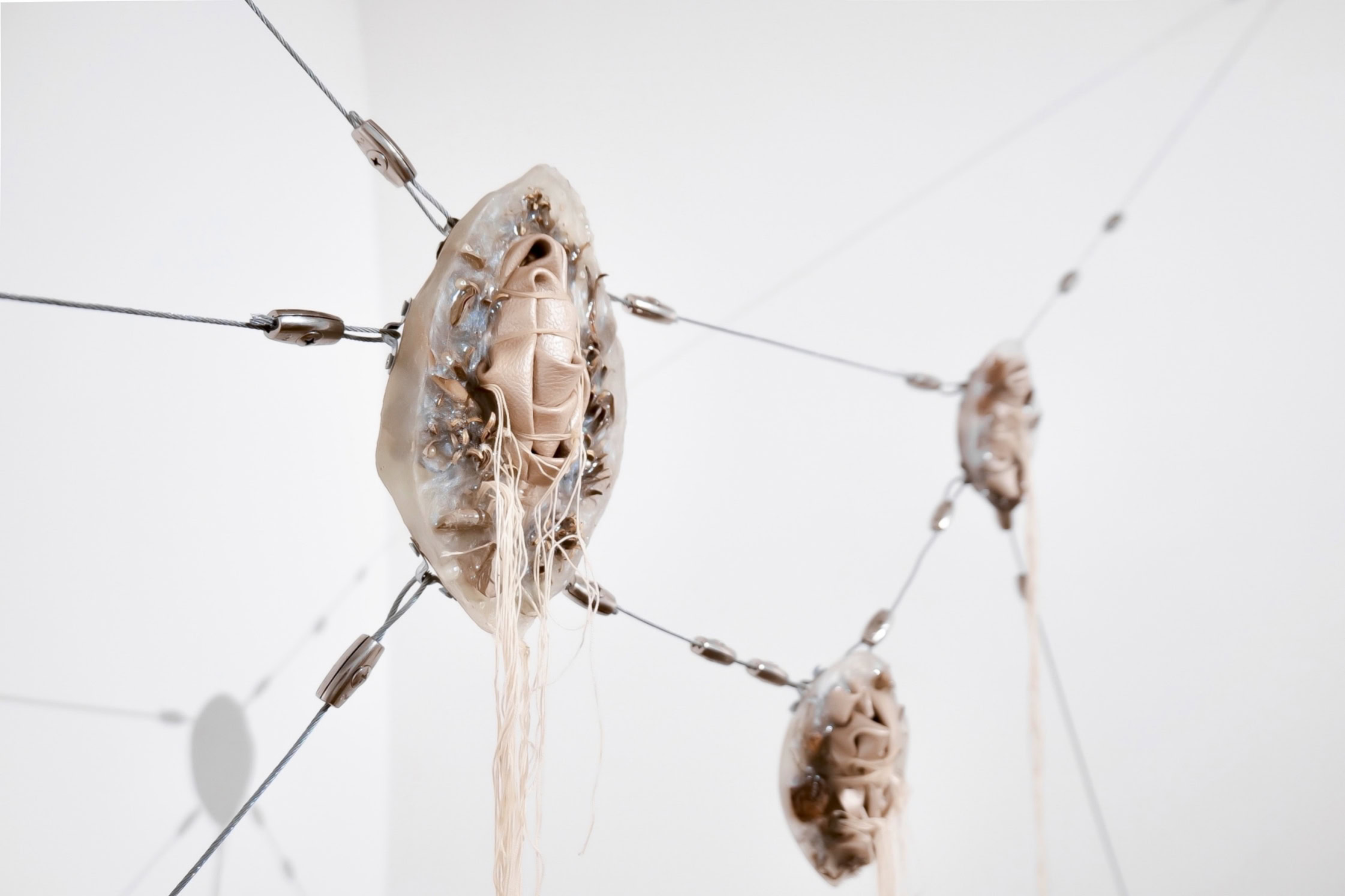
Chilelli’s work Kin Omnia (2023) is dedicated to the profound connections that are formed between vulnerable creatures and communities in order to survive and create a safe space. “As queer people, we are aware of the importance of creating such spaces to live better, together”, they explain. Kin Omnia consists of seven chrysalis-like resin eggs linked together by an ecological network that resembles natural structures, such as fungi and synapses. The installation reflects Chilelli’s belief in “making kin”, a concept borrowed from the feminist theorist Donna Haraway, where family is not genetic but chosen, fluid, and sustained by care. The work reflects on the importance of alliances, asking when we should turn toward others and when it is necessary to turn inward.

The word “hybrid” often comes up in conversations about Chilelli’s work. While the artist is fascinated with human transformation and the word hybrid, they worry that the term oversimplifies their aims. For Chilelli, hybrid forms are not just about taking two things and putting them together. When reflecting on the term, they state, “More than hybridisation, I think what we need is an implosion, an emerging of something different”. To express this idea, Chilelli composed a work titled HYPHA, partly inspired by the means by which fungi silently communicate through electrical signals beneath the earth – sharing information that helps them survive and sustains the wider ecosystem.

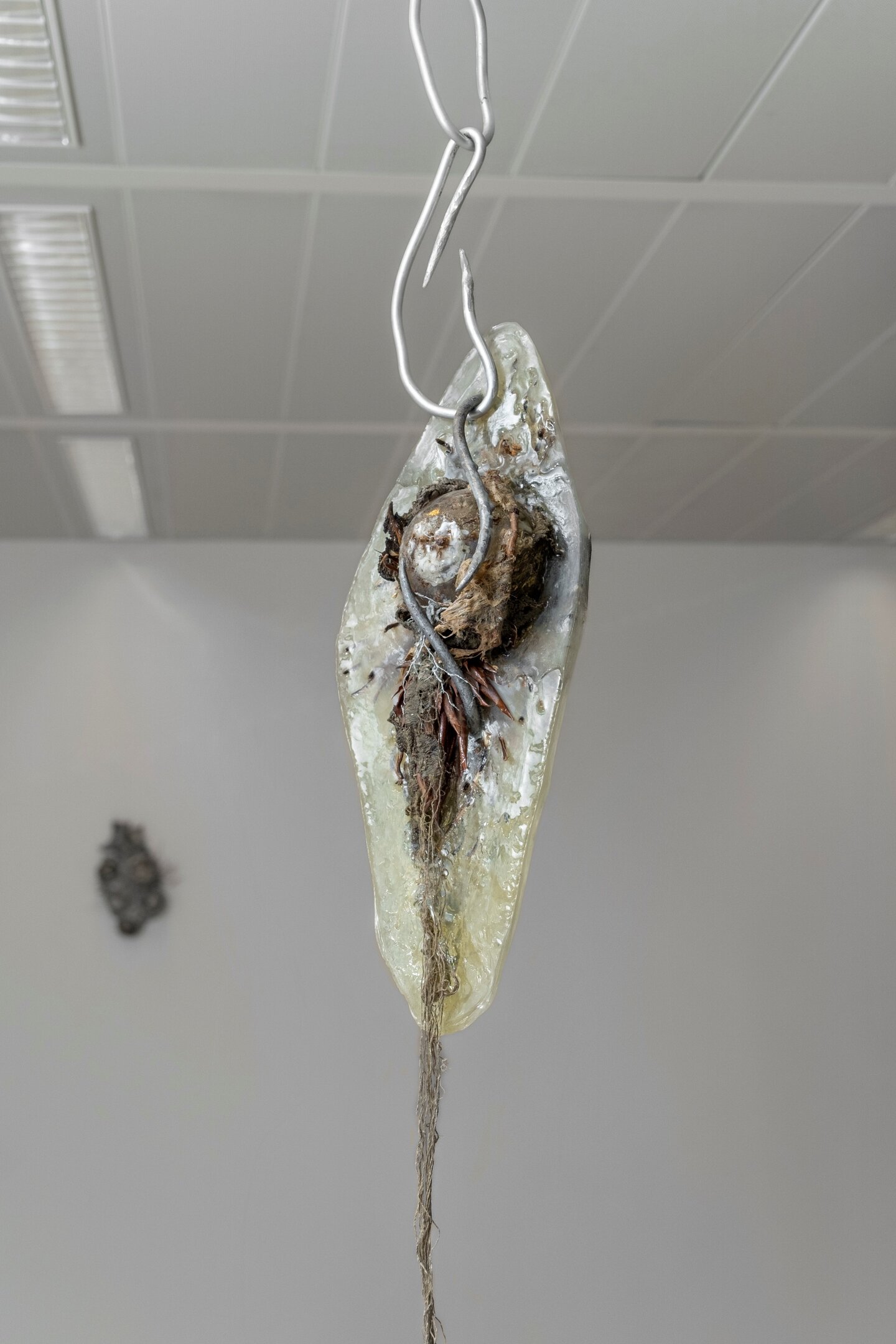
Many of these, the artist’s sculptures, are preserved in resin, a material that for Chilelli symbolises both protection and potential. Chilelli treats resin as a shell for vulnerable beings, a quiet space of care and compassion where transformation can occur. This delicate balance between dependency and strength is evident in Unknown Den (2023), an installation consisting of a group of sculptures surrounded and connected by moss and vegetation. The setting resembles a hidden den of large chrysalises, forming a shared ecosystem where all the elements blend together. One of the sculptures, Cicada (2023), is composed of flowers, fabric, and porcupine quills—juxtaposing the delicate with the dangerous. The installation is driven by the need for new narratives that can hold the many interwoven stories of life.

Messengers of other worlds
At first glance, Chilelli’s sculptures can seem utterly foreign, like strange creatures that resist easy description and conventional language. They are at once a social reality and a science fiction. This vision of a post-gender, post-human, collective body continues to evolve in their practice. As Chilelli puts it, “It becomes impossible to tell what’s outside and inside. Or to separate humans from non-human life”. In works like Cicada, Arborea (2023), and Serafini (2023), resin no longer simply protects but becomes generative – maternal forms giving rise to ecosystems and multi-faced messengers. These sculptures transform exhibition spaces into what Chilelli calls “secret gardens for the monster’s future promises”, places where queer, hybrid bodies can flourish.

In Chilelli’s world, monsters are not to be feared but embraced. Similar to Susan Stryker’s reclaiming of Frankenstein’s creature, Chilelli sees the “monstrous” as a sign of revelation, a herald of other possible worlds. Their work seeks to subvert the narrative of monsters, a word whose etymology stems from the Latin word monstrum, meaning “divine prodigy”, and the verb monere, meaning “to warn”. “Being queer, non binary, intersex is being a monster: messengers of other possible worlds”, Filo Sottile, an Italian trans writer, says in her book La Mostruositrans (2020) – a quote particularly close to Chilelli’s heart. It asserts that being a monster is about courage and freedom to self-identify.
Anti-heroes and overlooked protagonists are at the heart of Chilelli’s practice: monsters as guides, mutation as survival, the body as a site of endless becoming. By holding fragility and strength in the same hand, materials that both protect and transform, they invite us into a future that looks less like final resolution and more like a process of becoming. By turning toward the delicate and the monstrous – not to shame, but to celebrate – Chilelli shows us that transformation is a mode of survival. Their sculptures propose novel methods of coexistence and encourage viewers to consider new ways of living. In their words, “The future is not waiting for us anymore, we have to fight for it”. Chielli’s work challenges us to consider what kind of future is worth fighting for – and whether we’re willing to imagine one built on collective care.