

Justyna Smoleń (b. 1988) is a Polish artist who works with methods rooted in traditional craft techniques, weaving together feminist critique, ecocriticism and commentary on the capitalist and increasingly nationalistic structures that govern the world. She moves between painting and sculpture, objects and large-scale installations, but what stands at the core of her artistic practice is the ceramic collage — a technique she has been exploring in her work since 2018, when she first stumbled across a box full of childhood memories in the form of collectable porcelain figurines.

Smoleń’s practice relies on the never-ending processes of collecting and reforming that which she finds. What originated in the attic of her childhood house has gradually expanded into a nationwide — both digital and in-person — search for the remnants of mass-produced ceramic and porcelain objects. She finds all the necessary materials by rummaging through flea markets and yard sales, scouting landfills and resale portals.
Through this practice of gathering discarded everyday objects, she extracts the hidden narratives embedded within them, while reflecting on how these objects have shaped and continue to shape our collective imagination.
Through this practice of gathering discarded everyday objects, she extracts the hidden narratives embedded within them, while reflecting on how these objects have shaped and continue to shape our collective imagination. She subjects established cultural codes to critical analysis, transforming them through subtle yet precise and carefully considered interventions in the source material. This results in works resembling dreamlike formations — reinterpreting mythological creatures and reconstructing popular cultural narratives.

Broken Reflections, Broken Beliefs
Smoleń’s practice is based on combining the process of collecting and transforming discarded objects with reintegrating them into the art circuit through the deconstruction of both form and meaning. The artist intertwines these actions with traditional craft and artistic techniques, subjecting materials to simultaneous formal and semantic transformation.

This transformative process is where the collage arises from, embodying a set of dichotomies as it balances between destruction and creation, the past and the present, fragility and unbounded power — to change, to become, to imagine alternative realities. Smoleń reuses ceramic fragments or smashes porcelain figurines to bits herself to obtain the exact pieces she desires, and puts them back together in astonishing combinations. What emerges are intimidating hybrid beings that threaten the established order of the world.

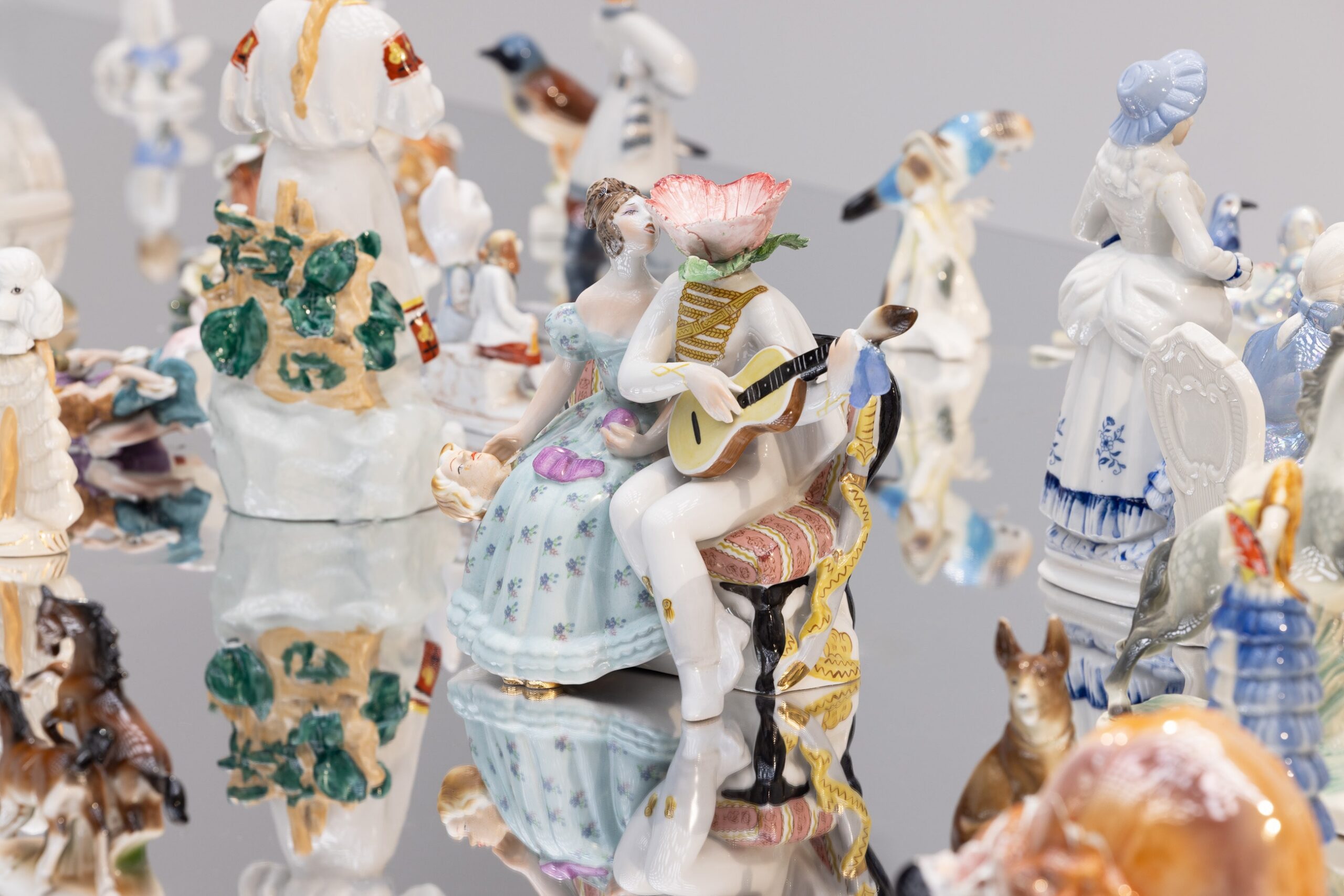
This approach first materialised through humorous interventions into individual ceramic objects, which evolved into hybrid beings that gather together around the eponymous Table (2021-2025). Set atop a reflective glass surface, the installation is a collection of reformed ceramic fragments found by Smoleń in her home province of Małopolska in the south of Poland. The transformed figures are met with their own reflections in the mirrored surface of the table, which encapsulates the clash between the real and the imagined, the actual and the desired.

These early interventions reveal a broader interest in the narratives embedded in everyday objects. The artist is most fascinated by the deep-seated assumptions about the world they perpetuate, moving from owner to owner until they end up just one figurative fish in the vast sea of waste, as society moves on to other, more relevant myths and beliefs. Entering into dialogue with Poland’s long-standing tradition of ceramic-making — which emerged in the 18th century and experienced a significant boom under communism, when Poles used porcelain decorations to assert their social positions and manifest prosperous futures — Smoleń’s practice deliberately questions the unrealistic aspirations or motifs that such figurines represented.
Imbuing traditional objects with new meanings, she gives new life to the unwanted, commenting on the oversaturation and overconsumption that dominate social and material relations, and push us to discard things in the blink of an eye in the search for better, nicer, newer alternatives. By placing such objects at the centre of her artistic practice, Smoleń reclaims and reimagines their lost meanings. In the process, she recognises and emphasises the concessions demanded by any kind of transformation — the destruction that is a necessary stepping stone on the way to rebuilding. Symbolically, her work thus circles back to the post-communist transformation, whose uncomfortable reality Polish people tried to soften by telling themselves stories of progress and prosperity, captured in porcelain figures that they, ironically, slowly abandoned as the new order took over.
Imbuing traditional objects with new meanings, she gives new life to the unwanted, commenting on the oversaturation and overconsumption that dominate social and material relations, and push us to discard things in the blink of an eye in the search for better, nicer, newer alternatives.
Hybrid Beings and Fragile Realities
Smoleń takes certain representations of the world — such as stereotypical, idealised images of women, patriarchal and heteronormative societal conventions, or the normalised mistreatment of animals — and remoulds them to create alternative ways of knowing and seeing. This results in a set of figurines such as Fall (2020), House (2021), Couple (2020) and Blue Tit (2021), which reimagine various aspects of the world through feminist and ecocritical perspectives. Seemingly merely ridiculous in form, upon closer inspection they offer a pointed critique of the pressure to fit in and become something, the complexities of modern romance and the cruelty towards animals that often goes unpunished.

In the series Hybrids, the artist advances to bigger spatial forms, building her collages from ceramic dishes, shells and conches, and porcelain pieces. Inspired by the world around her — nature, culture, history, human and more-than-human dependencies — she creates visual retellings of stories we know and admire, addressing questions of love, sentimentalism or consumptionism.
Inspired by the world around her — nature, culture, history, human and more-than-human dependencies — she creates visual retellings of stories we know and admire, addressing questions of love, sentimentalism or consumptionism.
Diana (2025) gracefully runs alongside a beautiful dog, her upper body shielded by a massive shell, perhaps aiming to elicit associations with the Roman goddess of the hunt and nature. Fall in Love (2022) — a vase filled to the brim with porcelain fragments that burst out of it, trickling to the ground — captures the uncontrollable overflow of emotion that tends to accompany the eponymous process. Shell (2025) amalgamates a thousand broken ceramic pieces, forming a mismatched but undeniably beautiful conch-shaped mosaic that reiterates the transformative potential of the discarded. Hybrid (2021), in turn, seems to represent the larger-than-world interspecies entanglements.

Conveying these underlying meanings through apt titles, the series — similarly to the rest of Smoleń’s work — relies on symbolic and material deconstruction, unravelling and reforming meanings, looking for novel representations and, most importantly, poking at the status quo.

Set in Stone?
In yet another collection of works, Lava, Smoleń departs from her previous preoccupations, entering the mythical realm of forest creatures: mushrooms and mosses, polypores and tree bark, dwarves, miners and outlaws. Another important conceptual component of Smoleń’s work shines through in this series — her fascination with national and folk narratives.

The pieces — such as Tree Fungus III (2023), which merges several dwarves with tree growth, transforming them into one with bark — rely on deep, dark, earthy tones that evoke unease and, at the same time, reflect humans’ inescapable connection to nature. Smoleń welcomes mythical creators, seamlessly incorporating them into her reimaginations of the world. The titular lava envelops these folktales and traditions, at once signalling the destruction of the old meaning-making systems and revealing their inescapable, foundational traces in contemporary Polish culture.

Her incessant exploration of hybrid forms and dialogue between folklore and geology continues with spectacular, colossal installations such as Mace (2024). Echoing the themes present throughout the Lava series, the sculpture refers to a stone formation found in one of Poland’s landscape parks — Hercules’ Club in the Ojcowski National Park.
After all, everything comes down to nature, which has existed long before humans and will continue to do so after we are gone.
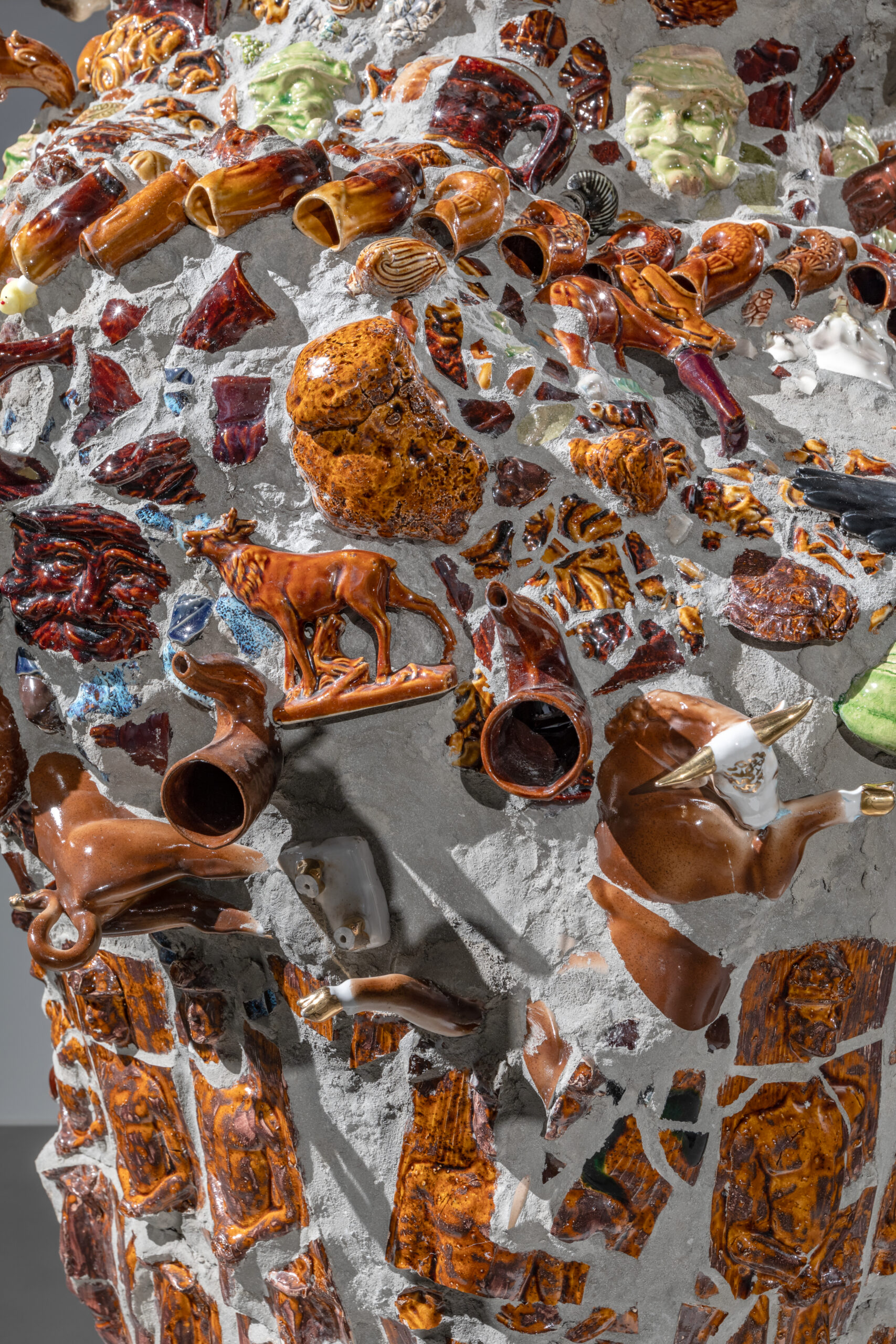
The sculpture, referencing a rock formation with a phallic shape, evokes symbols of male dominance. Elements such as ceramic imprints of mushrooms, stoneware hunting trophies, ceramic mugs, commemorative vessels, porcelain eagles in flight, and stags during the rut, embedded within the concrete structure of the object, become representations of patriarchal culture. The artist questions power relations embedded within, blurring the lines between nature and culture, the organic and the man-made. With that, Smoleń underlines the power of transformation, the fleetingness of societal norms and all that we deem permanent. After all, everything comes down to nature, which has existed long before humans and will continue to do so after we are gone.

BIO
Justyna Smoleń was born in Nowy Sącz, Poland, and now resides in Kraków. She graduated from the Faculty of Painting in the Kraków Academy of Fine Arts in 2013. She holds a doctorate from the Faculty of Art of the Kraków Pedagogical University in 2018. Together with Radek Szlęzak, she runs the artist-run space Rooter in Kraków. Her work can be found in many private collections worldwide and in the collections of various state museums, such as the MOCAK Museum of Contemporary Art in Kraków and the Bunkier Sztuki Gallery. She has been part of numerous solo and group exhibitions, both in Poland and abroad. Several series of Smoleń’s work were recently brought together in an exhibition titled Fragile Dreams, on display at the Bunkier Sztuki Gallery of Contemporary Art in Kraków in 2025.