






Mateusz Szczypiński (b. 1984) is a Kraków-based painter and collage artist whose work explores how images from art history, printed media, and popular culture continue to shape contemporary visual imagination. Drawing on archival photography, canonical artworks, and vernacular visual materials, he constructs layered compositions that function both as narrative scenes and reflections on the afterlives of images.

Working primarily through painting and collage, Szczypiński assembles fragments sourced from newspapers, postcards, printed reproductions of artworks, and other found materials. These elements are recomposed into images that initially appear cohesive but gradually reveal their composite structure. Historical references collide with contemporary visual languages, producing scenes that feel both recognisable and strangely displaced. When combining fragments from different visual traditions, he deliberately places them in new contexts so that “the painting is at the same time something known and unknown” (as he expressed in an interview with Contemporary Lynx back in 2013), creating a productive tension between familiarity and reinterpretation.


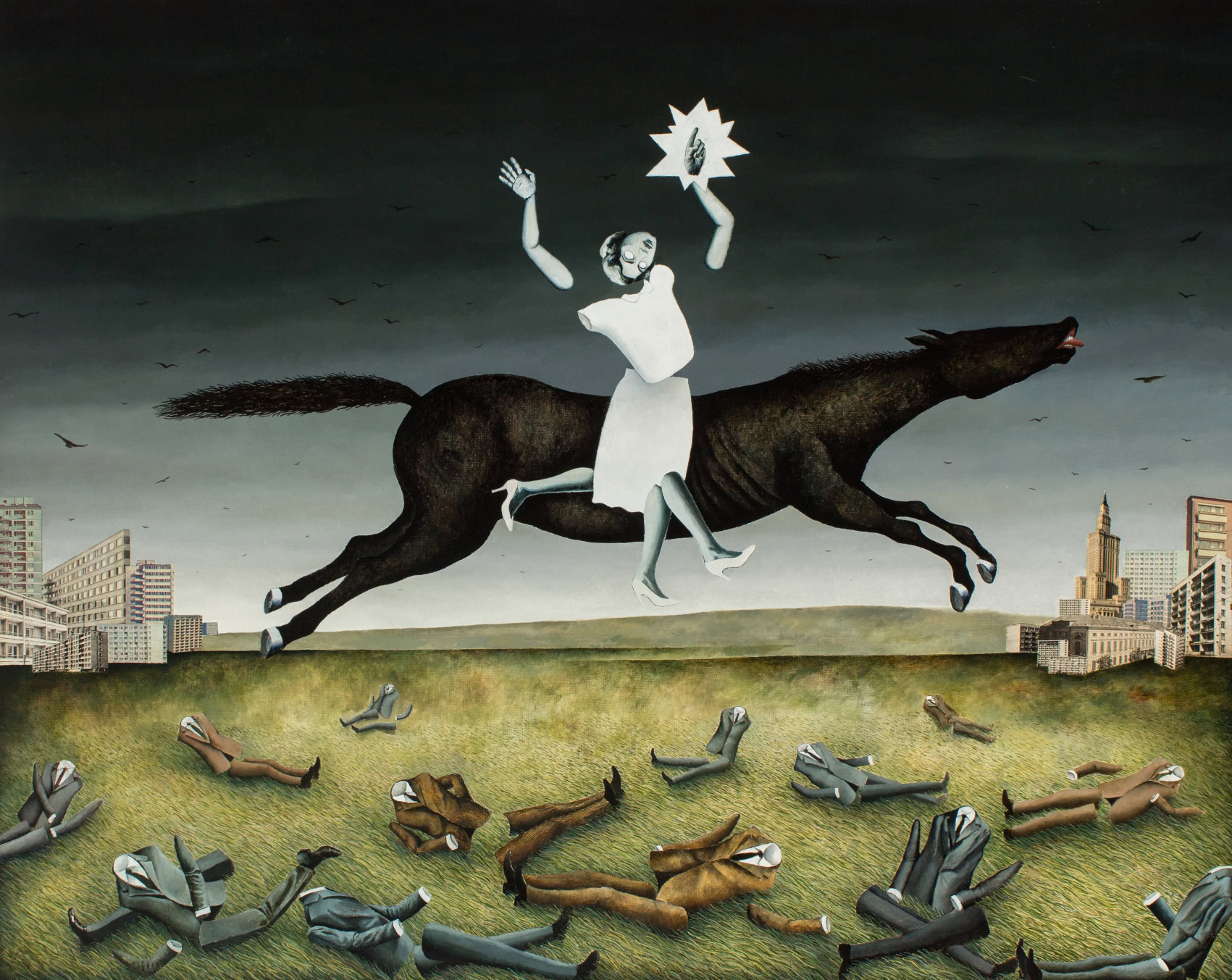
Rather than treating the archive of art history as fixed or authoritative, Szczypiński approaches it as a reservoir of forms that can be rearranged and reinterpreted. His practice, therefore, operates between analysis and invention, using painting as a means of examining how historical imagery continues to circulate within contemporary visual culture.
Utopia and the Mechanics of Repetition
In the cycle Utopia, Mateusz Szczypiński develops a critical reflection on the city as a metaphor for contemporary society shaped by the language of progress, rationality, and order. Rather than affirming these ideals, his works expose their instability, presenting a world in which the promises of development and security begin to fracture. The city appears as a distorted, dystopian structure – less a functional system than a fragile construct that reveals its own contradictions.

At the core of the series lies a tension between modernist visions of organisation and their lived consequences. Szczypiński shows how narratives of progress operate as surfaces that conceal deeper, persistent patterns: tribal mentalities, superstition, and mechanisms of control that continue to structure social life. In this sense, modernity loses its emancipatory potential and becomes a façade – an aesthetic and ideological layer masking more primitive and repetitive modes of behaviour.
The figures inhabiting these compositions are stripped of individuality, often rendered as anonymous participants in a larger system. They appear caught in cyclical, ritualised actions, suggesting a society governed less by conscious agency than by repetition. The city itself takes on a quasi-organic character, functioning like a self-regulating organism that absorbs its inhabitants and dictates their roles. Through this imagery, Szczypiński constructs a vision of collective life as mechanical, controlled, and ultimately self-perpetuating.


An important aspect of the series is the use of collage, drawing on printed materials from the 1960s and 1970s. These images, simultaneously outdated and recognisable, emphasise the continuity of visual and ideological forms across time. By recontextualising them, the artist points to the recurring nature of utopian narratives and how contemporary systems replicate earlier structures. Utopia thus emerges not as a proposal for an alternative future but as a critical portrait of a world caught in a loop, where the language of progress obscures the repetition of the same historical patterns.

Witch Hunt and the Persistence of Ritual
While Utopia examines the structures of contemporary society, the later series Witch Hunt turns toward the symbolic mechanisms through which societies generate fear, stigma, and exclusion. It explores the persistence of superstition and magical thinking within cultures that otherwise present themselves as rational and progressive.

Works such as Valkyries (2023), Tarot Cards Empress (2022), Hangman (2021), and Old Wives Summer II (2024) reference European art history with imagery taken from newspapers and contemporary visual culture. Figures reminiscent of allegorical painting appear alongside anonymous silhouettes dressed in suits, forming scenes that resemble surreal theatrical stages. Within these compositions, witches without eyes, mythological heroines, and spectral bodies coexist with modern characters whose identities remain deliberately obscured.

The visual language of the series draws on compositions associated with artists such as Pieter Bruegel the Elder, John Everett Millais, or Marc Chagall. Yet these references are fragmented and recombined into ambiguous narratives. Through this interplay of visual traditions, Szczypiński collapses temporal distance, suggesting that the symbolic mechanisms underlying historical persecutions continue to resonate in contemporary societies. As the artist has observed in his reflections on the project, modern culture often preserves atavistic reactions and mechanisms of exclusion beneath the surface of rational discourse, a tension that the works in the Witch Hunt explore through surreal and layered imagery.

Herbarium and the Intimate Archive
In contrast to the dystopian tone of the previous cycles, the more recent series Herbarium introduces a quieter and more introspective dimension to Szczypiński’s practice. Inspired by the structure of botanical collections, the project approaches memory as something that can be gathered and preserved – much like plants pressed between the pages of a herbarium.
Flying Lessons (2025), Szmaterlok (2025), Eastern Dreams (2024), and Silesian Empress (2026), to name just a few, present dreamlike landscapes in which human figures appear interwoven with vegetal forms. The imagery adopts a more fluid and lyrical visual language, balancing elements of surreal narrative with the atmosphere of magical realism.

Women occupy a central position within many of these compositions, appearing as figures connected to cycles of growth, decay, and transformation. In these works, the human body merges visually with the surrounding landscape, suggesting a symbolic relationship between identity, memory, and place. The herbarium functions here as a metaphorical archive where traces of lived experience are preserved. Just as botanical specimens record fleeting moments within the life of a plant, these works operate as visual containers for emotions, memories, and relationships.
Images After Images
Across these distinct cycles, Szczypiński repeatedly returns to the question of how images persist and transform across time. By assembling fragments drawn from art history, popular culture, and archival print media, he constructs compositions that reflect the layered nature of cultural memory.

His works suggest that the present is never entirely detached from the past; rather, it is composed of visual residues inherited from earlier representations. Collage becomes both an artistic strategy and a metaphor for this process, revealing how familiar forms are constantly recycled and reinterpreted. Through this method, Szczypiński’s paintings expose the instability of narratives that promise progress, rationality, or permanence while acknowledging the enduring power of images to connect different historical moments within a shared visual language.

Mateusz Szczypiński studied History of Art at the Jagiellonian University and painting at the Academy of Fine Arts in Kraków, completing his diploma in 2012. His academic grounding in art history continues to inform his practice, especially in the way he incorporates historical imagery and popular visual culture into his work. Over the past decade, he has presented solo exhibitions in Warsaw, Kraków, Stuttgart, and Ludinghausen, and his work has featured in group shows at institutions such as MOCAK – Museum of Contemporary Art in Kraków and the National Museum in Gdańsk. His paintings and collages are held in private and institutional collections internationally, and he participated in the 2025 Nostalgia. Poszukiwacze gasnących gwiazd exhibition at MOCAK. He is represented by lokal_30 gallery.


