



Ruofan Chen (b. 1996) is a Hubei-born artist whose practice engages slow, chronic forms of harm – invisible forces that quietly accumulate within bodies and environments, where body and the Earth become alike. Her work draws the viewer in through a quiet yet compelling sensibility that awakens curiosity toward what is so often overlooked. She attends to subtle emotional undercurrents, phenomena, residue, texture, and sensory moments. There is a softness and delicacy in her approach, yet beneath it lies a profound depth of thought, observation, and research.

Chen begins with embodied perception, where breath, skin, and nerves register environmental erosion. She examines the fragile connections between body and its surroundings, memory and technology. Across sculpture, installation, video, and material experimentation, Chen transforms simple, almost imperceptible experiences into multimedia reflections, revealing how the most evident and familiar aspects of life can also be the most difficult to perceive. Her works feel distinctly contemporary while carrying a silent, tangible sensitivity.
Her work draws the viewer in through a quiet yet compelling sensibility that awakens curiosity toward what is so often overlooked. She attends to subtle emotional undercurrents, phenomena, residue, texture, and sensory moments.
Affective Hybridity
In Warm Tree (2021), Chen examines the limits of memorisation and documentation and tries to overcome them by creating, what she calls, “a botanic embodiment of my feeling to my beloved dog”. Chen uses a Chinese wisteria branch as the base and covers it with mohair and her dog’s actual fur. The materials evoke the softness of a living body. She then renders the physical object into a 3D model and animates it, giving it the sense of movement as if the fibres flow in the wind. You want to touch and feel the branch; it appears strangely alive.

The digital model constitutes an extension of the physical object — they are in constant dialogue. In Warm Tree, Chen displays a series of contradictions: between virtual and real, timeless and tangible, eternal and ephemeral, movement and stillness, or technology and nature. Yet it is the personal dimension of the work that resonates most profoundly. A cherished being is translated into a speculative hybrid entity: part memory, part simulation. The boundaries between organic life, rendering animation, and emotional projection are deliberately blurred.

That sense of warmth carries into another work. While visually parallel and perhaps evocative of similar emotions from a distance, it emerges from a very different observation. Solace in the Bench (2024) reimagines a typical roadside dining-stall seat, frequently used by Wuhan labourers. Its wooden surface is not inviting or restful, but shaped by function and repetition. The salvaged stools are covered in hair, holding traces of bodily warmth and the heat of shared meals. In doing so, the work reflects on the politics of care and attention by foregrounding the bodily traces embedded within ordinary objects.
A cherished being is translated into a speculative hybrid entity: part memory, part simulation. The boundaries between organic life, rendering animation, and emotional projection are deliberately blurred.
The Ecology of the Imperceptible
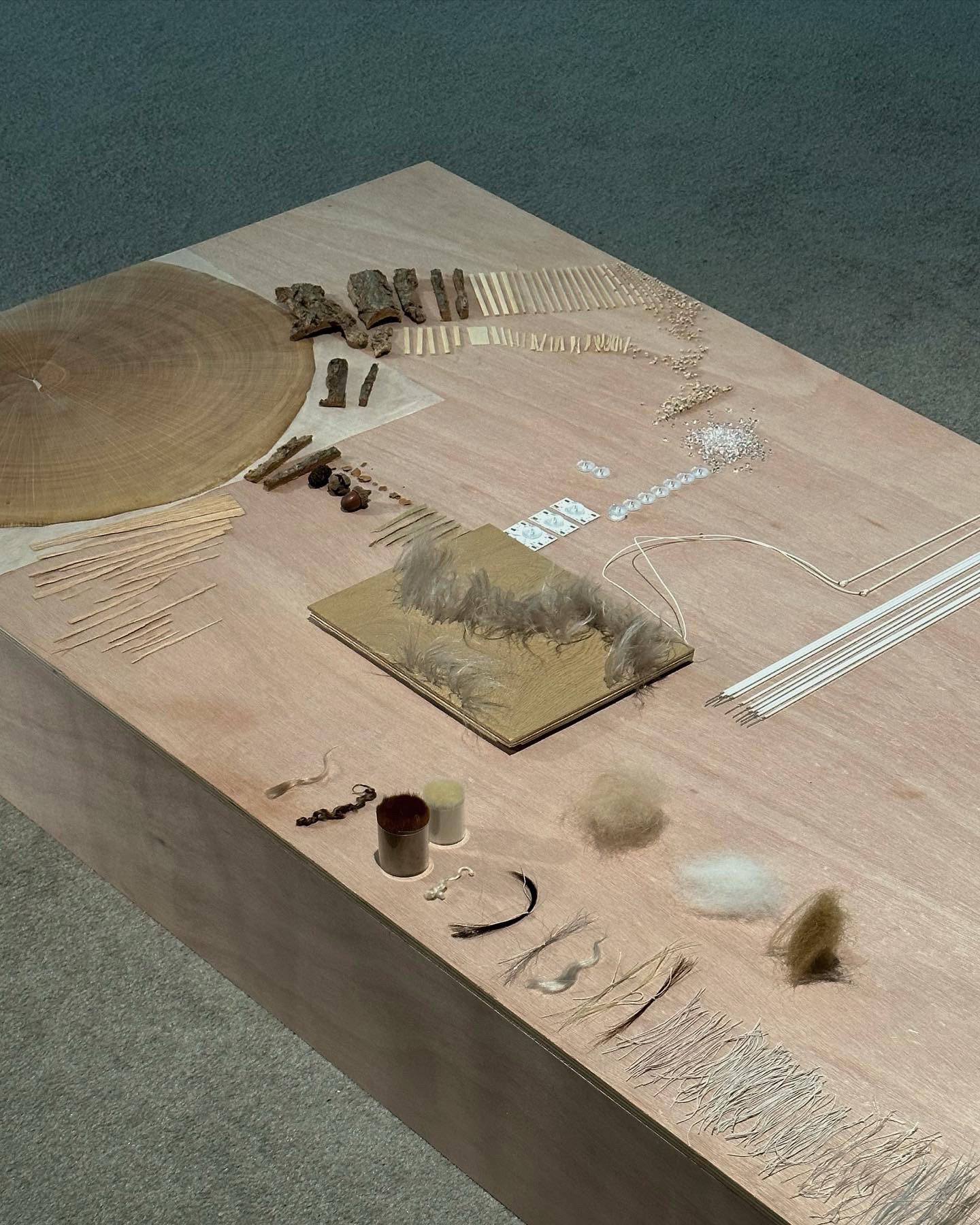
Wuhan reappears across Chen’s practice as a site through which the questions of labour, exposure, and care are further examined — from the social spaces of rest to the material conditions that structure everyday survival. Dust, as both material trace and metaphysical residue, has long been associated with entropy, memory, and the fragile persistence of presence. Across avant-garde and contemporary practices alike, it functions as a register of time acting upon matter; accumulation becomes a form of narration. Within this trajectory, Chen grounds dust in the lived realities of industrial production of a furniture factory on the outskirts of Wuhan.


Observed in sunlight, dust can appear almost beautiful, yet illumination ultimately renders its dense material reality. In Dust (2025), Chen speaks to these dualities of visibility and concealment. The dust traces exhaustion; it settles gradually into both space and body, operating as a metaphor for chronic conditions. This is paralleled in Chen’s grandmother, who suffered a stroke as a result of silent arterial blockages. Destruction here unfolds through unseen processes in which body and planet mirror one another.

What emerges is an ecology of the imperceptible: particles, conditions, and forms of violence that remain suspended just beyond immediate recognition. The dust is weightless and luminous before the viewer grasps what is being seen and what it signifies. That moment of delayed recognition becomes central. Beauty functions not as relief, but as a mechanism that draws us closer to the very conditions we might otherwise overlook. It exposes the instability of perception itself: what remains unseen is often already inhabiting us.


Change as a Condition
Chen’s sustained engagement with chronic forms of harm extends into other works, including a piece that begins with the absence of ice as a condition reshaping Earth’s and human ecologies. It begins in Fleinvær, north of the Arctic Circle, presented not as a remote exterior but as an active site where collective futures are being formed, both immediate and distant. She doesn’t address the climate crisis through spectacle, but turns to its quieter registers. Within contemporary ecological art histories concerned with refuge and vulnerable environments, a lineage emerges in which material fragility and atmospheric intensity become ways of thinking through instability.

Shelter (2024) reflects this precarity and the search for forms of refuge. Marked by a rare attentiveness to how the environment is perceived and recorded, Chen’s practice extends into processes of transcription and translation. In her residency journal, weather and mood are rendered as variables for software simulations of wind, light, turbulence, and sea state, while emotion itself becomes a meteorological force. Painting the island with a silver needle pen and allowing it to oxidise in its own air, she lets the place inscribe itself into the work, so that sensation is atmospherically carried, returned, and transformed through material trace.
Refuge is not monumental but delicate; the shelter becomes an extension of the body, a soft boundary against force. Even the fine gravel and dust she describes as slow, almost imperceptible intrusions, mirroring broader ecological conditions that are easy to overlook precisely because they are not immediately catastrophic.
Refuge is not monumental but delicate; the shelter becomes an extension of the body, a soft boundary against force. Even the fine gravel and dust she describes as slow, almost imperceptible intrusions, mirroring broader ecological conditions that are easy to overlook precisely because they are not immediately catastrophic. In this way, Chen’s work attends to a fragile continuity between environment and perception, where softness and attentiveness become modes of survival as much as forms of making.

BIO
Ruofan Chen was born in Hubei Province in China, and currently lives and works in Shanghai. She holds an MFA from the Royal College of Art and a BFA from the School of Visual Arts. She had solo exhibitions in China and the UK, and was a part of group exhibitions in the USA and Europe. Chen received the “ranran” Young Artist Prize by UCCA x XINTIANDI in Shanghai in 2023, and was shortlisted for both the Royal Academy Summer Exhibition and New Contemporaries in London. Ruofan’s latest projects include: Stay Connected: Supplying the Globe at Tai Kwun, Hong Kong; and The 15th Shanghai Biennale Does the flower hear the bee?, at the Power Station of Art.