






Soli Kiani (b. 1981) is an Iranian-born, Vienna-based artist who incessantly pokes at the power imbalance inherent to oppressive political regimes, devoting special attention to the one in her homeland. Emerging from the second generation of feminist art, Kiani’s multidisciplinary practice is rooted in her own background, but its aim is, first and foremost, to encapsulate the collective experiences of thousands of Iranian people.
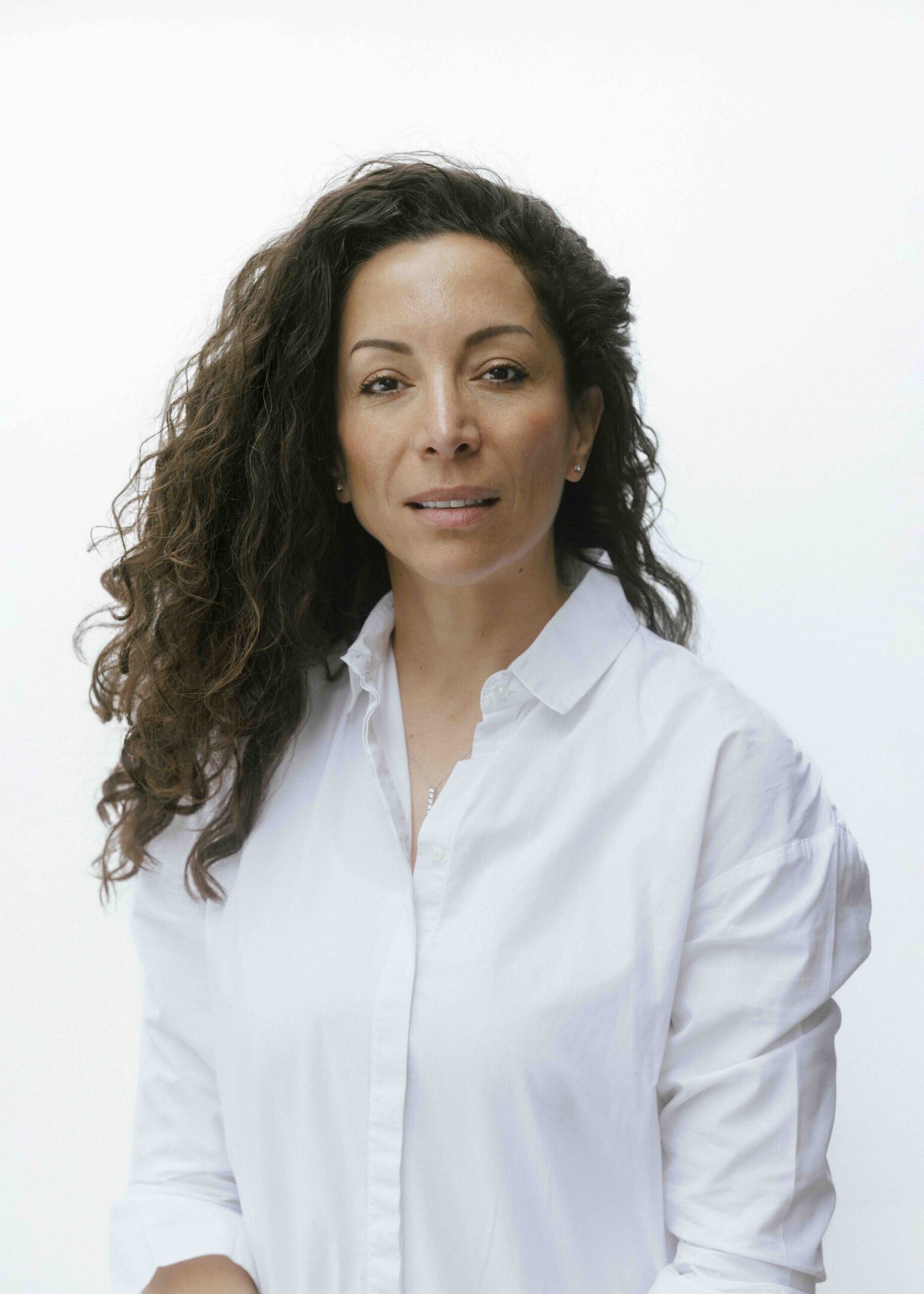
The artist’s socio-critical commentary manifests itself through pieces that tangibly evoke the raw feelings and sensations they are meant to capture. Moving between installations, objects, photography and painting, she creates powerful expressions of the loss of control and freedom that so many experience. By bringing audiences closer to conditions of life that they often find unfamiliar, she forces Western society to at last turn its eye to the injustices of the surrounding world. Kiani undermines the seemingly inevitable, pushes at the limits of what’s deemed acceptable and creates resistance in form, material and content.
By bringing audiences closer to conditions of life that they often find unfamiliar, she forces Western society to at last turn its eye to the injustices of the surrounding world.
Perpetually Breathless
Despite having moved to Vienna over two decades ago, Kiani’s coming of age in Iran echoes loudly in her work. Armed with intimate knowledge of the violations of human, and particularly women’s, rights in Iran, she conveys a vocal political stance with all her pieces. This stance, however, is surprisingly subtle – one has to know what to look for in order to find it. And yet, once they are made aware of the political subtext underlying Kiani’s artistic legacy, it is impossible to miss.
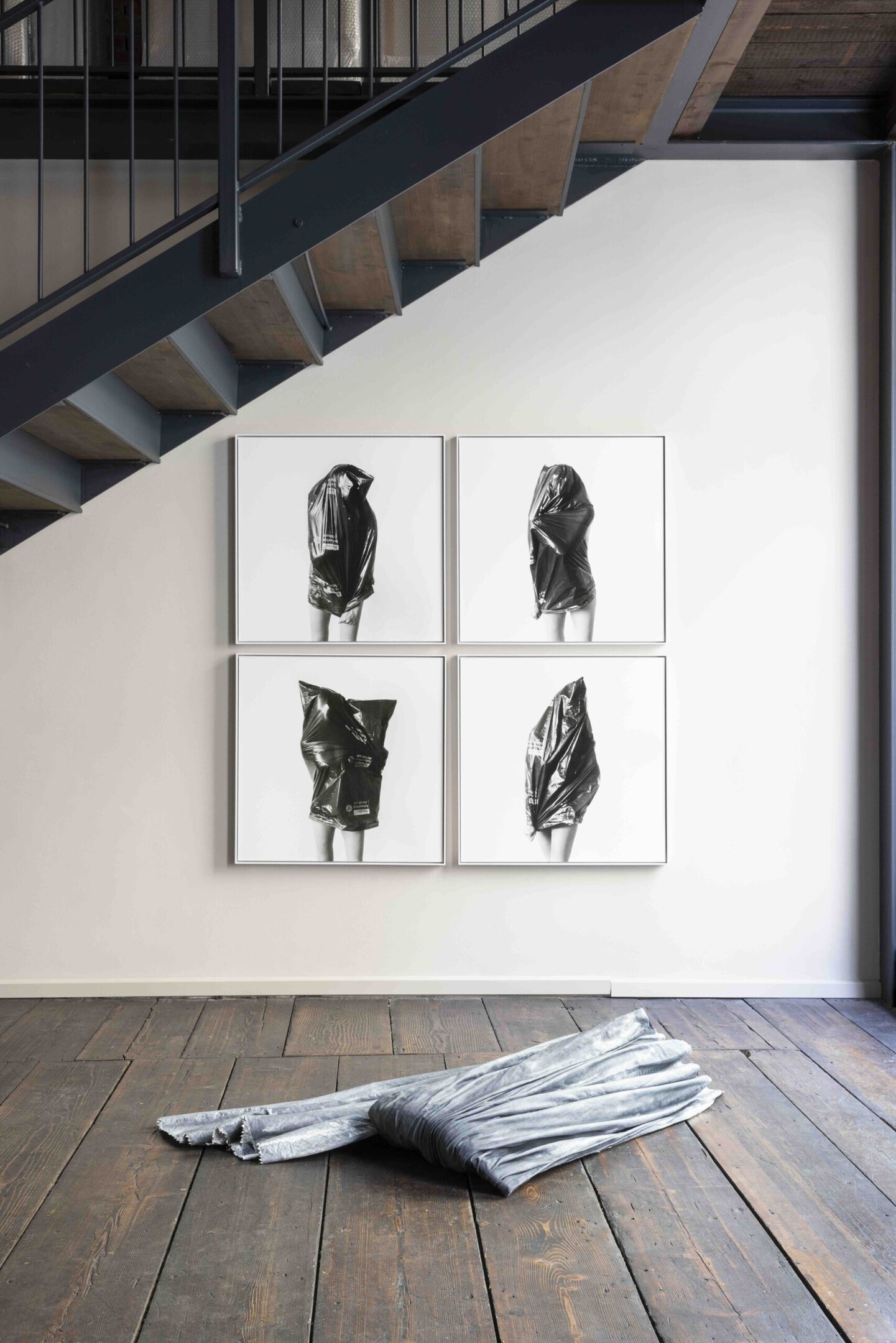
In a series of black-and-white photographs, Breathe (2020-25), a woman pushes and pulls at the rubbish bag she is trapped in. No matter how much force she puts into the fight, the plastic doesn’t give, but rather keeps stretching, wraps itself around the woman’s body, paralyses her movements and renders her helpless. The restrictive material references the chador – the full-body black garment women must wear under Sharia law. The photos, only strengthened by the series’ title, liken the restrictions put on women by Islamic law to the state of being trapped, feeling breathless and unable to escape a situation that may very well end in a tragedy.
The analogous series Stuck In (2023-24) is a collection of photographs depicting a man similarly enclosed in a trash bag. He is sitting down, seemingly resigned to his state. He does not try to fight it, but instead curves his body into a fetal position, with his head bent down, his feet peeking out under the edge of the bag, and his hands clasped together, as if in a silent prayer. By capturing a male model in the photographs, Kiani reflects on the effects of the regime on the entire population of Iran, including men who have increasingly protested the authorities’ treatment of women. Just like the woman in Breathe, the man is stuck in a terrifying reality that offers no way out.
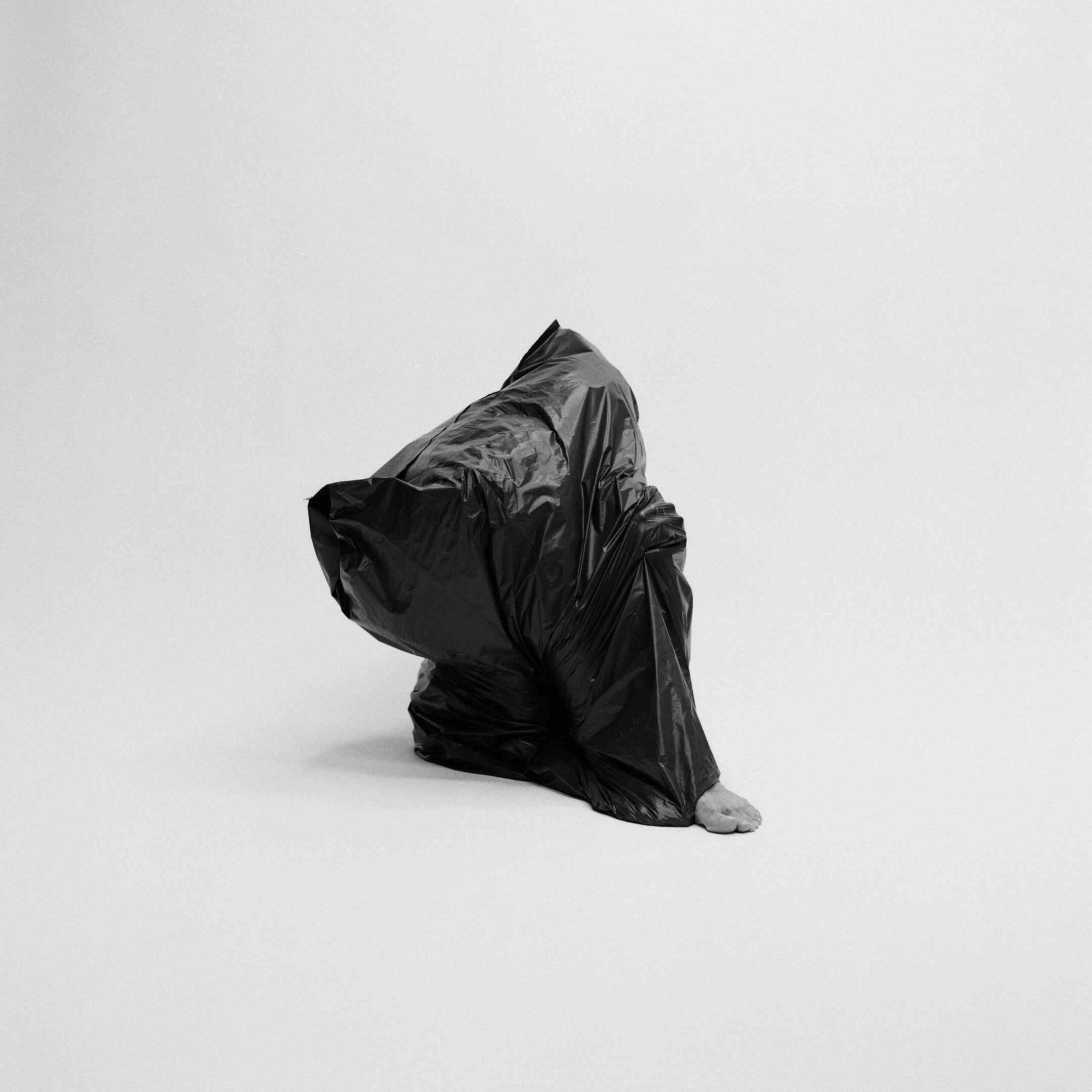
Born right after the Iranian Revolution, Kiani photographed models who, similarly to her, do not know the Iran of before. Having grown up in this reality, they might not realise the full extent of what they have been deprived of – yet, the sense of loss and restraint is so overwhelming that it completely envelopes them. It manifests itself on several – implicit and explicit – levels in both photographic series. In her artistic practice, Kiani takes conscious steps to counteract it. For instance, when displayed, the photographs are not kept behind glass, so as not to create yet another barrier between Iranians and the world outside of it, the world that lies beyond restrictive norms.
The Human Beneath the Veil
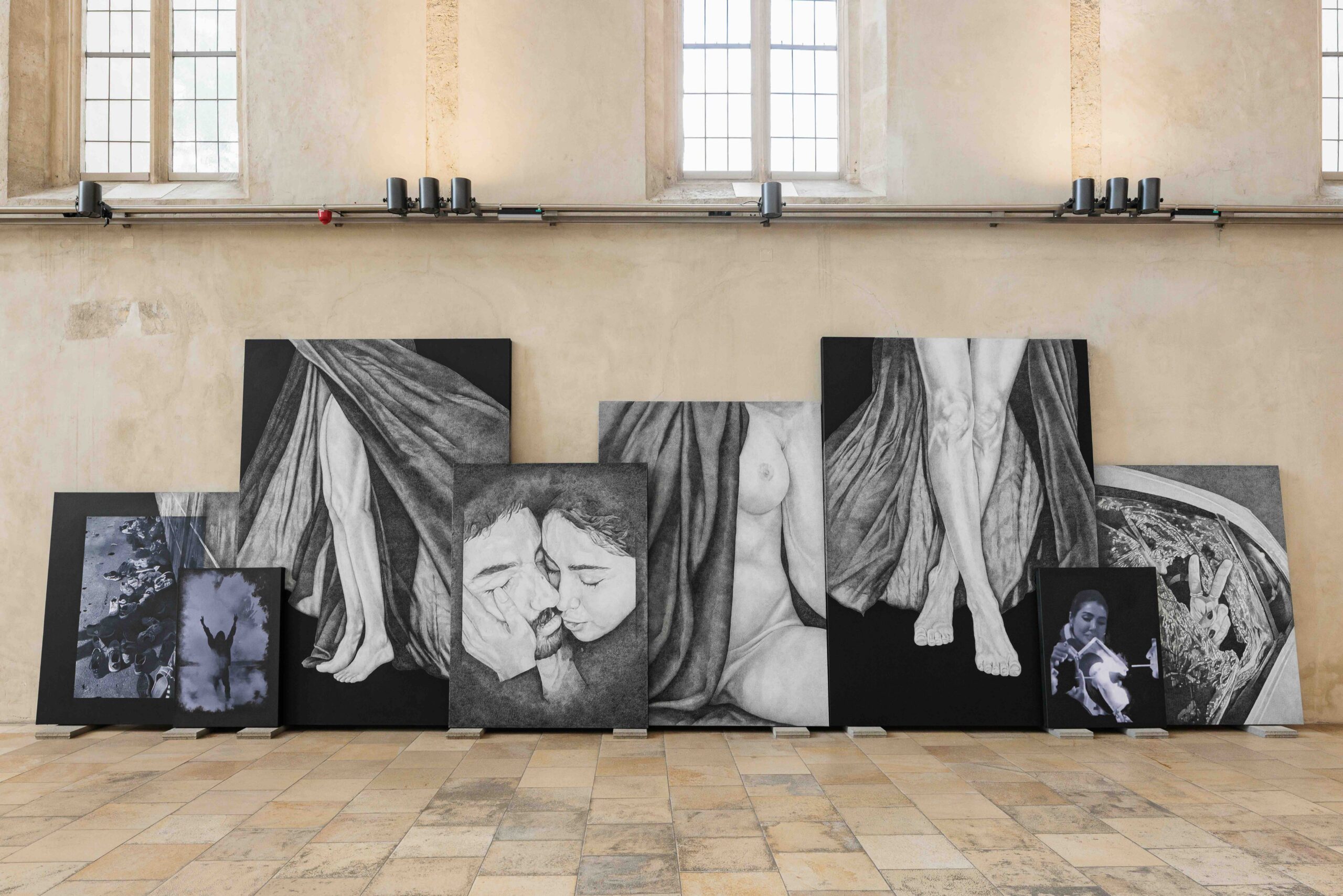
Kiani’s work around strict Islamic gendered dress codes also finds an outlet in her fascination with fabric, used both as the material and the object of her artistic explorations. In Crease (2024), a series of drawings depicting folds of an unidentified material, she explores the properties of fabric, documenting how it flows when captured on canvas. In Hope Moves History Towards Freedom (2025-26), a more recent collection of drawings and paintings based on images taken during protests happening in Iran over the past five years, the artist goes beyond just examining textiles by weaving human subjects into her pieces.
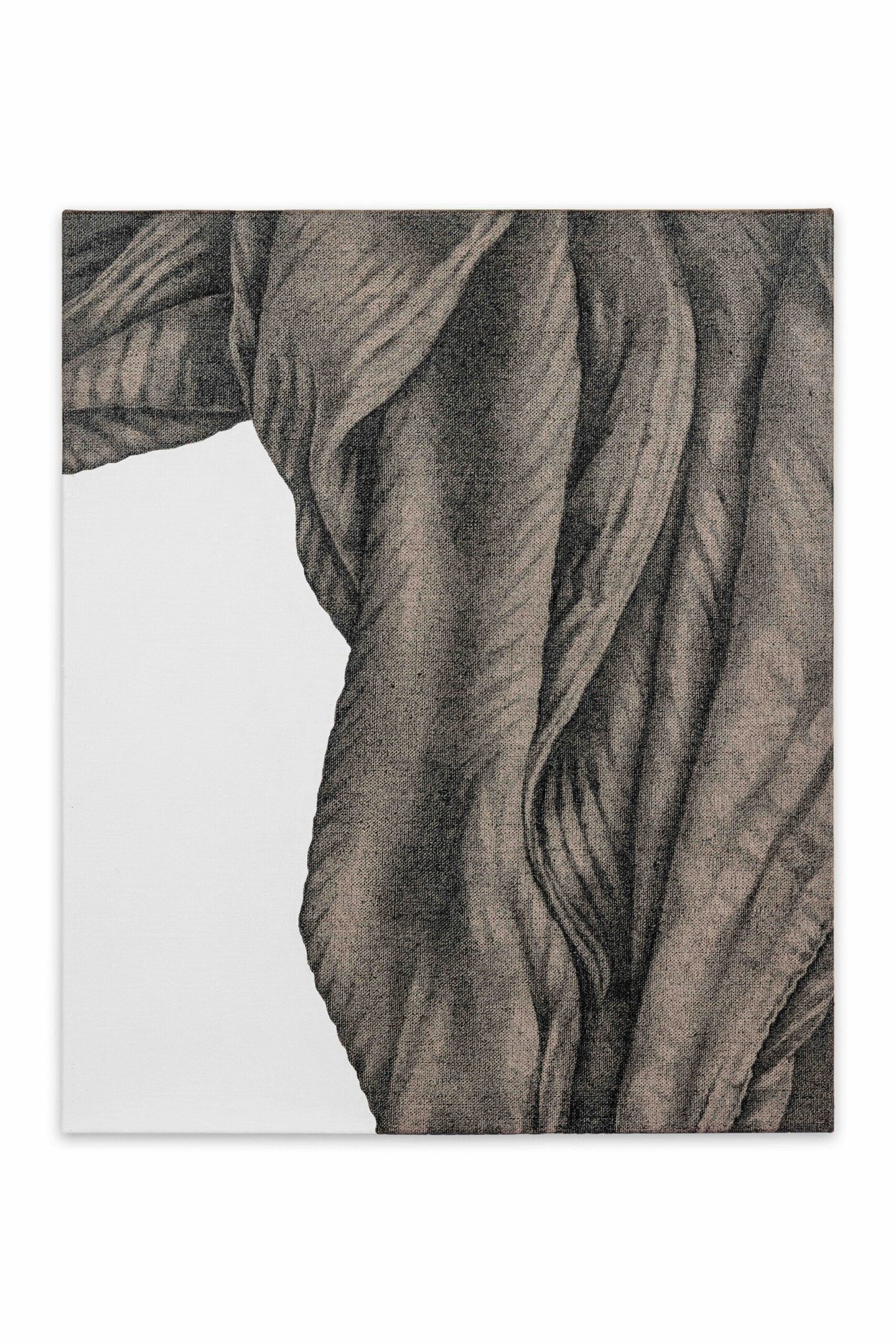
The works capture fragments of the body, partially concealed by rich, flowy fabric, which renders them particularly vulnerable. The body exists in a tense state between exposure and concealment, which mirrors the struggles Iranian people face in their fight to assert their oppositional voices while confronting censorship and repression. The works thus reference the price one has to pay for protesting the violations of basic human rights in Iran. The partially obscured body symbolically represents the never-ending fight for freedom and dignity that is continuously impeded by censorship, oppression and fear.
The pieces also bring to mind the age-old motif of drapery in art, used to showcase the artist’s craftsmanship and the painted subject’s figure. Most importantly, they vehemently oppose the norms Iranian women are expected to adhere to, pointing to the fact that fabric can be used to reveal and accentuate bodies instead of serving only to conceal them. The body thus emerges as a site of political struggle, autonomy and resistance. It is the subject of control, but one that doesn’t stop opposing it.
The partially obscured body symbolically represents the never-ending fight for freedom and dignity that is continuously impeded by censorship, oppression and fear.
In works such as Sepideh (2023), Kiani subverts this art-historical norm, using drapery to make visible the mechanism that renders women’s bodies invisible and insignificant. This shift in symbolic meaning coincides with the progression of the artist’s practice: from two-dimensional paintings towards spatial objects and sculptures. She began by transforming her drawings inspired by the chador, niqab and burqa into what she calls “plastic paintings” – painted canvases made stiffer with the help of glue and formed into three-dimensional shapes.

The spatial structures no longer centre on a human subject, and the fabric they’re made of no longer playfully and sensually uncovers the body. In this case, Kiani uses draped material to make the body disappear entirely – all that is left is discarded, forgotten cloth, lying on the ground or attached to a wall. The resultant structures are impersonal, multipliable and filled with sorrow. Symbolically, the human beings they represent lose their identities behind the veil, which has come to represent much more than just religious conventions.
Weaving the Pain
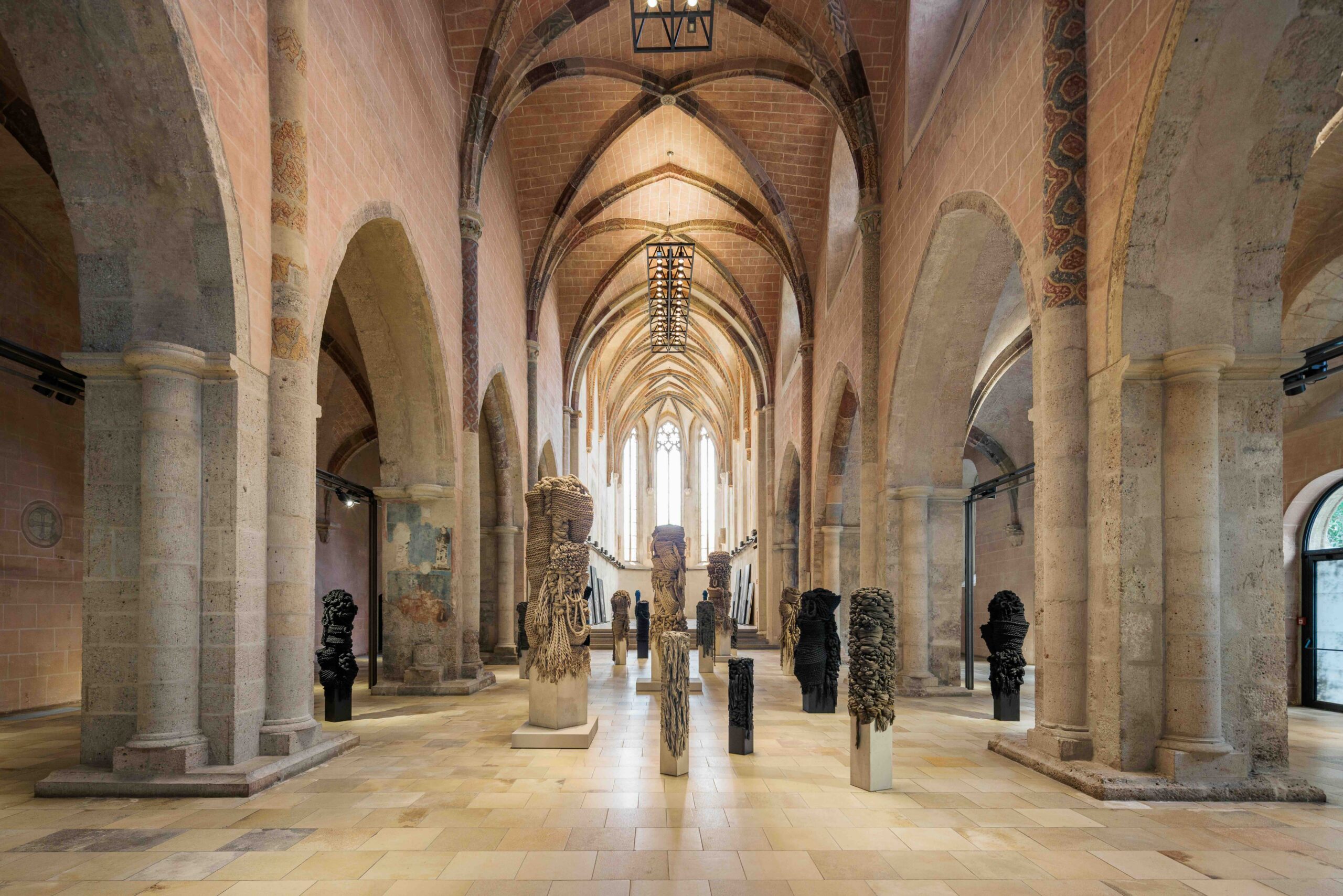
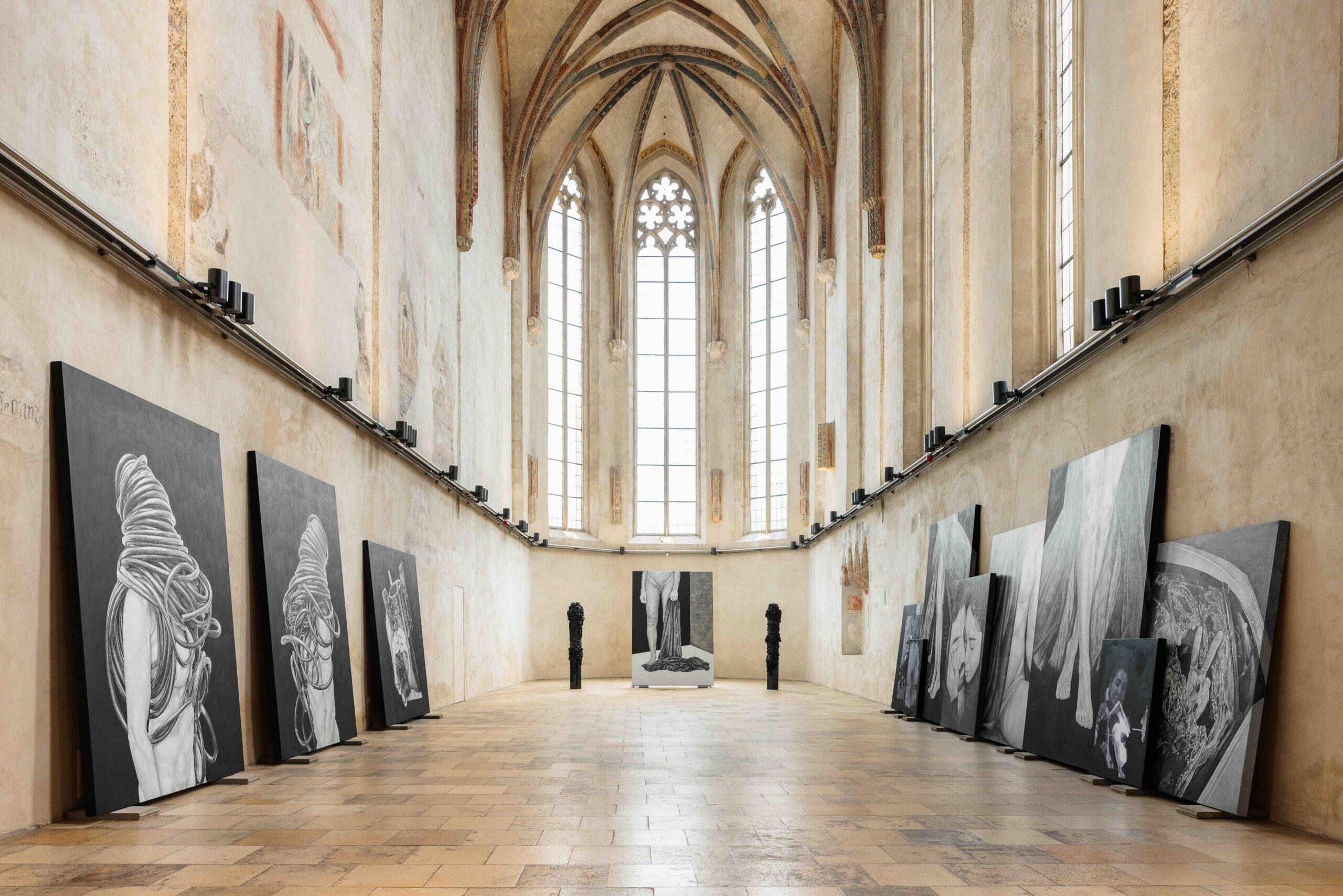
The series Blurred Line (2022-25), Shaped (2024) or Knot (2021-24) represent the next step in Kiani’s artistic journey. Here, the moulded fabric is fixed to a concrete core in an intimidating collection of knots, intertwined ropes and cords. Securing the material to an upright structure imbues it with a certain independence and stability that allow it to function as a freestanding sculpture. When displayed, these pieces at once form a crowd, yet exist in clear isolation, seemingly together but separate from one another. This positioning of the artist’s spatial works seems to mirror the situation of Iranian women who, despite appearing united as a group that faces the same forms of oppression, are often alone in their struggle. Seemingly autonomous, the pillars thus both need company to survive and are repeatedly deprived of this very comfort.
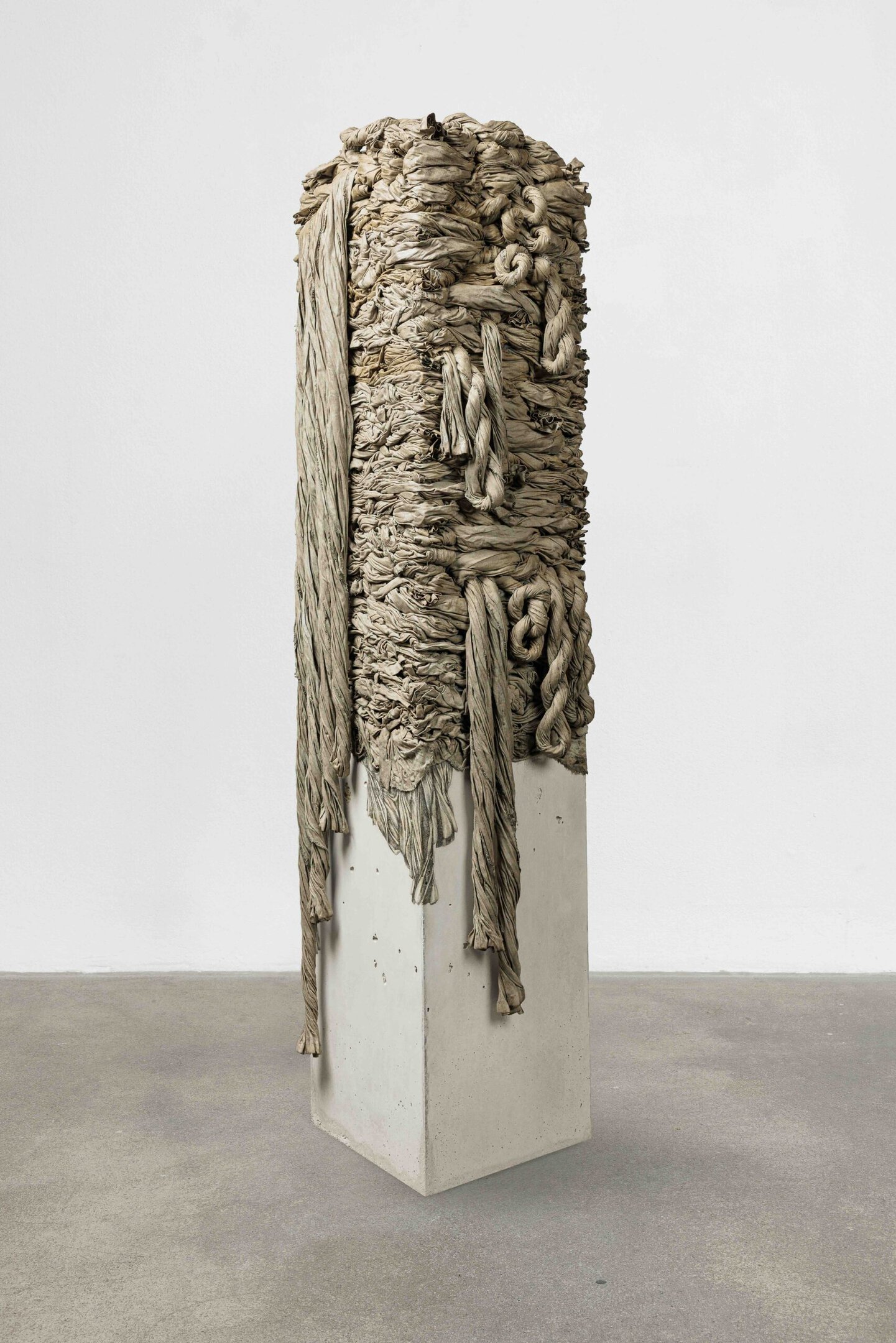
The specific materials she uses to form these sculptures are incredibly important, infusing the pieces with additional layers of meaning and complementing the themes she explores in her work. Hemp ropes, stiff heavy fabric, chains and knots resemble prison bars and nooses, directly reference execution by hanging, evoking feelings of restraint, control and suffering. All these materials are carriers of memories and resistance, which give them their weight, instrumentalised by Kiani to make her message all the more powerful.
The process of making these pieces is just as integral to the meaning they convey. It is physically demanding as Kiani first prepares the solid blocks by mixing and pouring concrete. She then weaves the previously prepared raw or painted fabric into knots and twists, pulling it across and around the concrete columns. It is a technique that requires a lot from her as an artist. In a way, the materials – and their associations – guide her physical labour, resulting in an artistic process that is more than just sculpting. It is heavy with meaning, pain and suffering from the very start.
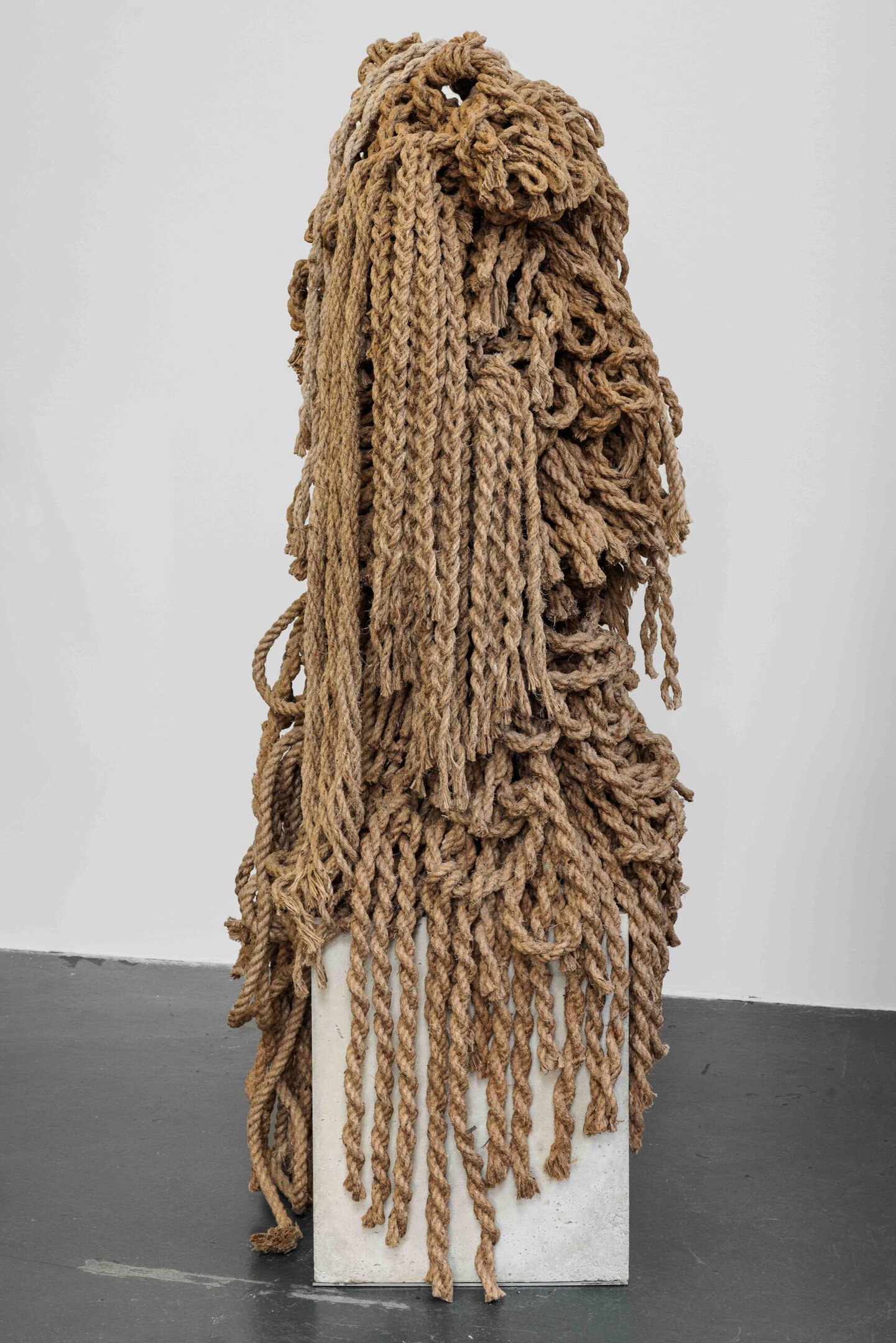
Kiani is an artist who purposefully moves between – even plays with – contradictions. Her works successfully convey the sense of being trapped. When displayed, they become monuments frozen in time and space, which only doubles the sense of restriction. As they balance between visibility and invisibility, they expose the constructed, artificial nature of the modern world. Through art, Kiani interrogates who gets to decide what is revealed and what is concealed – both figuratively and literally. In effect, her work attempts to undermine the norms that privilege some while persecuting others, and make visible the mechanisms of oppression currently in operation across the globe.
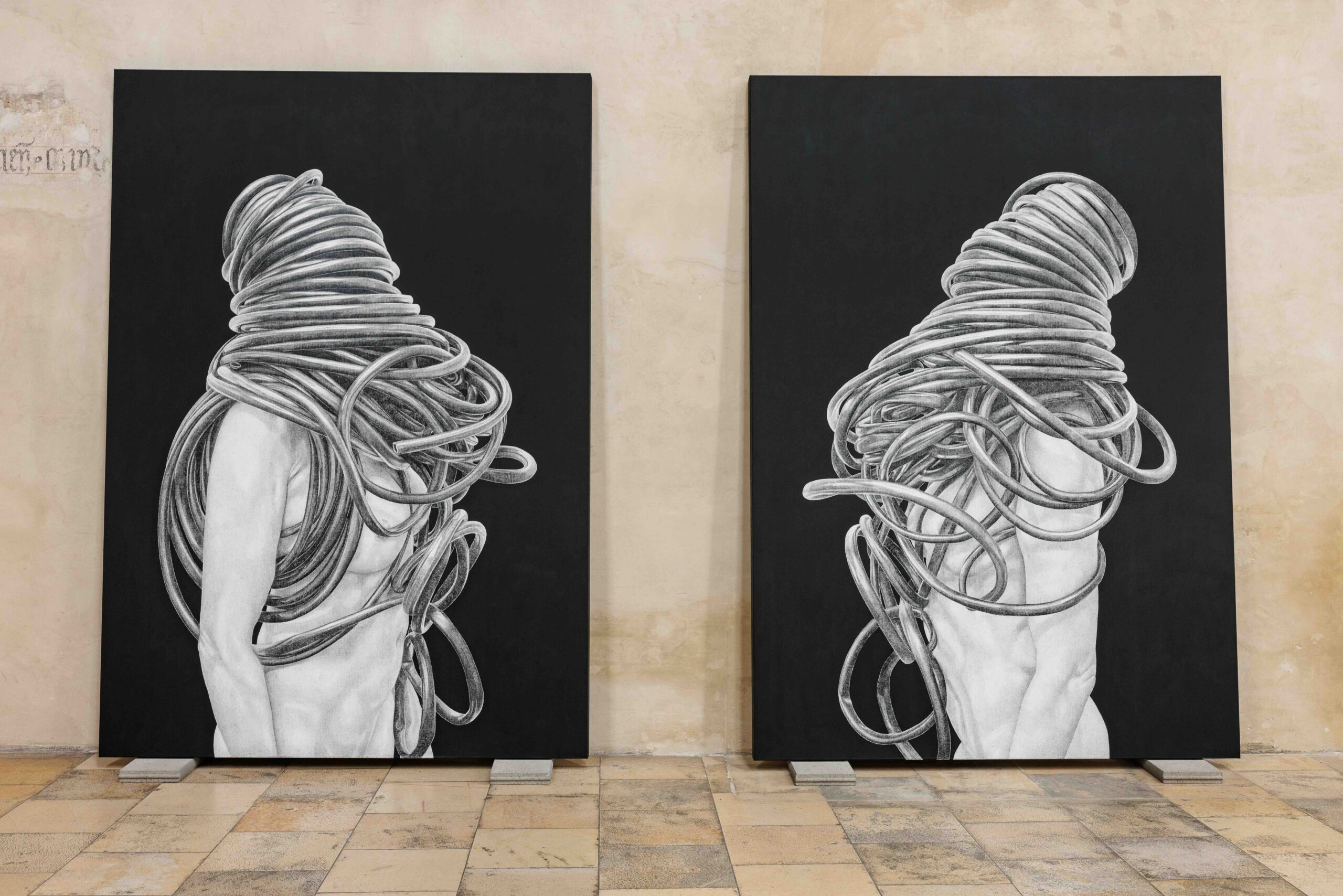
Her art is at once a reflection of her memories and a loud outcry against the Western world’s ignorance of what it does not want to see. Perhaps its most significant achievement is the role it plays in restoring agency to those who have been rendered invisible by political regimes. By refusing to accept seemingly immovable, inescapable, inevitable norms and systems, she takes a crucial step towards imagining a different reality.
Her works successfully convey the sense of being trapped. When displayed, they become monuments frozen in time and space, which only doubles the sense of restriction. As they balance between visibility and invisibility, they expose the constructed, artificial nature of the modern world.
BIO
Soli Kiani was born in Shiraz, Iran, in 1981. In 2000, she moved to Vienna, Austria, where she studied at the University of Applied Arts. Her works can be found in public collections in Austria, Germany, the United Kingdom and the USA. She is a recipient of several awards and residencies, including AIR 101 (2025), the Austrian State Scholarship for Contemporary Art (2023) and the Strabag Art Award International (2019). She has been part of numerous solo and group exhibitions, both in Austria and abroad. Her work is currently on display at the Kunsthalle Krems at Dominikanerkirche, in a solo exhibition titled Hope Moves History Towards Freedom.

Latifa Zafar Attaii was born in 1994 in Ghazni – Afghanistan. A few years later her family migrated to Quetta, Pakistan. She studied elementary school there as a refugee. Later she moved to Afghanistan to continue her studies. After entering to Faculty of Fine Arts at Kabul University, she was awarded the UMISAA scholarship to study at Beaconhouse National University, Lahore – Pakistan. She graduated from the School of Visual Arts and Design in 2017. She currently lives and works in Tehran, Iran.


