


Jerzy Budziszewski (Joshua Ben-Or) is part of a group of artists whose work evolved in close dialogue with the most significant movements of the post-war Polish avant-garde. He came of age artistically during a period when the experiences of historical constructivism were being reinterpreted by a new generation of artists. He did not, however, limit himself to their continuation, but made them the starting point for his own explorations, focusing on the relationships between form, space and light.

The exhibition Disturbed Structures, displayed between 9 July and 3 September 2026 at the Profile Foundation, brings the artist’s work into its full context, revealing the consistency of his artistic explorations and the evolution of his distinctive visual language. Alongside his early paintings, it features reliefs, spatial objects and sculptures that allow the viewer to trace the process of gradually crossing the boundaries between the image and space. The display is not merely a retrospective but an attempt to reinterpret the artist’s body of work from the perspective of contemporary reflection on geometric abstraction and the tradition of constructivism.
Alongside his early paintings, the exhibition features reliefs, spatial objects and sculptures that allow the viewer to trace the process of gradually crossing the boundaries between the image and space.
In the Avant-Garde Circles
Jerzy Budziszewski studied at the Academy of Fine Arts in Warsaw in Professor Stefan Gierowski’s studio and graduated in 1975. At that time, Gierowski’s studio was one of the leading centres of modern thinking about painting, shaping formal awareness and treating the painting as an autonomous area of study of colour, light and structure. The experiences gained in this environment had a lasting influence on the artist’s attitude, who, from the very beginning of his career, consistently developed the language of geometric abstraction.

As early as the 1970s, Budziszewski was already actively involved in the Warsaw avant-garde scene. He exhibited, amongst other venues, at the Współczesna Gallery and the Zapiecek Gallery. His collaboration with Marian Bogusz — one of the most significant practitioners of ‘matter painting’ in Poland — became an important stage in his artistic development. Budziszewski very quickly entered the circle of artists who treated geometry not as a formal convention, but as a tool for analysing space and organising the artwork. Another important factor in his early artistic career was his association with Henryk Stażewski, a pioneer of this art form in Poland, as well as with the wider circle of the Foksal Gallery.
From the very beginning of his career, Budziszewski worked simultaneously in painting, relief, sculpture, and projects within existing architecture. He treated each discipline as a different way of solving the same artistic problems. The reliefs and geometric compositions from the 1970s heralded his later spatial projects, in which light, material, rhythm, structure and the active presence of the viewer began to play an increasingly significant role.

In 1988, the artist moved to Israel, where he became interested in photography documenting the material traces of Jewish culture. This exploration resulted in a series devoted to cemeteries and synagogues, the album Żywym i umarłym (For the Living and for the Dead), and an exhibition organised together with Tadeusz Rolke. From 1994, the artist lived in New York, remaining an active participant of the international art scene until his death in Paris in 2006.

Between the Tradition of the Avant-Garde and the Contemporary Experience of Space
The legacy of constructivism did not end together with the historical avant-garde of the first half of the twentieth century. The ideas formulated by its pioneers — based on geometry, the rational organisation of form and the autonomy of the visual language — became a fixed reference point for later generations of artists. In Poland, the community gathered around Henryk Stażewski and Warsaw’s Foksal Gallery played a significant role in upholding this tradition.

Budziszewski’s relationship with Stażewski was not one of master and pupil, but rather a form of partner dialogue between two artists interested in issues of composition and image environment. Stażewski recognised the originality of Budziszewski’s explorations, emphasising his ability to create dynamism and the illusion of movement through the use of elementary geometric forms. It was during this period that the artist’s individual visual language, which went beyond the classical understanding of constructivism, was formed.

Although Budziszewski is sometimes included among the representatives of geometric abstraction, such a narrow and limiting label does not fully capture the nature and diversity of his work. For him, geometry is neither a goal in itself nor an expression of formal rigour. It is rather a tool for examining the relationships between stability and movement, plane and space, the materiality of a work and the experience of its reception. The artist views construction as a process subject to constant transformation rather than a closed system governed by fixed rules.
For him, geometry is neither a goal in itself nor an expression of formal rigour. It is rather a tool for examining the relationships between stability and movement, plane and space, the materiality of a work and the experience of its reception.
Budziszewski’s art develops at the intersection of many art forms. The individual disciplines do not function autonomously, but together form a coherent artistic programme whose focus is always the organisation of space. A painting ceases to be merely a flat composition; a relief transcends the boundaries of traditional painting; and a sculpture engages in a dialogue with its surroundings and with the movement elicited by the viewer. Consequently, the artist’s works resist clear-cut categorisation, positioning themselves between various media and ways of experiencing form.

He approaches constructivism not as a historical style, but as a method of thinking about art. For the founders of constructivism, geometry was not merely a means of expression, but a way of organising reality and constructing a universal language of art. The ideas developed by the great artists of the geometric avant-garde were based on the conviction that a work of art can function as an autonomous structure, free from narrative and representational elements.
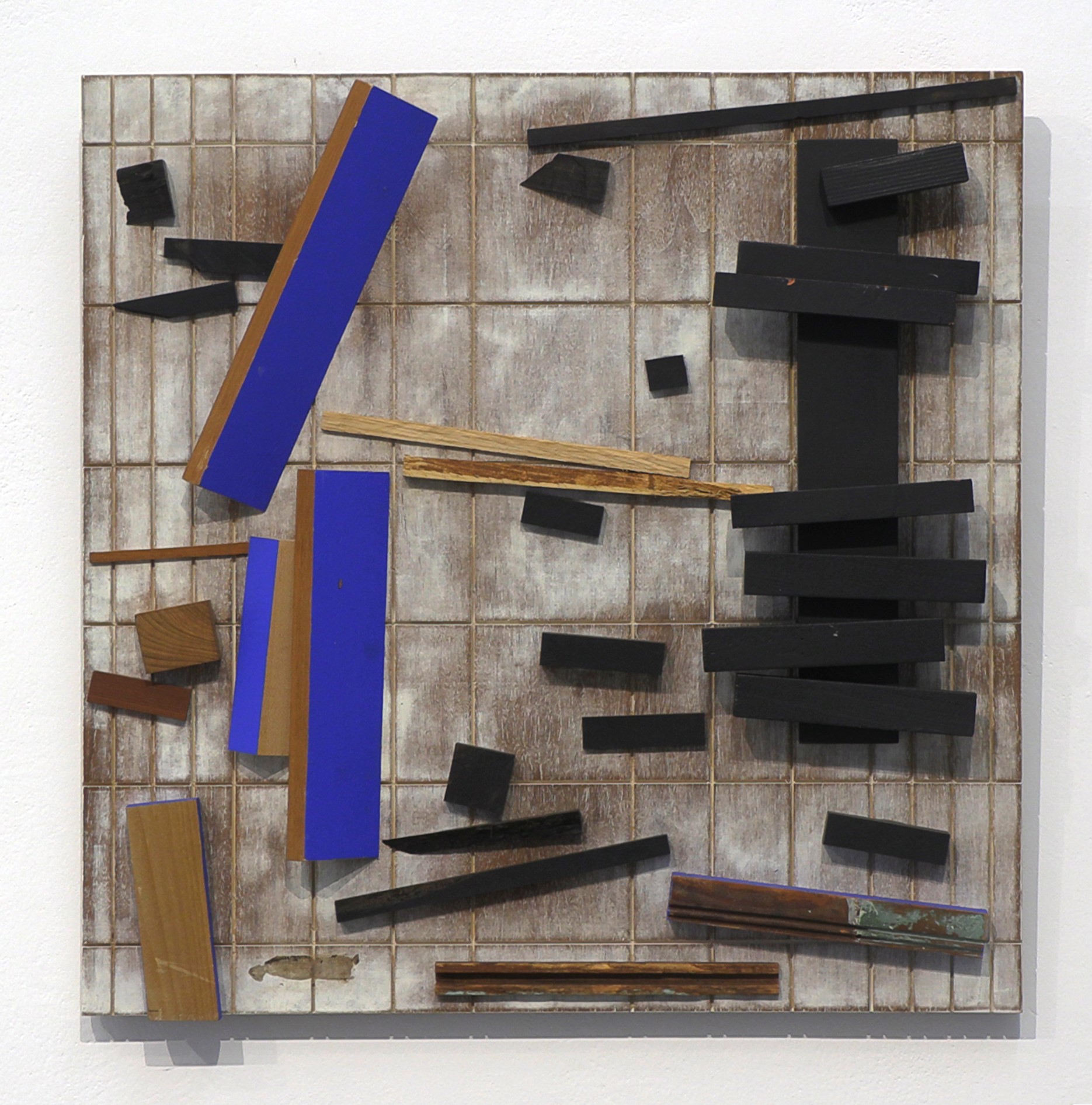
The artist refers to the works of Kazimir Malevich, Władysław Strzemiński and Katarzyna Kobro, yet does not repeat their solutions. He is interested in the moment when geometric order is subjected to tension and ceases to be a perfect structure. Repetitive modules, displacements, asymmetry and disruptions to rhythm become consciously employed means of constructing the composition, giving it a dynamic character and opening it up to the viewer’s changing experience. In this context, the exhibition title — Disturbed Structures — accurately reflects the essence of his artistic exploration. “Disturbance” does not, in fact, mean a rejection of constructivist principles, but rather their conscious transformation.

Space as a Medium
A natural consequence of Jerzy Budziszewski’s constructivist mindset was the gradual transcending of the boundaries of traditional painting. Despite starting as a painter, even in his early works, he was interested not in the illusion of space, but in the actual organisation of form. With time, the plane of the painting proved insufficient for the issues he was addressing. The evolution of his work went from painting, through relief, towards autonomous spatial objects that blurred the boundaries between painting and sculpture.

Any classification of this art finds justification in the artist’s characteristic formal language — a limited colour palette, the use of elementary geometric figures and a consistent compositional discipline. His early geometric compositions still retain the features of easel painting, yet their essential elements are rhythm and the relationship between simple forms. Squares, rectangles and modules do not serve a decorative function, but rather form the structure of the work. The significance of the composition comes not from individual elements, but from the tensions arising between them.
Any classification of this art finds justification in the artist’s characteristic formal language — a limited colour palette, the use of elementary geometric figures and a consistent compositional discipline.
Relief — a medium between painting and sculpture — occupies a special place in this artistic journey. Budziszewski does not treat it merely as a means of enriching the surface of the painting, but as a way of introducing actual space into its structure. The basis of his artistic language is the module, and yet the repetition of forms in his works does not result in a mechanical rhythm. The repetition is broken up by asymmetry, displacement and subtle changes in rhythm, thereby allowing the geometric form to retain its internal logic whilst gaining dynamism and interpretative openness.
This is particularly evident at the Profile Foundation exhibition, where reliefs take centre stage. In the works on display, such as Marcel and Helena (2024), overlapping layers of material create a variable play of light and shadow, thanks to which the work has no single, privileged viewpoint. The reception depends on the viewer’s movement and the exhibition conditions, but the composition itself takes on a dynamic character.

Light is also a significant contributor to these works; not only does it bring out their form, but it also co-creates their spatial continuity and enhances the impression of movement. The relief surfaces and multi-layered structures change their character along with the arrangement of shadows. Furthermore, the use of wood, whose natural texture and response to light counterbalance the coldness of geometric order, adds a sensual, organic dimension to the compositions. In this way, the geometric structure is no longer a closed system but instead becomes a process whose final form is revealed only through its interaction with the space and the viewer.
Open Structures
The artist is particularly drawn to the concept of space present in Malevich’s ‘architectons’, which he also subjects to his own reinterpretation. In Budziszewski’s work, the form does not function as a closed system, but as an element remaining in relation to its surroundings, light and movement. Geometry understood in this way does not have an organising function; it acts as a tool for exploring relationships.

This inspiration is apparent in the spatial constructions from the 1990s presented at the exhibition. The designs, originally made of wood, were later cast in bronze. They do not resemble classical sculptures with a compact structure, but rather open arrangements in which the surrounding space is as important as the material itself. The individual elements remain in a state of equilibrium, whilst retaining an impression of movement and constant tension. Each time the viewer walks around the object, new formal relationships are revealed, making them an active participant in the piece.
In Budziszewski’s work, the form does not function as a closed system, but as an element remaining in relation to its surroundings, light and movement. Geometry understood in this way does not have an organising function; it acts as a tool for exploring relationships.
Space is an integral element of the work, co-created by light, shadow and the viewer’s movement. Just as with reliefs, the geometric construction of the forms does not establish a static order but remains an open system of relationships, the meaning of which is revealed only through the process of perception.
Beyond the Boundaries of Constructivism
The evolution of Budziszewski’s art does not mean abandoning painting, but rather the consistent development of once adopted principles. Regardless of the medium used, the artist remained faithful to the issues of spatial organisation, the relations between forms and the impact of light. Thanks to this consistency, he created his own visual language, in which painting, sculpture, and architectural thinking create a coherent whole, forming one of the most original interpretations of the constructivist tradition in Polish contemporary art.

The exhibition at the Profile Foundation proves that Jerzy Budziszewski’s work remains a vital link in the development of Polish contemporary art, and that his original interpretations of structure and form continue to be relevant, opening up new possibilities for thinking about the relationship between the artwork and the viewer. The artist does not negate the tradition and legacy of the artists who preceded him, but rather develops it, demonstrating that geometric form can express not only order and harmony, but also change, tension and the work’s active relationship with space and the viewer. This is precisely where the originality of his work and its significance for contemporary abstract art are revealed.
The exhibition at the Profile Foundation proves that Jerzy Budziszewski’s work remains a vital link in the development of Polish contemporary art, and that his original interpretations of structure and form continue to be relevant, opening up new possibilities for thinking about the relationship between the artwork and the viewer.
Jerzy Budziszewski. Disturbed Structures
9.07–3.09.2026
Profile Foundation
Franciszkańska 6, Warsaw