




October 15 – October 18
How can we preserve our capacity to consciously imagine the future beyond the logic of prediction and optimisation? This question forms the starting point for this year’s Patchlab Digital Art Festival, taking place in Kraków from 15 to 18 October.
The festival’s anniversary edition offers an opportunity to reflect on fifteen years of transformations in digital art and Art & Tech culture through the lens of technological breakthroughs, promises and disillusionments. Since 2012, Patchlab has presented emerging phenomena at the intersection of art, science and technology, examining how successive innovations reshape our experience of reality, our imagination and our relationship with the world.
How can we retain agency in the face of processes whose scale and momentum extend beyond individual decision-making?
This year’s theme, “Dream Sim”, is deliberately open-ended. Dream refers to the dream of a technological future, to dreaming as a realm of imagination, and to the possibility of envisioning something that the system has not yet predicted. Sim is both a tool for bringing imagination into being and a system of simulation that increasingly begins to design possible futures on our behalf. Dream Sim explores the moment when technology ceases to be merely a tool for realising human visions and increasingly participates in producing those visions itself. The boundary between the real, the imagined and the simulated is becoming ever less distinct, as is the boundary between lived experience and its technological counterpart.
“Technologies that were meant to help us bring imagined futures into being are increasingly beginning to design those futures themselves. Artificial intelligence generates images, voices and narratives; digital models recreate places, bodies and processes; and XR allows us to experience alternative realities. Yet what is being simulated today is no longer limited to images and spaces, but extends to conversation, personality, presence and agency. Dream Sim asks what we have gained, and what we have surrendered in exchange for convenience, speed and automation,” says Elwira Wojtunik-Láng, Artistic Director of Patchlab Festival.
Polish premieres and audiovisual performances
Four days of Patchlab will feature exhibitions, audiovisual performances, VR and XR experiences, projects employing artificial intelligence, Artists’ Talks and animation screenings. The programme includes numerous works presented in Poland for the first time.
Making its Polish premiere at Pałac Potockich will be “Dark Rooms” — an immersive VR experience for adult audiences that takes participants through intimate stories addressing sexuality, identity, trauma and transformation.
One of the festival’s major events will be Ryoichi Kurokawa’s “nD”. The Berlin-based Japanese artist will present the latest iteration of his audiovisual series, developed continuously since 2005, during AVnight 1 at the Manggha Museum of Japanese Art and Technology. Earlier versions of the project have been presented at institutions including Tate Modern.
During the following two AVnights at Hevre+1, Polish audiences will also have their first opportunity to experience “Waluigi’s Purgatory” by British duo dmstfctn, featuring Polish saxophonist and artist Natan Kryszk and Greek artist Evita Manji. The interactive performance simulates a world in which artificial intelligence is sent to a purgatory for systems that have learned to “cheat” during training, while members of the audience can use their phones to influence the course of events.
Also receiving its Polish premiere will be “LES EMPIRES” by the Canadian duo Guillaume Coutu Dumont and Line Katcho — a retrofuturist audiovisual odyssey situated between science fiction, mythology and analogue electronics, presented in collaboration with MUTEK.
One of the works most closely resonating with this year’s festival theme is “Onirica” by the Italian studio fuse*, presented at Cricoteka — a live dance performance recognised as a finalist for the Lumen Prize 2025. First shown at the previous edition of Patchlab as an installation, the project now returns as a performance combining dance with AI-generated imagery produced in real time. Its point of departure is an archive of more than 28,000 accounts of real dreams, which artificial intelligence transforms into a fluid visual reality unfolding live before the audience.
Digital art exhibitions across three venues
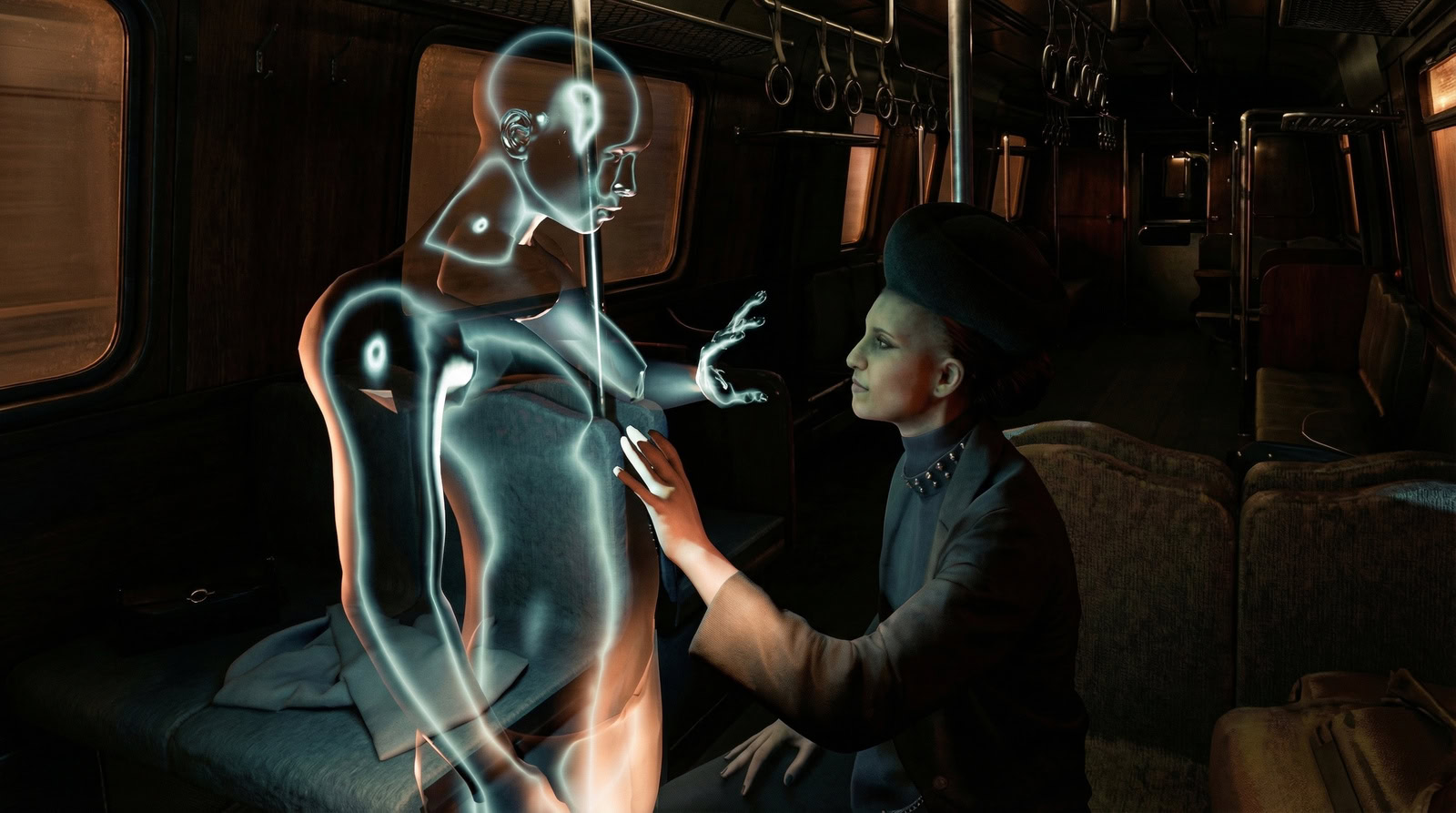
The main exhibition, “Dream Sim”, will feature, among others, Alan Kwan’s “Scent. Witnessing Without Power” — a cinematic game in which the player moves through a war-torn environment while being deprived of any meaningful ability to alter the course of events. In the interactive installation “Percipio”, Gáspár Battha investigates whether digital simulation can evoke the sensation of physical touch, while in “Speculative AI”, Birk Schmithüsen observes an audiovisual “dialogue” between two machines from which human participation has been removed, asking where communication ends and its convincing imitation begins.
The “Dream Sim” exhibition traces a trajectory from dreams and technological promise through simulation, loss of agency and prediction, towards an attempt to reclaim the imagination. The works develop different variations on the same underlying question: what happens when simulation ceases to represent the world and begins to participate in producing it?
At MOCAK, audiences will encounter Yiannis Kranidiotis’s kinetic installation “Punkt krytyczny / Tipping Point”, which demonstrates how models and forecasts can transform an invisible future into a physical experience unfolding in the here and now.
Paula Gaetano Adi’s “Guanaquerx”, awarded the Grand Prix at Ars Electronica 2025, combines contemporary robotics with Andean knowledge, materials and symbolism, proposing an alternative scenario for technological futures. The work will be presented in the exhibition space of Apteka Designu.
15 years of Patchlab Festival
“The fifteenth edition of Patchlab does not set out to offer a vision of the technological future. Instead, it confronts the ideas and promises that, over the years, we have associated with the development of digital tools and systems,” explains Elwira Wojtunik-Láng. “Fifteen years ago, we were asking what we could do with new technologies. Today, we are asking what they are doing to our plans — and whether we are still capable of imagining a future beyond what they can generate and predict.”
The anniversary is accompanied by the publication “THE BOOK. Patchlab Digital Art Festival 2012–2026” — an account of fifteen editions of the festival, their themes, participating artists and the transformations that have accompanied the development of digital art. The publication brings together the Patchlab archive and a broader history of technological, social and cultural change. It includes conversations, manifestos and essays by internationally recognised artists, curators and experts, including Jakob Kudsk Steensen, Tale of Tales, Ryoichi Kurokawa, Irini Papadimitriou and Piotr Krajewski. The book also extends beyond the printed page, incorporating digital elements in augmented reality (AR).
