




[polska wersja językowa poniżej]
Frida’s garden erupts with vibrant green, yellow, and pink vegetation against the cobalt blue walls, transporting every visitor who has had the privilege to pass its threshold into a space nothing short of magical. Everyone knows the Blue House where Frida Kahlo breathed, loved, and painted her entire life. Yet less has been said about the garden she created together with Diego Rivera.

This garden was a tacit witness to both complicated 20th-century Mexican history and turbulent personal events. Much of the social entertainment happened there as Frida and Diego preferred to receive their famous guests in the garden for celebrations and gatherings rather than in the house. The highs and lows of her marriage developed in that place. As life changes spilt over, the garden remained there as a constant refuge.
Gathering an array of local plant species and a collection of prehispanic sculptures in one place, it was more than a lush natural sanctuary – a manifestation of national identity and the artist’s deep faith in the Mexican Revolution. Here, everything has a meaning; it brings landscaping to the radical exercise in merging revolutionary ideas with organic scenery.

To this day, it is easily perceived as a living embodiment of Frida’s inexhaustible will to live and create. As the visitors pour into the courtyard of the Casa Museo Frida Kahlo today, they are encircled by the luxuriant, tropical, and vivacious vegetation. This vibrant green terrace and stunning flowers provide them with a sensual intro to the daily settings of Frida´s life. The garden remains what she intended – a daily reminder of Mexico’s natural beauty and cultural depth, inseparable from the art created within these blue walls.
“Here, everything has a meaning; it brings landscaping to the radical exercise in merging revolutionary ideas with organic scenery.”
From a small family garden to an open-air artistic salon
Mis abuelos, mis padres y yo (1936), now in the Museum of Modern Art in New York collection, depicts how the original garden looked. With a small courtyard, an orange tree at its centre, flowers and cacti, it was the epicentre of family life. Young Frida stands in the garden, presenting her parents on the day of their wedding, with the maternal and paternal grandparents above them in a family-tree-like manner. She also places her home as connected to the landscape of the Valley of Mexico, blending her personal history with nature as represented by the garden and the desert around the house.

Initially, the patio was used mainly for family kitchen needs. It was usual at that time to keep such a backyard for self-subsistence. It looked nothing like it does now, as it was meant to fulfil the practical economic need of self-reliance. So when encountering multiple photos from that early stage of her life, we see the foliage of that tiny patio, proving that from the beginning, local plants (roses, bushes, palms) decorated the walls and balcony. In her early painting, Dos Mujeres (Salvadora y Herminia) (1928), now in the collection of MFA Boston, we can see a fragment of that foliage, as two protagonists, domestic servants Salvadora and Herminia, stand in front of the wall, similar to what can be found in the archival photos of Kahlo’s family.
Then, in 1929, Diego and Frida got married. Because the mortgage threatened the house’s future, Rivera paid the debts and bought the whole property. The newlyweds moved in and lived there with Frida’s parents till their deaths, and then just two of them till the artist’s death in 1954. After the move, the pair quickly started transforming both the interior and exterior areas of the property to reflect their passion for native Mexican artistic traditions, building styles, and flora. The expansion of the property was related to Leon Trotsky’s stay at the Blue House. Because of the safety concerns, a plot of land in the vicinity was bought, too. On the terrace filled with flowers and bushes, countless parties took place. But it was also the place where Frida could relax, rest, and recuperate from her deteriorating health, far from prying eyes. At that time, the garden served her as an oasis, where she could escape and unwind. Her studio also had an ample view of the courtyard. If she wanted and was able to paint, she could rest her eyes on the plants and animals outside.

As such, the garden often served both as an open-air salon and a heaven for those who were attracted by the charismatic painter-host couple. From the presidents of Mexico, Lazaro Cardenas, Manuel Ávila Camacho, to famous actresses of that time, Maria Felix and Dolores del Rio, directors Sergiu Eisenstein and Luis Buñuel, and, of course, contemporary visual artists and the so-called “Los Fridos”, her students from the La Esmeralda school. Some archival photos also depict those cheerful moments, picnic gatherings, and meetings where Frida, lying in bed, is surrounded by her dear friends and beloved place.
Nature at the doorstep and on the canvas
The garden bloomed with intoxicating abundance – towering jacaranda trees dropping purple carpets, glossy philodendron leaves, and rose bushes climbing toward azure walls of the house. Sunflowers turned their faces skyward while delicate fuchsias popped out and marigolds burst in fierce orange flames like paddles. But this wasn’t just ornamental beauty. Orange trees perfumed the air with their blossoms, while apricot branches stretched heavy, plumped fruits.

Pomegranate trees offered their ruby fruits, and everywhere the essential spirit of Mexico thrived – formidable prickly pear cacti spreading their paddle-shaped arms and sculptural agave plants standing like green sentinels. Ferns unfurled in shadowy corners, palms rustled overhead, and an entire army of cacti and succulents claimed every sun-drenched spot with their otherworldly forms. The garden pulsed with life – some plants tender and ephemeral, others ancient and enduring, all creating a tapestry that was quintessentially Mexican.
Photographers Nickolas Muray and Gisele Freund captured these mesmerising details through their lenses. And they showed Kahlo dominating the nearly paradisiac scene. These photos also document how Kahlo incorporated certain blooms from her garden in her image – gardenias, dahlias, and bougainvillaea. The artist treated it as natural accessories, carefully matching a rich fashion inspired by popular clothes worn by peasants and indigenous women.
“Like all aspects of Kahlo’s life and work, her gardening practices demand attention and reward viewers with bursts of passionate, consuming intensity for those willing to engage with her vision fully.”

Each plant was carefully picked because of its link to the wild landscape or cultural history. For example, Calla lilies had originally arrived in Mexico through the slave trade, while Chinese chrysanthemums came via Spanish trading vessels. By contemporary gardening standards, much of the exhibition’s plant life appears relatively common. Even fewer elements could be described as subtle or restrained. Like all aspects of Kahlo’s life and work, her gardening practices demand attention and reward viewers with bursts of passionate, consuming intensity for those willing to engage with her vision fully.
These precious natural gems from the garden were presented primarily in Frida’s art, but can also be witnessed in Diego’s paintings, especially his beloved Calla lilies. He portrayed them as vital elements of vernacular culture multiple times (like Flower Seller, 1942, and Woman with Calla Lilies, 1945). They are so frequent in his art that some may identify Mexican daily life as embellished by these flowers.
Probably the most well-known when it comes to Mexico are the marigolds. Associated with the Day of the Dead in Mexico, the golden marigolds adorn the altars like luminous bridges between the world of the living and the realm of the ancestors, carrying the prayers and eternal love in their petals on that day. As key symbols of the vernacular culture, they appear often in the local art, so we may also see them in the LACMA collection work by 19th-century costumbrista artist Felipe Santiago Gutiérrez – Indian Woman with Marigold (Mujer indígena con cempasúchil) or the symbolist work by Saturnino Herrán from 1913, which is now in Museo Nacional de Arte in Mexico City. Frida also didn’t shy away from them, Marigolds were captured by her, like in the miniature Sueño de adiós (Naturaleza muerta con cempasúchil (1927).

Different cacti that naturally grow in the local desert, like Organ Pipe Cactus, Old Man Cactus, Pitaya, or Sweetheart plant, can be found depicted by other key Mexican artists like Graciela Iturbide or José Maria Velasco. Frida painted them in El amor, abrazo del universo, la tierra, yo, Diego y el Sr. Xolotl (1949). The portrait of Luther Burbank (1931) incorporates yet another plant that was present in the garden: Thaumatophyllum bipinnatifidum, a large tropical houseplant commonly known as the Tree Philodendron, Split-leaf Philodendron, or Lacy Tree Philodendron. While the sunflowers that were planted in the patio when the Kahlo family settled in Coyoacán were captured by Frida in her last work, Frida in Flames (around 1953-54).
Frida looks to nature encapsulated in the garden as a metaphor of organic and deity-like persona; she insists on painting after painting upon her primordial and biological relationship to the Mexican land. She is a part of it. She belongs to it, and that bond defines her. The Roots (1943) brings to mind Ana Mendieta’s Siluettas series [Read more about Ana Mendieta in the first issue of Mindscapes – here] or Delcy Morelos’ soil monumental structures, as they coincide with the message that Frida wanted to convey – we are organically bound to earth, we are part of nature. Having a garden must have prompted that realisation – or, perhaps, the other way round – the need for a garden was driven by a profound feeling or identification with the ecosystem.
The garden plant composition, however, also served the couple as a display of their own outlook on life. It was a projection of a far-reaching stand on the relationship to anything Mexican, plants, animals, and indigenous. The garden was an oasis that allowed them to keep everything dear and important close to home. It reflected their support for the Mexican Revolution, as the most important mass rebellion since the independence war, which reshaped the nation again, a century after the original struggle for political freedom. Frida and Diego strived to manifest a strong attachment to the principles and values of the Revolution in their work as well as in their daily life. Driven by these convictions, they created the garden and art. Their approach was a total and all-consuming work, when one cannot simply separate either.
Mexican landscape behind the window
The garden today remains of its original landscape, although new plants have been introduced. What draws our attention still is the pyramid, designed and commissioned by Diego Rivera in the 1940s, to display his collection of indigenous popular art and prehispanic archaeological discoveries. It draws attention thanks to the bright red and yellow colours. The stair pyramid, modelled on similar ones built by Mayas, does not dominate the space but punctuates it. At the time of the Day of the Dead, it serves as a traditional altar, put together for Frida. It is then covered by a sea of marigolds, which guide the souls to their ofrendas (food that they liked to eat, brought to the altar, adorned by flowers and photos of the deceased).
“Driven by these convictions, they created the garden and art. Their approach was a total and all-consuming work, when one cannot simply separate either.”

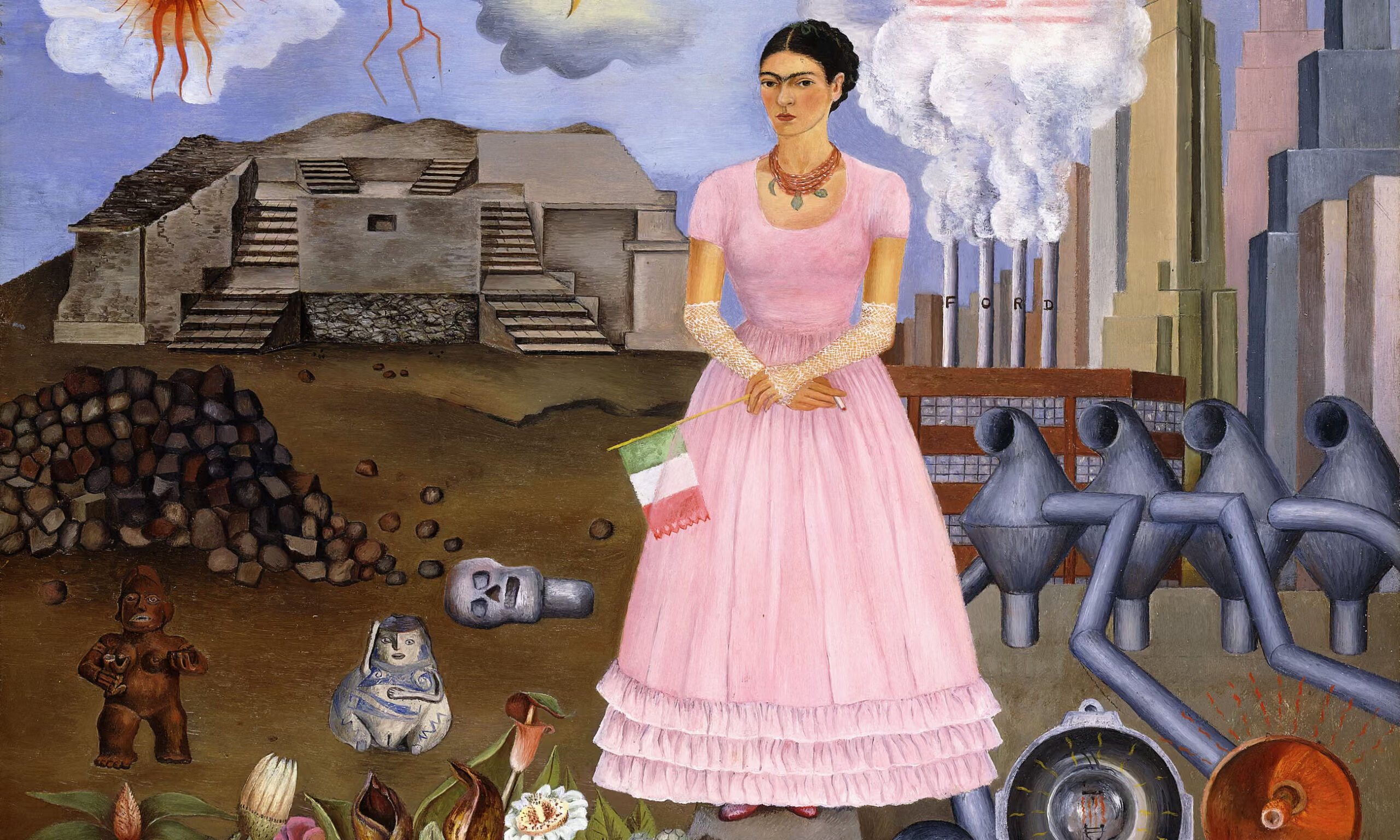
Piramide motif, of course, appears on Diego’s murales in Palacio Nacional and Frida’s Self-Portrait on the Border Line Between Mexico and the United States (1932), from the Collection of Maria and Manuel Reyero. As with the natural elements, cultural objects from the pre-Columbian heritage are on display in the art and the garden, demonstrating again the strong attachment to the non-Spanish past, celebrated by the post-Revolutionary governments and culture.
The space is also decorated with basalt and rock sculptures, from different cultures and times, from the Olmecas and the Mayans to the Mexicas. The effect is rather of an ethnographic museum than an actual depiction of cultural landscapes, as these cultures were placed in different areas of Mexico. It is a creation of both artistic vision (which wishes to showcase the idea instead of historical truth) and the times. The Mexican Revolution and its aftermath reorganised the visual culture, introducing more popular and precolonial references to the public sphere. The new society (the concept of “Cosmic Race” by José Vasconcelos, friend of Rivera and Minister of Education) had to have diverse symbols, rooted in the non-Spanish past. The garden at the Blue House became then a living advertisement, an archetype of kind – of reborn nation after the Civil War.

In this verdant sanctuary, the boundaries between personal sanctuary and political statement dissolved completely, creating a space where the intimate and the monumental coexisted as naturally as the indigenous cacti and imported roses that shared the same soil. Today, visitors walking through these same pathways experience not just a preserved historic space but a living testament to the revolutionary spirit that transformed Mexico’s cultural identity, where every flowering vine and ancient stone continues to whisper the stories of a nation reimagining itself. The garden remains what it always was – a place where art and life intertwined so completely that one cannot say where Frida’s vision ended and Mexico’s soul began. Both rooted in the same earth, both stretching toward the horizon of a dreamt-of Mexico – vibrant, free, and eternal.
“In this verdant sanctuary, the boundaries between personal sanctuary and political statement dissolved completely.”
Ogród ziemskich rozkoszy Fridy Kahlo.
Żywe płótno filozofii artystki.
Ogród Fridy eksploduje intensywną zielenią, żółcią i różem roślinności na tle kobaltowo-niebieskich ścian, przenosząc do prawdziwie magicznej przestrzeni każdego, kto miał okazję do niego wkroczyć. Wszyscy znają Niebieski Dom, w którym Frida Kahlo oddychała, kochała i malowała przez całe swoje życie. Mniej mówi się jednak o ogrodzie, który stworzyła wraz z Diego Riverą.
Ogród ten był niemym świadkiem zarówno skomplikowanej historii Meksyku XX wieku, jak i burzliwych wydarzeń osobistych artystki. Odbywała się tam większość spotkań towarzyskich, jako że Frida i Diego woleli zapraszać swoich sławnych gości na uroczystości i spotkania raczej do ogrodu niż do domu. W tym miejscu rozgrywały się wzloty i upadki ich małżeństwa. W miarę jak życie ulegało zmianom, ogród niezmiennie pozostawał schronieniem.
“Tutaj wszystko ma znaczenie; uprawianie ogrodu staje się radykalnym ćwiczeniem łączenia rewolucyjnych idei z organiczną scenerią.”
Gromadząc w jednym miejscu szereg lokalnych gatunków roślin i kolekcję prekolumbijskich rzeźb, ogród ten był czymś więcej niż bujnym sanktuarium natury – stanowił manifestację tożsamości narodowej i głębokiej wiary artystki w rewolucję meksykańską. Tutaj wszystko ma znaczenie; uprawianie ogrodu staje się radykalnym ćwiczeniem łączenia rewolucyjnych idei z organiczną scenerią.
Do dziś można to miejsce postrzegać jako żywe ucieleśnienie niewyczerpanej woli życia i tworzenia Fridy. Gdy zwiedzający wchodzą dziś na dziedziniec Casa Museo Frida Kahlo, otacza ich bujna, tropikalna, wręcz ekspresywna roślinność. Ten tętniący życiem zielony taras i oszałamiające kwiaty zapewniają odwiedzającym zmysłowe wprowadzenie do życia powszedniego Fridy. Ogród pozostaje tym, czym miał być według jej zamysłu – codziennym przypomnieniem piękna Meksyku i bogactwa jego kultury, nierozerwalnie związanego ze sztuką tworzoną w tych niebieskich murach.
Od małego rodzinnego ogrodu do artystycznego salonu na świeżym powietrzu
Obraz Mis abuelos, mis padres y yo („Moi dziadkowie, moi rodzice i ja”) z 1936 roku, obecnie znajdujący się w kolekcji Muzeum Sztuki Nowoczesnej w Nowym Jorku, przedstawia oryginalny wygląd ogrodu. Mały dziedziniec z drzewem pomarańczowym, kwiatami i kaktusami na środku był centrum życia rodzinnego. Młoda Frida stoi w ogrodzie, przedstawiając swoich rodziców w dniu ich ślubu, a nad nimi, niczym na drzewie genealogicznym, swoich dziadków ze strony matki i ojca. Łączy również swój dom z krajobrazem Doliny Meksykańskiej, splatając swoją osobistą historię z naturą reprezentowaną przez ogród i pustynię otaczającą dom.
Początkowo patio służyło rodzinie przede wszystkim do celów kuchennych. W tamtych czasach utrzymywanie takiego ogrodu przydomowego w celu samowystarczalności było czymś powszechnym. Wyglądał on zupełnie inaczej niż obecnie, ponieważ miał zaspokajać praktyczne potrzeby ekonomiczne związane z niezależnością. Dlatego też, oglądając liczne zdjęcia z tego wczesnego okresu życia Fridy, widzimy roślinność tego niewielkiego patio, co dowodzi, że od samego początku lokalna flora (róże, krzewy, palmy) zdobiły ściany i balkon. Na wczesnym obrazie artystki, Dos Mujeres (Salvadora y Herminia) (1928), obecnie znajdującym się w kolekcji Muzeum Sztuk Pięknych w Bostonie, możemy zobaczyć fragment tej roślinności, ponieważ jego dwie bohaterki, służące Salvadora i Herminia, stoją przed ścianą, podobną do tej, którą można znaleźć na archiwalnych zdjęciach rodziny Kahlo.
W 1929 roku Diego i Frida pobrali się. Ponieważ hipoteka zagrażała przyszłości domu, Rivera spłacił długi i kupił całą posiadłość. Nowożeńcy wprowadzili się i mieszkali tam z rodzicami Fridy, a następnie tylko we dwoje, aż do śmierci samej artystki w 1954 roku. Po przeprowadzce para szybko rozpoczęła przebudowę zarówno wnętrz, jak i zewnętrznych części posesji, aby odzwierciedlić swoją pasję do rdzennych meksykańskich tradycji artystycznych, stylów budowlanych i lokalnej flory. Rozbudowa posiadłości była związana z pobytem Lwa Trockiego w Niebieskim Domu. Ze względu na kwestie bezpieczeństwa zakupiono również działkę w pobliżu. Na tarasie pełnym kwiatów i krzewów odbywały się niezliczone przyjęcia. Było to jednak także miejsce, w którym Frida mogła się zrelaksować, odpocząć i zregenerować siły w związku z pogarszającym się stanem zdrowia, z dala od wścibskich spojrzeń. W tym czasie ogród służył jej jako oaza, w której mogła się schronić i odprężyć. Również z jej pracowni rozciągał się szeroki widok na dziedziniec. Jeśli miała ochotę i była w stanie malować, mogła dać odpocząć oczom, obserwując rośliny i zwierzęta za oknem.
W ten sposób ogród często służył zarówno jako “salon na świeżym powietrzu”, jak i raj dla tych, których przyciągała charyzmatyczna para malarzy-gospodarzy. Od prezydentów Meksyku, Lazaro Cardenasa i Manuela Ávili Camacho, po znane aktorki tamtych czasów, Marię Felix i Dolores del Rio, reżyserów Sergiu Eisensteina i Luisa Buñuela, a także, oczywiście, współczesnych artystów wizualnych i tzw. „Los Fridos”, jej uczniów ze szkoły La Esmeralda. Niektóre archiwalne zdjęcia również przedstawiają te radosne chwile, pikniki i spotkania, podczas których Frida, leżąc w łóżku, otoczona jest przez bliskich przyjaciół i ukochane miejsce.
Natura tuż za progiem i na płótnie
Ogród kwitł w oszałamiającej obfitości – wysokie drzewa jakarandy tworzyły fioletowe dywany, błyszczące liście filodendronów i krzewy róż pięły się w kierunku błękitnych ścian domu. Słoneczniki zwracały swoje twarze ku niebu, delikatne fuksje rozkwitały, a nagietki niczym wiosła tryskały ognistą pomarańczą. Nie były to jednak tylko ozdoby. Drzewka pomarańczowe wypełniały powietrze zapachem swoich kwiatów, a gałęzie drzew morelowych były pokryte ciężkimi, pulchnymi owocami.
Drzewa granatu oferowały swoje rubinowe owoce, a wszędzie kwitła esencja Meksyku – potężne opuncje rozkładały swoje przypominające wiosła ramiona, a rzeźbiarskie agawy sterczały niczym zieloni strażnicy. Paprocie rozpościerały się w zacienionych zakątkach, palmy szeleściły ponad głowami, a cała armia kaktusów i sukulentów zajmowała każde nasłonecznione miejsce swoimi nieziemskimi kształtami. Ogród tętnił życiem – niektóre rośliny były delikatne i efemeryczne, inne pradawne i trwałe, a wszystkie razem tworzyły typowo meksykańską mozaikę.
Fotografowie Nickolas Muray i Gisele Freund uchwycili te hipnotyzujące detale przy pomocy swoich obiektywów. Ujęli również Kahlo dominującą w tej niemal rajskiej scenerii. Fotografie te dokumentują także, w jaki sposób Kahlo włączała do swojego wizerunku niektóre kwiaty z ogrodu – gardenie, dalie i bugenwille. Artystka traktowała je jako naturalne akcesoria, starannie dopasowując je do bogatej mody inspirowanej popularnymi ubraniami noszonymi przez chłopów i rdzenne kobiety.
Każda roślina została starannie wybrana ze względu na jej związek z dziką przyrodą lub historią kultury. Przykładowo, kalie trafiły do Meksyku w wyniku handlu niewolnikami, a chińskie chryzantemy przybyły na pokładach hiszpańskich statków handlowych. Zgodnie ze współczesnymi standardami ogrodniczymi większość roślin prezentowanych na wystawie wydaje się stosunkowo pospolita. Jeszcze mniej elementów można by określić jako subtelne lub stonowane. Podobnie jak w przypadku wszystkich aspektów życia i twórczości Kahlo, jej praktyki ogrodnicze również wymagają uwagi i nagradzają pełną pasji, pochłaniającą intensywnością tych, którzy chcą w pełni zaangażować się w jej wizję.
” Podobnie jak w przypadku wszystkich aspektów życia i twórczości Kahlo, jej praktyki ogrodnicze również wymagają uwagi i nagradzają pełną pasji, pochłaniającą intensywnością tych, którzy chcą w pełni zaangażować się w jej wizję.”
Te cenne naturalne skarby z ogrodu pojawiały się przede wszystkim w sztuce Fridy, ale można je też dostrzec w obrazach Diego, zwłaszcza jego ukochane kalie. Wielokrotnie przedstawiał je jako istotne elementy kultury ludowej (np. na obrazach Vendedora de flores z 1942 roku i Mujer con alcatraces z 1945 roku). Pojawiają się one w jego sztuce tak często, że niektórzy mogą utożsamiać meksykańskie życie codzienne z tymi kwiatami.
Aksamitki są prawdopodobnie najbardziej znanymi meksykańskimi kwiatami. Kojarzone ze Świętem Zmarłych, złote aksamitki zdobią ołtarze niczym świetliste mosty między światem żywych a królestwem przodków, niosąc tego dnia w swoich płatkach modlitwy i wieczną miłość. Jako kluczowe symbole kultury ludowej często pojawiają się w lokalnej sztuce, dlatego możemy je również zobaczyć w kolekcji LACMA w dziele XIX-wiecznego artysty Felipe Santiago Gutiérreza Mujer indígena con cempasúchil lub na symbolistycznych pracach Saturnino Herrána z 1913 roku, znajdujących się obecnie w Museo Nacional de Arte w Meksyku. Frida również ich nie unikała i uchwyciła je na przykład na miniaturze Sueño de adiós (Naturaleza muerta con cempasúchil (1927).
Różne gatunki kaktusów, które naturalnie rosną na lokalnej pustyni, takie jak kaktus organowy, kaktus starzec, pitaja czy kaktusy o sercowatych liściach, można znaleźć na obrazach innych ważnych meksykańskich artystów, takich jak Graciela Iturbide czy José Maria Velasco. Frida uchwyciła je na obrazie El amor, abrazo del universo, la tierra, yo, Diego y el Sr. Xolotl (1949). Portret Luthera Burbanka (1931) zawiera jeszcze jeden element, który był obecny w ogrodzie: Thaumatophyllum bipinnatifidum, dużą tropikalną roślinę doniczkową, powszechnie znaną jako filodendron podwójnie pierzasty. Natomiast słoneczniki, które zostały posadzone na patio, gdy rodzina Kahlo osiedliła się w Coyoacán, zostały uwiecznione przez Fridę na jej ostatnim dziele, Frida in Flames (ok. 1953-54).
“Kierowani tymi przekonaniami, stworzyli ogród i dzieła sztuki. Ich podejście było kompleksowe i pochłaniające, jako że nie można tak po prostu oddzielić jedno od drugiego.”
Frida postrzega naturę skupioną w ogrodzie jako metaforę organicznej i boskiej postaci; nieustannie maluje kolejne obrazy przedstawiające jej pierwotną i biologiczną więź z meksykańską ziemią. Jest jej częścią. Należy do niej, a ta więź ją definiuje. The Roots (1943) przywodzi na myśl serię Siluetas Any Mendiety [Więcej o Anie Mendiecie można przeczytać w pierwszym numerze Mindscapes – tutaj] lub monumentalne konstrukcje z gleby Delcy Morelos, ponieważ pokrywają się one z przesłaniem, które chciała przekazać Frida: jesteśmy organicznie powiązani z ziemią, jesteśmy częścią natury. To właśnie posiadanie ogrodu musiało skłonić ją do tej refleksji. A może było odwrotnie – potrzeba posiadania ogrodu wynikała z głębokiego poczucia identyfikacji z ekosystemem.
Kompozycja roślin w ogrodzie służyła jednak również parze jako wyraz ich własnego spojrzenia na życie. Była to projekcja dalekosiężnego stanowiska w sprawie relacji z wszystkim, co meksykańskie – roślinami, zwierzętami i rdzennymi mieszkańcami. Ogród był oazą, która pozwalała im zachować blisko domu wszystko, co ważne. Odzwierciedlał on ich poparcie dla rewolucji meksykańskiej, najważniejszego masowego buntu od czasu wojny o niepodległość, który na nowo ukształtował naród sto lat po pierwotnej walce o wolność polityczną. Frida i Diego starali się manifestować silne przywiązanie do zasad i wartości rewolucji zarówno w swoich pracach, jak i w życiu codziennym. Kierowani tymi przekonaniami, stworzyli ogród i dzieła sztuki. Ich podejście było kompleksowe i pochłaniające, jako że nie można tak po prostu oddzielić jedno od drugiego.
Meksykański krajobraz za oknem
Ogród zachował swój pierwotny krajobraz, chociaż wprowadzono do niego nowe rośliny. Niezmiennie uwagę przyciąga piramida, zaprojektowana i zlecona przez Diego Riverę w latach 40. XX wieku, by zaprezentować jego kolekcję rdzennej sztuki ludowej i prekolumbijskich znalezisk archeologicznych. Zwraca ona uwagę dzięki jaskrawym czerwonym i żółtym barwom. Schodkowa budowla, wzorowana na tych budowanych przez Majów, nie dominuje przestrzeni, ale ją podkreśla. W okresie Dnia Zmarłych pełni ona funkcję tradycyjnego ołtarza przygotowanego dla Fridy. Pokrywa ją wtedy morze nagietków, które prowadzą dusze do ich „ofrendas” (jedzenie, które lubili jeść, przyniesione do ołtarza, ozdobionego kwiatami i zdjęciami zmarłych).
Motyw piramidy pojawia się też oczywiście na muralach Diego w Palacio Nacional oraz w Autoportrecie Fridy z 1932 roku, znajdującym się w kolekcji Marii i Manuela Reyero. Podobnie jak w przypadku elementów naturalnych, obiekty kulturowe pochodzące z dziedzictwa prekolumbijskiego są eksponowane w sztuce i ogrodzie, demonstrując silne przywiązanie do niehiszpańskiej przeszłości, celebrowanej przez post-rewolucyjne rządy i kulturę.
Przestrzeń jest również ozdobiona rzeźbami z bazaltu i skał pochodzącymi z różnych kultur i epok, od Olmeków i Majów aż po Meksykanów. Efekt przypomina raczej muzeum etnograficzne niż rzeczywiste przedstawienie krajobrazów kulturowych, ponieważ kultury te były rozmieszczone w różnych regionach kraju. Jest to dzieło zarówno wizji artystycznej (która chce ukazać ideę, a nie historyczną prawdę), jak i ducha czasów. Rewolucja meksykańska i jej następstwa zreorganizowały kulturę wizualną, wprowadzając do sfery publicznej bardziej popularne i przedkolonialne odniesienia. Nowe społeczeństwo (koncepcja „rasy kosmicznej” José Vasconcelosa, przyjaciela Rivery i ministra edukacji) musiało mieć różnorodne symbole zakorzenione w niehiszpańskiej przeszłości. Ogród w Niebieskim Domu stał się wówczas żywą reklamą, swego rodzaju archetypem odrodzonego narodu po wojnie domowej.
W tym zielonym sanktuarium granice między osobistą świątynią a deklaracją polityczną całkowicie się zatarły, tworząc przestrzeń, w której to, co intymne, i to, co monumentalne, współistniały tak naturalnie, jak rodzime kaktusy i importowane róże, dzielące tę samą glebę. Dzisiaj turyści spacerujący tymi samymi ścieżkami mogą doświadczyć nie tylko zachowanej przestrzeni historycznej, ale także żywego świadectwa rewolucyjnego ducha, który zmienił tożsamość kulturową Meksyku, gdzie każda kwitnąca winorośl i każdy stary kamień wciąż szepczą historie narodu, który na nowo odkrywa swoją tożsamość. Ogród pozostaje tym, czym zawsze był – miejscem, w którym sztuka i życie są tak całkowicie ze sobą splecione, że nie można powiedzieć, gdzie kończy się wizja Fridy, a zaczyna dusza Meksyku. Jedno i drugie zakorzenione w tej samej ziemi, sięgające horyzontu wymarzonego Meksyku – tętniącego życiem, wolnego i wiecznego.
“W tym zielonym sanktuarium granice między osobistą świątynią a deklaracją polityczną całkowicie się zatarły.”

Przedsięwzięcie finansowane w ramach Krajowgo Planu Odbudowy i Zwiększenia Odporności (KPO) ze środków Unii Europejskiej – NextGenerationEU w ramach inwestycji A2.5.1 “Program wspierania działalności podmiotów sektora kultury i przemysłów kreatywnych na rzecz stymulowania ich rozwoju”.