



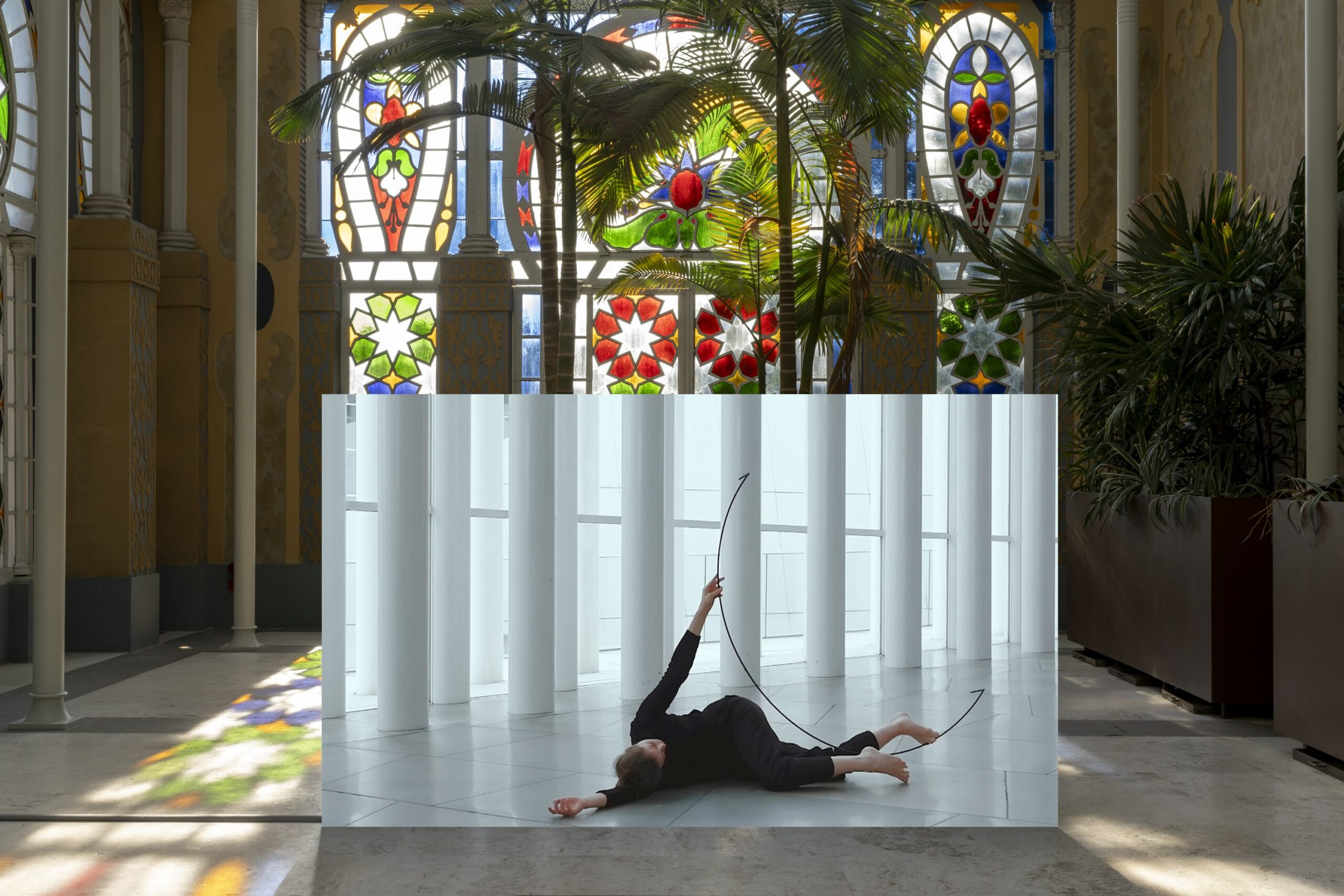
Two hands teeter on supportive blocks, as the body glides through space with immense control. These are the exquisite aerial interventions performed by one of two gymnasts in no mental scars, no nursed grudges (2022), a video installation by Agnieszka Mastalerz that examines the sinister mechanisms of control, obedience and conformity to which bodies are subjected.

For the Warsaw-based artist, bodies are human and non-human, individual and collective, merging with computers and machines. In no mental scars, no nursed grudges, organic execution is partnered with learned computer programming, as an anthropomorphic robot performs a similar choreography to the dancers, yet memorises it through a different method. As we find ourselves in a world in which ever more automated processes erase human touch, her work holds increasing relevance.

Her new solo exhibition The Props Assist the House, curated by Gaia Bobò, takes place at the Polish Institute and Villa Torlonia in Rome, Italy, from 3 October to 20 November 2026. To mark its opening, we spoke to Agnieszka Mastalerz about surveillance society and the need to move in a world set on restrictions.

Maggie Kuzan: Your exhibition title, The Props Assist the House, comes from an Emily Dickinson poem. What does this “house” look like today, and what are its most invisible yet influential “props”?
Agnieszka Mastalerz (AM): I chose Dickinson’s title for two reasons — one literal, one metaphorical. I’m drawn to the forms that shape us, whether physical structures or hidden systems. The literal house appears in Remainder (2026), which references Le Corbusier’s 1927 Doppelhaus, now the Weissenhofmuseum in Stuttgart.
Even when we can’t change the structures around us, being aware of them gives us a sense of freedom.
The poem’s house is something being shaped, a person held up by outside forces. Only when the scaffolding comes down can it stand on its own. Rebellion usually follows, then comes either a critical return to those influences or a rejection of them. I’m thinking above all of the humans who can decide independently. Even when we can’t change the structures around us, being aware of them gives us a sense of freedom.
MK: What can the audience expect upon entering the gallery space?
AM: The exhibition is divided into two parts — one at the Palazzo Blumenstihl, the neo-Renaissance home of the Polish Institute, and the other at the Moorish Glass House, an orangery in Villa Torlonia known as Serra Moresca.
At the Institute’s entrance is Supports, a series of photographs I began during the pandemic in 2020. My work needs movement, and botanical gardens were one of the only places that kept functioning at the time, so I went to the Warsaw Botanical Garden with an analogue camera. I noticed structures holding up the plants, forms that could be sculptures in a different context. The plant leans on the support, yet takes a shape it wouldn’t have when growing unconstrained. About 60 of the 200-plus photographs are shown on slide carousels, which gives the series a quasi-scientific character.
Meanwhile, a choreographic video from 2021 is on display at the Serra Moresca. I treat the photographs as sketches and the video as their development. I commissioned three structures — one to restrict the knees, one to surround the shoes, one to step inside — and invited choreographer Elisabeth Schilling to improvise with them, while asking her: “Do these supports help you with improvisation, or get in your way?”

MK: This exhibition is heavily based in choreography. When we think about which bodies are able to move freely in space at the moment and what limitations are in place to restrict them — border-crossing protocols, visa checks, surveilled public spaces — what limitations does choreography bring, too?
AM: I’m not a choreographer. My strength lies in concepts, which arise in solitude. When a little girl appeared in my first choreographic video, I couldn’t imagine telling her what to do, so I invited a professional choreographer. In Luxembourg, I explained the concept and said, “If you can, improvise.” How she moves is entirely her choice.
Moving away from choreography, residencies let me cross borders when many people are refused visas. A young woman from Iran was accepted to a residency in Stuttgart, but someone in an office decided she couldn’t leave. As a European, I’ve never been unable to leave anywhere, except once, when I was stuck at the airport after Russian drones entered Polish airspace. I thought, this war really does affect my everyday life. Then I thought that, compared with Ukraine, there are no restrictions at all.

MK: Where do you see the tension between choreography as an aesthetic language and as a medium of expression?
AM: Someone once told me my projects are visual traps, which made me think of my first portfolio project, about hidden animal traps, where the camera became a tool of control. It matters to me whether a work’s aesthetic attracts viewers. Once someone notices something visually interesting, they may spend more time with it. As for choreography, it’s popular now: most museums are dancing. But I don’t want to reach for tools simply because they’re trendy.
It matters to me whether a work’s aesthetic attracts viewers. Once someone notices something visually interesting, they may spend more time with it.

MK: A thread of social justice runs through your work, from the topic of affordable housing in Sluice (2018) to the question of what constitutes a normative body in Mould (2025). What reactions do you want to evoke?
AM: Above all, reflection. I don’t want to impose my opinion, but my works lean towards drawing attention to what’s being exploited. Mass-produced plants are a metaphor for unification — a flower is a gesture of love, but once it looks like a thousand others, it stops being special.
Mass-produced plants are a metaphor for unification — a flower is a gesture of love, but once it looks like a thousand others, it stops being special.
Sluice (2018), my diploma work, made together with Michał Szaranowicz, was first shown in old buildings beside the newly built Port Praski housing complex in Warsaw, so people could experience the effects of gentrification. We showed it in a basement as a metaphor for a change of social level. Anthropomorphic gloves opened and closed on a screen so large that the gloves appeared human-sized, and you felt trapped between the hands of someone influential. It provokes some discomfort — not the kind that keeps you awake, but one that works as a trigger to look differently at the surroundings we live in every day.

MK: In Remainder (2026) dancers caress furniture, walls and household objects. Can touch be a form of empathy? Can we build new systems of being through it?
AM: As I mentioned before, we filmed in Le Corbusier’s Doppelhaus, which is now a museum called Weissenhof. It was built in 1927 and remains almost the same after nearly a century. Modernist architecture is cold, a kind of sterile showroom, and photographs of when people lived there show how it stops being modernist once someone hangs things on the walls.
What mattered to me was inviting people the house wasn’t designed for. It was made for a bourgeois family: two parents and a child. Le Corbusier worked with a human measure, his Modulor, settling on a man exactly six feet tall — or 183 centimetres. I invited eight young students from the Academy of Fine Arts in Stuttgart who participated in optional physical activity classes. They didn’t adhere to traditional nuclear-family models. Their task was to explore the space with their bodies, because every body is different. We wanted to see how their measures, absolutely not that of an 183-centimetre man, fit within it. In the context of touch, I wonder whether it can be seen as a kind of taming of this cold, sterile space.

MK: In Untitled (Remote Control) (2017) you thermographically photographed sites of political decision-making. What other mechanisms of control have you explored recently, and which are most threatening now?
AM: The heat was a metaphor. The thermal camera let me see the invisible structure that influences us, and it reversed the direction of observation: every day we are observed, but this time I was the one looking into a place I can’t normally access.
But if we leave art aside, what’s dangerous right now, and discussed a lot, is algorithms. Because of them, we’re not quite the autonomous house from Dickinson’s poem. Only through reflection, stepping back, or even switching off, are we able to form our own opinion.
Recently I’ve worked on silk farming. My latest work, made at the Vila 31 x Art Explora residency in Tirana, involves editing archival material on mass silkworm breeding. It’s about dependence: we have domesticated the mulberry silkworm so much that it has lost its sight, its protective colouring and its ability to fly. We keep the species alive, and it pays with its life. But if we leave art aside, what’s dangerous right now, and discussed a lot, is algorithms. Because of them, we’re not quite the autonomous house from Dickinson’s poem. Only through reflection, stepping back, or even switching off, are we able to form our own opinion.