
What does it take to truly understand one another? Presented in the Polish Pavilion at the 61st La Biennale di Venezia, Liquid Tongues explores communication beyond spoken language, bringing together experiences of the Deaf, sign language and reflections on interspecies communication.
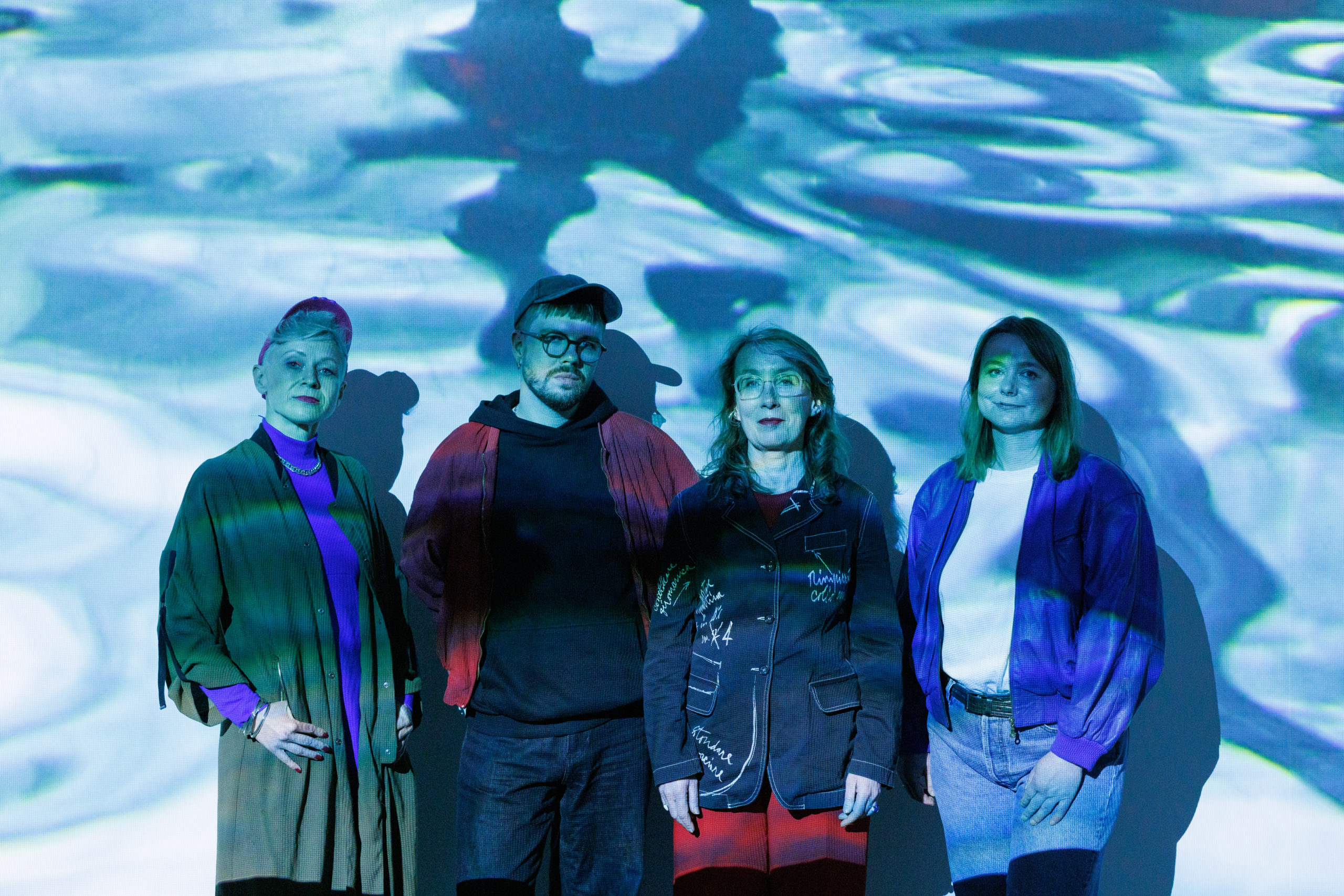
The project had begun to take shape long before this year’s Biennale through a series of collaborations, artistic experiments and shared ideas. Looking back at its development, Bogna Burska and Daniel Kotowski discuss years of working together, artistic experimentation, the concept of Deaf Gain, and the evolving meaning of national representation in the context of the Venice Biennale.
Daga Ochendowska: For readers who have not yet had a chance to visit the Polish Pavilion, what kind of experience is Liquid Tongues? What does the viewer see, hear and feel from the moment they enter the exhibition space?
Bogna Burska: Upon entering the pavilion, the viewer finds themselves between two screens and is immediately enveloped by sound. Liquid Tongues is a two-channel audio-video installation. One screen, rectangular in shape, is positioned at eye level. The other, in the form of an irregular trapezoid, is suspended above the viewers’ heads on the opposite side of the pavilion. Between them, there is a wide seating platform. One can sit and focus on a single screen or step back and watch both simultaneously.
Both videos last exactly thirty minutes and are synchronised with one another. The audience is immersed in a multichannel sound environment, and during the refrains, the sound is accompanied by vibrations that can be physically felt.
In the videos, we see Chór w Ruchu (Choir in Motion), whose members sing and sign both underwater and above water. They perform a poetic libretto while simultaneously attempting to interpret the communication of humpback and sperm whales in International Sign and in English. Or rather, they are imagining what such an interspecies translation might look like.

DO: Could one say that Liquid Tongues grew out of a desire to expand the very notion of communication? Where would you locate the origins of this idea?
BB: That depends on how far back we want to go. Perhaps it began in 2018, while I was working on my play Bunt Głuchych (The Rebellion of the Deaf) at Zachęta – National Gallery of Art in Warsaw. During the production, together with Marta Kalinowska, a Polish Sign Language (PJM) interpreter, we came up with the idea of creating a choir that could sing and sign simultaneously, along with the dream of creating a group composed of hearing and Deaf participants. Daniel Kotowski was a consultant on the project. We only managed to realise it in 2025 in Bunt Głuchych. Odnowa (The Rebellion of the Deaf. Renewal). Daniel curated its first revival, while Ewa Chomicka supported the development of the choir throughout its different iterations and accompanied me in pursuing this idea.
Another important moment came with my experiments in underwater filming in the Bay of Puck in 2024. I started trying to speak underwater and realised that people who sign retain their communicative abilities there, unlike those who rely on sound. This inspired me to make a video in which Daniel and I communicate underwater. I speak while Daniel signs, reversing the usual hierarchy between spoken and signed communication. We filmed it in the summer of 2025 under the title Oddychaj (Breathe), with Magda Mosiewicz behind the camera and Jola Woszczenko curating the project.
Around the same time, I watched the documentary Fathom (2021), which explores whale communication. I called Ewa Chomicka and said that a choir working across spoken and signed languages should attempt to interpret these codes, songs and calls. I became fascinated by the possibility of a form of communication that extends beyond the human and imagined a human vocal-sign superlanguage that might help us understand other beings and, quite simply, allow us to think more expansively.
For a long time, I have also been preoccupied with the thought that, on the one hand, linguistic barriers remind us of how fundamental communication is. On the other hand, we constantly see that sharing a common language does not guarantee understanding or peaceful coexistence. I am equally fascinated by the extent to which language limits and shapes our thinking, and by how difficult it is to move beyond it. I feel close to William Burroughs’ notion of language as a virus, Eduardo Kohn’s reflections on forms of communication that exceed the human world, and Nick Enfield’s thinking on how language organises social relations.
I became fascinated by the possibility of a form of communication that extends beyond the human and imagined a human vocal-sign superlanguage that might help us understand other beings and, quite simply, allow us to think more expansively.
Daniel Kotowski: I would like to add something regarding underwater communication. Signing underwater is nothing new to me. Within Deaf communities, we know that we can communicate under a wide range of conditions: underwater, in noisy environments, in spaces full of echoes, or even through glass. This is one aspect of the concept of Deaf Gain, which has taken many forms around the world. Unfortunately, most people simply do not see this or are unaware of it.
Deaf Gain invites us to understand deafness not through the lens of loss but through the knowledge and capacities that Deaf communities contribute to our shared world. Many things we now take for granted – from film subtitles to side-view mirrors in cars – have emerged from the needs and experiences of Deaf communities.
I also often think about Michel Foucault’s concept of biopower, which informs my practice. I think about how mechanisms of power and social norms shape what becomes visible and what is recognised as knowledge. Within such structures, Deaf Gain and Deaf voices are often marginalised or remain invisible. And this concerns not only Deaf people, but many other groups as well.
Many things we now take for granted – from film subtitles to side-view mirrors in cars – have emerged from the needs and experiences of Deaf communities.

DO: Your project is about communication, yet it also seems to be the outcome of an exceptionally complex communicative process in itself. How did you build this collaboration?
BB: The project expanded on ideas that had emerged through the aforementioned collaborations. The reversal of communicative hierarchies between spoken and signed language was already present in Oddychaj (Breathe). Daniel expanded this idea through the concept of Deaf Gain, opening it up to other forms of knowledge and value that emerge from deafness.
Ewa Chomicka and Jola Woszczenko developed the project curatorially and were deeply involved in its artistic decision-making processes. Magda Mosiewicz was responsible for cinematography, Alicja Czyczel for choreography, and Aleksandra Gryka for the musical composition. The film also features the accomplished freediver, Natalia Wilk. Alicja and Daniel worked on the choreography and on developing new signs, while I was largely responsible for running the film set.
A very large team contributed to the production. Katarzyna Szczerba and Michał Kupicz oversaw the sound. We also had remarkable production support, both from Zachęta and the film production team. Magda Mosiewicz supervised the cinematography together with a team of camera operators and people responsible for lighting. The editing was done by Maja Ziarkiewicz, while the colour grading was created by Magda Niziel. Chór w Ruchu (Choir in Motion) and the sign language interpreters also did extraordinary and deeply committed work.
As you can see, it was a highly complex production. The four of us – the two artists and the two curators – were responsible for the project’s conceptual framework and for bringing all these elements together into a coherent whole.

DO: How does Liquid Tongues engage with the idea of In Minor Keys proposed by Koyo Kouoh?
BB: For us, Koyo Kouoh’s curatorial text In Minor Keys is not solely about the minor key as a musical mode. It is also about amplifying quieter voices and pausing long enough to hear them. In this sense, our project responds to her proposition quite directly. We are trying to show how much richer reality becomes once we begin to listen to voices that are routinely overlooked.
I often think about how long it takes us – the undeservedly privileged majority – to recognise values that have always existed alongside us. In this case, these are voices that enrich our world.
For us, Koyo Kouoh’s curatorial text In Minor Keys is not solely about the minor key as a musical mode. It is also about amplifying quieter voices and pausing long enough to hear them.
DK: What is overlooked are not only voices, but also the knowledge and value of the experiences of marginalised communities, which have long been co-creating our world, even though their contributions often remain invisible. We want to draw attention precisely to these ‘building blocks’ – to their significance and to the need to recognise them.

DO: I cannot resist mentioning the pair of seagulls that built a nest right outside the entrance to the Polish Pavilion and, for several weeks, became its unexpected co-inhabitants. Do you see this situation as an unintended yet meaningful commentary on a project devoted to communication and coexistence?
BB: Seagulls are wonderful! We feel honoured that they chose our pavilion. I was very worried that they would not withstand the crowds during the opening days, but they remained completely unfazed.
When the chicks hatched, we had to give up a large portion of the area around the nest because the parents defended their young fiercely. I would like to think of this as a sign that coexistence with other species is possible and that we do not have to keep displacing them so radically.
DK: It was quite an amusing experience. While installing the exhibition, we started looking into which species of gull it was and discovered that it was a European herring gull. We also wondered how long it takes for the eggs to hatch and found ourselves observing the pair and their routines around the nest.
At first, many people did not realise they were dealing with a wild animal. We were surprised that some even thought the gull was part of the installation or a form of performance. We had to keep explaining that people should not get too close, feed the birds or interfere.
After returning to Poland, we kept waiting for news of whether the chicks had hatched. We became emotionally attached to this little gull family. Had they not nested there, we probably would never have learned what life in such a place looks like for them. In a way, we entered into a kind of interspecies relationship.

DO: How do you see this project within the framework of the national pavilion – a format that, by definition, is based on distinction and representation? Did this framework feel like a limitation to you, or rather something to be critically reworked?
BB: I had been thinking about the ideas that shaped this project long before the national pavilion came into the picture. They were not conceived with a national pavilion in mind but emerged simultaneously across several different projects.
What ultimately took shape was a proposal that speaks about communication in the context of a national pavilion not only through the various forms language can take, but also across species. It is a utopia, but also simply a dream. At the same time, a number of research initiatives, such as CETI (the Cetacean Translation Initiative), suggest that this dream is already being pursued in certain ways. It can come true.
In this sense, the national pavilion becomes a space for thinking about an order of the world that clearly exceeds political and national divisions.
DK: More than in the concept of the national pavilion or nationality overall, we were interested in the question of what communication is and how many forms it can take.
As Deaf people, we experience every day that communication is not limited to a single system or mode of expression. That is why language itself, and the search for new forms of relation and understanding, became our point of departure.
As Deaf people, we experience every day that communication is not limited to a single system or mode of expression. That is why language itself, and the search for new forms of relation and understanding, became our point of departure.

DO: At the same time, this year’s controversies surrounding the Russian and Israeli pavilions once again reminded us that national pavilions are never neutral spaces for presenting art. Have situations like these changed the way you think about what it means to participate in this format today, and about the responsibilities that come with representing a country through art?
BB: I think that whenever geopolitical and national frameworks come into play, they inevitably bring with them a whole web of dependencies, interests and conflicts. Serious difficulties arise from trying to reconcile these different forces. This year’s events made that particularly visible, although, in truth, this is always the case.
Together with the Ministry of Culture and National Heritage and Zachęta, we signed a letter of protest against the presence of the Russian Pavilion in our capacity as the artistic and curatorial team representing Poland. As private individuals, we also signed a protest concerning the Israeli Pavilion. We closed the pavilion for several hours to take part in a pro-Palestinian demonstration, and encouraged others to visit the Ukrainian Pavilion.
Even so, it is difficult to feel at ease with the situation as a whole. I have a sense that the Biennale Foundation handled the situation in a deeply troubling way and forced all participating individuals to confront this tension continuously.
DK: Yes, I agree with what Bogna is saying. In situations like these, it is difficult to speak of a single experience or a single perspective. Public attention becomes concentrated around major political conflicts because the mainstream almost always gravitates towards already dominant issues.
At the same time, when all attention is directed towards those conflicts, quieter voices become even more marginalised. This creates a tension with Koyo Kouoh’s proposition, which invites us to listen precisely to those experiences and perspectives that remain at the margins, including those of Deaf people.
In this sense, the situation of the Biennale is full of contradictions.

DO: After experiencing this year’s Biennale, I would like to ask something more personal. Has participating in a national pavilion changed the way you think about representation? How do you navigate the role of becoming, willingly or not, a symbolic representative?
DK: I can speak only for myself here. I do not think of myself as a representative of a national pavilion.
Two things are particularly important to me. The first is that, during the Biennale, I can use my own language – sign language – in a space where spoken language is dominant. I do not adapt myself to a phonocentric environment. For me, this is an affirmation of the presence and visibility of sign language within that space.
The second is empowerment for the Deaf community, especially for people and groups who experience multiple forms of marginalisation. I am thinking of those who often do not have the resources or the space to stand up and say, ‘I am here.’ People who rarely have an opportunity to see their identities reflected in public space.
During the Biennale, I met a Deaf person from Chile who communicates through sign language. They were deeply moved. I knew exactly how they felt.
During the Biennale, I met a Deaf person from Chile who communicates through sign language. They were deeply moved. I knew exactly how they felt.

DO: The project is devoted to communication, but were there moments during the process when communication between you broke down?
DK: Yes. We live under capitalism, which means that everything is expected to be fast and convenient. Capitalism operates through a logic of constant acceleration. Spending time communicating with someone who does not use spoken language is often considered inefficient because it requires greater concentration. You have to write, wait for a response, and devote time and attention to the exchange.
We have developed ways of communicating that allow us to understand one another without major difficulties, but only when there is no pressure of time. In this project, most of the team consisted of hearing people who communicate through spoken language, and, at the same time, we were working under significant pressure from deadlines and successive stages of production. Fortunately, we were accompanied by sign language interpreters throughout the process.
At times, we did not understand one another, but not because we were unable to communicate. Rather, it stemmed from differences between the structures of sign language and spoken languages, as well as from different ways of thinking shaped by them. In those situations, we simply had to devote more time to explaining things to one another.

DO: After several weeks of the pavilion being open, was there a response from visitors that surprised you or challenged your own expectations of how the work would be received?
DK: One thing that surprised us was that audiences applauded after the film ended. Of course, applauding after a performance is a well-established convention in theatre, but here we are dealing with an exhibition. So, for us, it was quite an unexpected experience.
There was also a comment that disability should make the viewer feel uncomfortable. I keep wondering what that actually means. Does it mean that there has to be an image of suffering for the audience to feel guilt, compassion or pity?
I therefore ask whether disability really has to be represented through the lens of suffering. What mattered more to me was that some viewers recognised the knowledge, skills and forms of communication present within Deaf communities.

DO: To conclude, is there anything that had to remain outside the pavilion? Was there an aspect of the project that could not ultimately be translated into the exhibition?
DK: We have underwater footage of a dialogue between Bogna and me, but in the end, we decided not to include it. This was mainly due to the film’s running time and the fact that these scenes did not fit coherently within the overall narrative of the work.
Although we were sorry to leave them out, we are happy with the final version of the video.