



What happens when an extinct species returns to a world governed by the logic of the capitalist market? In Mateusz Pecyna’s graduation project Ex Utero (2025), a resurrected mammoth quickly becomes a biotechnological product, even a source of scent to be bottled as perfume. Using speculation, absurdity and digital media, the work turns the idea of de-extinction into a reflection on the contradiction of contemporary society and the systems that shape it.

Pecyna’s work received the Contemporary Lynx Magazine Award at this year’s Best Art Diplomas competition, organised by the Academy of Fine Arts in Gdańsk. Following the award ceremony, we spoke to Mateusz about whether art can still challenge the systems it is part of, how humour and absurdity can help confront helplessness, and what it means to use technology critically while remaining entangled in its contradictions.
Daga Ochendowska: Mateusz, your awarded work Ex Utero explores what happens when the prospect of bringing a species back to life meets the logic of the capitalist market that turns the specimen into a product. Does speculation offer you a way of taking the logic of reality to the point of absurdity, in order to better reveal the mechanisms already at work within it?
Mateusz Pecyna: Speculation is, for me, a kind of contemporary mythmaking. Today’s information overload leaves us without the context that would give depth to the images and narratives we absorb. Speculation allows me to construct short stories which — whilst rooted in particular contemporary phenomena — reveal entirely universal themes beneath their surface. Although Ex Utero focuses on the very specific phenomenon of de-extinction as developed by Colossal Biosciences, I have attempted to situate it within a broader perspective by asking how we have even arrived at such an absurd point in history. I believe this was one of the most important aspects of this work.

DO: Your works tackle contemporary issues — from the development of new technologies to the mechanisms of capitalism — yet at the same time they do not leave the art world itself outside their scope of criticism. Although they possess a clear critical potential, you often resort to fiction, irony and the absurd. How do you personally understand the critical nature of your art?
MP: I think art has already lost the critical potential that was present in the historical avant-garde movements. The market has taken over this sphere, and it is no longer just collectors but also large corporations that are bringing artists and institutions under their control, in a sort of “partners-in-crime” arrangement. This is, of course, an active process, yet the capital in question seems to be doing just fine without any major obstacles, and even with public approval. Perhaps the belief in art’s revolutionary potential was itself a naïve utopia and one that underestimated the rules of the world beyond its boundaries.
On the other hand, I get the impression that art is sometimes treated too seriously from the perspective of capitalist labour logic. Although the professionalisation of this sector brings artists tangible benefits (more stable rights, better pay, institutional support), I am not sure of the final outcome of this game. Art is drifting further and further away from life — it has become a self-referential, hermetic system closed to outsiders. My works are also entangled in this issue, and I actually strive to expose it through them, using devices known from mass culture. In this way, I attempt to dismantle the framework in which I operate and reclaim at least a semblance of autonomy.
Art is drifting further and further away from life — it has become a self-referential, hermetic system closed to outsiders. My works are also entangled in this issue, and I actually strive to expose it through them, using devices known from mass culture.
I would thus describe my art as “problem-oriented” rather than “critical”, because instead of maintaining a moralising distance, it prefers to explore the tensions in which it is entangled, whether it likes it or not. This is how I created Earth Rescue Kit, my latest work, in which — with the help of Krzysztof Gol — I devised a kit in the form of a portable rucksack to protect the world from global warming. This project was developed as part of the European programme Heritage Lens, which brought together twelve artists from various countries and comprised three workshop sessions: in Łódź, Riga and Seville. My work addressed the issue of so-called eco-guilt — that is, how corporations cleverly shift systemic blame onto individual consumers by selling us yet more products designed to ease our guilty consciences. The question is, however, whether the grant that financed my work is not, in fact, also based on a similar premise at the level of cultural policy, thereby creating a carbon footprint disproportionate to its actual impact on the crisis in question.

DO: I have noticed that you often use very appealing, sometimes even amusing, forms to portray disturbing phenomena. This contrast can leave the viewer feeling bewildered — it is not entirely clear whether one should laugh or feel uneasy. Are you interested in the way contemporary culture is able to transform even its own crises into something we want to watch, consume or perhaps even crave?
MP: Exactly. I am very interested in how certain ideas or ideologies find their physical reflection in the form of a product, and how that product then has a reciprocal effect on consumers. In my opinion, the emotions evoked in this way are far more significant than one might think. In my works, I often try to confront the viewer with this dilemma — the juxtaposition of content and emotion in a given representation. This cognitive dissonance brings out something that particularly interests me: the realisation that we are doing wrong often does not stop us from continuing to act in this way. That is exactly why, instead of lecturing the viewer, I try to join them in deconstructing the mechanisms that cause our rational judgement to falter.

DO: Simulation is a recurring theme in your work. It is often difficult to tell where reality ends and your own version of it begins. Are you specifically interested in blurring that boundary?
MP: Yes, although I would reverse the question I am seeking an answer to: Where does fiction end and reality begin? We live in a culture of self-references, riddled with simulacra and algorithms that control our choices. Reality mimics films and computer games, reproducing not only their content but even their visual forms — just think of the footage from the war in Ukraine. All of this desensitises us. Despite the ubiquitous suffering pouring out of our devices, we retain the perspective of a player, emotionally separated by the screen, our interface.
Where does fiction end and reality begin? We live in a culture of self-references, riddled with simulacra and algorithms that control our choices.

DO: The use of AI remains controversial, and for some artists, it is a completely unacceptable tool. You use it very freely and incorporate it into your practice, which also caught my attention during the Best Art Diplomas exhibition. How do you reconcile your critical view of this technology with your decision to use it yourself?
MP: I am not surprised that the use of AI in art is controversial. After all, this is a technology based on the theft of intellectual property and the consumption of enormous human and environmental resources. Another problem is AI-generated content flooding the internet with a tsunami of slop, deepfakes and fake news. My perspective here is somewhat pessimistic in a sense that I believe this race was lost long ago — we are dealing with a machine so powerful that no force can stop its development, and it is not individual consumers who will determine the pace of this process.
As an artist, I do not want to exclude myself from this discourse, but rather to contribute to it and seek out applications of artificial intelligence that expose its inherent dangers.
However, many questions remain unresolved regarding the policy on AI use. As an artist, I do not want to exclude myself from this discourse, but rather to contribute to it and seek out applications of artificial intelligence that expose its inherent dangers. For this reason, I use this tool with caution — not to add to the aforementioned slop, but to open up new dimensions and contexts for it.

DO: Your projects take many different forms — from photography and video to objects, installations and digital simulations. I wonder what actually determines your choice of medium. Do you search for a form that can best portray a given phenomenon, or rather one that is itself part of the mechanism you want to show?
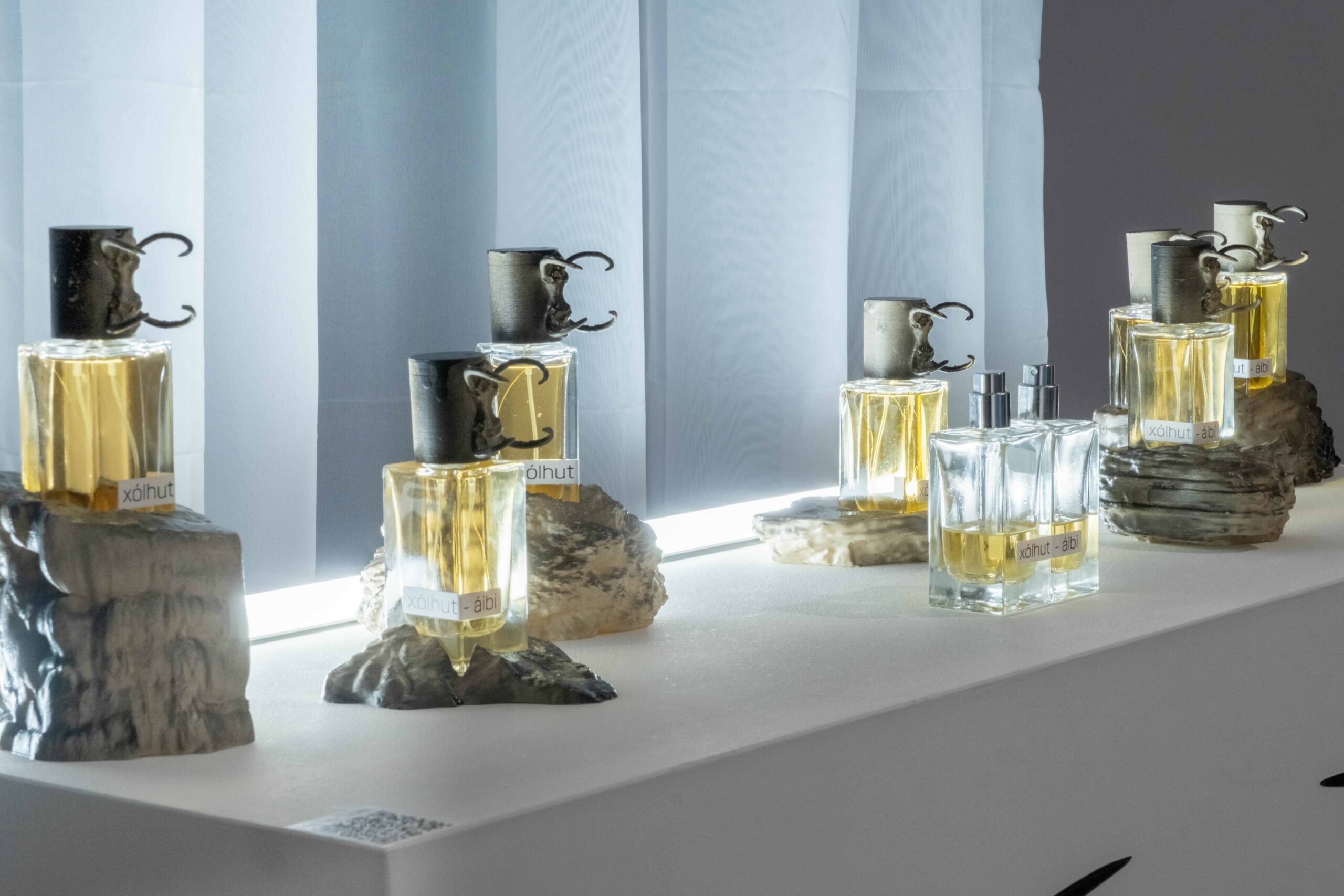
MP: Although working with video comes most naturally to me, I always try to choose the medium that best suits the phenomenon I am exploring at the moment. The criteria for this choice vary, but they usually originate from my immediate surroundings. For example, my ambivalent attitude toward the sudden surge of interest in niche perfumery among people in my circle indirectly led to the creation of the work xólhut-áibi — the scent of an extinct mammoth — developed in collaboration with the perfumer duo Martyna Oleszczak and Anna Cendrowska.
Besides, I often work by breaking down a given topic into smaller elements and building the project like a constellation that comes together as a coherent whole only when arranged in a space. It is important to me that the variety of techniques I use engages the viewer and allows them to explore the exhibition rather than simply passively observe it.
DO: When I examine your works, I get the impression that they often begin with a juxtaposition of things that, at first glance, seem to have little in common. In What’s the Point?, the art world meets FIFA, and in Take-away, the reality of a courier’s job enters the museum. Do you notice similarities between these distant phenomena first, or do such associations only emerge as you work?
MP: I think this is a matter of how I perceive reality. Back in school, I was never good at memorising things. To remember something, I always needed a model, an experience or a suitable analogy. Otherwise, my brain would reject new information, demanding a deeper understanding of the mechanism.
What starts as an intuitive association or a joke usually leads me to discover a broader structure and to deconstruct phenomena I previously had no idea even existed.
In art, that model for me is reality, or just everyday life. When I explore a given problem, I look for its symptoms in my own surroundings, and I have to admit that I have never been disappointed yet. What starts as an intuitive association or a joke usually leads me to discover a broader structure and to deconstruct phenomena I previously had no idea even existed.

DO: Would you agree that the absurd is part of your artistic sensitivity? What roles do sense of humour, pleasure, and fun play in your thinking about art?
MP: Yes, I think I agree. The absurd also has a therapeutic role for me — it helps me both distance myself from reality and immerse myself in it. It helps me to persevere in it despite everything. My ideas naturally arise from this feeling, balancing between analysis, research and, indeed, a sense of humour or fun. Although one might accuse me of trivialising problems, I would argue quite the opposite — a problem only becomes serious when we measure it by “human standards”. This is, in fact, a debate that reminds me of the Polish pavilion at the 2024 Biennale and the work Repeat after Me II by the Open Group collective. The physical constraint that dominated the pavilion, the children’s laughter, and the tragedy of war in the background created an unbearable tension that, paradoxically, allowed one to touch upon this trauma much more deeply than with any traditional narrative. This demonstrated that humour and playfulness do not have to undermine the gravity of a subject — they can become the only available tool for confronting helplessness.
Moreover, humour plays an important cognitive and communicative role — it enables the successful synthesis of often complex ideas into a concise form, as perfectly exemplified by contemporary memes. When it comes to my work and ideas, I try to ensure that this element is present from the very beginning. I know the viewer has much less time than I do to get acquainted with a given topic, so in this case, humour serves as a key that helps them quickly navigate their way around it.

DO: Your works move freely between the aesthetics of scientific experimentation, internet culture, advertising and science fiction. I am wondering what shaped your visual imagination. Do you feel closer to the traditions of the visual arts, or to the images and narratives you grew up with outside the art world?
MP: Before I began my art studies, my cultural experience was minimal. This meant I had to learn very quickly to make up for what I lacked compared to my peers. My lack of prior cultural education made me absorb images with great fascination, but also with a sense of distrust — after all, this wasn’t “my world”. It seems to me that my sensitivity was formed right there, and that is where it remains to this day — at the intersection of these two realities. Today, I feel much more confident in the realm of visual art than I do among the registers I grew up with; yet it is precisely those early codes that give me a sense of distance from it, preventing me from forgetting the life that goes on outside of the gallery sphere.
Today, I feel much more confident in the realm of visual art than I do among the registers I grew up with; yet it is precisely those early codes that give me a sense of distance from it, preventing me from forgetting the life that goes on outside of the gallery sphere.

DO: It has been an intense year for you — awards and honours, the presentation of Ex Utero during Warsaw Gallery Weekend, and now you are starting your studies in Leipzig. Can you tell us about your plans for 2027?
MP: Oh, a lot has happened this year — to be honest, now I am hoping for a little rest. My next step is a postgraduate program (the so-called Meisterschüler) at the HGB Leipzig under Professor Anna Ehrenstein. I really appreciate her uncompromising approach, and I believe this collaboration will help me better define my practice. Leipzig also has excellent workshop facilities, so I will certainly continue experimenting formally. As for exhibition plans, in early 2027, my class and I are preparing a joint project for the European Month of Photography in Berlin.