




For decades, Sopot has been balancing between its two identities: a seasonal resort and a cultural hub. The pier, the beach, restaurants, music and theatre stages are all embedded in a scenography of Art Nouveau architecture, the forest, and the landscape of a coastal town. Over the years, however, besides the tourists craving a holiday adventure, the town has also attracted painters, filmmakers, and writers, becoming a vital destination for artistic bohemia.

Nowadays, especially in the summer, this spirit seems to have been pushed to the margins – it is muffled by the loud restaurant gardens, which effectively draw the attention away from the cultural spaces. Regardless – or perhaps because of this – Sopot is ever more clearly fighting to establish its artistic identity. Independent venues are springing up in the side streets, rewriting the town’s cultural map. One of them is Splot Gallery – a thriving contemporary art space located in a beautiful old townhouse, just a few blocks from the sea.
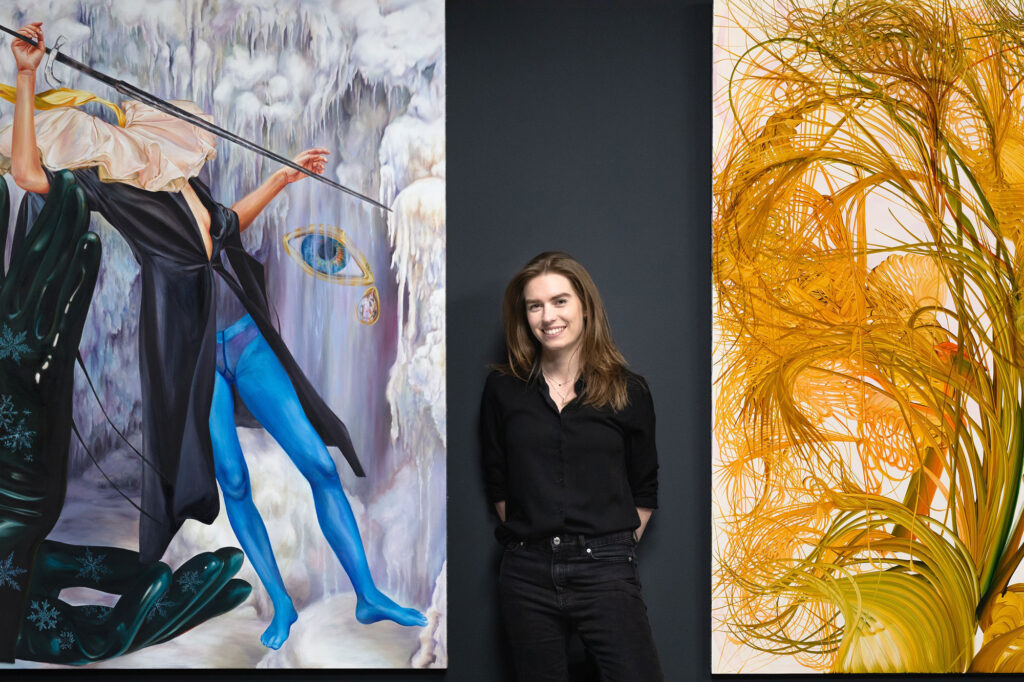
I went to Michał Wirtel’s exhibition Transitions on a July day that was anything but summery. Heavy rain accompanied me from the train station to the gallery door, giving the exhibit title an almost symbolic meaning. Inside, a peaceful, meditative display awaited, and it quickly calmed and enveloped me in its aura. I was welcomed by Małgorzata Popinigis, the owner of Splot, who told me about the beginnings of the gallery, their plans and collaboration with Michał, who was absent due to a plein-air painting workshop.
The conversation with the artist took place a week later, at our common alma mater, the Academy of Fine Arts in Gdańsk, whose origins can be traced back to Sopot and Berger’s villa, located just a few steps away from the townhouse where the Splot Gallery operates today.

Daga Ochendowska: Let’s start with the title of your exhibition. What does it mean to you? What kind of transitions did you have in mind – a spiritual, existential, or painterly?
Michał Wirtel: A little bit of everything. The concept itself was conceived in the period before Easter, which is, after all, a time for a symbolic transition from death to life. This theme resonated strongly within me then. But the exhibition is also about other transitions, such as those in colours. Earlier paintings were bright and yellow, and now, in Sopot, there are also darker tones from that series.
Transition as a process, as a way of functioning. Human life – from birth to death – is also a transition. It is also a continuation of the Glimmer series, which I have been working on since 2023. At first, it was a formal experiment – light, brightness – and now it has all started to branch out. It is not a fixed form, but a constant transition. Anyway, I like the word itself – “transitions” – it reminds me of childhood, some secret passages, hidden paths. It is very broad.
D.O.: In your art, the theme of light frequently appears not only as a formal effect, but also as a spiritual one. Is the light in your painting related to the sacred, the metaphysical? How do you understand it?
M.W.: It’s multi-layered. Light fascinates me as a physical phenomenon – something that allows us to see colours, space, other people. We have a mechanism inside us allowing us to see, and it is amazing in itself. But light also has a spiritual dimension. In Catholicism, it is associated with seeing and understanding. With perceiving reality more broadly, more deeply. To me, light is something that connects the material with the immaterial.

D.O.: Is the spirituality that permeates your art the result of specific practices? Would you call yourself a believer?
M.W.: Yes, I am a Catholic, and it is my starting point. But over the years, my painting has evolved. It was once firmly rooted in a liturgical, sacred space. Nowadays, I see it more as a record – sometimes almost intimate, personal, like a diary. It is still spiritual, but secular. A record of experience.
D.O.: In Sopot, specific memories and objects are the starting point for many works: Ginger, Tulips, Rwanda. What happens when you turn personal memories into a painting? Is it a form of catharsis?
M.W.: It is not a form of purification or therapy. Rather, it is a record. I document a moment, a person, a situation. Each painting has its own story and goes through several stages of life – from concept, through painting, to the encounter with the audience. I am happy to talk about what I paint, about specific paintings, but I don’t think everything needs to be told and explained – I want the viewer to have space for their own experience. For their own adventure with the painting.
” I see it more as a record – sometimes almost intimate, personal, like a diary. It is still spiritual, but secular. A record of experience.”
— Michał Wirtel
D.O.: So your paintings are of a contemplative nature?
M.W.: Yes. I think this encounter – calm, silent, unharried – is the most important.

D.O.: At the Splot Gallery, you are also showing new, much darker paintings. Does this change in colour reflect your inner state?
M.W.: It was a rather natural turn. From the very beginning, when I was planning this series, I felt that I needed to open up to a different palette – a darker and deeper one. Light is also present in the darkness – if you can distinguish a form in a dark painting, that means that light is still working.
D.O.: You created a mural inspired by Herzog’s film on one of the walls of the dark part of the exhibition. Albino crocodiles. What did you find moving about this metaphor?
M.W.: Have you seen this film?

D.O.: Yes, but unfortunately only in 2D.
M.W.: So have I, but I adore this film! Cave of Forgotten Dreams. I also show it to my students in my psychophysiology of vision classes. I think it is a particularly important work – not only for artists, but for everyone. Herzog brilliantly constructs the narration. The ending – where the crocodiles are – is such a plot twist – a clash with the abyss of misunderstanding between us and the people from thousands of years ago.
D.O.: Do you think that if, as a result of some event, the Splot Gallery were to be hibernated with your paintings for 20,000 years, would anyone in the future be able to understand them?
M.W.: I don’t think so. Similarly to Herzog’s film – without any records, we will probably never know what the group handprints on the cave wall meant. Without context, my paintings would also be incomprehensible. This is why conversations, records, and meetings are so important.

D.O.: In one of the curatorial reflections for your exhibition, there is a sentence: “Nothing is real, nothing is certain”. Despite this, are you still searching for some form of permanence, or have you accepted that Creativity, like life, is a constant process of change and groping in the dark?
M.W.: I think that one does not exclude the other. Spirituality gives me a solid foundation – both a floor and a ceiling. But the outside world, politics, the body, time – these are fragile. You cannot predict what will happen next month. Spiritual life allows me to find my place in all of this.
“Without context, my paintings would also be incomprehensible. This is why conversations, records, and meetings are so important.”
— Michał Wirtel
D.O.: How do you see the future of yourself and art in a world full of crises?
M.W.: The world is suffering – both spectacularly and quietly. There are wars and conflicts, but also human loneliness, which is not so easy to notice. I see for myself how easy it is to reach for the phone and to drown yourself out. Perhaps the time will come when people, tired and wounded, will begin to seek meaning anew in spiritual life. Extreme moments often lead us to this.

D.O.: Are the scenes you show in your paintings such borderline moments?
M.W.: No. They are rather everyday moments – encounters, real-life situations. Before that, I felt tempted to tackle big topics – death, suffering – but I think it was beyond me. It was too broad, too difficult to capture. Now I focus on the little things. The Glimmer series, which I have been developing for two years now, allows me to still talk about important things, such as life and death, but from a personal perspective.
D.O.: Are you going to continue developing this series?
M.W.: Yes, definitely. It’s my own technique, and each painting becomes material for another microseries. I painted Aloe, and it left me unsatisfied – that it is just a single take. And yet these [aloes] are such interesting forms – organic, with thorns, with a smooth surface. I could create 50 paintings of them alone. Like Damien Hirst did with trees! I feel that, if time allows, I will continue painting this series for many more years to come.

D.O.: Has your collaboration with Splot Gallery opened up a new field of activity for you?
M.W.: Yes! For me, it was an opportunity to experiment. An exhibition in an old townhouse was like being in a laboratory to me. There was a suggestion to refurbish both rooms, but when I saw those shabby walls, I thought: this is perfect! Here I can play with a dark palette and mural. I think it worked. It opened up new possibilities. The very form of this space – with the rooms and doors – is itself a kind of transition. In fact, I thought of the title when everything was almost ready.
D.O.: Are you already planning your future exhibitions?
M.W.: Yes. I am working on a series for my doctoral dissertation. It will be its culmination. I hope it will be possible to see it soon.
D.O.: In that case, I wish you perseverance and good luck.
M.W.: Thank you very much. That is the plan.
Translated by Beata Ekert