






Like an open wound, ruddy-crimson paint leaks out of its thick impasto surface, carving out the word “flesh”. Pulsing with energy, colour springs from the ash black, like a volcanic eruption. It breaches the borders of the canvas, refusing to stay within the tight pictorial frame. Flesh (2017), one of the works on display in Mira Schor‘s first UK solo exhibition, WET/London, epitomises the artist’s unique, undefinable body of work.

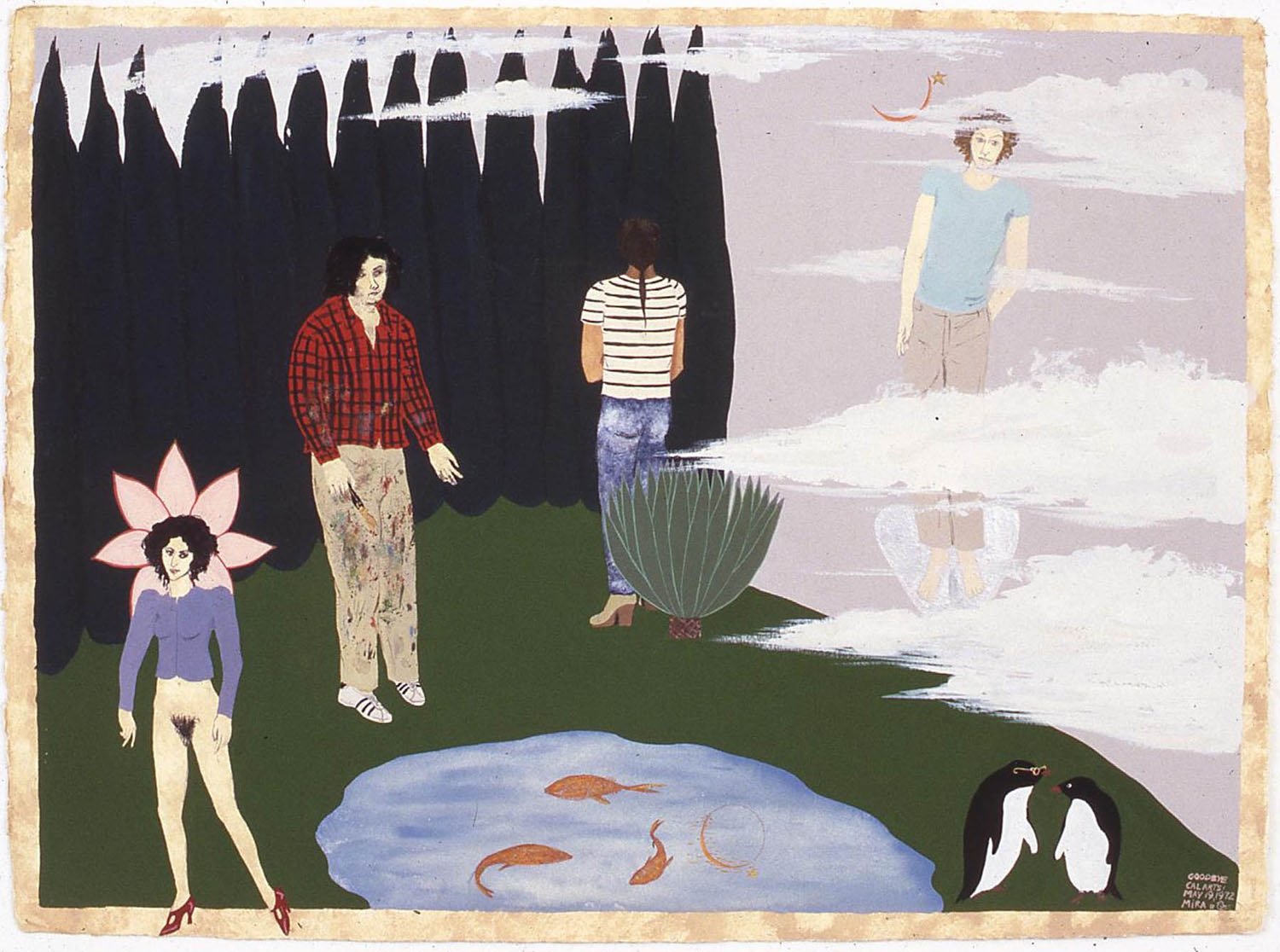
An artist, writer and feminist, Schor has delivered a biting critique of the art canon for over fifty years. After graduating from CalArts with an MFA in painting in 1973, she began exalting the corporeality of her materials through amorphous, bodily compositions. Her visual language stands out in a medium traditionally dominated by men — from the haunting, veiled and masked visages of her 1977 and 2025 Masks series, which recall the psychosexual portraits of the late Carol Rama or Marlene Dumas’s bleeding watercolour apparitions, to the flat mise-en-scène of early works such as Graves (1973) and The Two Miras (1973), set in wild landscapes. Her incisions into the male-dominated discursive fabric extended to writing, too. Alongside her contributions to the CalArts Feminist Art Program, where she studied with Judy Chicago and Miriam Schapiro, in 1986, together with her friend and co-editor Susan Bee, she established her own magazine, M/E/A/N/I/N/G, publishing critical texts by voices cast out of the mainstream art press.

Daughter of Polish-Jewish refugees, Schor’s work carries extra political weight, intensified by the climate in the United States after 9/11 and since Trump’s inaugurations. She spills her incisive thoughts into her writing, including her blog, A Year of Positive Thinking and, more recently, on her Instagram, which offers survival strategies in a world set on division. Like Patti Smith’s Instagram account, it reminds us of the power of a single voice to effect positive change. Schor is, as such, a quiet force to be reckoned with. Straddling painting, academia and political activism for decades, she remains an enigma — a little like what Roland Barthes, writing on photography, once called a “message without a code”.
Schor’s exhibition opens on 9 October 2026 at Mimosa House in London. Ahead of the opening, we spoke to the artist about her continual need to create, the importance of political activism within online communities, and the magical slipperiness between the pen and the paintbrush.
Maggie Kuzan: It’s almost thirty years since the publication of your work, Wet: On Painting, Feminism, and Art Culture (1997). Why did you decide to revisit the word Wet and use it as the title of your London show?
Mira Schor: It was suggested by Mimosa House, and at first I thought it was an old premise, as I’d composed many of the essays before ’97. It references debates within feminist art that I don’t think are as relevant today, namely people saying “women shouldn’t paint; they should just do photography.” That was basically the ’80s in a nutshell. But then, I reflected that Wet is what carried my name across the ocean. I’ve spent maybe two or three days of my life in London, and I’ve never shown work here, so I decided on WET/London to shake things up a little and situate the work in a new place.
It references debates within feminist art that I don’t think are as relevant today, namely people saying “women shouldn’t paint; they should just do photography.” That was basically the ’80s in a nutshell.
MK: You’ve also spoken about the leakiness, or the viscosity, of women’s art — is that correct?
MS: I write about certain notable male critics’ disgust with the “goo” of painting in an essay called FIGURE/GROUND (1989), one of the major texts I wrote in the ’90s. One time, at the post office in Tribeca, I ran into a slightly older painter friend, who painted thick abstractions and had a strong Southern accent. He drawled, “I just love your article about goo.”
I rang a bell at a moment when the critique of painting was very dominant, even though paradoxically some young male painters were prized. Men could critique it because they were doing photography, and Women like Cindy Sherman, Barbara Kruger and Jenny Holzer were favoured, so I started writing about painting and sculpting. Those conditions have changed tremendously, but it’s interesting to me that of all my books, Wet still holds currency. After 29 years, it’s still in print, and I’m incredibly proud of that.

MK: You were a student at CalArts in the Feminist Art Program in the 1970s; you were also one of the contributing participants of Womanhouse (1972), a site-specific installation questioning what constitutes suitable art material. Thinking of the word “house”, what was going through your mind when planning the site-specific painting for this show? What does the architectural symbolism of the hearth signify to you?
MS: It never really occurred to me. I was much more interested in doing a much bigger painting than I normally do. The curator, Daria Han, showed me a video of the space, with a back wall and a balcony you could look out from, and all I thought was how interesting it would be to stand on the balcony, at the same level as the painting. It was as simple as that.
I chose a work with the most brilliant colour. It has a cartouche of text in it, a thought bubble coming out of the pubic area of a non-representational, elongated figure, which reads “at risk”. It’s all appropriated language I’ve been working with since Trump came into office the second time. Within a couple of months, PEN had published a list of banned words that the regime was evidently trying to delete from government documents, and I incorporated some of them, “risk” among them. Then I saw a woman on TV who’d worked in the government in those first months say she could no longer do her job in kidney disease research, because her only duty was deleting banned words. That was the first and only confirmation I had that this really was a thing, so that’s why I chose that word.

MK: You have stated that, “Women are filled with language.” Hélène Cixous speaks of the need to create a “feminine writing”. How do you understand the relationship between language, the female body and the visual image in your own practice?
MS: Since I was a young woman, I’ve carried an image in my head of women sitting in a movie theatre, thinking, “There are all these women in this room, and they could all disappear or never be heard from again, and nobody would care.” That was the start of feminism for me, and I thought, all those women are filled with language. I’m very influenced by one of the most important passages in feminist literature, from Virginia Woolf [holds up a copy of A Room of One’s Own on camera]. See how many post-its I have! She talks about how women have been in rooms for millions of years, and how those rooms are permeated with their stories, which must eventually burst out. That rang such a bell with me. I’m lucky to have been born into a time when I could express myself and be part of a feminist movement, though we’re experiencing backlashes even today. Susan Faludi’s Backlash, which came out in 1990, gave a name to what was already happening.
Since I was a young woman, I’ve carried an image in my head of women sitting in a movie theatre, thinking, “There are all these women in this room, and they could all disappear or never be heard from again, and nobody would care.” That was the start of feminism for me, and I thought, all those women are filled with language.

MK: You identify as both an artist and writer. Where do those boundaries collapse? I’m thinking too of automatic drawing, and how it may link to your psychoanalytical approach to conversing with painting.
MS: A well-known critic once said, “You really can’t be both a painter and a writer.” Well, I can. There’s quite a history of painters who were also notable writers. I started writing and co-editing M/E/A/N/I/N/G with my friend Susan Bee because I couldn’t get my first essay — on David Salle’s representation of women — published anywhere. From there, I started a blog, A Year of Positive Thinking, and eventually an Instagram. I sometimes worry about talking into space and realising people are actually reading or watching. In some ways, I’ve retrenched into the smallest, easiest space: how many characters do I have here? How much can I fit in? There’s something wonderfully open-ended about writing. You have no idea who’s reading. It goes out into the world, and you don’t necessarily hear back, but it’s out there. I like that.
There’s something wonderfully open-ended about writing. You have no idea who’s reading. It goes out into the world, and you don’t necessarily hear back, but it’s out there. I like that.

MK: How has social media shaped, or informed, your practice?
MS: I’m just lucky I’m not a teenager, because social media would have been seriously destructive for me. Occasionally, I get upset, and I’ve blocked a number of people, but I do feel this is a real community, connected to the real world. It’s not as good as having coffee in the same room, but we share things, and it matters. Some mornings, people alert me to something in the New York Times, because I’ve been doing annotated covers of the paper since 22 January 2017, the day after Trump’s first inauguration. It’s an easy form of activism, in a sense.
Writing gave me much greater access to the world than my studio work did, which required someone to visit and give me a space to show it. It started with one person showing a text to another, who turned out to be a Guerrilla Girl. There was no internet then, but when we published the magazine, people would Xerox it for their students, and Xeroxes were all over the country. Sometimes your voice, a modest voice from a small space, finds someone to whom it makes a difference. When social media came along, I leaned into it, because it felt like a very natural space. You never know who’s going to see your work, or how they’ll feel. Sometimes it’s not pleasant, but it’s still something. It’s the least I can do, and I live alone, so I need to speak to them. I’ve always done it, right?
Sometimes your voice, a modest voice from a small space, finds someone to whom it makes a difference.
MK: Are there any artists or activists who are really inspiring you at the moment?
MS: Heather Cox Richardson, who writes Letters from an American. Around midnight, she posts these letters, taking up a current story, often with historical background. She’s knowledgeable, forthright, courageous and gutsy, but her writing is also very accessible. She now reaches millions of people, and she’s one of the people I admire most.

MK: Do you have a favourite word at present?
MS: There was a whole conversation on Facebook the other day about slating fancy words. One of my friends said “hybridity”, and I thought, “hybridity and indexicality”. I hate to say it, but indexicality is actually one of the ways I work: I put one layer of paper under another, so I have an instant indexical trace of the drawing I just did, and I often show both. So, let’s say, indexicality.
WET/London is on view at Mimosa House, London from 9 October to 5 December 2026.
A well-known critic once said, “You really can’t be both a painter and a writer.” Well, I can.
About Mira Schor
Mira Schor (b.1950) is a New York-based artist and writer noted for her advocacy of painting and for her contributions to feminist art history. She was a member of the CalArts Feminist Art Program and a participant in the historical feminist art installation Womanhouse. Schor received her MFA in painting from CalArts in 1973. Her work has been included in exhibitions at Centre Pompidou Metz (2024), Musée de Rochechouart (2023), June (2021), Kunsthaus Graz (2020), Kestner Gesellschaft (2019), The Jewish Museum (2010), Hammer Museum (1996) and P.S.1 (1992). In 2023, the Pinault Collection-Bourse du Commerce in Paris organised a solo exhibition with a focus on works on paper from the 70s. She is the recipient of awards in painting from the Guggenheim, the Rockefeller Foundation, the Marie Walsh Sharpe, the Pollock-Krasner Foundation, and the College Art Association’s Frank Jewett Mather Award in Art Criticism. She received the 2019 Women’s Caucus for Art Lifetime Achievement Award in recognition of her work as a feminist painter, art historian, and critic.


