



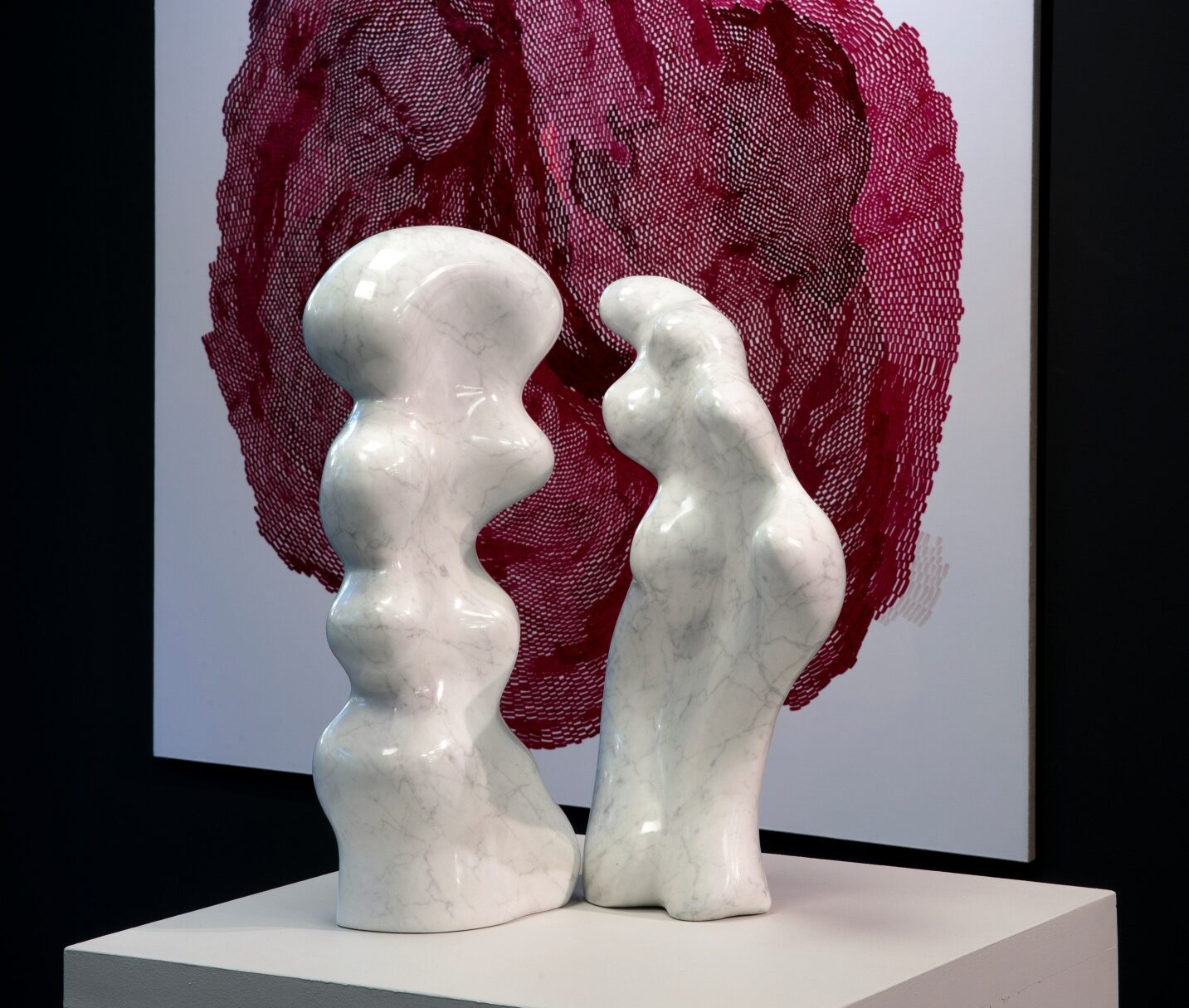
“What is this? What am I looking at? How do I feel? What brings me joy, and what causes me anxiety?”, ask the curators of State of Focus at Piękna Gallery in Warsaw. Presenting the works of Jan Musiałowski and Martyna Ścibior, the exhibition encourages visitors to pause for a moment and find calm in a world dominated by distraction and sensory overload. “Every day brings a new wave of information that only confirms that a few things remain constant and certain. Realising the inevitability of change, it is worth pausing and focusing on the present moment”. And these artists aim to teach us this.

Although working in different media, Jan Musiałowski and Martyna Ścibior share a reflection on process, matter, and transformation. We talk to them and the curators – Stefania Olbrycht, the Piękna Gallery director, and Przemysław Kasztelewicz – about the idea behind the exhibition, the creative process, and how art can help us find peace in today’s reality.
Paulina Mamot: How can we understand the title – State of Focus? How did the concept for the exhibition come about, and how is it reflected in the work of the presented artists?
Stefania Olbrycht: The exhibition by Jan Musiałowski and Martyna Ścibior is one of the most significant exhibitions we have created in our ten years of existence as a gallery. The process of creating the exhibition coincided with a time when grief over the loss of Sławek Górecki, founder of Piękna Gallery, who passed away in May, was intertwined with a determination to continue working and fulfil his clear wish for the gallery to continue its mission. This emotional moment made me realise that art and its creators are what best allow us to concentrate and organise our thoughts.
The title was chosen to draw attention to the need for focus – a particularly difficult one to achieve in today’s overstimulated world. At the same time, the ‘state of focus’ relates to matter and how it transforms from one form into another. Both stone and metals – the materials most often used by Musiałowski – and nail polish – the medium in which Ścibior creates – change in the creative process, ultimately telling the story of their transformation – a story that the artists want to convey to us.

P.M.: Martyna Ścibior and Jan Musiałowski work in completely different media, yet their work seems to share a focus on the creative process and breaking conventions. Could you tell us more about why you decided to pair these artists together?
Przemysław Kasztelewicz: Jan Musiałowski himself noticed the similarity in form when he saw Martyna Ścibior’s painting in our gallery at the New Masters exhibition. But it is not only that connects the two artists, but also their approach to work and a certain aesthetic sensibility. At Piękna Gallery, we love abstraction and subtle minimalism. The most important artists whose exhibitions we have hosted are Stanisław Fijałkowski, Władysław Strzemiński, and Władysław Jackiewicz. We really aspired to create an exhibition of young artists operating in a similar sensibility register. The contemporary scene is dominated by figuration, and we know that, in addition to intense stimuli, the viewer also craves calm.
An important aspect of both artists’ work is their reflection on the role of the people around them in the creative process. Martyna Ścibior obtains her material – leftover nail varnish – in only one way: from people who want to share it with her. For Jan Musiałowski, both the acquisition of the material and some stages of the creative process require the participation of other people. These relationships are captured in the work.
P.M.: Jan, in your work, you use materials such as marble, wood and steel. Each of them has different properties and offers different possibilities for expression. They also require considerable physical effort in the creative process. How important is your relationship with the material you work with?
Jan Musiałowski: The relationship with the material is crucial in my work, and I see it in a broader humanistic context. Different materials have accompanied us throughout history and have been changing. We have built deep, natural relationships with them, based on centuries of experience, and we place our trust in them, which remains with us. Some of these materials are, to me, a testament to their times, evoking nostalgia. The more contemporary ones, such as steel, are simply sexy because of their properties.
Alongside the relationship with the material, there is a relationship with the tool – the one that shapes, processes and allows this dialogue to take place. Most of the materials our hands work with can only be touched, without the possibility of interference. In this context, the tool builds a relationship and, as an extension of the hand, makes its own vibrant contribution to the process. The relationship with the material is also pure knowledge about geological processes, the way matter is shaped, historical and social discourse, and also my own – how I came across a specific raw material. I approach these stories with respect and delicacy – an intimate contact even.

P.M.: One could say that the process of sculpture creation begins at the moment the material itself is formed. When you create from one that has undergone endless transformations, sometimes over millions of years, how do you know when to end the artistic transformation process, when to put down your chisel? And what emotions accompany this moment? Is this moment of completion more intuitive, emotional, or does it result from observing the material itself?
J.M.: Some of my works are in a never-ending process. I consciously allow them to undergo constant transformation. I am also open to new experiences and experiments, because I like it when something surprises me. Matter always carries this potential within it. I even see it in finished works – I then induce this thought into a new work, I try to continue it, entering some spaces more deeply and making certain decisions more boldly. Sometimes I need to return to certain stages to take a closer look at them. I share my goals, and sometimes even my creative intentions, with my loved ones. This gives me a clear goal for what can sometimes be a very long creative journey.
Such openness does not come easily to me, but it allows me to fulfil not only artistic but also human needs: to understand, to listen, to share with someone the pain that accompanies effort, as well as the euphoria that accompanies success. Therefore, one of the key values of art is its ability to establish communities: artists, gallery owners, curators, and all audiences guided solely by their own aesthetics in their assessments. These multi-layered relationships often give me additional context for evaluating my work.

P.M.: Now, Martyna, where did the idea to replace classic paints with nail polish come from? How do these two painting media differ in terms of their expressive possibilities?
Martyna Ścibior: It wasn’t an idea, but a natural consequence and reaction to the outside world. Shortly after graduating in 2013, I rented a tiny studio at Królewska Street in Warsaw. Two years earlier, I had rejected figurative painting in favour of abstraction. One Friday, I brought red nail polish to the studio. I was going to paint my nails for an important occasion on Saturday. But in the studio, surrounded by canvases, paints, brushes and all the mess, I looked at the nail polish, which instantly replaced the paint in my work. I am attentive enough to notice the appearance of this initially foreign element, but I am also ready to introduce it into my work.
Using only nail polish in painting is a limitation imposed on myself and by myself. However, this constraint allows for focus and control, careful observation, meditation, and examination of fragments of reality. I often feel that fragments of reality are deceiving; only together, after a long time, do they give a certain image.
Nail polish is more than just paint. These colours were chosen by specific people, stayed with them for some time, participated in events, saw a lot, and know a lot. They carry with them both individual experiences and universal ones, experienced by many. They were also intentionally given to me for a specific purpose: to become part of a community of images, to exist side by side. This simple gesture is reinforced by a group of women. The diversity of colours is also the diversity of stories behind the nail polishes given to me. I have not returned to the paint since 2013.

P.M.: The leitmotif of the exhibition at Piękna Gallery is change, the transformation of matter. You collect leftover nail polish, which usually ends up in the rubbish, and transform it into paintings. This activity has a lot to do with the spirit of upcycling. Is ecology an important stimulus for your work? Do you see a symbolic dimension in this, related to renewal and the cycle of life of matter?
M.Ś.: I am a collector. My collection is an unlimited source of inspiration for me, enabling anthropological observations through contact with the women from whom I obtain them, but also through observations of the collection itself, its diversity in terms of colour and quality, by watching it grow and the items themselves become heavier and heavier.
The acquisition of my collection begins with contact with a person who, as part of an ecological approach, wants to sensibly dispose of their leftover varnish that is still usable. They want to become part of a community, a collective entity that contributes to the paintings. In a consumer society that has been recognising the need to find meaning in something other than buying for many years now, ecological attitudes are becoming very popular, although they often manifest themselves in a desire to give me too much of their unnecessary, no longer satisfying paint, rather than in stopping buying it. Maybe one day my source will run dry. Then I will go back to the paint.

P.M.: Let’s get back to the concept of the exhibition. The curatorial text points out that we live today in a reality where we are constantly bombarded with content and stimuli, causing us to struggle with a constant sense of distraction, fatigue, concentration problems, and mental health issues. How do you think art can help us counteract this reality?
S.O.: When we see an intriguing work of art, our concentration is limited to its field. Current affairs disappear for a moment, and the work provokes questions, associations and emotions that go beyond everyday problems. A work of art with which we enter into such a dialogue is a kind of land of reflection. A visit to a gallery or museum can offer this experience, but the true power of art is revealed when we live with the work. Collecting art is a form of mental health care.
P.M.: Art is also subject to constant change. Its canons are changing, new materials are appearing. Works often become increasingly ephemeral, elusive, and woven into our everyday lives. As a gallery, you are developing the New Masters project, dedicated to artists of the younger generation, expanding the canon of Polish art with new names. How do you see the place of Piękna Gallery in the context of the Polish contemporary art scene? What are your further plans for its development?
P.K.: For the first time, the New Masters project will no longer be an auction, but a temporary exhibition where the works on display will be available for purchase. The concept of New Masters was born in 2021, during the COVID-19 pandemic. At that time, face-to-face contact between collectors and works of art was difficult, and auctions, especially those conducted online, were the most popular form of purchasing artworks. Today, auctions are less popular, and our collectors appreciate the opportunity to meet and talk. Auctions are situations of tension and competition, which we have plenty of in our everyday lives. The opportunity to purchase a work of art without the additional stress and uncertainty of an auction does not disrupt the subsequent relationship between the work of art and its new owner.
S.O.: Piękna Gallery has entered a new chapter in its history: its founder, Sławek Górecki, who established the gallery exactly 10 years ago, has handed it over to his daughters, Małgorzata Majcherczyk and Caroline Krzoska, and to us to manage. We represent a different generation, and we want to combine Sławek’s passion and love for art with a reflection on the challenges of today’s world.
These include, among others, concern for mental health and respect for the environment, which, in our opinion, is what we offer in the State of Focus exhibition. The solo show of Edyta Hul, an artist we represent, planned for next year, will also explore these issues. It is not only art that deserves more attention. The interpersonal relationships that develop around it also become more meaningful if we devote sufficient time to them. This is how we see our role as a gallery – we want it to be a place for building relationships, both with works of art and between people, because only in such conditions can art and people flourish.

State of Focus: Jan Musiałowski & Martyna Ścibior
September 19 – October 24, 2025
Piękna Gallery, Warsaw

Supported by Piękna Gallery.