
What we remember is shaped as much by what we notice as by what we overlook. This interplay of memory and perception was at the heart of the exhibition When Light Breaks the Dark, held from 29 May to 1 June 2026 at the Bomb Factory Art Foundation in South Holborn, London — an independent arts organisation supporting experimental and emerging contemporary practices. Curated by Emma (Xinyan) Gu, it confronted rigid narratives and questioned reality through the lens of memory and imagination. Bringing together seven emerging artists from London’s top art schools working across a variety of media, the presentation touched on the subjects of self-expression, social structures and the relationship between the individual and the systems we live in.
When Light Breaks the Dark extends beyond a conventional presentation of artworks, creating a spatial experience where the relationships between artworks, audiences and the gallery environment become central to the exploration of issues of perception and attention.
As an artist and curator, Emma Gu views exhibition-making as an artistic practice in itself, constructing exhibitions as collective artworks shaped by context, spatial relationships and audience experience. Through this approach, When Light Breaks the Dark extends beyond a conventional presentation of artworks, creating a spatial experience where the relationships between artworks, audiences and the gallery environment become central to the exploration of issues of perception and attention.
What We See and What We Remember
The London gallery space shaped the perception of the exhibition using the large gallery windows as an important narrative tool, luring the viewers inside and opening the exhibition space to the external world. Passersby were able to experience the art, even if just for a brief moment, when they were met with the silent gaze of the long-gone fighters and activists of the Red Army Faction (RAF). Material Damage – Nostalgia by William Denis confronted the viewers with these controversial historical figures, remembered as heroes by some and criminals by others.

The German far-left militant group, formally designated as a terrorist organisation by the government, was responsible for a series of bombings, kidnappings and assassinations. And yet, without knowing this context and the subsequent historical narrative surrounding its members, the black-and-white eyes evoke merely curiosity. The work questions the meaning of history and memory and how they’re intertwined and rewritten by the passage of time and competing narratives. The strangely silent, unsettling gaze also served as an invitation to participate in the exhibition and reflect on the questions it posed.
Inside, Kate McClenaghen’s paintings stood in opposition to Material Damage. Here, there is no obvious human presence. Instead, we encounter urban spaces and fragments of city architecture, strangely calm and dreamlike compared to Denis’s works. The paintings, each titled with a timestamp, depict urban environments bearing silent witness to fleeting moments and perhaps even life-changing events. How often do we look up from our daily commute to briefly make note of our surroundings, only to notice a strange detail that becomes forever associated with that moment in time? Human memory works in a strange way — a familiar smell or image can pull us back into the past unknown to others. McClenaghen’s paintings immortalise that feeling and the importance of those moments, encouraging the act of noticing and being intentionally aware and connected to the reality we live in.

Further in the exhibition, Ren Yao’s vividly colourful portraits depicting two military figures, General Ha and General Hum, were strongly influenced by Buddhist religious iconography. Their vibrant and expressive faces and stylised hand gestures contrast with the modern military uniforms and guns, creating a clash between the sacred and the profane. The figures become half deities, half military personnel. The artist explores how secular individuals are turned into symbols and immortalised through iconography and how those representations create new narratives and rewrite the old ones in our collective memory.
Through the lens of culture and tradition, it’s difficult to distinguish what’s an objective truth and what’s a narrative prescribed by society and the ruling power. In a way, these portraits mirror Denis’s unfiltered black-and-white photographs of the RAF members’ eyes, which required historical context and framework to understand the story they were trying to tell. Here, the context and narrative become more important than reality itself. We don’t need to know who the generals were, whether they were actual historical figures or cartoon characters, to decipher the established symbols of power and the sacred. The stylised depiction creates meaning on its own and turns the ordinary into extraordinary, just like repeated narratives and representations turn stories into history.

From Collective to Personal Memory
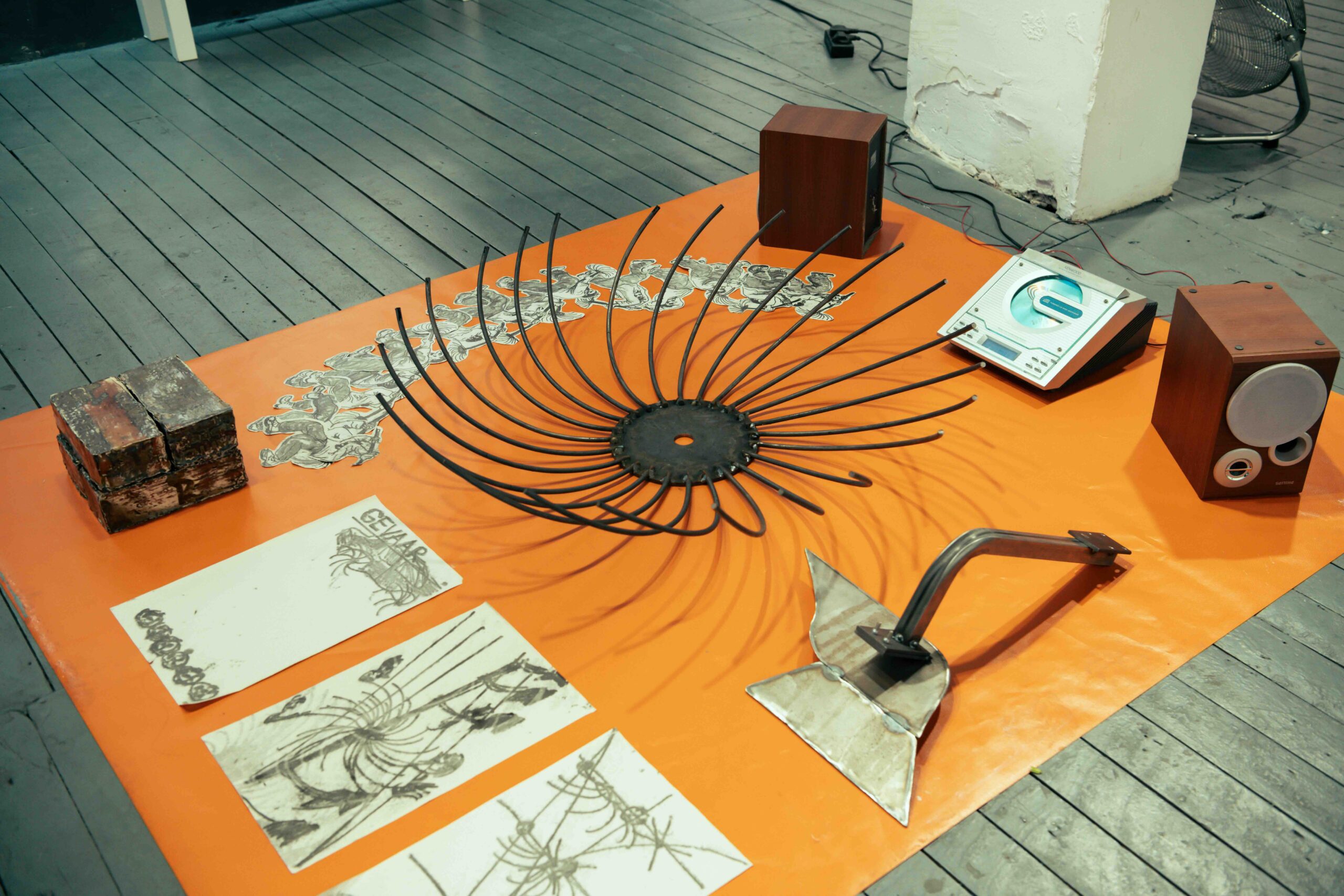
Unlike Denis and Yao, Sirui Lao turns inwards and traces individual experiences shaped by the passage of time. When the Rain Approaches is a small, intimate sculpture formed from sharp knives and hooks, items once used in an act of self-destruction, now a testament to an act long passed. Despite the violence they represent, the objects have been repurposed into a delicate installation bearing a resemblance to a ship. From afar, the sculpture appears almost ethereal and dreamlike, revealing its disturbing elements only up close. The work explores how the passage of time transforms negative experiences and memories, reshaping our lives and endowing them with new meaning and purpose. However, traces of trauma remain and become incorporated into memory while the past is carried into the future in its new form. The inner structure of individual memory in Lao’s work appears no less complex and multifaceted than that of a society.

Another work presented at the exhibition that deals with personal experience was Zacky Zhao’s intimate video piece CM310 (IL-4Rα antibody) documenting the artist’s experience of participating in a clinical drug trial for atopic dermatitis. It’s an archive of living with a chronic illness — an invisible burden only fully known and understood by the affected. The body holds the memory of what it’s been through, a deeply personal experience that becomes public through the act of revealing it to the audience. The artist explores the relationship between the individual, represented by the body and its boundaries, and public space.

Loneliness and isolation are commonly discussed in relation to chronic illness, as the experience is often misunderstood by society, which can at times feel alienating when sharing the full extent of it seems almost impossible. The screen displaying the video was set against the large gallery windows, with the busy street full of passersby serving as the background to the footage, and the artist’s body facing away from it. Its placement only added to the symbolism of the work and the viewer’s reception of it, with the intimate memory being simultaneously shared with the audience and yet isolated and inaccessible to the wider world.
Through the lens of culture and tradition, it’s difficult to distinguish what’s an objective truth and what’s a narrative prescribed by society and the ruling power.
The Practice of Noticing
Kilig Chen Sun’s highly expressive painting, The Strike, depicts a radically different image. The scene containing multiple symbols and seemingly unrelated elements feels like a fever dream escaping interpretation. Its humorous, joyful atmosphere, borrowing from pop art, requires more attention than the usual glance gallery attendees give most contemporary pieces. The painting invites the viewer to decipher the meaning behind its symbolism. However, it seems a futile task. Just like in a dream, the individual elements look familiar and recognisable and yet, when assembled together, they challenge our memory and leave us to create our own meaning and narrative.

In contrast, Wayne Liu’s two figurative paintings displayed in the gallery windows served as a clear commentary on contemporary society. The hybrid zoomorphic figures of dog-like characters seem cold and detached, watching quietly, almost bored or even slightly annoyed, as one of their kind is disappearing. The indifference seems cruel, but is not unheard of in today’s world. The passivity may seem shocking, but in everyday life, many choose to remain observers rather than intervene or question the situation.

The act of noticing and recognition becomes a starting point for reflection and dialogue. By bringing together diverse artistic approaches across painting, sculpture, installation and moving image, the exhibition created a space to engage with different forms of memory, perception and representation, encouraging visitors to reconsider the narratives and structures that shape everyday experience. The titular light breaking the dark is thus an invitation towards greater awareness. What brings the works together is a quiet hope that change is possible if we refuse to accept the normalised order and look around once in a while.
By bringing together diverse artistic approaches across painting, sculpture, installation and moving image, the exhibition created a space to engage with different forms of memory, perception and representation, encouraging visitors to reconsider the narratives and structures that shape everyday experience.