



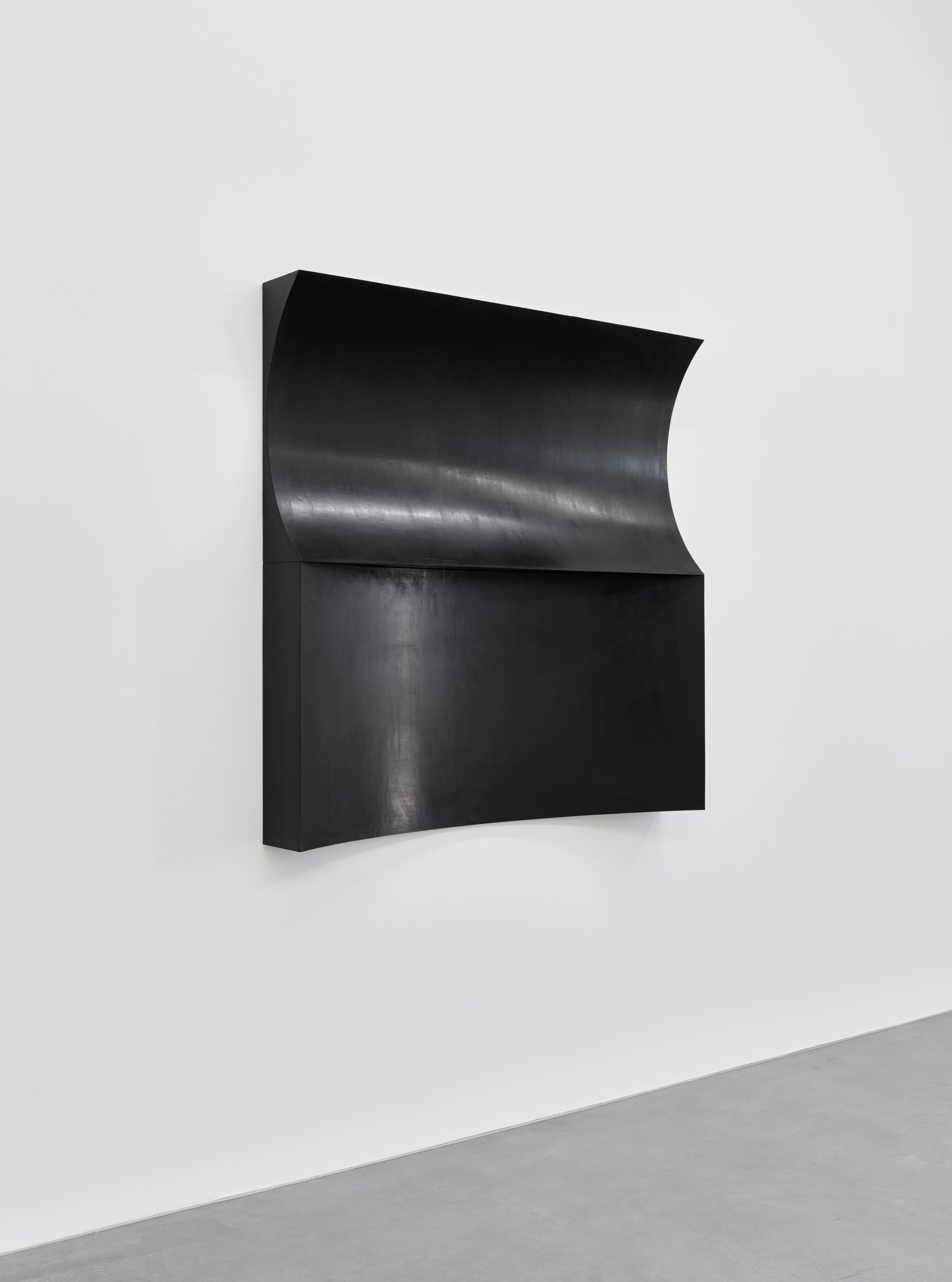
Two concave intruders warp the thick, tar-like surface of a 160×160 cm canvas, bathing the flat void in light. One is subtle, leaving a ringlet like a well-read book on the base perimeter, curling inwards. The second is fiercer, casting a luminous wave, a landscape of moonlight across the obsidian horizon. Like the imprint of a body left in a worn-out settee, or the stiff plastic basins in a doctor’s waiting room, set out purely for the occupancy of passengers and collapsing under the sedimented memory of bodily heat, Untitled (2021) grieves for something that once was.

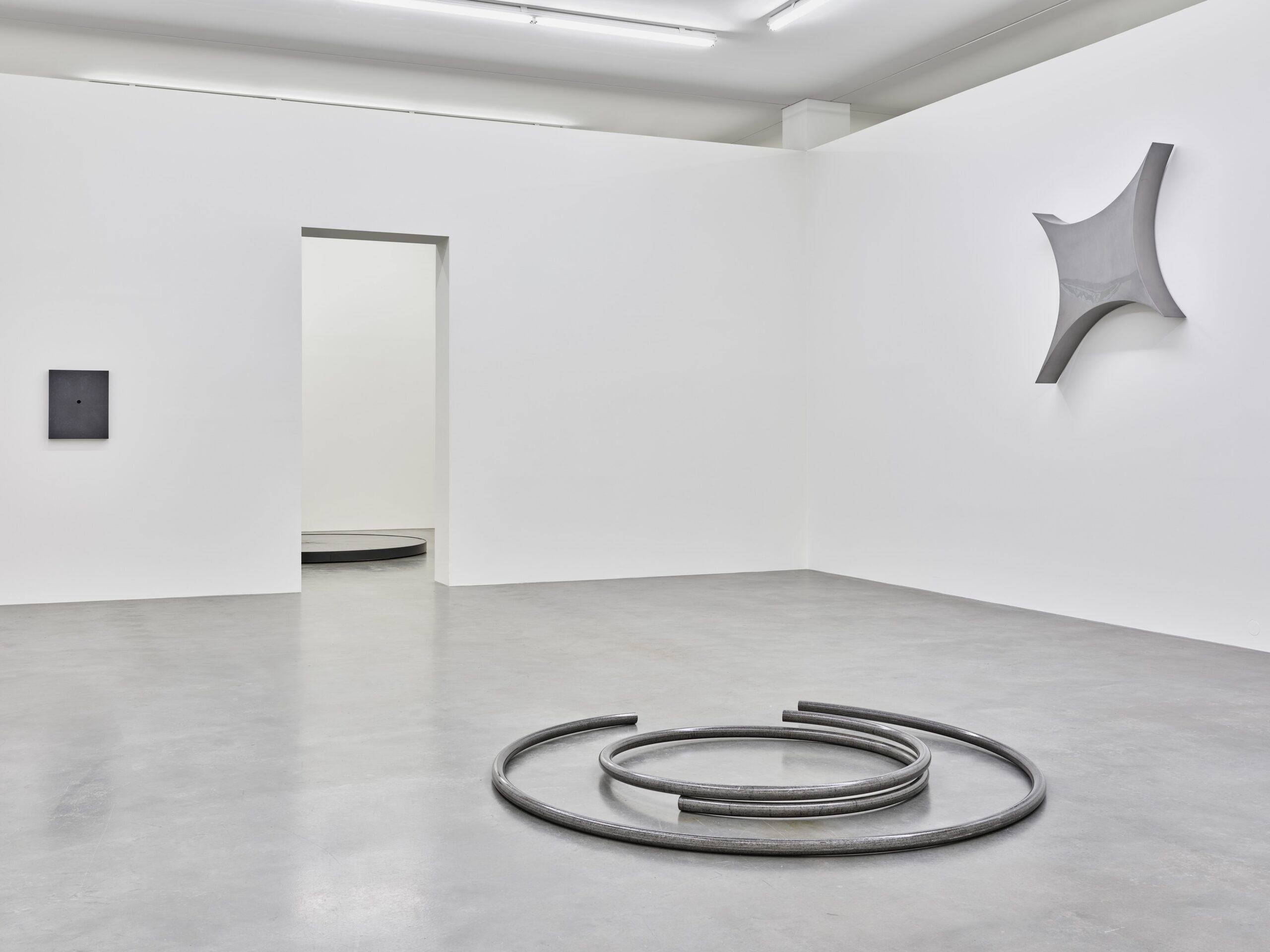
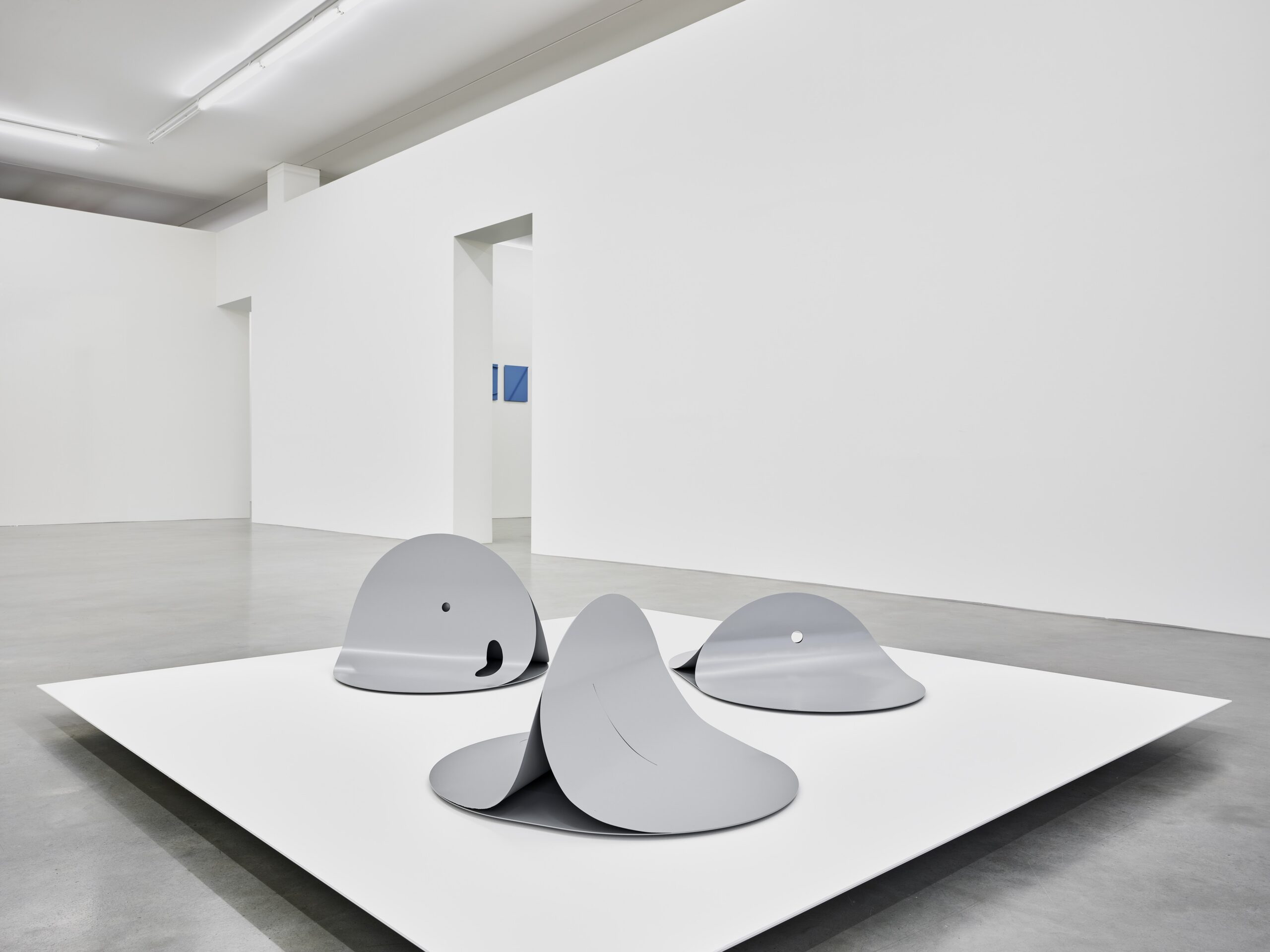
It is a fitting place to begin an enquiry into Randzone, the first solo exhibition of Michał Budny at PEAC — the Paul Ege Art Collection in Freiburg im Breisgau, Germany — taking place from 27 September 2026 until 15 February 2027. The Polish-born artist lives and works in Warsaw and Prague and is no stranger to the institution: their collection already holds some of his works. During the first encounter with the artist, Lea Altner, the director of PEAC and curator of the exhibition, was impressed by his keen powers of observation and his sensitivity to people and situations that find their material expression in works. But the show came about on his own initiative. The result is a landscape that visitors can wander through, with over twenty-five works in different media, including film, circulating across the space. Steel sculptures slither across the floor, while rubber and fibrous hanging works jut out of the walls, demarcating points of reflection for the viewer. Randzone, in English “edge-zone” or “margin”, evokes a geographical location. As a viewer, you are constantly negotiating how to navigate it, deciding which objects merit closer inspection and which require distance.
Randzone, in English “edge-zone” or “margin”, evokes a geographical location. As a viewer, you are constantly negotiating how to navigate it, deciding which objects merit closer inspection and which require distance.

Beyond the Emotional Detachment of Minimal Art
Open-endedness ripples throughout the show. The works on display sit at some distance from the Minimal Art movement for which the Paul Ege Art Collection is known, as Budny’s practice explores aspects beyond the surface question of what constitutes a picture. Consider Frank Stella’s Black Paintings, which, devoid of emotional heart, were direct transfers of black frames onto canvas, leaving an artist associated with the Minimal Art movement to offer the maxim: “What you see is what you see.” Untitled (2021) by Budny is their antithesis. With its slumped residue, it does not offer a determined reading. Rather, the drooping of rubber unlocks stored memories within us, beyond the material properties of the work.
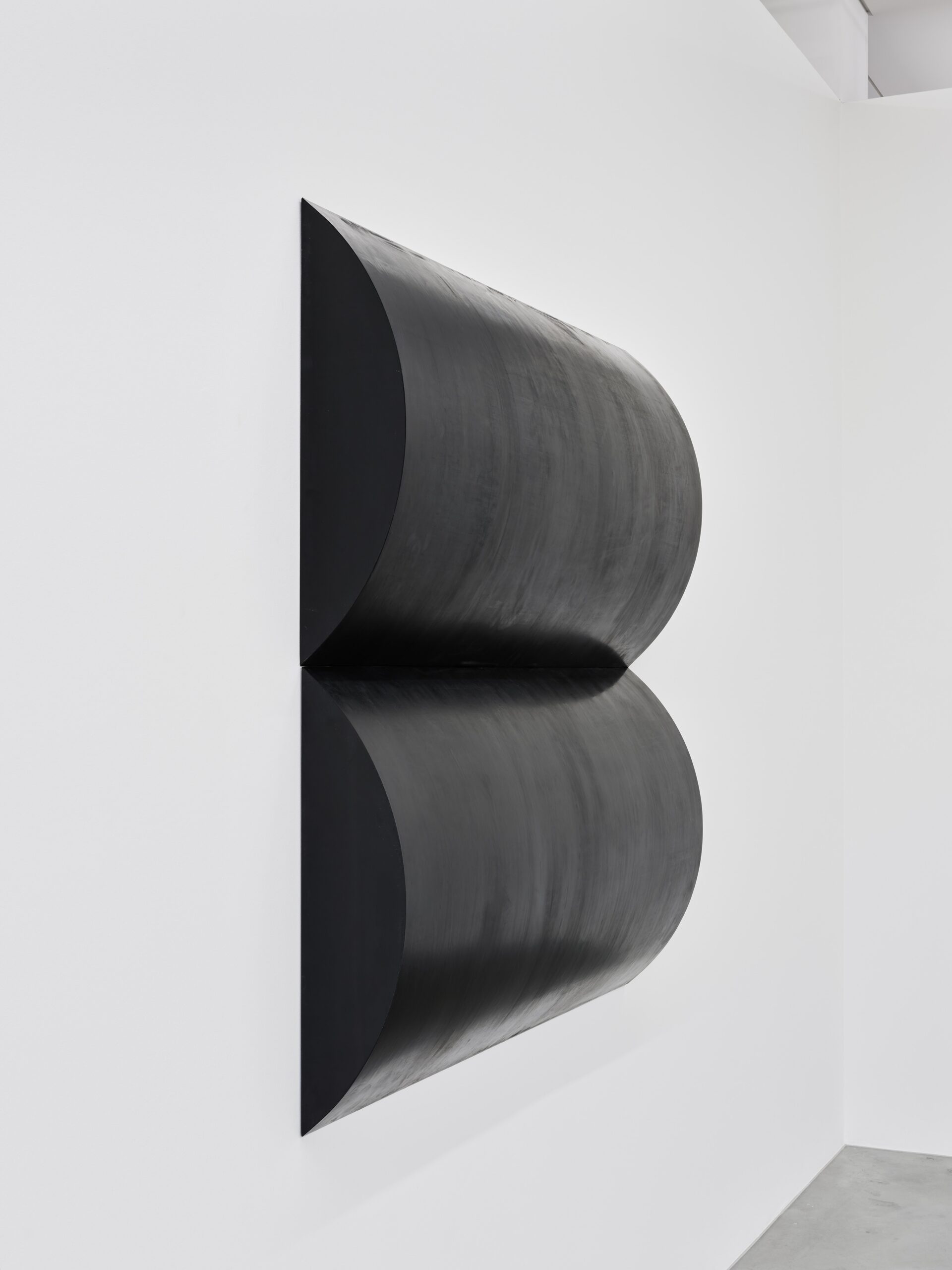
Budny’s work evokes emotions, places and relationships through the friction between formal compositions and tactile materials. Stella and his contemporary Robert Morris favoured a steely, mechanical repetition that rejected the sensation and sensuality of the Abstract Expressionists of the time. Human presence, by contrast, is constant throughout Budny’s swathes of paint and his impressions in fabric and porous materials. His works transcend the visual: through organic materials, he engages with different senses. Made partially of rubber, Untitled (2021) triggers perhaps the most evocative sense of all — that of smell. As the Proust effect shows, olfactory memories are among our strongest. Every individual’s interpretation of rubber differs, however, and this is where the ambiguity of Budny’s work lies. Just as the black paint on the two versions of Untitled (2021) is never entirely black but holds varying degrees within it, Budny’s work is always open.
Budny’s work evokes emotions, places and relationships through the friction between formal compositions and tactile materials.
Ambiguity as a Vehicle for Open Meaning
That ambiguity also bubbles up in the unfinished quality of the works. Assembled from wood, coated paper and a blanket, Only Fear (2015) is a 190×125×8cm rectangular structure recalling a resting place. From park benches to airport terminals, train carriages to hospital beds, these temporal chambers fester in the mind upon viewing the upright milky slate. Puffy bundles of paper tucked in at the border hint at a bedsheet, beckoning the viewer to lie on its warm surface. Yet, as the title suggests, suspicion fills this intimate encounter. Made from simple materials and left without any additional furnishings, the work invites us to imagine whether it represents a former resting place or a possibility yet to come. Budny’s minimal execution leaves us in a state of suspension, with conclusions left for us to draw.

The carefully chosen materials heighten the open interpretations. Rather than a monolith, scraps, swathes, segments and sheets of ‘poor’ materials like plywood and cardboard function as mini time capsules, triggering individual memories in the viewer. What were these former containers and furnishings? Whom did they belong to? Once again, Budny departs from the Minimal Art Movement’s desire to dictate absolutes and gears us towards open-endedness and uncertainty. Unlike Stella, who once declared, “We believe that we can find the end, and that a painting can be finished”, Budny brings a rhizomatic reading to his work. Like his contemporary, Richard Tuttle, who utilises everyday materials such as nails, mohair, sawdust, silicone, staples, and straight pins, the Polish artist steers the audience towards the unconscious rather than any rational meaning.
Looking Between the Gaps
As we weave our way throughout the exhibition, we also pay attention to the negative space. Meaning often emerges from within it. Seen close up, Tear (2017) rewards us with a cryptic message. A teardrop-like orifice emerges from twin jute ropes swerved repeatedly into a horseshoe-like form. By utilising a coarse fabric like jute, often favoured for transportation and packaging due to its long-lasting properties, a textual dissonance arises. Roughness and tenderness collide thanks to the organic form that emerges in the negative space. It is precisely this negative form in Tear that imbues it with emotion. The teardrop suggests something that once was, something cut out or lost: a bittersweet remainder. Like Rachel Whiteread, whose casts of stairwells, bookcases and hot water bottles invite us to see the invisible spaces within and around an object, Budny draws our gaze to the residue of materials, to their wear and tear as traces of the human spirit.
Simple geometric forms, from circles to squares, recur throughout the show, allowing more complex readings to emerge. Initial meanings are withdrawn, making room for our own interpretations.

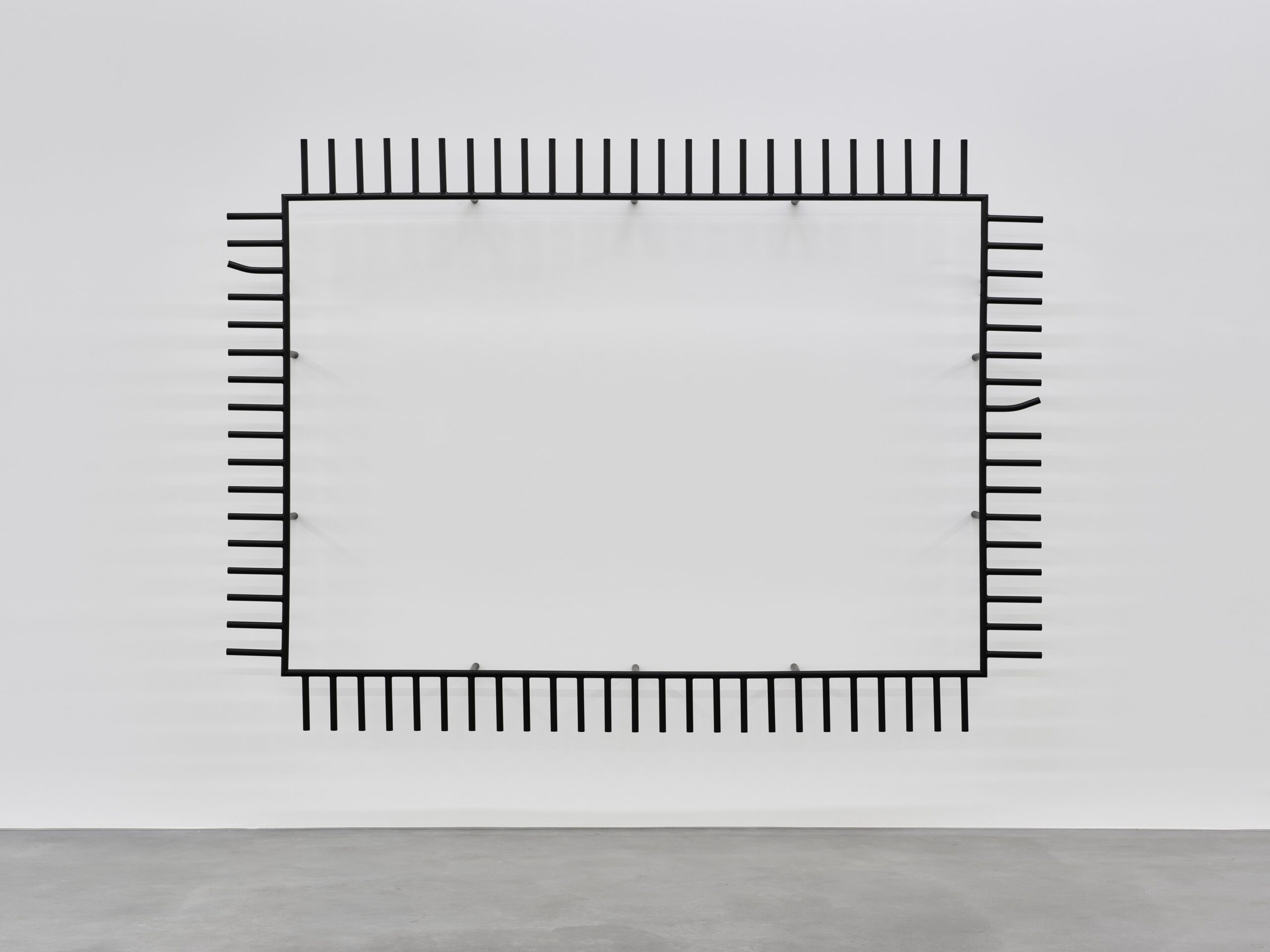
Elsewhere, Budny evokes traces of memories not through the absence of form but through stripping it back. Simple geometric forms, from circles to squares, recur throughout the show, allowing more complex readings to emerge. Initial meanings are withdrawn, making room for our own interpretations. Minimal works such as Sign (2016) invite the viewer to draw connections beyond the initial shape. Echoing the giant disc of a railway station clock, its uniform, compressed arms point inward instead of outward, as on a regular dial. This playfulness of form allows familiar elements to take on unexpected meanings. Like the Ready-Made school, which reappropriated found objects with a new language, Sign is not the clock it first appears to be. Despite its simple geometry, the painted metal sign, when viewed again, could be an orifice or a portal.
Budny has compared his poems to haiku, a Japanese poetic tradition with strict parameters. Like haiku, his works reduce representation to allow for maximum interpretation. Titles such as the whimsical Flying Carpet (2016) ignite the imagination within his strict visual language. However, it is not the individual artworks that are haikus, but their overall assembly in the exhibition layout. Works have been deliberately hung at unusual levels, so that they are not supplements or surface displays but inform the journey the viewer undertakes. Lea Altner likens it to a “collective spatial installation”. In this show, it is clear that Budny is an artist of space, not just objects.
Budny has compared his poems to haiku, a Japanese poetic tradition with strict parameters. Like haiku, his works reduce representation to allow for maximum interpretation.