
A city built around water is never entirely still. Along Istanbul’s Golden Horn, ferries cut through the current, cars inch along the waterfront, pedestrians navigate the stretch between roads and docks, and ships appear beyond the buildings. Follow the water far enough and the landscape changes: all roads lead to Tersane Istanbul.
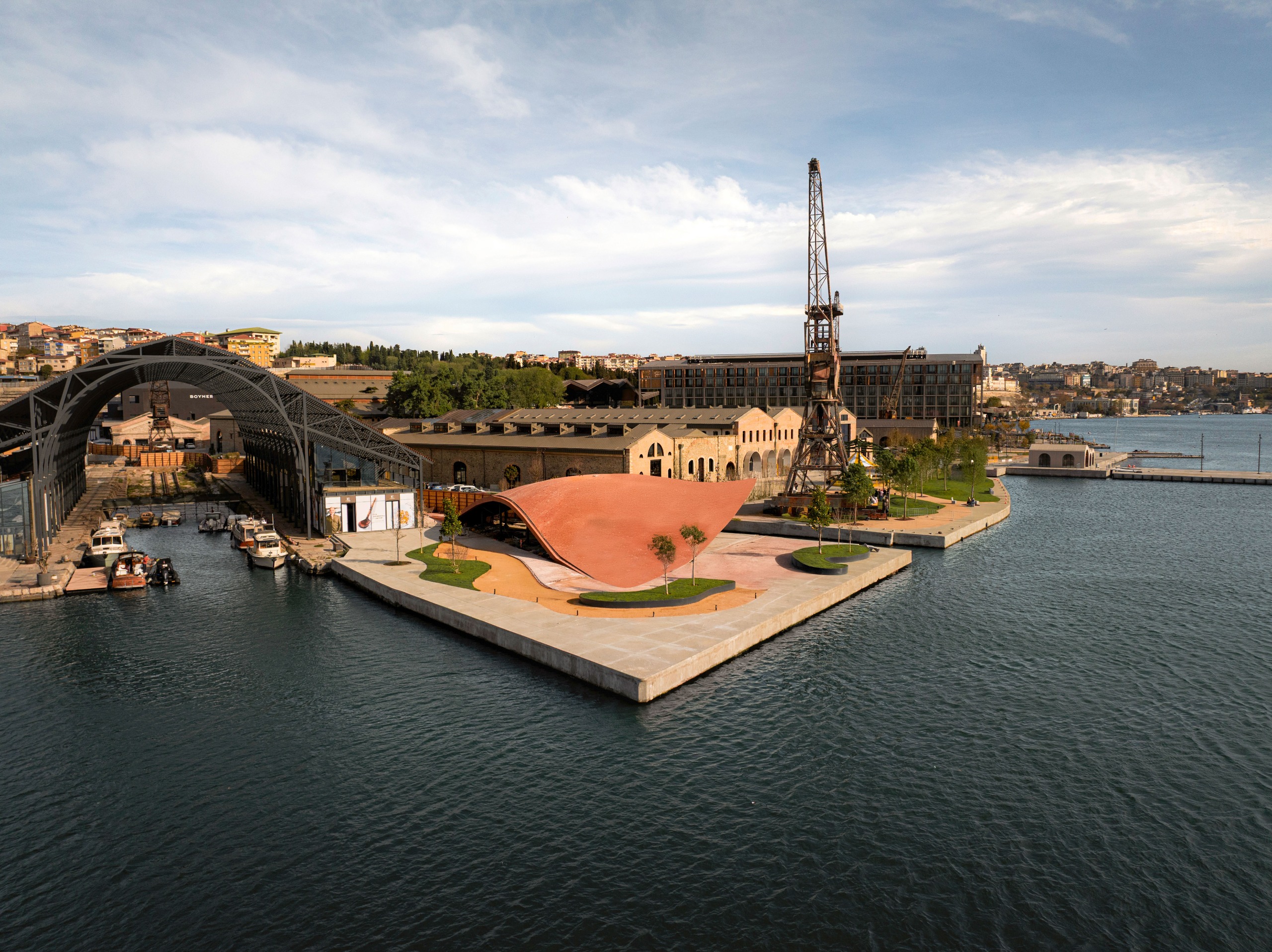
For centuries, this was a shipyard — a place of vessels, labour, repair and departure. For the 21st edition of Contemporary Istanbul, the nature of its industry took on a different form. Crates gave way to canvases, sculptures and installations. Across this historic site, 70 galleries brought together 736 artists and 1,372 artworks. Among the fair’s many presentations, these nine booths stood out for their considered selection of works and their distinctive approaches to material, form and meaning.
Erdal İnci presented by Art On, Istanbul
Photogrammetry usually begins with a camera moving around an object. In Erdal İnci’s works, it becomes an alternate way of seeing buildings. By photographing historic structures from different viewpoints, the artist gathers thousands of images and assembles them into three-dimensional digital reconstructions. Rendered with a semi-transparent shader, his buildings hover between solidity and reflection: arches, ceilings, corridors and courtyards appear within a single image, as though the architecture has slipped free of the viewer’s fixed position. The effect is particularly evocative when applied to historic buildings. Their walls and arches remain recognisable, their surfaces still hold within them the accumulated histories, yet their solidity seems to dissolve.

One work focuses on the Karatay Madrasa in Konya, built as an institution of higher learning when the city was the capital of the Seljuk Sultanate of Rum. Its monumental stone portal opens onto a covered central courtyard, surrounded by a domed central space, a western iwan, and chambers to the north and south, one of which contains Karatay’s tomb. Every surface belongs to an existing structure, yet the resulting image could never have been made from one position. Neither conventional photographs nor digital models, İnci’s reconstructions offer another way of apprehending architecture — bringing its proportions, surfaces and histories together in a single view.

Yıldırım Çakmakçı presented by Galeri 77, Istanbul
The veil changes the room. Worn by a man in Yıldırım Çakmakçı’s What Remains (2026), it introduces an unsettling detail into an otherwise recognisable domestic vernacular: a kettle, a mirror, a child standing beside a door. The room is familiar, but something in its logic has fractured, leaving behind a sense of an altered life. Absence becomes a powerful presence. Çakmakçı does not depict loss directly; he traces its residue through the minutiae of a life that must continue. The mirror reflects a veil, but no face, turning reflection into a sign of someone who is no longer there. The kettle remains tethered to a habit repeated over years, its ordinariness made poignant by the absence it now carries. Everything remains where it should, yet nothing means quite what it once did. This tension between the quotidian and the uncanny runs through Çakmakçı’s practice, where his background in graphic design and advertising informs a precise visual economy in which objects become emotional signifiers and omissions become a form of narrative.

At the doorway, the child becomes the emotional fulcrum of the work. She can see the possibility of leaving, but cannot reach it. There is no lock, only a fear so deeply internalised that it has acquired the force of architecture. The threshold becomes a psychological boundary constructed through experience, silence and the apprehension of what lies beyond. Çakmakçı’s painting reveals a painful truth about home — the place associated with protection can, over time, become the very place from which escape feels impossible. The white crow heightens this sense of helplessness. Against the black crow’s familiar iconography of death and misfortune, the white counterpart suggests innocence, hope and truth. Yet it cannot intervene. It can only bear witness — a reminder that seeing another’s suffering does not mean that you possess the power to save them.

Abed Al Kadiri presented by Galerie Tanit, Munich and Beirut
In 2020, Abed Al Kadiri looked out over Beirut and watched the sky turn an intense, almost unnatural red. Against a city already inscribed by rupture, the colour carried an unsettling beauty — a moment of chromatic intensity he brought back to the studio. There, the sunset was distilled into a red circle suspended above a forest of charred trees.
When he later left Beirut for Paris, he carried that image with him. It would return repeatedly in his work, each iteration gathering new associations as the years passed, as it did in Short Poems, a series of small paintings made at dusk, where vanishing light becomes a fragile repository for memory. What begins as an observation of the sky gradually turns into an act of preservation: an attempt to hold fleeting radiance against the certainty of disappearance. By the time the motif enters Cataclysm (2024), the circle has shed the specificity of a single sunset and acquired a far heavier symbolic charge. It shows catastrophe through its aftermath — what violence leaves behind, what memory carries forward, and what remains luminous despite everything.

Al Kadiri studied Arabic Literature and Fine Arts, disciplines that converge in a practice deeply attuned to language, memory and the psychic aftermath of violence. His landscapes are not theatres of destruction; they are its residue. Charcoal accumulates across the surface like scorched matter, while pastel moves through the darkness in spectral passages of colour, holding the material vocabulary between ash and atmosphere, devastation and remembrance. At the centre, the red circle persists. It carries Beirut within it, but also the skies of Gaza and the countless landscapes transformed by war. Sun, wound, warning, eclipse, ember — it refuses to settle into one fixed signification. That ambiguity gives the image its force. Its persistence is not redemption, but endurance: a small, incandescent remainder held against the dark.

Hande Şekerciler presented by JD Malat, London and Dubai
The human figure has occupied sculpture for millennia, yet its expressive possibilities remain in perpetual flux. Hande Şekerciler draws on the sculptural legacies of Hellenistic antiquity and the Renaissance, reimagining the body through a contemporary visual lexicon. Her figures are elongated, folded and digitally distorted, hovering between anatomical recognition and abstraction, familiarity and estrangement. Şekerciler’s works often begin in the digital realm, through modelling, 3D scanning and AI-assisted sketches, before entering the foundry’s elemental world of moulds, fire and molten metal. As the virtual image assumes physical form, the exactitude of the algorithm gives way to the contingencies of matter: heat alters surfaces, gravity determines the fall of a form, and the hand leaves traces that resist digital prediction.

At the centre of her practice is the body as a repository of conflicting emotional states, a site where vulnerability, intimacy, tension and desire find physical expression. Through altered proportions, charged gestures and shifting surfaces, her sculptures reach beyond likeness to explore the less tangible forces shaping our relationships with ourselves and others. Technology extends this inquiry, opening new formal possibilities while remaining grounded in the material intelligence of sculpture.
This tension between the inherited language of the figure and its technological reinvention finds resonance in Confluence, JD Malat Gallery’s presentation of ten artists navigating the intersections of figuration and abstraction, personal histories and urban imaginaries. Neither classical ideal nor technological artefact, they inhabit a shifting territory in which the human form becomes both an enduring sculptural proposition and a reflection of contemporary experience.

Margarita Ivy and Bystrík Klčo presented by the Karpuchina Gallery, Prague
Before death could be understood as an ending, it was something Margarita Ivy encountered as a child: a presence she could see but not yet comprehend. What she witnessed became intertwined with imagination, and those early impressions remained in memory, changing shape as she grew older. These reflections on mortality and childhood memory form the starting point of a joint project developed by Ivy and Bystrík Klčo, a Slovak intermedia artist whose practice revisits and transforms the objects and cultural codes through which ideas of identity and normality are formed. Together, the two artists developed the project’s themes and working methods, establishing a shared framework for their exploration of memory, identity and experience.

Within this collaboration, Ivy independently created a baby’s dress cast in epoxy resin. Small, delicate and empty of the body it was made to hold, the dress becomes a vessel for absence — its scale suggesting a life imagined, remembered or already beyond reach. What might signify innocence acquires a more complicated emotional register, suspended between tenderness and impermanence. Epoxy resin gives Ivy’s reflections a physical language. Transparent and tactile, it allows forms to be layered and suspended within the surface, as though a fleeting memory might be caught before it dissolves. Yet preservation carries its own melancholy. To encase something is to acknowledge its fragility; to keep a trace is to admit that the original cannot be preserved. Resin becomes both material and metaphor, holding memory still while reminding us that memory itself is mutable.
Having developed its themes and working methods together, the two artists arrive at a common inquiry through distinct roles: Ivy gives the ideas material form in the resin dress, drawing on her personal engagement with childhood and mortality. The work remains hers in its making and expression, while belonging to a project shaped through their collaboration.

Through the translucent dress, the intimate and the collective meet without losing their distinction. An object associated with childhood becomes a repository for absence, its material permanence set against the vulnerability of the life it evokes. The work holds memory in suspension, somewhere between the tangible and the spectral.
Kevork Mourad presented by Leila Heller, New York and Dubai
A wounded bird carries an ancient contradiction: the instinct to fly persists even when the body can no longer obey it. In The Wounded Bird (2026), Kevork Mourad gives this tension a physical, almost lyrical form. At 80 inches high and 45 inches in diameter, the large-scale work occupies the space between drawing, object and sculptural installation. Acrylic and ink spread across cotton fabric, while hand-cut elements are layered in two planes, allowing the image to acquire depth, interruption and movement. The bird remains recognisable, yet its fragmented anatomy suggests a form in transition — a body suspended between rupture and repair, still bearing the memory of what it once could do. Mourad transforms a familiar motif into a vessel for displacement, memory and the fragile persistence of hope.

A multidisciplinary Syrian-Armenian artist, Mourad has spent more than two decades expanding drawing beyond the fixed picture plane, bringing it into dialogue with animation, music and performance. His practice engages with Middle Eastern politics and history, the plight of political refugees and questions of religious tolerance, often through collaborations with musicians and performers. Yet drawing remains his point of departure: lines accumulate, fracture, disappear and return. In The Wounded Bird, cutting becomes an extension of the drawn line, its fragments lending the image a tactile vulnerability, as though the body has been separated and painstakingly reassembled. Suspended between flight and fall, the bird carries the psychic weight of departure without becoming its illustration. There is tenderness in its wounded state, but also a stubborn refusal to vanish. Its layered construction becomes an allegory for lives reshaped by rupture — memories carried across borders, identities held together through change, and the longing to move forward when the past has left its mark. The bird cannot quite fly, yet it has not forgotten the sky.

Wolfgang Stiller presented by Mark Hachem, Paris, Beirut and New York
A matchstick is an instrument of brief consequence: struck into flame, it fulfils its purpose through its own extinction. In Wolfgang Stiller’s ongoing Matchstickmen series, this mundane object assumes a human likeness. Elongated wooden bodies, crowned with charred and burnt faces, occupy a territory between grotesque and poignant. Their proportions lend them an almost absurd fragility, yet their scorched visages carry the gravity of lives already marked by consumption. Stiller began this series during his two-year stay in China, where he worked as a guest professor at New York University’s Shanghai campus. The matchstick serves as an incisive metaphor for human expendability, exposing a social order in which individuals are valued for their utility and discarded when their purpose has been served.

Stiller’s practice — spanning sculpture, drawing and installation — returns repeatedly to the body as a site of vulnerability, transformation and estrangement. In the Matchstickmen, the burnt head becomes both an irreducible marker of identity and a reminder of morality; each figure retains personhood even as its material suggests imminent erasure. The absurdity gives way to a recognition that human existence, like the match’s brief flare, may be rendered disposable by the very systems that depend upon it.

Hwang Seontae presented by Pontone Gallery, London
Tempered glass, etched lines and an internal source of illumination form the basis of Hwang Seontae’s practice, in which transparency becomes a means of giving shape to the intangible. Through printing, etching and painstaking layering of glass, the South Korean artist constructs interiors that hover between drawing and sculpture, with their furnishings, windows and architectural planes reduced to fine, almost clinical outlines.
Colour is absent; instead, an integrated LED source lends volume to these linear structures, revealing surfaces that shift between translucency and opacity as the viewer moves around them. What initially resembles a precise architectural study gradually acquires a more elusive character: shadows suggest physical mass, the glass introduces a sense of duration, and the austerity of the line gives way to an unexpected emotional charge. The resulting works are at once meticulously constructed and difficult to locate within the boundaries of representation, their material presence offset by an almost weightless quality.

The interiors open onto expanses of greenery, their windows establishing a visual continuity between the measured geometry of domestic space and the world beyond. Yet their careful arrangements contain no inhabitants. A chair, an open window or the suggestion of sunlight becomes a trace of human presence, as though life has momentarily withdrawn, leaving the architecture to hold its place. Glass lends this absence a particular tension, its apparent permanence complicated by its vulnerability to fracture.
As the illuminated compositions extend into the viewer’s surroundings, the distinction between the depicted interior and lived space begins to loosen. These are not rooms to be entered, nor images to be apprehended at a glance, but constructions in which memory, materiality and perception converge. Their emotional register lies precisely in what remains unresolved: the uncanny recognition of a place that feels familiar, though it belongs to nowhere in particular.

Erdağ Aksel presented by Siyah Beyaz Art Gallery, Ankara
A folding ruler is designed to establish distance, proportion and scale. In Erdağ Aksel’s Look! Show! Go!, however, it becomes an obstacle to seeing. Wooden folding rulers are arranged side by side across the surface of the work, forming a dense, slatted screen through which a human figure can be glimpsed but never fully discerned. The object’s practical purpose is subverted: what should clarify instead obstructs, turning a familiar instrument into a meditation on the limits of sight. This tension between order and disruption has long informed Aksel’s sculptural practice. Drawn to ordinary objects and the systems through which authority makes itself tangible, he invests recognisable forms with an unsettling ambiguity. His constructions possess the exactitude of engineered structures, yet suggest how readily such order can be unsettled. The viewers’ encounter with Aksel’s work is contingent upon their position: move to one side, and the figure shifts in clarity, fragmented by the repeated wooden segments. The title acquires an ironic edge; to look is not necessarily to understand, just as to show does not guarantee revelation.

Marking its 43rd anniversary this year, Siyah Beyaz Art Gallery presented the first work in Aksel’s three-part series alongside an assembly of different generations of artists contrasting in material, form and approach. Amid the presentation’s varied practices, Aksel’s rigorously assembled work asserted an architectural presence, its disciplined geometry lending structure to an otherwise elusive image. The rulers transform an everyday object into a subtle inquiry into how we interpret the world, and how much remains beyond our grasp.