There is a shared question running through the practices of Nona Inescu and Oláh Gyárfás: what happens to things after they lose their original function? A stone after it stops being perceived as landscape, a plant after it stops being decoration, a textile after it is no longer a tool, a body after it becomes a trace. Although their artistic languages emerge from different territories, both artists construct worlds in which matter is never passive. Materials carry histories, remember gestures, register transformations, and continue to exist beyond human control.


Presented together at Art Encounters Foundation, the exhibitions Afterlife – Still Life by Nona Inescu, curated by Diana Marincu, and The Broken Corner of the Cube by Oláh Gyárfás, curated by Ami Barak, create an unexpected conversation about preservation, fragility and adaptation. One artist looks toward geological time, ecological systems, and the unstable boundaries between human and non-human life. The other returns to inherited materials, rural memory, and the intelligence embedded in craft. Inescu thinks through stones, plants, shells, and bodies; Gyárfás through hemp, hay, wood, clay and textiles. Yet both arrive at a similar conclusion: matter is not simply something we use. It is something we live with.
Although their artistic languages emerge from different territories, both artists construct worlds in which matter is never passive. Materials carry histories, remember gestures, register transformations, and continue to exist beyond human control.
Different Temporalities of Matter
Since the beginning of her practice, Nona Inescu has developed one of the most coherent artistic vocabularies of her generation, built around fragile systems of relation between bodies and environments. Her work proposes a fundamental shift in thinking about nature: it was never a background. The flower is not only a flower. The stone is not an inert object. The landscape is not scenery where human histories unfold. These elements are active participants in larger networks of existence.

A similar displacement occurs in Gyárfás’s work. His materials are not neutral substances waiting for artistic transformation. Hemp, straw, hay or old fabrics already arrive with their own biographies. Before becoming sculptures, they belonged to systems of agriculture, labour and everyday survival. Rather than erasing those histories, the artist allows them to remain visible. His sculptures seem to ask a question very close to Inescu’s: what memories survive inside matter?
The difference lies in the scale of time each artist activates. Inescu expands perception toward deep time — geological, biological and planetary rhythms that exceed the human lifespan. Gyárfás works with inherited time, the transmission of gestures, techniques and objects from one generation to another. One looks at what existed before and will remain after humanity; the other at what humans leave behind through touch, work and care.
Inescu expands perception toward deep time — geological, biological and planetary rhythms that exceed the human lifespan. Gyárfás works with inherited time, the transmission of gestures, techniques and objects from one generation to another.
This relationship with different temporalities appears clearly in Inescu’s 2017 series of black-and-white photographs, Concretions (Geophilia), one of the key works for understanding her practice. The artist inserts her own body into landscapes populated by Romanian trovanți, geological formations sometimes described as “growing stones.” Instead of treating them as strange natural objects, she approaches them as bodies operating according to another rhythm.

The encounter produces a reversal. The human figure, usually considered the central subject of representation, suddenly appears temporary and fragile. The stones become the entities carrying duration. Their existence unfolds through a temporality almost impossible for humans to comprehend. They will remain long after individual bodies disappear.
But the work is not about human insignificance. It is about coexistence. Inescu is interested in how different forms of matter inhabit different durations: the brief life of a plant, the biological time of the body, the almost unimaginable persistence of geological formations. Her images create a space where these incompatible rhythms meet.

Gyárfás creates similar encounters, but through cultural rather than geological memory. His hemp textile works originate from materials connected to his family history. His grandfather stored hemp fabrics used for grain sacks — utilitarian objects belonging to agriculture and everyday labour. The stripes visible on these textiles once functioned almost like codes, carrying information about producers and origins.
When Gyárfás introduces these materials into sculpture, he does not transform them into nostalgic relics. Instead, he activates them differently. A fabric that once transported grain begins to transport memory. A practical object becomes a carrier of emotion. Like Inescu’s stones, these textiles demonstrate that matter contains histories larger than its immediate appearance.

Preservation Through Transformation
This shared interest in preservation becomes even more visible in Inescu’s Shells (2024), Reliquaries (2022) and Preservers (2023-2024). These works operate somewhere between armour, fossil, archaeological fragment and impossible protection device. The artist creates structures around bodies, stones or plants, as if attempting to offer them a new form of survival.
The gesture is intentionally paradoxical. A shell suggests safety, but it also reveals vulnerability. Armour exists because something can be harmed. Preservation exists because disappearance is inevitable. The sculptures, therefore, do not actually defeat time. They preserve something more fragile: the human desire to resist disappearance. Inescu acknowledges that every attempt to conserve is incomplete. Bodies change. Plants mutate. Stones erode. What remains is not permanence, but evidence of transformation.

Gyárfás approaches preservation from another direction. His sculptures also protect something, but what they preserve is not biological existence. They preserve gestures: sewing, collecting, repairing, washing, assembling. His works are archives of human interaction with materials. In Szénaizmok and Szalaghegyen (translated as Hay Stacks and On a Mountain of Ribbons), hay, straw, hemp and wood become strange hybrid presences. They resemble protective creatures or mythological bodies suspended between animal and object. Their forms feel ancient and futuristic at the same time.
The exhibition describes them as psychopomp figures — beings that guide transitions between different states of existence. This idea reveals something essential about Gyárfás’s practice. His sculptures are rarely fixed objects. They are transitional bodies. Here, his work meets Inescu’s most directly. Both artists create forms that appear to be in the middle of becoming something else. A body becomes a shell. A plant becomes an archive. Hay becomes a creature. Fabric becomes skin.

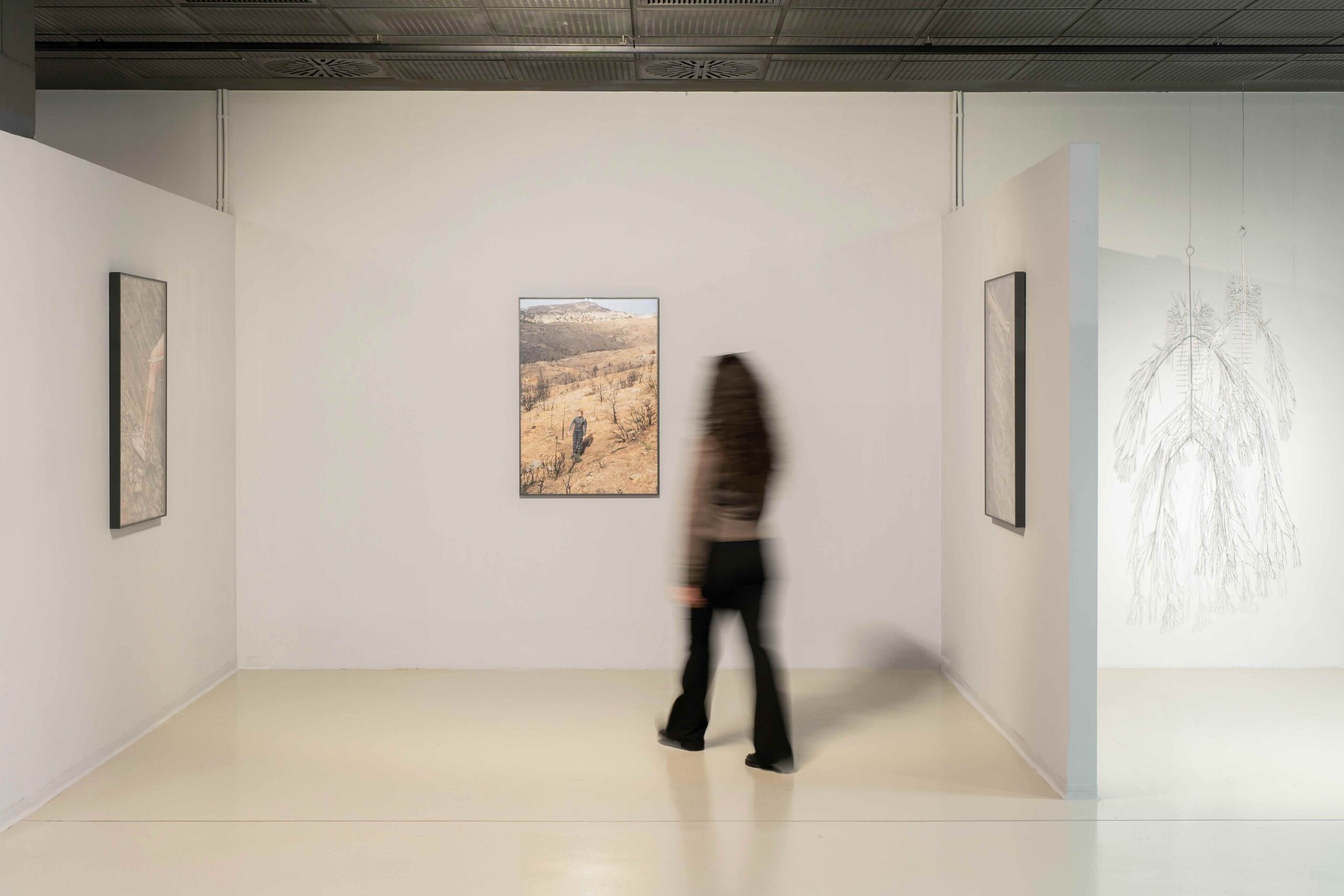
Neither artist is interested in the purity of classification. This refusal of fixed categories reaches one of its strongest expressions in Inescu’s Ecuator Nocturn, developed after the 2024 wildfires on Mount Pentelicus in Attica. The work brings together burnt vegetation, tortoise shells and references to the human body within the same field of attention. Everything exists on equal terms: animal remains, plants, landscape and human vulnerability.
The disaster revealed something central to the artist’s thinking. Protection itself has limits. The tortoise shell, usually understood as a perfect natural armour, becomes useless in the face of a force that exceeds it. What appeared as a symbol of defence becomes a reminder of shared fragility.

This is where Inescu moves beyond conventional ecological discourse. Her work does not simply state that nature must be protected. Instead, it challenges the hierarchy that separates the protector from the protected. Humans, animals, plants, minerals and climate are not positioned as independent categories but as participants in the same fragile system. The landscape is not the background — it is the structure itself.
They both understand transformation not as failure but as the natural condition of existence. Nothing survives by remaining identical to itself.
Gyárfás arrives at a similar conclusion through different means. His large reed installation, created from bundles collected from the Danube Delta, transforms organic material into a monumental yet unstable presence. The work occupies the exhibition space like a living formation rather than a constructed object. Its monumentality is fragile. As time passes, small fragments loosen and fall. The sculpture accepts its own transformation: instead of resisting change, it incorporates it.

This is one of the strongest connections between the two artists. They both understand transformation not as failure but as the natural condition of existence. Nothing survives by remaining identical to itself. Inescu demonstrates this through ecological and biological systems. Gyárfás demonstrates it through objects and cultural memory. The mountain after fire, the mutated flower, the ageing textile and the collapsing organic sculpture all speak of the same process: continuation through change.
Embodied Perception
The sensory dimension of their works is equally important. Both artists move beyond vision as the dominant way of experiencing art. Their materials demand proximity. Inescu’s works ask the viewer to become attentive to surfaces: the hardness of metal, the fragility of shells, the tension between organic forms and artificial structures. Gyárfás introduces smell, texture and physical memory. The scent of hay immediately transports the viewer beyond the exhibition space — towards rural landscapes, childhood experiences, agricultural cycles or forgotten forms of labour.

This attention to embodied perception recalls Juhani Pallasmaa’s argument that modern culture often reduces experience to detached observation. Genuine perception emerges through contact and participation. The world is not only something we look at. It is something we inhabit. Both exhibitions operate through this principle. They do not simply present objects to be observed. They create situations in which viewers become aware of their own relationship with matter.
Inescu’s Harriet (2020) makes this relationship particularly complex. The work refers to Harriet Cole, whose nervous system was famously dissected in the nineteenth century by anatomist Rufus Benjamin Weaver. The artist translates the nervous network into metal, transforming something hidden inside the body into an exposed structure. The result is both beautiful and unsettling. A system normally associated with sensitivity, communication and vulnerability becomes a hard sculptural form. The interior becomes exterior. The invisible becomes visible. But visibility creates another problem — when something is exposed in order to be understood, does it also become available for control?

This question connects unexpectedly with Gyárfás’s treatment of textiles and handmade processes. His works also expose what is usually hidden: the labour behind objects, the intelligence of the hand, the accumulated gestures that industrial production often erases.
During the installation process, the artist mentioned an injury to his finger that left him unable to bend it completely. It is a small biographical detail, but one that resonates strongly with the logic of his sculptures. These works depend on imperfect, physical processes: touching, repairing, stitching, adapting. The hand is not simply a tool that creates form; it is integral to the thinking process. In this sense, both artists question intelligence itself. Inescu expands intelligence beyond the human body, towards plants, ecosystems and geological processes. Gyárfás locates intelligence in inherited gestures, craft and material knowledge.

The Potential of Rupture
The works inspired by flowers growing in irradiated environments represent another important point in Inescu’s investigation. These sculptures could easily become symbols of catastrophe. Instead, they occupy a more ambiguous space. Influenced by ideas such as James Lovelock and Andrew Watson’s Daisyworld model, Inescu becomes interested in the capacity of living systems to reorganise themselves under altered conditions. The flowers continue to appear, but they appear differently. Their altered forms contain both damage and persistence.
Adaptation is not presented as a simple story of survival. Mutation does not erase destruction. Transformation carries memory. Gyárfás’s hybrid organisms, made from wood, clay, plants, crushed shells, sand and textiles, function according to a similar logic. They look like archaeological discoveries from a civilisation that never existed or biological remains from an imagined future. They are impossible to place in time. They appear both ancient and new.

This instability is precisely the point. Tradition, for Gyárfás, is not something frozen. It is a material that can continue changing. The title The Broken Corner of the Cube becomes significant here. The cube suggests perfection, rationality and control. The broken corner creates an opening where something less predictable can enter: softness, organic growth, memory, imperfection.
One begins with nature and arrives at culture. The other begins with culture and returns to nature. What connects them is the understanding that every object is a temporary arrangement of relations.
This broken corner could also describe the space where the two exhibitions meet. Both artists challenge the fantasy of complete control. Inescu does so by showing that humans exist inside larger systems that cannot be dominated. Gyárfás does so by allowing materials to maintain their own behaviour and history.
One begins with nature and arrives at culture. The other begins with culture and returns to nature. What connects them is the understanding that every object is a temporary arrangement of relations. A stone is not only a stone. A textile is not only a textile. A shell is not only protection. A plant is not only a decoration. Each carries traces of processes that began before us and will continue after us.

In the end, Afterlife – Still Life and The Broken Corner of the Cube are not exhibitions about saving what disappears. Their ambition is more subtle: they ask what disappearance actually means when matter constantly changes form. Perhaps preservation was never about keeping things identical. Perhaps it was always about allowing transformations to remain visible.
Nona Inescu and Oláh Gyárfás propose two different but deeply connected ways of looking at the world: one through geological and ecological interdependence, the other through memory, craft and inherited materials. Together, they reveal a world where persistence matters more than permanence, where fragility becomes a shared condition, and where matter — whether stone, plant, textile or body — is never silent. It continues.