

What does it mean to feel safe? Is it a locked door, a familiar street, a body left unremarked upon as it moves through public space? Safety is rarely a fixed condition — it is a negotiation, renewed every time we step outside, speak our minds, or simply exist in a body the world has already decided how to read. For many, especially women, that negotiation begins early and never fully ends. To ask what makes a woman feel unsafe is, in effect, to ask what society has built her to expect: appraisal, interruption, a vigilance that accompanies even the most ordinary outing. Safety, in this light, is not the absence of danger but the presence of enough trust — in institutions, in strangers, in one’s own body – to stop counting the exits.

It is this fragile, contested terrain that Poems of Unrest, on view at Haus für Medienkunst in Oldenburg until 13 September, sets out to map. The exhibition is drawn from the fifth edition of OFF-Biennale Budapest, an institution founded in 2015 in direct response to the growing state control over Hungary’s cultural institutions and one that spent a decade as the country’s largest independent platform for work that refused to fall in line with official cultural policy. That policy took shape under Viktor Orbán’s Fidesz government, which held power for sixteen years — from 2010 until its landslide defeat in the April 2026 parliamentary election, when Péter Magyar’s Tisza party ended what commentators had come to call the ‘Orbán era’.
The Oldenburg presentation carries this history with it: the works on view are not merely ‘about’ insecurity as an abstract concept but emerged from a context in which the erosion of safety and free expression was, for over a decade, a lived and daily condition.
Across those sixteen years, the government progressively tightened its grip on museums, universities and public discourse, folding cultural institutions into a broader project of what political scientists term ‘state capture’. OFF-Biennale emerged as a direct counter-model to this consolidation, functioning less as a conventional exhibition series than as an act of civic infrastructure: a space where independent voices and democratic exchange could still take place despite the surrounding institutional pressure. The Oldenburg presentation carries this history with it: the works on view are not merely ‘about’ insecurity as an abstract concept but emerged from a context in which the erosion of safety and free expression was, for over a decade, a lived and daily condition.

Security as Weapon, Security as Wound
The curators, Katalin Székely and Edit Molnár, take as their starting point a bitter irony of the present political moment: the language of safety has been captured by the very forces that manufacture insecurity. Poems of Unrest pushes back, not by rejecting the desire for safety as illegitimate, but by reclaiming it – asking what a genuinely inclusive, feminist, care-centred notion of security might look like, and what forms of collective imagination might get us there.
The exhibition’s feminist recalibration insists that any serious account of security has to begin here, in the spaces we are taught to think of as safe by default.
For its Oldenburg iteration, the exhibition narrows its lens toward the intimate. Where the original Budapest biennale addressed security as a broad geopolitical condition, this presentation returns the question to the family, the home and the body — sites popularly imagined as havens, yet where the first and most enduring forms of unsafety are so often learned. Patriarchal control, domestic violence, the loss of bodily autonomy, the quiet tribalism of ‘us and them’: these do not arrive from outside the domestic sphere but are frequently produced within it, before radiating outward into wider social and political life. The exhibition’s feminist recalibration insists that any serious account of security has to begin here, in the spaces we are taught to think of as safe by default.

Poetry as Method
The title’s invocation of poetry is not incidental. Across the exhibition, ‘poetry’ operates less as a literary genre than as a mode of address — an insistence that the emotional and the ambiguous deserve as much analytical weight as the political or statistical. This is precisely the terrain that critic and novelist Jennifer Higgie maps in The Mirror and the Palette, when she writes that ‘as psychoanalysis has made so clear, human beings move through life dictated to by a mess of conscious and unconscious memories, acts and feelings. The language of art is a reflection of this: it’s one of slippages, ambiguities and contradictions that are communicated via images, which are, by their very nature, indeterminate.’ Poems of Unrest takes this indeterminacy seriously as a working method, trusting images, objects, gestures and fragments of language to hold contradiction without resolving it — to let grief sit beside resilience, and fear beside tenderness, without forcing either to cancel the other out.

This approach finds one of its most resonant precedents in the work of Paula Rego, whose paintings and prints have long refused to soften the violence embedded in domestic and institutional life. Rego’s women are neither victims nor heroines in any simple sense; they are complicit, furious, cunning and wounded all at once, inhabiting a pictorial language dense with folklore, bodily distortion and unresolved psychological charge. Rego herself offered one of the more useful definitions of what this kind of work demands, describing an artist as ‘someone who goes to a place where no one’s been before, and brings back something we/you have never seen before but instantly recognise.’ It is a fitting description for an exhibition that asks its viewers to travel into uncomfortable, half-acknowledged territory — the fear that lives inside a family, a home, a body — and to recognise it as their own. Rego’s engagement in the exhibition reinforces her feminist genealogy, underscoring that the struggle for bodily autonomy — over who controls the female body and under what pretext of ‘protection’ this occurs — has a long visual history, with current events forming the latest chapter.

Anna Daučíková’s work extends this exploration to queer visibility and the body as a space of political interaction — a body never permitted to simply exist without being subjected to ‘reading’, categorisation and the disciplining influence of the structures surrounding it. Meanwhile, Flo Kasearu, whose work frequently uses domestic architecture (locks, fences, and security measures) as a metaphor for the psychology of safety, suggests an unexpected and incisive perspective: the objects we install for a sense of security often most eloquently reveal what we fear.
Conflict, Displacement, and Collective Voice
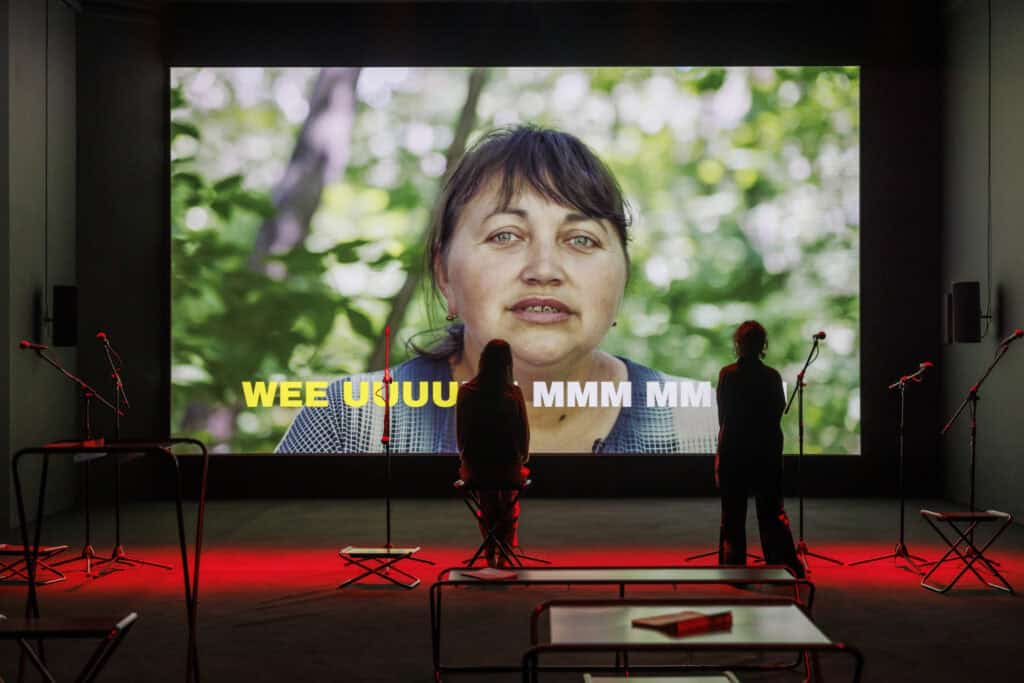
In other sections, the exhibition broadens its scope to address the geopolitical forces that generate widespread insecurity. The Ukrainian collective Open Group — internationally renowned for projects that transform the testimonies of those displaced by war into acts of participation and often starkly candid expression — juxtaposes the reality of armed conflict with the exhibition’s more intimate, personal dimension. It serves as a reminder that threats in domestic life and on the geopolitical stage are not isolated phenomena but links in the same chain: an aerial bomb and a locked bedroom door are both parts of a single, long story about people deprived of the ability to determine the terms of their own survival.

It serves as a reminder that threats in domestic life and on the geopolitical stage are not isolated phenomena but links in the same chain: an aerial bomb and a locked bedroom door are both parts of a single, long story about people deprived of the ability to determine the terms of their own survival.
Róza El-Hassan addresses similar topics — issues of forced displacement and the search for shelter. Drawing on her own experience (she is of Hungarian-Syrian descent), the artist asks: what structures — political, familial, or physical — can hold a life together when its familiar foundations collapse? Concurrently, Larry Achiampong’s creative practice, which frequently addresses themes of colonial legacy, migration, and collective memory, expands upon the exhibition’s central idea: that the question of who can feel safe is inseparable from the history of empires and racially motivated exclusion.

Among these more explicitly political positions are works that explore unrest through the lenses of ritual, humour and everyday materiality. Ingela Ihrman’s engagement with biological processes and decay, Robert Gabris’s exploration of Romani and queer identities, and Cal Kowal’s historical juxtaposition with Charlotte Moorman, whose radical, body-centric practice alongside Nam June Paik transformed the public image of the ‘safe’ or ‘acceptable’ female body expand the exhibition’s timeline, insisting that contemporary unrest runs deep and that the resistance to it has an equally long, yet little-known history — one disproportionately authored by women artists.
Care as Counter-Strategy
What ultimately distinguishes Poems of Unrest from a simple survey of contemporary anxieties is its refusal to end in diagnosis alone.
Underlying this statement is a deeper, personal reflection on the very nature of consciousness. By making conscious choices, we embrace the fullness of life — even when those choices entail hardship; indeed, such challenges are sometimes essential. Yet, it is crucial to ensure that we are truly making these choices ourselves, rather than blindly allowing circumstances to dictate our path. Living unconsciously breeds unnecessary suffering; thus, it is wiser to consciously choose the challenges we will inevitably face. Without cultivating awareness, you risk living your entire life at the mercy of your own emotions and thoughts. Until you realise that you are not your thoughts, a single negative reflection stands between you and unhappiness. Until you learn to resist the impulse to act on every passing emotion, you will remain trapped in a cycle, reliving the same situations over and over.

Ultimately, the goal is to become a more conscious individual: by recognising negative behavioural patterns, you gain the opportunity to act differently, and each such action alters the course of your life. This is precisely the message the collection Poems of Unrest conveys to its audience: it calls not for passive empathy but for a more demanding form of inner work — the ability to clearly perceive the behavioural patterns that breed insecurity within us and to find the strength to respond to them in a new way.

In this sense, the project in Oldenburg serves simultaneously as a regional extension of the OFF-Biennale’s mission and as an independent, albeit understated, statement: the indeterminate, elusive language of art is not a sign of weakness in the face of urgent political challenges but rather the very tool that allows for the accommodation of the contradictions inherent in them. The question of what grants us a sense of security is, at its core, a question of what kind of society we are prepared to build together. Poems of Unrest exhibition offers no simple answers, presenting instead seventeen voices and vital attempts to keep that question open.
This is precisely the message the collection Poems of Unrest conveys to its audience: it calls not for passive empathy but for a more demanding form of inner work — the ability to clearly perceive the behavioural patterns that breed insecurity within us and to find the strength to respond to them in a new way.
OFF – Poems of Unrest
10 June – 13 September 2026
Haus für Medienkunst in Oldenburg, Germany
More