



With forty new commissions exhibited at iconic landmarks, Abu Dhabi’s inaugural Public Art Abu Dhabi Biennial transformed the city into an emirate-wide celebration of art, culture, and community. Building on the theme Public Matter, more than seventy artists from the UAE and around the world explored the concept of “public” within the unique context of both Abu Dhabi and Al Ain’s urban environments.
In a place like Abu Dhabi, the natural environment dominates and determines the ways, locations, and community spaces, and defining what it means to be public becomes crucial. To understand the role of these spaces in forming the city’s unique identity, the Biennial looked at it from various angles – from the cultural imaginaries of different transitory communities and the conditions under which these communities become public to the importance of public art.

Creating a majlis of sorts and part of their project Urban Negotiations, Ana María López Ortego, Harold Guyaux, and Viviana Parada Camargo, members of the Arquitectura Expandida, crafted a wooden ping-pong table, and “drift” through Abu Dhabi neighbourhoods, sparking spontaneous encounters with the communities. As the weather warmed, the ping-pong table became a hotspot in the evenings.

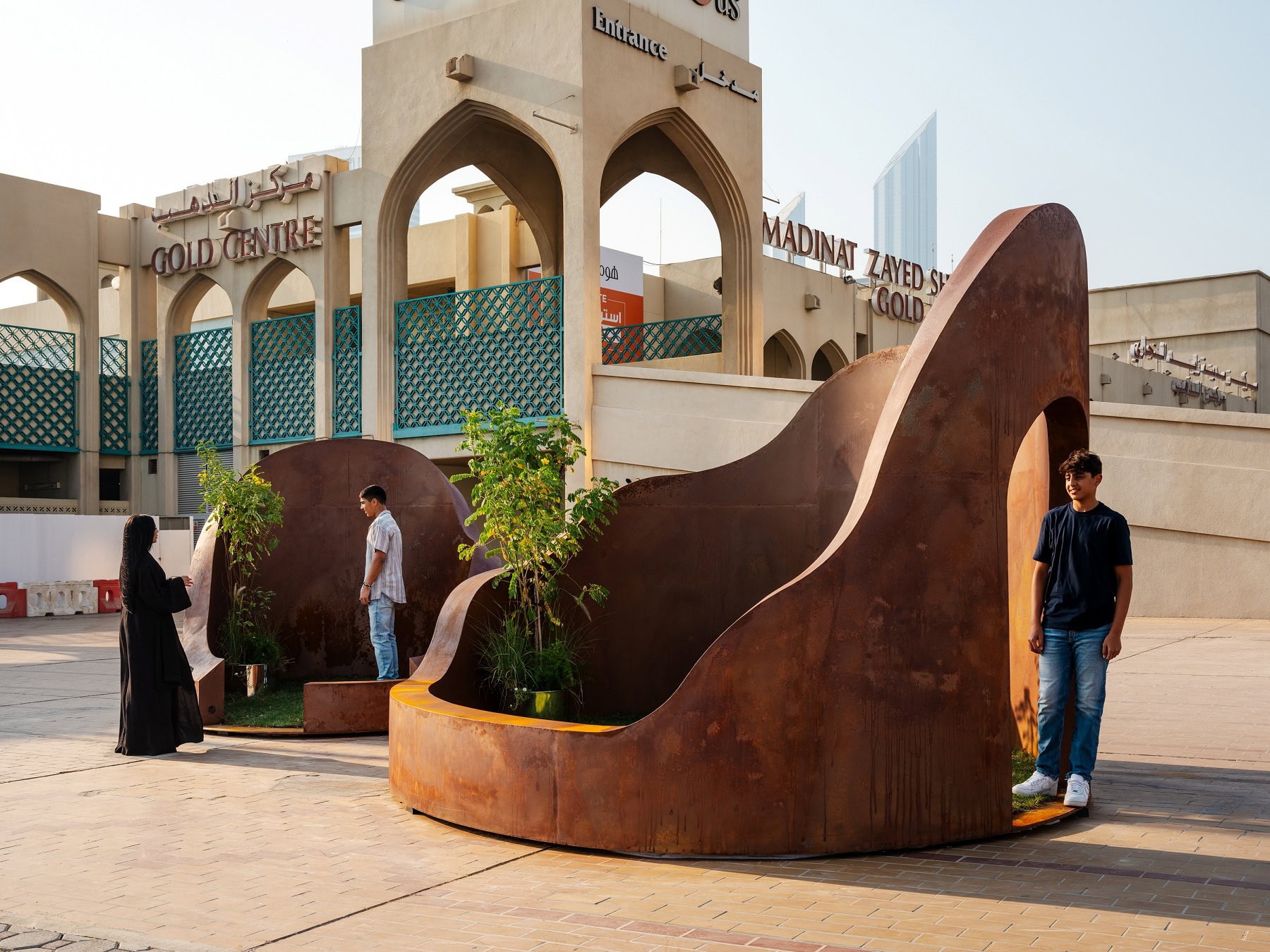
Situated parallel to Abu Dhabi’s Corniche Road near Etihad Square, Rand Abdul Jabbar’s Crown was an ode to “making home” in Abu Dhabi and creating a space where contemporary representations of identity are linked to notions of collective learning and growth. Crown framed the downtown skyscrapers, nearby iconic sculptures such as the dalla (coffee pot) and medkhan (incense burner).

In Let’s Not Wait to Fill Our Cups with Time, Nnenna Okore reflected on Abu Dhabi’s unprecedented development over the past fifty years, exploring how time and space efficiency have transformed the arid desert into a vibrant metropolis. Hundreds of multicoloured, circular hessian elements are integrated into a mesh system enveloping the façade of the heritage watch tower in Heritage Park, signalling that progress is possible when time is used wisely while highlighting sociocultural diversity.

“With every installation, we are harnessing the power of public art to advance the creative legacy, cultural infrastructure and quality of life within Abu Dhabi through placemaking and collective memory”, Clémence Bergal, Public Art Abu Dhabi Director at DCT Abu Dhabi, said. “The breadth of artists and artworks on display is a testament to Abu Dhabi’s long-term efforts to integrate art into the fabric of society, and ultimately to make it accessible and available to all”.

Beyond the public art displayed across eight easy-to-follow routes throughout Abu Dhabi and Al Ain, a rich public programme included artist-led workshops at Anga Art Collective’s Migration Granary, performances on artist Tania Candiadi’s beach-front Nomadic Stage, and Afra Al Dhaheri’s D-constructing Collective Exhaustion at the National Theatre. Interactive storytelling at Ayesha Hadhir’s Playful Traditions, a public art park which featured three elements traditional to the fishing industry – a dhow (sailing vessel) transformed into an interactive playground, a gargour (traditional fishing trap) whose dome was reimagined as an area to spark creativity, and a water fountain displaying local fish – nurtured an appreciation for art amongst younger audiences.