The exhibition The Space Between at this year’s KodlContemporary functions as a transparent Gesamtkunstwerk. Housed within a glass volume, the installation establishes a rhythmic dialogue with the surrounding neoclassical architecture of Prague, mediating the boundary between the internal gallery environment and the city’s historical urban fabric. Here, the sterile silence of the traditional white cube is abandoned in favour of a semipermeable membrane. It is a space where the city’s sedimented memory, stored in ancient stone and shifting history, bleeds into the contemporary interior to dissolve the threshold between the street and the sanctuary.
It is a space where the city’s sedimented memory, stored in ancient stone and shifting history, bleeds into the contemporary interior to dissolve the threshold between the street and the sanctuary.
The gallery does not merely house the artworks but rather becomes an active subject itself, a crystalline vessel where the golden light of the Vltava or the rhythmic percussion of raindrops falling against the glass are invited to participate in the dialogue. Within this enclosure, the weight of the surrounding architecture and its medieval and neoclassical heritage are not external observers but fundamental participants in an alchemical process of spatial transformation. The glass walls act as a prism that filters the passage of time, allowing the ghost of the city’s past to mingle with the urgency of the present moment.

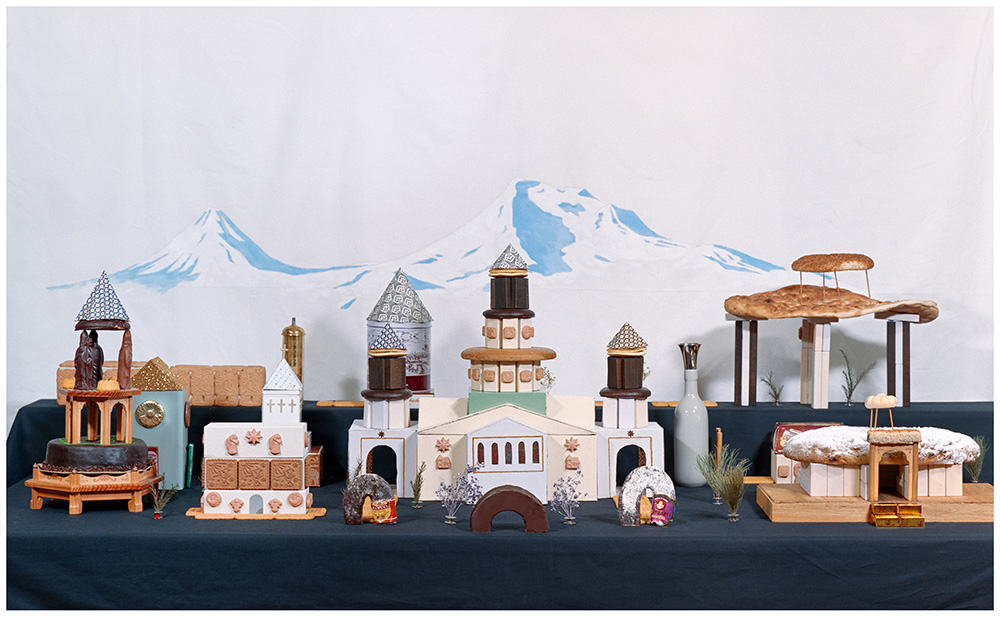
This alchemy is anchored by the exhibition architecture of Richard Loskot, who elevates the transitional zone, the quiet gap, and the pause to the status of a primary medium. Within this total work of art, the viewer is no longer a mere observer but a vital pulse within a sensorial ecosystem. Loskot interrogates our architectural utopias through a tactile poetry of contrasts, utilising translucent stones that whisper of the fragility of our structures and raw wooden blocks that serve as maquettes for an imagined future of inhabitation.

By choreographing these moments of stillness, Loskot reveals that the in-between is not a void but an interwoven ecology of political, social, and cultural layers. These intervals act as the connective tissue of the exhibition and encourage a slower, more deliberate navigation. It is a place where the physical weight of the materials, such as the coldness of the stone and the warmth of the wood, acts as a grounding force against the ethereal and shifting light of the glass environment. The spatial arrangement demands a physical negotiation, forcing the body to acknowledge the gravity of history while simultaneously floating in a sea of transparency. In this curated interspace, meaning is not delivered as a finished product. Instead, it is emerging in the friction between the archival past and the unfolding present.

Navigating this space, one is struck by an urgent and visceral intergenerational dialogue that collapses the chronological distance between the artists. A haunting kinship emerges between Magdalena Jetelová, whose land art is forged in the fires of post-communist struggle, and Veronika Hapchenko, who navigates a capitalist reality shadowed by the immediate spectre of war. While Jetelová translates the vibration of music and performance into sculptural space, The Essential is No Longer Visible (2021), Hapchenko dissects Soviet techno-politics and their scarring of the landscape. Through her airbrush technique, Fountain (Figure) (2024), she rewrites cartographic symbols to challenge the permanence of borders. Her arrows, once indicators of Soviet river diversion and the hubris of controlling nature, now point toward power structures that transcend anthropocentric logic. She suggests a world where architecture and organic matter exist in a shared metamorphosis, a state of constant flux where the map no longer dictates the reality of the territory.


Joining this dialogue are Michal Škoda’s architectural maquettes and drawings, Bez Nazvu II (2023). His work frames possible simulations and sculptural ideas of space, defining areas to be shared or inhabited by investigating the tension between substance and void. Škoda leaves his forms and narratives open-ended, showing spatial structures as constantly negotiated dimensions that refuse to settle into a singular meaning. Here, modernist traditions of proportion and basic gestures shape a concentrated social perception, focusing on the essential relationship between architecture, everyday life, and personal perception. His drawings act as blueprints for a consciousness that seeks to find a home within the absence, turning the void into a sanctuary for thought.

Within this curated void sits Stanislav Libenský’s Glass Grid (1958), a seminal work that oscillates between an architectural plan and a rhythmic system organising the viewer’s gaze. Alongside Jaroslava Brychtová, Libenský’s sculptures from the 1990s demonstrate how light acts as a direct mediator of form, where the interval in space is generated by physical substance itself. Their legacy proves that space is born of events rather than rigid forms, possessing a deep performative potential that resonates through the glass. The glass is not a barrier but a medium of revelation, capturing the unseen forces of the environment and rendering them visible through refraction and shadow.

This principle finds a contemporary, geometric echo in the paintings of Jan Poupě. In works such as Portal IV (2025), Liquefaction (2025), and Great Shadowplay (2025), Poupě reveals that space is never a solid boundary but a shifting situation. Each motif translates an architectural event into a study of lighting and proportion. In Poupě’s canvases, the viewer is the final catalyst because the geometry dissolves or solidifies based on the angle of observation, mirroring how the gallery’s own glass-cube architecture reacts to the shifting Prague sun. His work suggests that our reality is a matter of perspective, a series of portals that open and close as we move through the world.

Following the structural logic of the grid and the liquefaction of Poupě’s geometry, Magdalena Jetelová introduces a performative deconstruction that challenges the very stability of the room. Her vibrating glass wall serves as a primary disruptor, putting the entire architectural structure into a state of perceived motion. This allows the subject to sense the direct course of historical performances, specifically the symbolic burning of the hillside across the bridge, an act that transformed the landscape into a witness of political upheaval. These flames find a contemporary resonance in the charred markings on nearby canvases, suggesting that the fire of the past has never truly been extinguished. Jetelová does not merely represent history; she deconstructs the present form of architecture through a new visuality, uncovering excluded contexts and forcing a temporal shift that collapses the distance between the archival event and the present encounter.

Following the thought of philosopher Félix Guattari, the exhibition perceives space as a constantly changing constellation of relationships. Rather than a silent backdrop, the gallery becomes an architectural agent, a catalyst that actively participates in the formation of social and sensory behaviours. The dialogue stretching from Libenský’s 1958 grid to Poupě’s negotiated portals and Hapchenko’s ideological abstractions reinforces a mental ecology. By juxtaposing the foundational logic of Czech glass art with contemporary performance and the visceral anxieties of the present day, The Space Between provides a site for transgenerational synthesis. In this context, the biomorphic is not merely an aesthetic choice. It is a Guattarian resistance against rigid, anthropocentric structures of power, an assertion that life and art are inseparable from the environments they occupy. The exhibition argues that we must cultivate a new way of seeing, one that recognises the intricate webs of dependency that link the human to the non-human and the historical to the possible.

The Space Between succeeds in elevating the local context of Prague to a universal meditation on the fragility of social structures. The exhibition functions as a profound reminder that our built environment is never static. Through the elemental forces of light, stone, and the rhythmic organisation of the grid, the exhibition opens new forms of interpretation for the interspace, that fertile ground where the past and the future collide in the present moment. This interspace is where the meaning reveals itself, in the moments of hesitation and the spaces between the pillars of established thought. It is within these specific ruptures, the friction between the structural rigours of Libenský and the liquid portals of Poupě, the heat of Jetelová’s performative fire and the non-anthropocentric anxieties of the youngest generation, that a raw, unscripted intimacy with the environment emerges. The glass cube ceases to function as a traditional gallery. Instead, it becomes a site of experimental containment, a place where the fracture is not a flaw but a necessary breach for the intrusion of external realities. This light is not a consoling glow but a volatile, active frequency that disrupts the visual perception and forces a confrontation with the precariousness of what tends to be considered solid.
The exhibition refuses a final resolution, offering a suspension within the threshold instead. It invites lingering in the uncertainty of the “in-between” where the boundaries of the self and the architectural skin remain blurred.
The exhibition refuses a final resolution, offering a suspension within the threshold instead. It invites lingering in the uncertainty of the “in-between” where the boundaries of the self and the architectural skin remain blurred. This is a testament to a collective persistence that builds not for eternity, but for the immediate, shifting now. In the face of systemic collapse and the shadows of war, these crystalline structures do not offer a universal hope; rather, they serve as fragile, temporary vessels of resistance. They are as sharp as shards of glass and as heavy as the stone that remembers, existing as a shared, difficult metamorphosis that demands we remain awake to the tremors of the present.

The Space Between
KodlContemporary in Prague
Exhibiting artists: Veronika Hapchenko, Magdalena Jetelová, Jan Poupě, Michal Škoda, Stanislav Libenský & Jaroslava Brychtová