

For 国建 ā á ǎ à – KENBO’s Art Journey from the East to the West, Liang Guojian brings together a body of work that traces the shifting spaces between form, context, and cultural memory. Known as KENBO (“Old Ken”) since the age of seventeen, a nickname given to him by classmates for his mature character and passion for history, Liang has carried the name into his artistic practice.

The exhibition is not merely a survey of his work across China and Europe, nor an attempt to resolve ‘East’ and ‘West’ into a single visual language. Instead, it follows a practice formed through encounters: between traditional Chinese painting and Western modernism, ritual and abstraction, preservation and destruction, personal memory and public history, as well as the natural world and the increasingly unstable conditions of the Anthropocene. Curated by Stanisław Ruksza and Andrzej Wasilewski, 国建 ā á ǎ à KENBO’s Art Journey from the East to the West is on view at Trafostacja Sztuki in Szczecin, from 12 June to 11 October 2026.

A perception that unfolds
The exhibition is structured in two parts — one dedicated to the Anthropocene, the other to Dust and Moss, where KENBO turns the accumulation of dust and moss into a metaphor for experience, transformation and the continual re-making of perception. The project’s focus on cognitive evolution is reflected in its title, ā á ǎ à. These four tone marks of Hanyu Pinyin, the standard romanization system for Mandarin Chinese, indicate pitch and tone; for KENBO, they become a sequence for encountering art: from bewilderment, through friction and attempted understanding, to dialogue, and finally recognition and awe. In his Cantonese interpretation, they move roughly from “What is this?” to “What on earth are you talking about?”, then “Ah, I see… maybe,” and finally “Oh, so this is art!” He describes this as his deliberately “brutal” interpretation of the ineffable nature of abstract art. The humour is important: the journey begins with not knowing.

In Homage to the Square (To Fire) (2026), KENBO places the geometric language associated with Josef Albers and Kazimir Malevich alongside the square motifs of traditional Chinese spirit money. The resemblance initially produces the response represented by ā: what is this? Yet the encounter reveals how dependent form is on context. Malevich’s Black Square (1915) marked a radical rethinking of painting; the square on Chinese spirit money is embedded in folk ritual and practices of communication with the dead. The encounter reveals how differently the same form can function across cultures. KENBO sees these as two paths of abstraction — one seeking essence, the other condensing reality into a practical or ritual form. What appears self-evident in one context can therefore become opaque in another: this is the á moment — confusion, friction, the noise that accompanies cultural dialogue.

Yet the exhibition does not stop at difference. Its third tone, ǎ, suggests that meaning moves: once forms leave their original contexts, they acquire new associations through use, encounter and dialogue.This openness to movement and exchange is rooted in KENBO’s own history. Born in Foshan, Guangdong, in 1973, he was trained in traditional Chinese painting, while his education was also shaped by a Soviet-influenced academic system of drawing, colour, composition, oil painting, watercolour, gouache and lacquer. He nevertheless returned to the brush and rice paper, describing the familiar material as a kind of lifebuoy offering security and spiritual comfort. His later encounters in Poland and Germany, particularly his relationship with the artist, soprano and composer Sigune von Osten and his years at Trombacher Hof, exposed him to contemporary practices in which concept could take precedence over established technique. Rather than abandoning tradition, he began to explore the interplay between these systems, turning their different approaches into material for his work.

His artbooks extend this tension between preservation and destruction. In the tradition of Chinese painting and calligraphy, image and writing share a common origin — “shuhua tongyuan”. KENBO’s early books engage with this continuity, while later works turn the book into an object that can be damaged, burned and transformed.

Memory Materialized
The questions of maintenance and demolition become planetary in Footprints of the Anthropocene (2026), KENBO’s Five Elements book series. Drawing on the traditional Chinese system of “Wu Xing”, the Five Phases — Metal, Wood, Water, Fire and Earth — KENBO gives each a contemporary material form: cast concrete; tree stumps and straw; video documentation of invisible water; volcanic lava rocks bearing scorch traces; and local soil and cow dung. Rather than preserving the Five Elements as a historical system, he uses them to consider the changing relationship between human activity and the Earth. The materials themselves become witnesses to transformation, waste and interdependence, bringing an ancient cosmology into the unstable conditions of the Anthropocene.
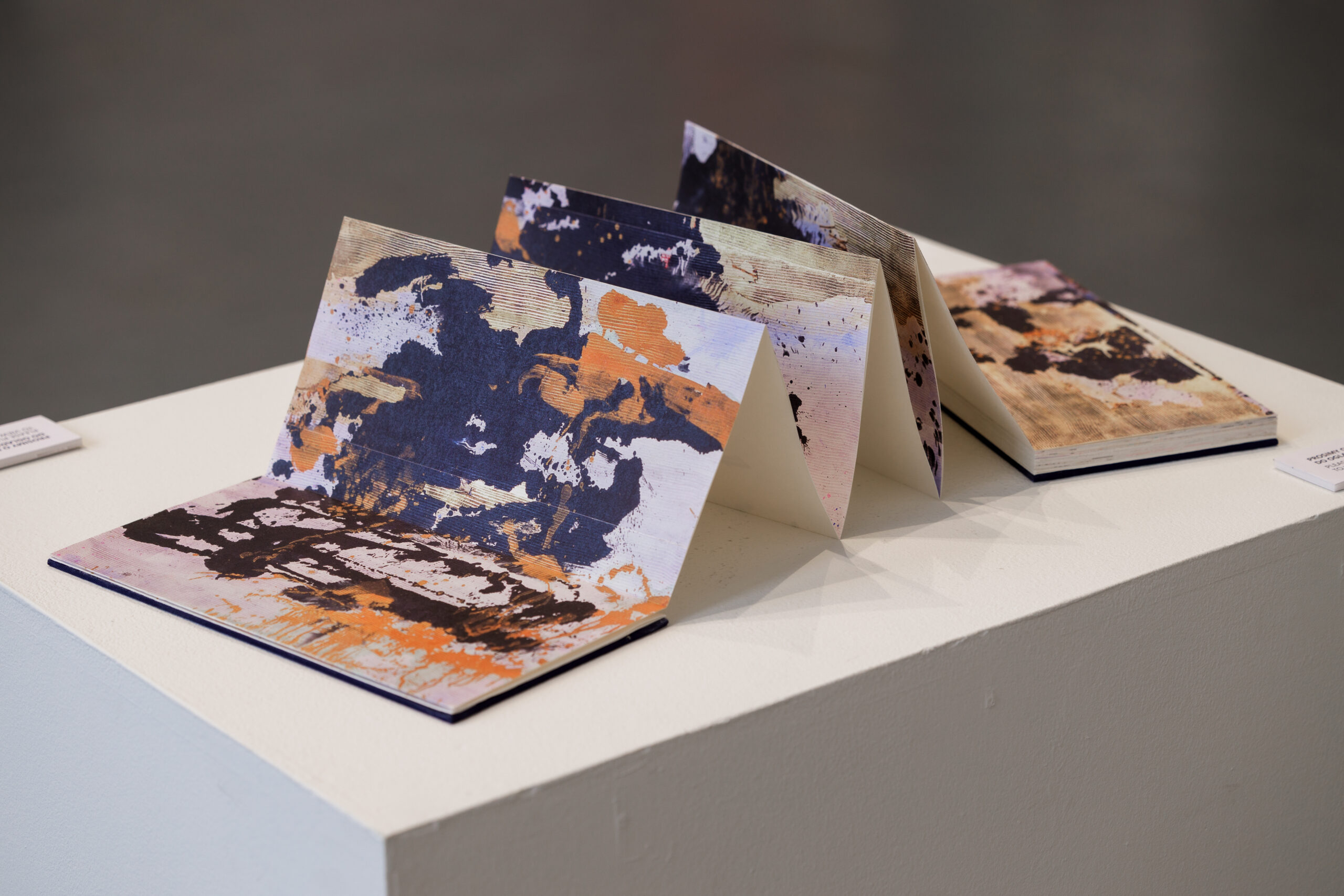
This relationship between material trace and memory is particularly powerful in WANDERING 1941–1944 (2026), an installation combining one of KENBO’s artbooks with a Second World War postcard purchased in Wrocław. The postcard begins simply: “Dear Stefa.” Those two words open onto an enormous history. The writer is trying to contact Stefa after letters have been returned from Lviv. Family members are dispersed, employment is uncertain, bombs are falling, and the writer describes the exhaustion of wandering. The postcard is not a historical overview; it is one person attempting to reach another when ordinary communication has become precarious. That is precisely what gives the work its force. Stefa becomes more than a single lost memory; the postcard opens onto the countless ordinary lives that disappear behind the scale of historical narratives, in the West as well as the East. Exile, displacement, loss of livelihood, separation and despair become legible through a few lines written on the move.

His accompanying question is deliberately unsettling: “Keepers, vets, and bosses; tourists and trapped beasts behind iron bars — who is cute, who is terrifying, who is pitiful?” It shifts the work from one wartime story towards the structures of power that determine who observes, who controls and who becomes vulnerable. Under the same sky, people can become witnesses and participants in systems of violence; brother can turn against brother. History becomes not only a record of what happened, but a test of how we choose to remember it.

That act of observing and remembering extends into 123 Days When Chinese Ink Meets the Confluence of the Oder River: A Record of an Irreversible and Variable State of Time, KENBO’s work-in-progress, created through the hands of Trafo team members who bring Chinese ink into direct contact with water from the Oder. Each day produces a new, unrepeatable composition as the ink disperses through melting ice, making the passage of time part of the work itself. The series becomes both a literal and conceptual encounter between KENBO’s Chinese artistic language and the Polish landscape in which the exhibition unfolds. Like memory itself, the image cannot be fixed; it changes through time and through the act of looking.

This sense of continual change brings us to the final tone, à, which is less a moment of resolution than an opening into further uncertainty. “Oh, so this is art!” is deliberately comic, but the recognition it describes is not definitive. KENBO imagines the exhibition as a mirror wrapped in the kasaya, the Buddhist monastic robe, around which Zen masters gather, debating what they see: “I am always so careless, using too much force and shattering the mirror. While gathering the fragments, I discover many selves.” The exhibition becomes a process of looking, sorting and reconsidering, where meaning emerges through attention rather than a clear-cut interpretation. Art’s value may lie less in establishing what something definitively is than in creating the conditions for sustained attention.

Perhaps the most useful way to understand the journey in 国建 ā á ǎ à is as a continuous process, free from fixed cultural identities. ā asks what we are looking at. á confronts the difficulty of understanding it. ǎ recognises that meaning can emerge through exchange. à arrives at recognition — not closure. For KENBO, this openness is not an unfinished state. Art can be a key, he suggests, precisely because it opens ways of seeing that might otherwise remain restricted. The journey from East to West is therefore also a journey through uncertainty: towards recognition, but without closing meaning down.

Supported by Trafostacja Sztuki in Szczecin