

We inhabit an era where the swipe of a thumb has successfully collapsed the distance between historical tragedy and consumerist desire. On the same high-resolution glass screen, a video of a drone strike in Ukraine or Gaza is immediately succeeded by a sponsored post for designer shoes, which is in turn followed by a curated holiday selfie or a soundbite about ecological doom. What once seemed irreconcilable — intimacy and exposure, grief and distraction, the historical weight of a region and the frictionless speed of the algorithm — now coexist in a state of permanent, vibrating suspension.
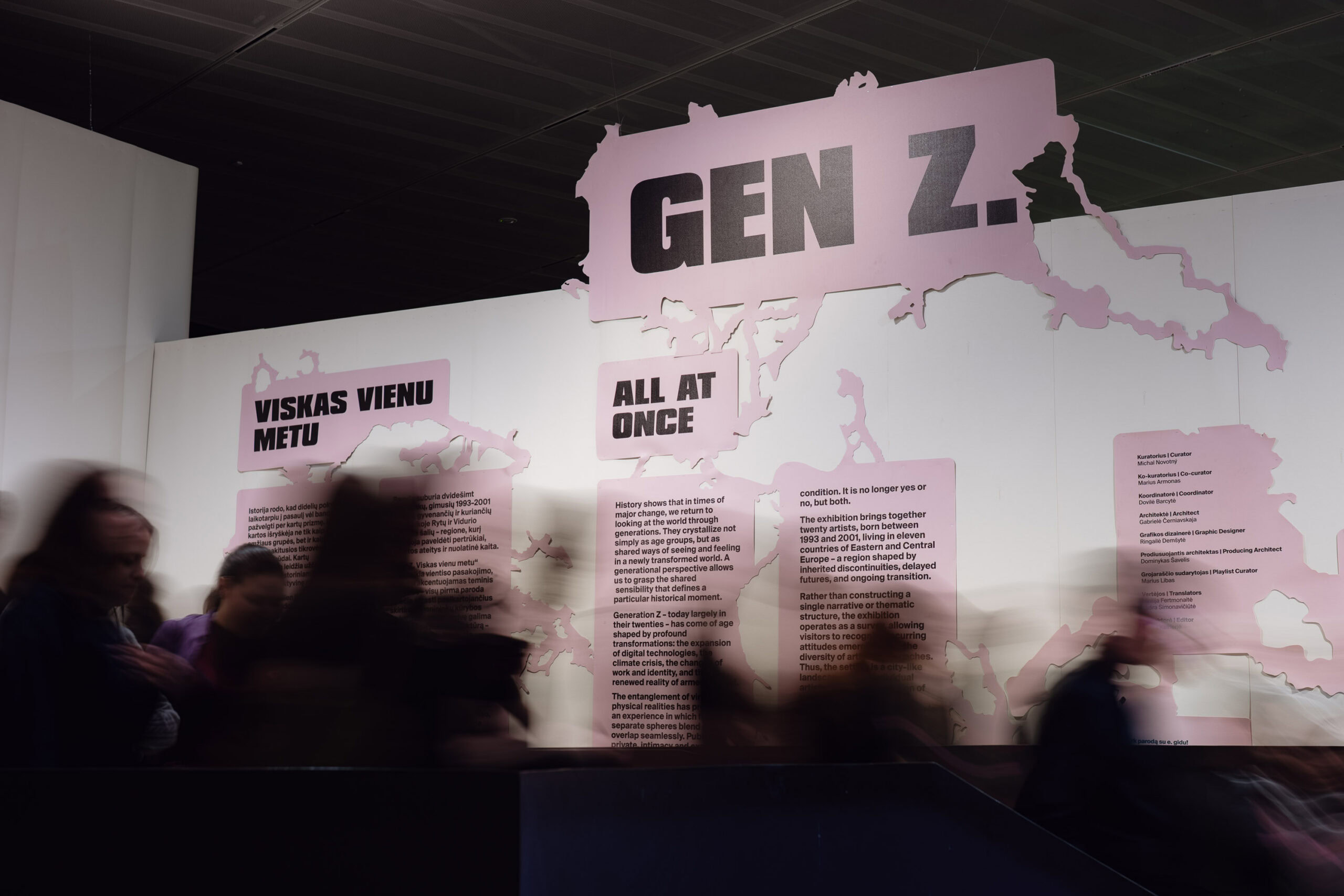
This is the psychological and material terrain of the exhibition Gen Z. All at Once held at MO Museum in Vilnius until August 30 2026. Curated by Michal Novotný and Marius Armonas, the show gathers twenty young artists from eleven Eastern European countries. This is a region defined not by a unified, linear memory, but by what the curators describe as ‘inherited discontinuities, delayed futures, and permanent transition.’ Yet, instead of attempting to resolve these historical ruptures or construct a grand, tidy narrative, the artists choose to inhabit the instability. Designed with an elegant, labyrinthine sensitivity by architect Gabrielė Černiavskaja, whose soft, undulating partitions and rolling expanses of artificial turf transform the space into an uncanny hybrid of sculpture park, playground and speculative landscape, the exhibition functions as a dense, relational field.
What once seemed irreconcilable — intimacy and exposure, grief and distraction, the historical weight of a region and the frictionless speed of the algorithm — now coexist in a state of permanent, vibrating suspension.

Kitsch and Melancholy
To grow up in the post-socialist space is to grow up in the shadow of a copy. In the works of Bulgarian-American artist Aaron Roth, the visual and psychological residues of capitalist transition in the Balkan region are dissected with a sharp, post-ironic scalpel. Roth’s practice dwells on the absurd excesses of ‘turbo-folk’ aesthetics and the regional desire to mimic Western prosperity — a desire that frequently bordered on the grotesque.
To grow up in the post-socialist space is to grow up in the shadow of a copy.
One encounters a plexiglass print with a stack of obsolete, beige power supply units and computer processors. Glued to their yellowed plastic casings are blue European Union flag stickers — a pathetic yet deeply moving testament to the region’s desperate bid for technological and political modernisation, where progress is signalled not by functional superiority, but by the application of a bureaucratic emblem. Nearby, Roth’s West (2024) presents a sheet of coarse oriented strand board (OSB) — the cheap, temporary material of construction sites and economic precarity — into which the word ‘West’ has been deeply and elegantly carved. At the bottom corner of the board, two small, square windows are cut out, revealing a photograph of a drab, pink-painted post-communist residential block. The piece operates as a brilliant semiotic trap: West is at once a geographical and ideological destination, and the brand of cheap cigarettes that fueled the lungs of those who built the transition.

In another installation, Dubai Dreams (2024), Roth combines quilted, black faux-leather upholstery (reminiscent of cheap nightclub booths or the interiors of imported luxury cars) with chrome shower hoses and hookah pipes, framing a postcard from Dubai. This is the aesthetic of ‘turbo-folk’ capitalism: a dream of luxury built from plastic, chrome and imitation leather, where the promise of the global market is translated into a localised, highly fetishised spectacle of wealth.
Flesh and Self-Replication
A significant portion of the exhibition is occupied by an intense, often uncomfortable exploration of contemporary sexuality. This is no longer the traditional gaze of classical art history, but a complex, highly mediated female gaze that has been fundamentally reshaped by the omnipresence of the camera lens and the social media feed. Yet, as several works suggest, this female gaze remains haunted by patriarchal structures; instead of inventing an entirely autonomous female sexuality, it often mirrors a version of the male gaze, as if the female subject is permanently viewing herself from the outside, through the eyes of an imagined spectator.

This psychological feedback loop is vividly captured in Helena Parys’ paintings. In Fly Trap (2023), a naked female figure reclines across a dark, purple-black landscape, her body sharply foreshortened and partially turned towards the viewer. Beside her, an open laptop displays a cropped digital image of her own breasts. The figure is thus split between her physical body and its mediated double: the body is no longer presented as a self-contained, lived reality, but as an image to be captured, inspected, circulated and repeatedly validated through the screen.
The desire to merge with the interface, to carry oneself as an eternal, digitised duplicate inside a smartphone, becomes a survival strategy against disappearance. This theme is echoed in Parys’ small pencil drawing, Kitty (2023), where a young woman, wearing a hood shaped like a glaring cat’s head, stares blankly into the cold light of her phone, her face illuminated by the very device that isolates her.
The desire to merge with the interface, to carry oneself as an eternal, digitised duplicate inside a smartphone, becomes a survival strategy against disappearance.
In dialogue with Parys, the paintings of Dominika Kováčiková inhabit a hyper-feminine, dreamlike space where innocence, vulnerability and latent violence coexist. Kováčiková’s canvases are populated by soft, fleshy bodies, ribbons and animals that initially suggest a saccharine, fairytale-like domesticity, only to subvert it with a quiet, menacing undercurrent. It captures moments when the ‘cute’ and the ‘subservient’ turn into something dangerous, active and sovereign.

In the painting Fragile (2025), a soft-pink belly, adorned with a sparkling navel piercing, dominates the upper half of the canvas. Below it, on a red-and-white satin cloth, lies a pristine, glossy-eyed fawn. Beside the animal, a scrap of paper bears the handwritten confession: ‘If I gave up on being pretty, I wouldn’t know how to be alive.’ It is a devastatingly honest distillation of the performative burden of femininity under late capitalism — beauty not as a source of pleasure, but as an existential condition for survival.
Tactile Discomfort and the Weight of the Material
While much of the exhibition deals with the weightlessness of the digital sphere, several artists insert a heavy, visceral materiality that grounds the viewer in the raw discomfort of the physical body. Sarah Nõmm’s installations serve as a powerful somatic counterweight to the glossy surfaces of the surrounding paintings. Her work utilises materials associated with domestic labour, traditional femininity and bodily confinement. Suspended from the ceiling is a series of white corsets and undergarments, Stringere (2023), that have been violently altered, woven with long strands of human hair and rough, unspun wool. These hanging objects resemble discarded skins or old instruments of torture, highlighting the ways in which the female body is historically and materially bound, laced and disciplined.

Below them, in Untie My Silk Ribbons (2022/2023), a rusted iron bed frame is stretched apart, its metal springs bound and wrapped in beige and soft pink fabrics that resemble bruised skin, bandages or swollen limbs. The installation speaks of illness, confinement, and the heavy, unscrollable reality of physical suffering — a reminder that despite our digital avatars, our primary dwelling remains a fragile sack of bones and flesh that decays, hurts, and demands care.
The Cosmic Grotesque and the Exhaustion of Progress
If hyper-femininity in the exhibition is experienced as a beautifully decorated trap, masculinity is represented as an exhausted, self-devouring engine of progression. This is the core of Czech artist Matyáš Tserhack Maláč’s painterly practice. Maláč’s canvases are filled with an uncanny, greasy unease, heavily influenced by the visual glitches of generative AI and the aesthetics of early computer graphics.

In the painting The Universe Is Exactly What It Is (2024-2025), an astronaut stands on a barren, lunar surface under a full moon, looking down at a colossal, mutated human body that stretches across the cosmos. From the body, a giant phallus ejaculates into the void. It is a brilliant, savage parody of the ‘space race’ and the colonising impulse — the ultimate extension of human expansion revealed as nothing more than a lonely, masturbatory gesture in the silent dark of the universe.
Scroll Down, Loser, We Are Optimising Ourselves
Having nursed on the blue light of hand-held monoliths — where the entire cosmos of human culture, from Star Wars to Shrek, from war reports to skincare tutorials, is compressed into the same indifferent five-inch viewport — this generation does not seek to resolve contradictions. Even Christopher Nolan’s reluctant acceptance that films might be watched on iPads gave rise to the internet’s gleeful parody of The Odyssey being viewed on Tamagotchis, MP3 players and refrigerator screens, collapsing the hierarchy between cinematic monumentality and the smallest digital display. Instead, they inhabit contradictions. In this exhibition, dread and play, intimacy and hyper-exposure, the sacred and the synthetic, do not collide so much as they co-exist in a state of fluid, liquid tension. It is a portrait of the self not as a stable monument, but as an ongoing, anxious performance of self-production, desperately seeking shelter within the very networks that threaten to dissolve it.

If late capitalism has turned the human body into the ultimate site of speculative real estate, Nikola Balberčáková’s 2024 video piece r/ForeverAlone now appears especially prescient. The title refers to a Reddit forum where users share accounts — part confession, part self-narration — of chronic loneliness, social alienation and perceived romantic exclusion. Balberčáková transforms fragments of these posts into a fictional dialogue, while retaining the ambiguity of a platform where testimony and creative writing often overlap. The work enters the broader dysphoric underworld of online loneliness, self-surveillance, resentment and compulsive self-improvement among young people. Much of its language carries the fatalistic logic now widely associated with ‘looksmaxing’ and adjacent subcultures: the belief that social value, intimacy and even one’s future are determined by facial symmetry, bone structure and other supposedly measurable traits. Cosmetic obsession here forms part of a wider ideology of optimisation, in which the body is treated simultaneously as defective material, personal failure and an engineering problem.
It is a portrait of the self not as a stable monument, but as an ongoing, anxious performance of self-production, desperately seeking shelter within the very networks that threaten to dissolve it.
What makes the work particularly compelling is that it also gestures toward the conspiratorial atmosphere surrounding these communities, where the rhetoric of self-enhancement increasingly overlaps with transhumanist fantasies, algorithmic influence and suspicions that loneliness itself has become something engineered, amplified or even manufactured. Whether these narratives describe reality or merely reveal the psychological need to locate hidden architects behind contemporary alienation remains unresolved — a productive ambiguity that Balberčáková wisely leaves open. Practices such as ‘bone smashing’, epitomised by figures like the grotesque internet deity Clavicular, become more than symptoms of body dysmorphia: they are expressions of a culture increasingly unable to separate biological destiny from technological intervention, or genuine self-fashioning from the suspicion that transhumanist fantasies are being engineered and circulated from above by powerful tech interests.

Balberčáková’s aesthetic strategy is a masterful high-wire act, balancing on the knife-edge between the neon-saturated theatricality of cosplay and the deadpan, algorithmic alienation of internet memes. By embodying an anime-inflected persona, she exposes the tragic pathology of our era: the illusion of virtual solidarity masks a devastating, absolute solitude. Underneath the absurd, dark humour of Balberčáková’s work lies a profound psychological grief — the quiet, agonising realisation of a generation that has been automated out of human warmth.
Phantom Memories, Sacred Afterlives
If Balberčáková captures the horror of the optimised present, Tornike Gognadze’s BOOM BALL (2025) retreats into the ghostly, fragile sanctuary of memory. Gognadze’s video work unfolds in the melancholic aftermath of a celebration — that suspended hour of the night when the music has faded, the guests have vanished, and only two young adults remain. Yet the atmosphere recalls a profoundly childhood experience: the uncanny feeling of being awake after the adults have gone, wandering through the abandoned traces of a gathering that suddenly feels mysterious, intimate and faintly haunted.
Adorned in a heavy, theatrical cabaret makeup that acts both as a shield and a portal, Gognadze’s protagonist constructs a highly personal, fragile mythology out of the ephemeral. The work becomes an exquisite metaphor for the fictional architectures of collective memory in the post-Soviet landscape. Gognadze evokes the famous urban legend of the Tbilisi Zoo, where generations of citizens swear they spent their childhoods marvelling at a majestic giraffe — an animal that, in historical reality, survived there for a mere two weeks. This phantom giraffe becomes a monument to our collective need for enchantment. Gognadze suggests that our memories are not objective archives but poetic survival strategies; we invent the wonders we require to endure the grey landscapes of our lives. The cabaret aesthetic here is not a gesture of irony, but a tender, protective frame around the vulnerability of childhood longing.
Rituals for a Ruined World
The search for transcendence in a post-catastrophic world reaches its aesthetic and philosophical zenith in Weronika Wysocka and Oksana Pawełko’s collaborative video work, Rite Raid Ride (2024). Operating with a cinematic sophistication that is nothing short of breathtaking, the artists position their narrative at the intersection of extreme isolation and the ancient, tribal hunger for the collective sacred.

Rite Raid Ride is a speculative excursion into a future that feels both archaic and post-apocalyptic — a world where the rugged aesthetics are infused with neopagan mysticism, technophilic witchcraft and shamanic rituals. The video is rich with intertextual echoes, most notably referencing Vladimir Nabokov’s labyrinthine novel Pale Fire, which itself deals with the slippery, paranoiac nature of translation and interpretation. Wysocka and Pawełko ask a vital question: when our digital gods fail us, what new forms of spirituality will we assemble from the ruins? Their characters — part-oracle, part-bricoleur — perform cybernetic rituals that feel deeply urgent, as if trying to re-consecrate a world that has been stripped of its magic. With its flawless scenography and hauntingly realised archetypes, Rite Raid Ride suggests that even in the scorched earth of the Anthropocene, our instinct for ritual and transcendence remains indestructible.
Rather than retreating into irony or moralising about digital life, the artists draw beauty, anxiety and unexpected tenderness from its toxic glow, turning memory, fantasy and ritual into defiant strategies for survival.
Ultimately, Gen Z. All at Once refuses the comfort of resolution. The artists inhabit the instability of an Eastern Europe propelled from late socialism into the algorithmic excess of late capitalism without any sustained sense of normality, where the past survives as a set of glitching files that continue to distort the future. Yet this unsettled present is also, by many measures, an unprecedented field of freedom, visibility and self-determination — one whose gains are neither complete nor guaranteed to endure. Rather than retreating into irony or moralising about digital life, the artists draw beauty, anxiety and unexpected tenderness from its toxic glow, turning memory, fantasy and ritual into defiant strategies for survival.