Interface, Narrative, Temporality (2025) begins in the air. The scene presents the city from the perspective of a drone-like camera gliding across a city turned upside down: traffic moves along streets suspended overhead, dense forests tangle into towers, while layers of buildings, cables and foliage render depth undetectable. The viewpoint evokes both the patrol of a drone and the logic of surveillance, yet Engin Demir uses this disorienting perspective to conduct a critical enquiry into how the world is constructed and perceived through data.

Byung-Chul Han argues that digital surveillance is especially effective because it is no longer bound to the physical and optical limitations of analogue systems. Digital surveillance is, in his terms, “aperspectival”; it eliminates the blind spots inherent in perspectival vision and enables “surveillance from any and every angle.1 Demir’s Interface, Narrative, Temporality similarly adopts an aperspectival mode of vision. The moving image repeatedly shifts between views of urban space, natural landscape, the infrastructures of data centres and seemingly immaterialdigital environments. Demir’s visual language moves across multiple scales and registers, unveiling the infrastructures of data through which contemporary reality is composed of. Through this, data embedded within the material organisation of the space are traced and exposed: in the flows of traffic monitored across the roads and the extensive cables that carry and transmit the information. Demir thus renders visible the material systems that recede behind the seamless digital interfaces.

Into this emerges a single figure in a white jumpsuit, a garment resembling a cleanroom bunny suit – a layer that protects the chip from human contamination rather than the human from the environment. Bleached hair, bleached brows, removed all colours of the body. The figure eventually arrives in a room where it confronts its ‘data double’ across a pane of glass. At this point, Demir’s enquiry extends to examining how data constitutes the self.

The data double offers a visual form to what Han calls the “Quantified Self”: a subject continuously translated into information to be tracked and monitored. Han argues that digital technologies allow the body and everyday life to be recorded through data points—temperature, calorie consumption, movement and other forms of behavioural measurement. Yet this accumulation does not necessarily produce a more complete understanding of the individual. Instead, Han argues, the self is “broken down into data until no sense remains.”2
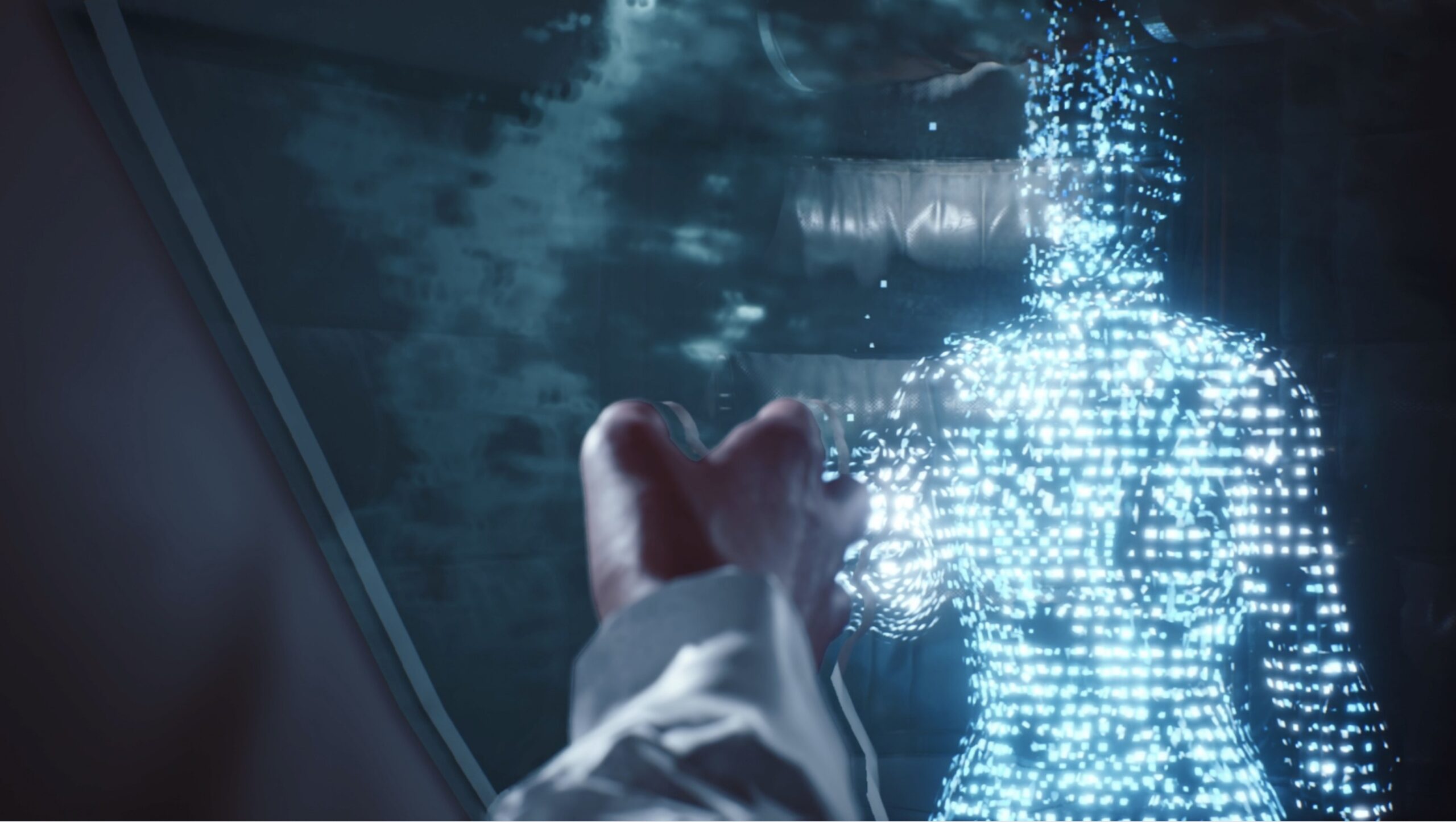
Demir literalises this contradiction through the encounter between the body and its data double. The double appears to contain what constitutes the individual—preferences, behaviours, desiresand dispositions rendered as information—while the physical figure appears increasingly emptied of distinguishing characteristics. Through the self and its data double, Demir reveals the paradox of the quantified self: as an individual becomes increasingly legible through data, the complexity that constitutes the self is simultaneously flattened into what can be measured.
Written by Kahyun Lee