



Exploring the intersection of migration, identity, and contemporary creativity, Art Voyage’s Echoes of Migration Summit is not your traditional conference. It’s a “cultural catalyst”, as the organisers highlight. Founded by Tima Jam, Art Voyage aims to do exactly that – amplify migrant voices within the arts, with its new biennial being an international and hybrid fair, championing work from all over the world.
In the lead-up to the Echoes of Migration Summit taking place on October 10, 2025, in the heart of London, we spoke to Tima about the origins and inspiration behind the summit, Art Voyage’s mission and her own perspective as a migrant, female creative fighting for systemic change.

Maggie Kuzan: As an Iranian-born, British citizen, how has your multicultural upbringing shaped your approach to the festival and guided your professional and personal interests over the years? And what motivated you to programme the Echoes of Migration Summit?
Tima Jam: I was born in Tehran (Iran), and when I was five, my family moved to Bushehr, a beautiful city in southwest Iran, by the Persian Gulf. Growing up there, surrounded by people from diverse heritages, dialects, and traditions, taught me the importance of celebrating difference and treating it with dignity. Those early experiences gave me a deep appreciation for cultural diversity and a lasting curiosity about how identity and belonging shape who we are.
That understanding became a guiding force in my life. Twenty years ago, I decided to leave Iran, living in Malaysia, then Croatia, and Turkey before finally settling in Lewisham, London, in 2019 — a borough which has incredible multicultural energy that made me feel truly at home. Each place I’ve lived has added new layers to how I see the world, shaping both my personal journey and my curatorial vision.
Growing up between different cultures also made me deeply aware of the complexities of migration — how it can be both a challenge and an extraordinary source of creativity. This understanding inspired me to build platforms that amplify underrepresented voices and create meaningful dialogue across borders.
Echoes of Migration is, in many ways, a reflection of my own journey. As someone who has lived across countries and finally found a sense of belonging within a multicultural community, I see myself as part of these echoes. The project goes beyond the everyday — it confronts urgent questions about identity, belonging, and the decentralisation of art, highlighting how migrant narratives are not peripheral but central to contemporary creativity.
Bringing the Summit to the RSA felt like a natural step to extend these conversations to a broader stage — uniting artists, cultural leaders, and communities to collectively reimagine how we recognise, value, and support migrant voices in the arts.

M.K.: Exactly. London’s creative scene is based on its heterogeneous identity. It has prided itself on the vastness of its nationalities and cultures. Alongside their programmed public installations and workshops, what impact do you hope that the works of artists like Vladimir Lalić, Ryan Hawaii and Alice Burnhope will bring to Manor House Gardens and the surrounding area of Lewisham?
T.J.: London’s strength has always been its diversity, and Lewisham really embodies that spirit. With Vladimir Lalić, Ryan Hawaii, and Alice Burnhope, we wanted to commission works that speak to identity, memory, and belonging, while being experienced directly in the heart of the community.
Lalić’s large-scale sculpture, To Move, is to Bloom, rises from the lake in Manor House Gardens in the form of a dragonfly. It draws on his own experience of displacement, symbolising migration as a natural cycle of fragility and renewal. As Lalic said, this installation is for them, for those who have crossed borders, for those who live in between cultures, and for those who have found belonging in this vibrant borough, same as him.
Hawaii’s A Tapestry of Lewisham takes the form of a reimagined bench, created with textiles and community research. It weaves together local heroes, small businesses, and flags of migrant communities, celebrating the cultural lifeblood of the borough.
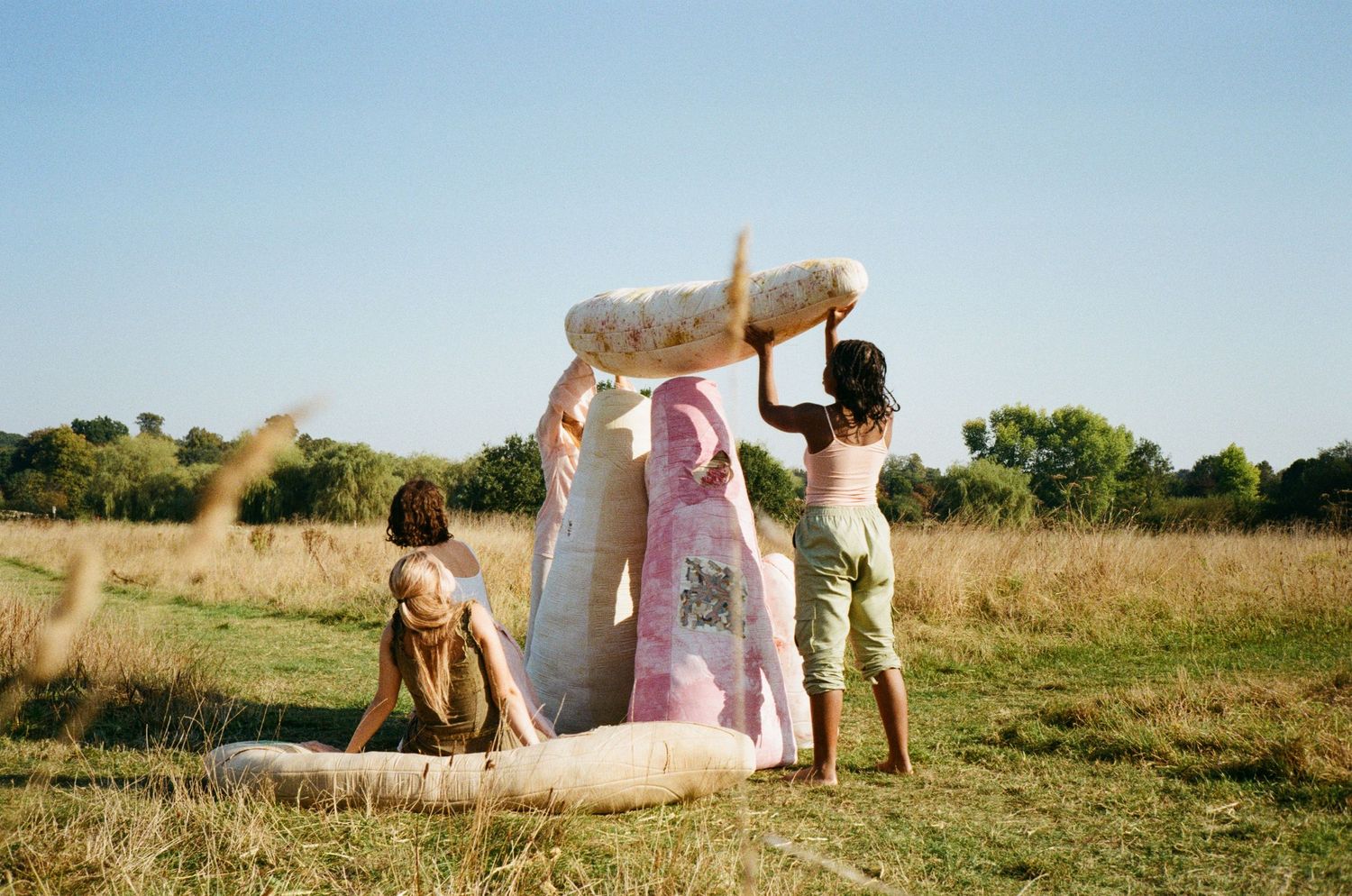
Burnhope’s Crafting Connections workshops bring residents into the creative process directly, through natural dye and embroidery. The collaboratively-made piece will be unveiled as a travelling installation and shown at the Summit.
Together, these works transform a familiar park into a cultural landmark, one where the community can see their own stories reflected, and where visitors are invited to engage with Lewisham as a site of resilience, creativity, and innovation.

M.K.: What do you think are the main obstacles and challenges standing in the way of arts organisations and non-profit spaces instigating real change in the UK today?
T.J.: One of the biggest challenges for arts organisations and non-profits is that, especially at the beginning, so much is expected with very limited resources. We were fortunate to receive support from Arts Council England and the National Lottery Project Award for our first project, which affirmed that our mission is valued, but we are still constantly working to turn our ambitions into reality.
Another obstacle is inclusivity: who gets seen, who gets funded, and who feels invited into the conversation. Real change requires more than good programming — it requires structural shifts. That’s exactly what we aim to explore through our Summit, which brings together over 20 leading voices, from curators and cultural leaders like Rose Issa, Roxane Zand, and Tamsin Ace, to artists such as Alice Burnhope and Paulo Arraiano. Across five panels, we’ll address urgent issues like “The Role of Cultural Memory & Heritage” and “The Role of Institutions in Supporting Migrant Artists”, creating space for genuine dialogue and reflection, and much more you will have the opportunity to hear if you join us.


M.K.: But then, the upcoming Art Voyage Biennial, launching in 2027, will take the form of a nomadic biennial — echoing the spirit of initiatives like the Young Artists Biennale from Europe and the Mediterranean (GO!) in Gorizia and Nova Gorica earlier this year, which promoted cross-border collaboration. How can such nomadic formats and heterogeneous sites, with amorphous cultural identities, become a source of inspiration for you?
T.J.: Every city we engage with carries its own rhythm — a cultural pulse shaped by history, memory, and community. Some are cohesive, others beautifully fragmented, but it’s precisely within these contrasts that creativity flourishes. By working across borders and embracing diverse contexts, we nurture authentic artistic exchange and cultivate a dialogue that evolves with each new edition.
As a nomadic biennial, we view movement not as a challenge but as a vital opportunity for connection and reinvention. Each location invites us to engage with its layered histories and shifting identities, uncovering stories that resist simple definitions. This constant state of fluidity pushes us to grow through collaboration, while remaining deeply rooted in the local.
Ultimately, every edition becomes a living conversation with its surroundings — shaped by its people, stories, and cultural dynamics. Our nomadic model is both a curatorial philosophy and a commitment to cultural listening, adaptability, and shared authorship.

M.K.: What events and activities have you planned in the lead-up to the main Biennial itself?
T.J.: I envisioned Art Voyage not just as an organisation, but as a movement — a platform for meaningful change built on collaboration. It’s made possible through the collective support of our Board of Trustees, including the Advisory Board and Artistic Council, alongside an expanding network of visionary brand partners, philanthropists and cultural experts who believe in art’s power to shape social change and reimagine how art connects communities across the world.
In the lead-up to the Biennial, we’re already building momentum through mentoring programmes and residencies for emerging and underrepresented artists, as well as community workshops, exhibitions, and public art. This is followed by the Summits and international exchanges, which connect people across borders. All of this is about creating access, visibility, and dialogue.
For us, the Biennial represents the culmination of ongoing work — the result of years dedicated to supporting artists, fostering community engagement, and nurturing international collaboration. It’s about building lasting momentum, trust, and global networks that will make 2027 a truly transformative moment for artists, communities, and audiences alike.

M.K.: Speaking of connection and community, with the rise of nationalism sweeping across Europe, the cross-cultural curatorial approach of biennials and projects such as Art Voyage might give an opportunity for opposing such ideologies. How much of an impact do you think we are able to make through cultural collaborations?
T.J.: Art has always spoken the language of humanity — a language that transcends borders, politics, and fear. That’s where its real power lies. Cultural collaborations have the ability to counter division by bringing people together through creativity, empathy, and shared experience.
Art Voyage was built on this belief: that art can dismantle barriers, amplify underrepresented voices, and create spaces where people feel seen, connected, and valued. Through our projects, we aim to challenge narratives of exclusion with stories of belonging, resilience, and hope.
We may not change the world overnight, but every collaboration, every exhibition, every dialogue plants a seed of transformation. True impact lives in the relationships we build, the opportunities we create, and sometimes, in changing just one artist’s life — however, that one story can inspire many more!

Art Voyage: Echoes of Migration Summit
October 10, 2025
RSA House – 8 John Adam St, London