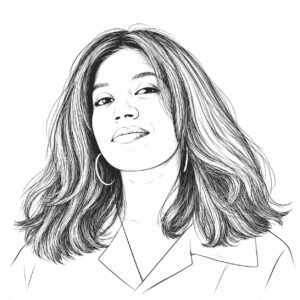
Tracing the porous boundaries between body, environment and matter, Victoria Yuanli Yuan’s practice considers corporeal experience as a process of continual exchange, where water, memory and material transformation unsettle the limits of the self.
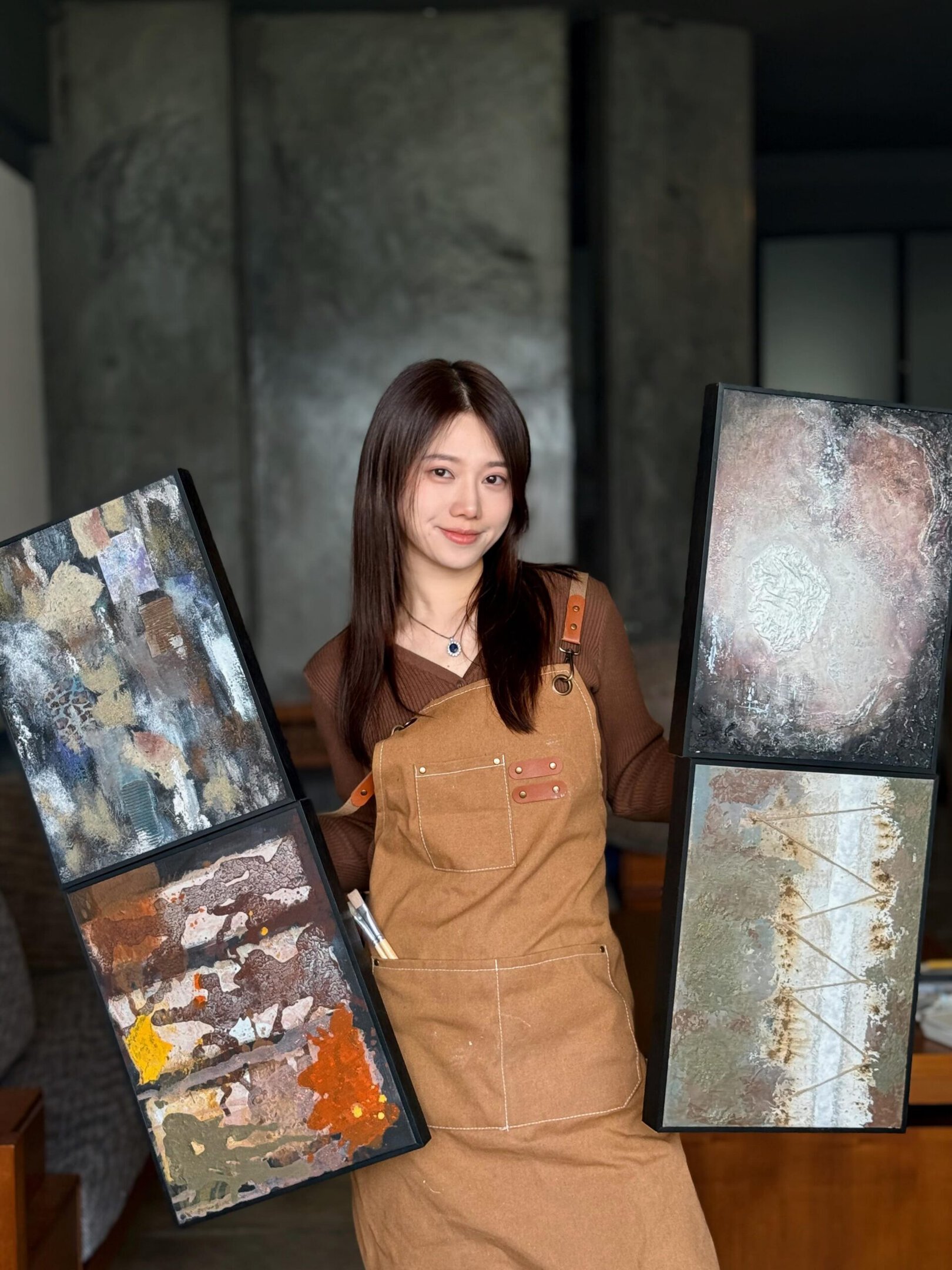
Victoria Yuanli Yuan is a London-based artist, born in Shenzhen, China, whose practice moves between painting and moving images. Educated in the United States, Yuan draws on personal experience and cross-cultural observation alongside hydrofeminist thought, material feminism and posthuman ecofeminism. Her work considers femininity, vulnerability and resilience through an understanding of the body as fluid, permeable and shaped by its surroundings. Across her paintings and moving-image works, skin, water, data, memory and matter become interconnected, while gleaming, blurred, fractured and layered surfaces complicate distinctions between interior and exterior, presence and disappearance.

The dissolution of fixed forms is evident in Yuan’s Untitled (2022) paintings. Informed by Chinese landscape painting and the abstract spatial language of Zao Wou-Ki, the series moves away from depicting a particular landscape towards an atmosphere assembled through movement, texture and pressure. Working with a palette knife, Yuan layers,scrapes and displaces oil paint until mountains, rock, water and mist become suggestions within a shifting pictorial field. The Chinese expression “as light as a feather, as heavy as Mount Tai” provides a conceptual hinge for the series, bringing weight and lightness into the same pictorial space. Pigment carries the density of memory, emotion and time even as colour and air appear to disperse across the canvas.

This instability becomes increasingly corporeal in Soma Archive (2023). Faces, skin and limbs are fragmented into visual units that recall the technologies through which individuals become biometric markers, identity categories and behavioural data. Yet liquid brushwork prevents the body from remaining fully legible. Forms dissolve into light and water, placing technological classification against the material processes through which bodies breathe, consume, exchange and shed. The body emerges as both readable and uncontainable: information that can be captured, and matter that continually exceeds its classification.

In The Host Body (2023), Yuan turns towards the structures that determine what can be contained, accommodated or excluded. Organic and industrial materials meet across the surface without settling into a stable hierarchy, making containment appear as an active and uneasy process. The paired titles, Suppression (Healing), Anomaly (Newborn), Assimilation (Advancement) and Aftermath (Afterlight), sharpen this tension. Their parenthetical terms expose how language can recast control as care, progress or illumination. What appears to be protected may also be controlled, while what is classified as anomalous may simply be something a system has yet to accommodate. The host becomes an ambiguous figure: a space that enables existence while determining the conditions under which that existence is permitted.

The Body as an Environment
Light in Womb (2024), brings Yuan’s interest in permeability into an image of beginnings. A human-like newborn form appears within a blue, translucent membrane that recalls amniotic fluid, cellular structures and the ocean. Yet the work does not establish the womb as an enclosed space. Its visual language continuously expands outward, connecting the formation of a single body to the larger aquatic conditions that sustain it. The waves and diffused forms surrounding the figure make the distinction between organism and environment difficult to maintain.

This connection also complicates the idea of birth as a moment of separation. The newborn emerges into the world while remaining visually embedded within the same fluid field from which it has formed. Yuan therefore presents individuation as incomplete: the body begins to take shape without becoming fully autonomous. The membrane is consequently less a protective wall than a threshold through which life, matter and sensation remain connected. The work introduces a different register of vulnerability, one rooted not in exposure to external forces but in the fact that existence begins through dependence and remains materially interconnected.
And Then There Was Light (2026) returns to landscape, but with a structure that has been unsettled. At its centre, the lighthouse appears assembled from displaced geometric forms, its verticality threatened by the suggestion of tilting, fracture and reorganisation. A structure conventionally associated with stability and orientation is made precarious. The surrounding sea, mountains and swirling sky intensify this instability, placing the lighthouse within a temporal landscape that seems to be continuously shifting.

The lighthouse depends on the promise of a fixed point, yet Yuan presents a structure unable to fully secure itself. Its light offers orientation without certainty, mirroring the way memory accumulates unevenly rather than providing a stable route back to the past. Seen alongside Light in Womb, the work reverses the direction of Yuan’s enquiry: the newborn emerges into an environment from which it cannot be separated, while the lighthouse attempts to orient itself within one that continually shifts. In both, the environment becomes an active force in shaping how the subject understands its position.
Myth as Spectacle
With Divine Entertainment Ltd. (2025), Yuan turns towards the construction of myth itself. Drawing on Hieronymus Bosch’s The Garden of Earthly Delights, the work brings Chinese and British mythologies into the same theatrical landscape, alongside recognisable sites such as the White Cliffs, Stonehenge and Battersea Power Station. Mythical creatures, architectural landmarks and natural forms occupy the same visual field, producing an imagined world in which histories that would ordinarily carry distinct cultural meanings become part of a single, deliberately excessive spectacle.
The title introduces an important shift in how this world can be understood. By attaching “Ltd.” to the divine, Yuan gives mythology the language of a registered company: something with a brand, a product and an implied commercial structure. The humour is immediate, but the gesture also changes the status of the images within the work. A monument can become a logo; a mythological creature can become a mascot; a sacred narrative can be reformatted as entertainment. The work’s visual excess reinforces this logic, presenting an environment in which almost everything appears available for display.

What makes the work compelling is the collision between cultural specificity and visual standardisation. Chinese and British references are assembled within the same fictional enterprise, creating an uneasy familiarity in which recognisable symbols become detached from their original contexts. Yuan draws attention to how cultural meaning can be reorganised as symbols circulate beyond the traditions that produced them.
The work also treats images themselves as transferable commodities. Myth, monument and landscape become visual units that can be combined, branded and redistributed, with the fictional company exposing cultural packaging as part of the work’s subject. Divine Entertainment Ltd. therefore considers how collective histories are transformed when their symbols enter systems of circulation and consumption.
Surfaces in Negotiation
Across Yuan’s practice, the surface is never simply where an image ends. It is where different materials, systems and forms of experience come into contact. Metallic grounds catch and distort reflection; translucent passages allow forms to recede; accumulated and damaged layers expose the history of their own making. A body can dissolve into landscape, a landscape can acquire corporeal vulnerability, and a digital image can reduce the individual to information before painting returns that information to the physical world. The surface holds these contradictions without resolving them.

Yuan’s engagement with feminist and ecological thought is therefore embedded in the construction of the works themselves. Accumulation, abrasion, translucency and fracture become ways of thinking through dependence and agency. The structures that promise stability, a membrane, a host, a lighthouse, a monument, remain conditional. They protect, organise and orient, but are also vulnerable to pressure, transformation and reinterpretation.
It is within this negotiation between material and digital forms that Yuan’s practice feels particularly resonant. Her engagement with digital modelling, moving image and data extends these concerns into a contemporary image culture increasingly shaped by AI, where bodies, landscapes and identities can be generated, manipulated and circulated as information. Yet Yuan does not allow the digital to become detached from material experience. Digital processes remain in contact with paint, texture, reflection and the physical surface, drawing attention to what can be obscured when bodies are translated into data or images.

Within the context of contemporary art in the UK, this approach feels particularly relevant: Yuan neither positions technology in opposition to the body nor treats materiality as a retreat from the digital. Instead, the two continually inform one another, exposing the increasingly unstable boundaries between embodied experience and its technological representation.
Yuan’s practice leaves these tensions unresolved. Across painting, mixed media, moving image and digital modelling, she constructs spaces in which matter, memory and identity remain in negotiation. What appears to be a boundary becomes a point of contact, and what appears fixed begins to shift. In Yuan’s work, the surface is not a limit to be crossed, but a place where transformation is already underway.