






Looking at Xawery Wolski’s biography, one might think it was almost ready-made for a film script. Quite an ambitious one at that. After studying art in Warsaw, he broke away from the grey reality of 1980s Poland to continue his education in Paris and later in New York. Then came Peru, Mexico, Thailand and India, followed by many years spent living abroad. Wolski, a Polish sculptor who has been part of the international art world for decades, developed his practice through travel and encounters with different places. There is a reason I begin with his biography.
On the Road, curated by Eulalia Domanowska at the State Art Gallery in Sopot, traces this trajectory through the artist’s work. Wolski engaged with local materials, techniques, symbols and practices, gradually absorbing elements of them into his own work. The geography of his life can be read as a catalogue of forms carried from one context into another. Along the way, their ties to a particular place of origin become less distinct, while their meanings open onto contexts far beyond it.

I have the impression that the more places appear in Wolski’s biography, the harder it becomes to assign his art to any one of them. Interestingly, for all the geographical change, his artistic language remains remarkably consistent, as though what he encountered along the way had accumulated within a single practice developed over decades.
The geography of his life can be read as a catalogue of forms carried from one context into another. Along the way, their ties to a particular place of origin become less distinct, while their meanings open onto contexts far beyond it.
The show opens with Boomerang, made in Carrara in 1986 and resting on a plinth, the earliest work on display. Rounded, smooth and heavy, the shape of the object remains recognisable, while the marble’s weight suspends its original function, opening the form to associations of movement, distance and return. In its immediate vicinity, Domanowska places Wolski’s most recent works, from 2026: traces of sweeping hand gestures captured in material, which she herself describes as ‘final gestures’.

Forty years of the artist’s practice stretch between these objects, although it would be difficult to guess as much from their forms alone. Wolski’s biography is precisely situated in time and space, while his art seems to evade both almost entirely. Works from different decades meet in a shared language, without clear stylistic breaks. Wolski is on the road, yet his works seem to exist outside time.

The Grammar of Connection
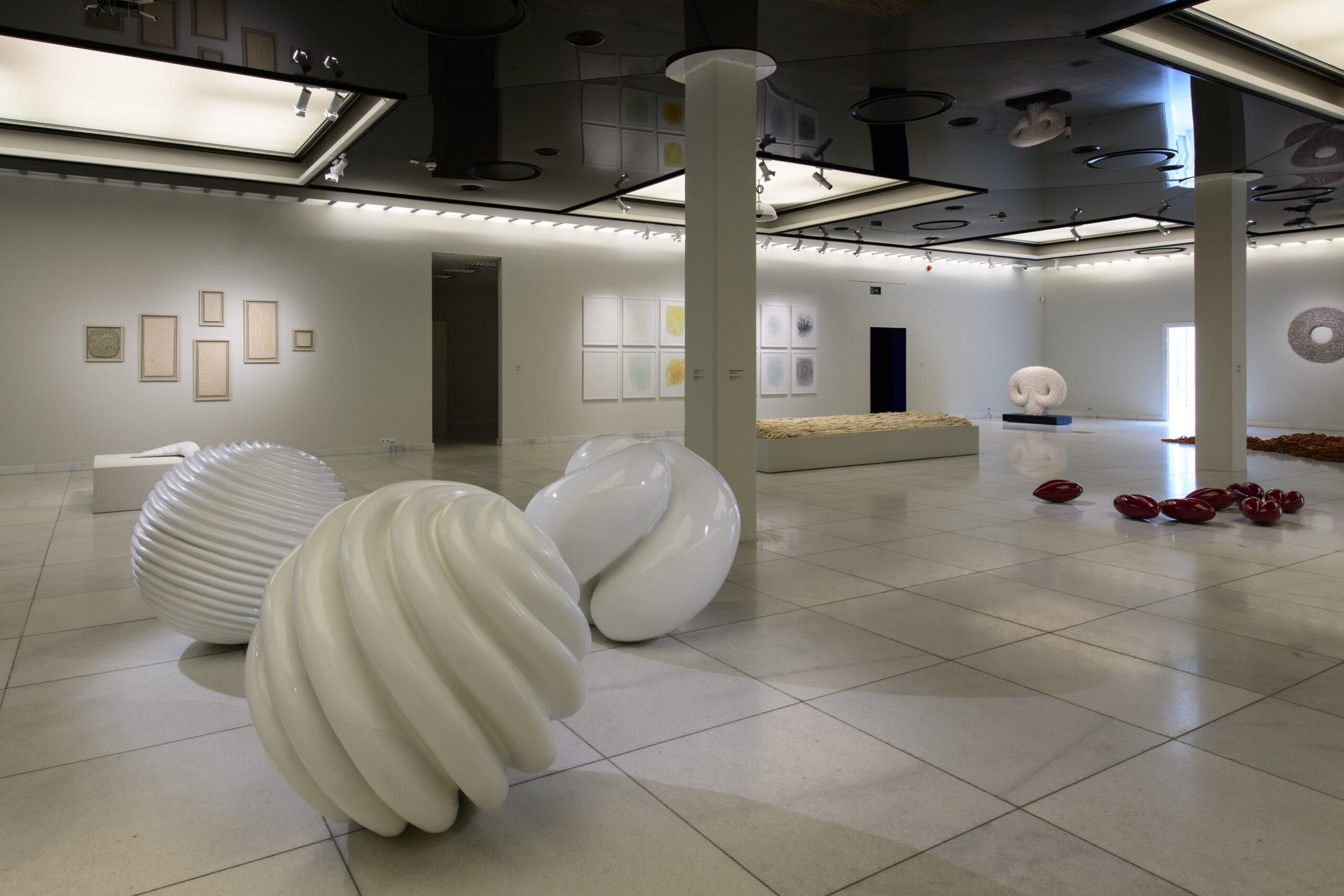
Deeper into the gallery, attention shifts to a group of large, intensely red seeds, a recurring motif in the artist’s practice, scattered directly across the floor. Glossy and rounded, they draw the eye from a distance, forming the visual heart of the exhibition. Their shape is simple, but their enlarged scale and deep red colour quickly push them beyond any single association. A slit running through the centre evokes lips, a body, perhaps an organ, while the form remains clearly legible as a seed. He extracts the most basic shape from things, alters its scale, material or context, and leaves the viewer with a form whose original meaning remains present without exhausting its possibilities. For Wolski, reduction becomes a means of condensing meaning. The simpler the shape, the more room it leaves for further, often contradictory interpretations.
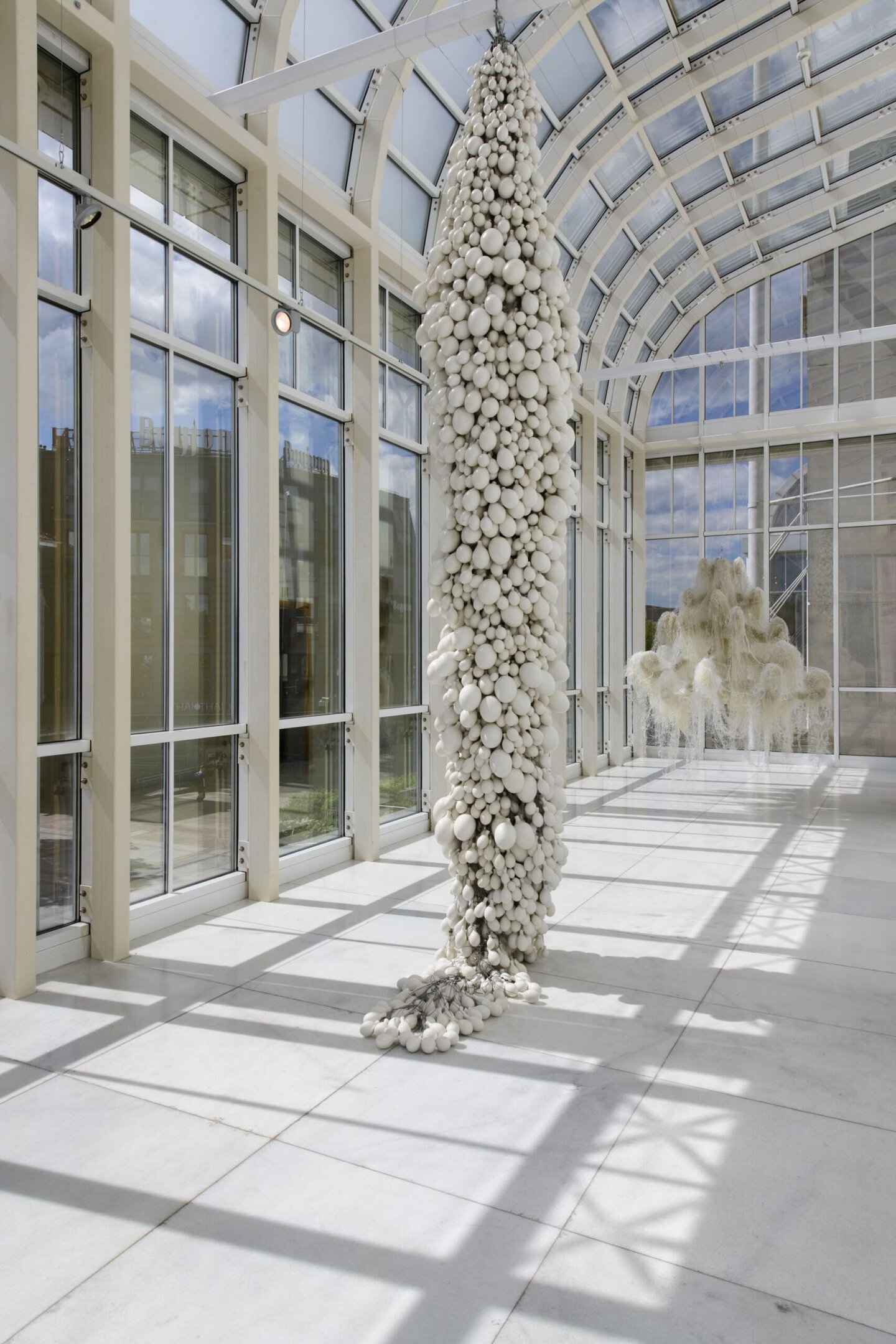
Around the central part of the exhibition, individual elements begin to connect, multiply and form larger structures. Huge white links, among the artist’s most recognisable forms, lie on the floor; nearby, a long chain stretches through the space, while combinations of tiny seeds and ceramic elements take the shape of dresses, ponchos and mandalas. In another work, small fish vertebrae are threaded one after another, creating a new order out of the remains of an organism. Connecting, binding, threading and weaving seem to be the fundamental verbs of this practice. Scale is equally important: a small element can be monumentally enlarged or repeated until the very rhythm of multiplication produces a new form. A single module becomes a link, the link becomes rhythm, and rhythm becomes a larger structure. The chain carries associations of bonds, closeness and continuity, as well as restraint and restricted movement. The dresses and ponchos, meanwhile, retain the memory of the human figure even though the body itself is absent. Though empty, these garments evoke the body’s shape and scale, acquiring a mysterious, almost ceremonial aura.
For Wolski, reduction becomes a means of condensing meaning. The simpler the shape, the more room it leaves for further, often contradictory interpretations.
That aura works particularly well with Domanowska’s arrangement of the exhibition. There is plenty of space between the works, as though each of them needed room to breathe. The sparseness of the display slows down the act of looking, while symmetries and organic shapes create an atmosphere of concentration. There is something cool and detached about these objects, yet they are surprisingly pleasurable to look at. Their smooth surfaces, precision and formal elegance readily seduce the eye, at times even taming what might otherwise be unsettling: the restraint implied by a chain, the void left by an absent body, or the strangeness of organic forms. This tension prevents them, despite all their aesthetic discipline, from becoming merely perfect objects.

Calm Surfaces, Shifting Meanings
After decades spent outside Poland, Wolski returned to his family estate in Dańków, where he now runs studios and an artist residency and continues to develop a sculpture park. It is the same land on which his father and grandfather, both involved in genetics and plant breeding, worked on varieties of triticale. Seen in this context, the red seeds scattered across the gallery floor in Sopot acquire an additional dimension. Family genealogy and artistic practice meet in the same elemental form. A seed is a beginning of life and a carrier of inheritance; in Wolski’s work, it also becomes a form capable of moving between scales, materials, places and meanings.

This ambiguity returns in Minotaur, one of the exhibition’s most intriguing works. The mythological monster, a hybrid of man and bull, confined to a labyrinth and inspiring mortal fear, takes the form, in Wolski’s hands, of a rounded, compact body covered in spikes derived from plants’ natural defence mechanisms. Human, animal and plant converge in a single figure, complicating its cultural meaning. A creature that embodies danger is itself equipped with a system of protection. Are we looking, then, at a monster we need to defend ourselves against, or at a creature that itself feels threatened?

Wolski draws on familiar objects and symbols, lending them an almost magical aura. They seem imbued with significance, yet resist any clear association with a particular culture, belief system or ritual. There is something ceremonial about them, as though they belonged to a system whose rules we somehow recognise without ever having learned them. This may also explain why Wolski’s objects seem to slip so easily outside time. Their connection to the earth, nature and materials that have accompanied human life for millennia gives them something primordial, while their formal restraint points just as readily towards the future. At a moment when everyday reality feels saturated with political conflict and images of war, Wolski’s insistence on form, matter and contemplation offers a rare kind of respite. Yet this apparent timelessness comes at a price: the cultural specificity of the sources Wolski draws from becomes blurred within his remarkably coherent visual language. His objects could have been unearthed in an archaeological excavation or belong to a world yet to come.
Wolski draws on familiar objects and symbols, lending them an almost magical aura. They seem imbued with significance, yet resist any clear association with a particular culture, belief system or ritual.
Supported by State Art Gallery in Sopot


