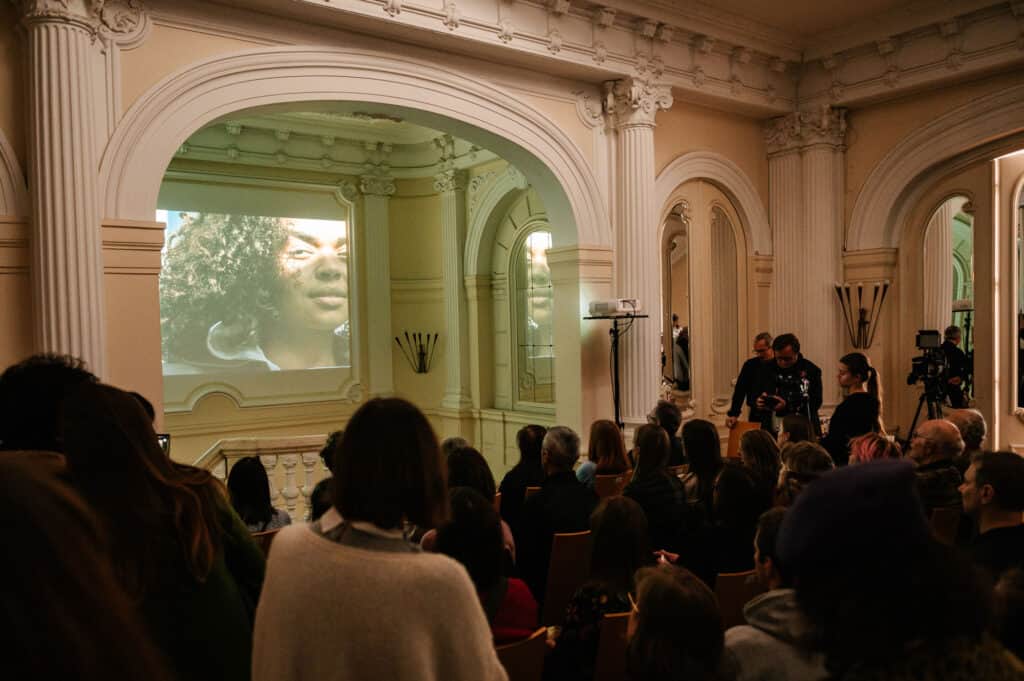
Asia NOW returned to the Monnaie de Paris for its 11th edition with renewed energy and expanded scope. Under the theme Grow, this year’s edition encouraged viewers to move beyond the East-West binary and consider what it means to come from a place and to be shaped by its culture and history.
What began as Europe’s first fair for Asian contemporary art, Asia NOW has grown from 18 to nearly 70 galleries and broadened its reach from East Asia and West Asia to the Middle East. Guided by the mission of “My East is Your West”, this year’s fair challenged East-West stereotypes, positioning “Asia” less as a fixed geography and more as a methodology – a versatile, and at times insurgent, approach to thinking and creating.
Against this backdrop, we selected ten artists whose practices stood out in October. Their work offers new ways of fostering connection and understanding – discover them below.
Rusudan Khizanishvili
Georgian artist Rusudan Khizanishvili (b. 1979) creates vivid, symbol-laden paintings which draw on Georgian iconography, regional history, and folklore. Raised in post-Soviet Georgia and based in Tbilisi, she channels both ancestral memory and the region’s turbulent past into dreamlike, altered realities populated by hybrid figures and chimeric forms. Her compositions echo the theatricality embedded in Georgian culture, animated by an intuitive approach to colour – “brainwaves,” as she describes them – that heightens the mystical and emotional charge of her imagery.
Across her work, Khizanishvili explores cultural memory, the female body, and myth, drawing on archetypes, ecofeminist thought, and an evolving interest in transhumanism. Women appear as protectors, warriors, and shape-shifters, their patterned garments and symbolic armour recalling both ancient goddesses and the legacy of Queen Tamar. These figures reflect the artist’s own experience of growing up with a single mother in a patriarchal society while forging her own independent artistic path. She was represented by LJ Galerie at Asia NOW 2025.


Peter McDonald
Painter Peter McDonald (b. 1973) works between Japan and London. His practice is defined by luminous colour, pared-down geometry, and gently surreal depictions of everyday social spaces. Trained at Central Saint Martins and recipient of the John Moores Painting Prize (2008), McDonald transforms classrooms, studios, and casual gatherings into scenes where figures flatten, dissolve, or become translucent – suggesting the mutable boundaries between people, environments, and shared imagination.
Exhibited internationally, from Tate St Ives to the 21st Century Museum of Contemporary Art in Kanazawa, his work balances playfulness with quiet reflection. Through these crisp, dreamlike compositions, McDonald continues to develop a visual language that emphasises openness, connection, and the subtle choreography of communal life. In Paris, McDonald’s work was featured by Kate MacGarry Gallery.


Daiya Yamamoto
Daiya Yamamoto (b. 1986) is a Japanese artist known for his trompe-l’œil oil paintings. Born in Nara Prefecture, Japan, Daiya Yamamoto trained in oil painting at Hiroshima City University before quickly gaining recognition, with early exhibitions at institutions such as the Hiroshima Prefectural Museum of Art and the Okanoyama Museum of Art. Yamamoto is deeply rooted in the trompe-l’œil tradition, drawing inspiration from Flemish masters whose works captivated him in museums and printed reproductions. For the artist, the precision of trompe-l’œil offers a universal pathway into painting – accessible to any viewer, regardless of prior art history knowledge.
While traditionally tied to Western art, Yamamoto reframes the genre through a distinctly contemporary Japanese lens. He distils his compositions to their essentials, placing everyday objects within spare, luminous settings that flirt with abstraction even as they maintain hyperrealist clarity. Suspended plants, scattered objects, and fine pencil lines punctuate his meticulously rendered surfaces, producing still lifes that feel both timeless and quietly uncanny. His minimal palette and deliberate spatial restraint transform the ordinary into something contemplative and resonant. Through this synthesis of tradition and innovation, Yamamoto has emerged as one of Japan’s leading contemporary practitioners of trompe-l’œil. His work was displayed by Galerie Taménaga at Asia NOW 2025.


Fatima Kaleem Khan
Fatima Kaleem Khan is a Pakistani visual artist whose work examines how domestic life, popular culture, and state narratives shape the construction of femininity in South Asia. Raised across multiple cities in Pakistan, she navigated an array of school systems and national curricula, each offering sharply different versions of history, discipline, and national identity. These early encounters with moral instruction, nationalism, and gendered expectations form the backbone of her artistic practice. Drawing from the melodramatic world of Pakistani and Indian soap operas, Kaleem transforms stills from these serials into vivid, unsettling tableaux that question the spectacle of the “ideal woman”.
Her drawings reframe familiar tropes – betrayal, confession, obedience, rage – to reveal how feminine spaces such as the home and school discreetly support state ideologies. If the state prefers its heroines to be patriotic and compliant, Kaleem gravitates instead toward the antagonists – the women deemed excessive, disobedient, or possessed in soap operas. In her hands, this maligned figure becomes a destabilising force: a narrator who embellishes, distorts, and rewrites the script. Kaleem’s work positions these narrative glitches and emotional overflows as counter-histories, proposing that melodrama can be a form of critique, and that domestic interiors are never as apolitical as they seem. Kaleem’s work was showcased by Method Gallery.


Nilima Sheikh
A pioneering figure in Indian contemporary painting, Nilima Sheikh (b. 1945) is known for her lyrical, research-driven works that draw on miniature painting traditions, feminist history, vernacular craft, and the poetics of place. Trained at the Faculty of Fine Arts, Baroda, Sheikh has developed a practice grounded in storytelling – layered compositions painted on handmade paper, cloth, or scroll-like panels that move between myth, memory, and lived experience. Her long-standing engagement with Kashmir, displacement, and women’s histories animates much of her work, lending it a quiet political force.
Across five decades, Sheikh has exhibited internationally, contributing to major biennials and museum surveys while remaining deeply connected to pedagogical and collaborative practices in South Asia. Her works often unfold as immersive environments – portable murals, travelling exhibitions, or series meant to be read in sequence – foregrounding painting as both narrative and site. She lives and works between Baroda and Srinagar. Her work was part of a collaboration with Milaaya Art Gallery at Asia NOW 2025.

Park Chae Biole
Born in Paris and raised in South Korea’s Gangwon Province, Park Chae Biole (b. 1997) grew up in a multilingual, creatively charged household that continues to shape her artistic sensibility. Fluent in five languages, she later returned to France to study at the École des Beaux-Arts de Cergy, graduating with honours in 2020. Her work combines sculpture, painting, and installation, exploring mobility, memory, and the body’s relationship to space. Biole’s recent pieces emphasise lightness and minimalism: she builds delicate walkers and diorama-like sculptures, and paints landscapes on portable bamboo blinds, enabling her work to move easily between contexts.

A parallel thread in her practice engages with natural cycles and the ethics of reuse, ideas deeply rooted in both Korean and Japanese cultures. Avoiding waste – whether in cooking, craft, or household ritual – is understood as a form of care, and this sensibility informs Biole’s approach to materials and process. Although her aesthetic is distinctly her own, Biole maintains a fluid creative exchange with her twin sister, Park Chae Dalle, choosing at times to intertwine their works in shared exhibitions. Together, they co-founded NEST, a research-focused platform through which they explore ideas such as slowness, attention, and the rituals of daily life. At this year’s fair, Galerie Anne-Laure Buffard presented Biole’s work.

Park Chae Dalle
Park Chae Dalle (b. 1997) shares many of the formative influences of her sister – a home-school education in Gangwon Province that encouraged experimentation, curiosity, and linguistic dexterity. After earning honours at the École des Beaux-Arts de Cergy in 2020, Dalle expanded her practice through a literary creation programme at the University of Le Havre, presenting her writing at the Maison de la Poésie. Dalle’s practice is anchored in what she describes as active patience: knitting, writing, and painting as durational gestures that accumulate meaning over time. She often begins with soft materials – threads, fabrics, handwoven structures – which she paints, reworks, and reassembles into installations that hover between text and textile.

While Dalle’s practice is grounded in her own sensibility, she prefers not to draw a firm line between her work and Biole’s. She embraces the interplay of their approaches, noting that their practices can “interfere” productively, generating ideas neither would reach alone. As co-founders of NEST, the twins develop exhibitions, performances, and research projects through this shared, ever-evolving dialogue. Galerie Anne-Laure Buffard also exhibited Dalle’s work alongside her sister’s at Asia NOW 2025.

Chang Hyun Lee
Sculptor Chang Hyun Lee (b. 1997) works with the quiet remnants of materials – pattern paper, discarded prints, photosensitive textiles – to explore how the body is measured, segmented, and historically flattened into systems of craft and display. Based in Seoul, South Korea, Lee’s practice often begins with casting the torso or shoulder, then rebuilding these forms as fragile papier-mâché shells. Cut open, rejoined, and handled repeatedly, they retain seams, pressure marks, and the grain of paper: traces of labour that have long outlived their original function.
Through layering, covering, and repeated handling, Lee’s work resists a single form. Instead, he attends to the strata where form first begins to surface, where sensation and structure meet in tenuous equilibrium. By pulverising the technical language of pattern-making and reassembling it into delicate, hollow forms, he reverses the fashion industry’s impulse to dehumanise. The body re-emerges not as a fixed image but as something provisional and felt—an intimate architecture that lingers, almost overlooked. In Paris, he was represented by IAH Gallery.


Nouf Aljowaysir
Nouf Aljowaysir (b.1993) is a multidisciplinary artist whose work merges data, machine learning, and personal narrative to examine migration, identity formation, and the politics of digital representation. Working across video, algorithmic image-making, and performance, she often uses her own biometric data – facial scans, movement patterns – as a starting point to explore how bodies are interpreted, classified, and sometimes distorted by technological systems.
Aljowaysir has exhibited internationally in both art and research contexts, contributing to a growing conversation on AI’s cultural and ethical implications. Her projects foreground the tension between lived experiences and the abstractions of computation, revealing what is lost, translated, or newly imagined when identity becomes data. She lives and works between the United States and the Gulf. Aljowaysir was represented by Gazelli Art House.


Hind Al Saad
Based in Doha, Hind Al Saad’s practice oscillates between graphic design and computation, exploring the intersections of the digital, the mechanical, and the physical. Working across code, computation, and printmaking, she develops procedural systems that allow form and pattern to evolve through structured, iterative processes. Her work transforms technical frameworks into immersive, sensory experiences, emphasising both process and outcome. Al Saad reconceives the familiar – walls, clocks, light, code – as vessels for reflection, merging Islamic spirituality and technology into contemplative experiences.
Al Saad’s projects often draw on Islamic artefacts and cultural principles, interpreting them through contemporary systems to create layered, curated experiences that bridge tradition and experimentation. For instance, her piece Earth is a Witness featured at Asia NOW uses concrete, copper, and LCD text to reflect on how the earth records human actions, embedding Islamic interpretations of memory into the materials of modern life. By merging computational logic with hand-crafted processes, she situates her practice at the threshold of art and algorithm. In Paris, Al Saad’s work was featured by Al Markhiya Gallery.


Contemporary Lynx was a media partner of this year’s Asia NOW Art Fair.