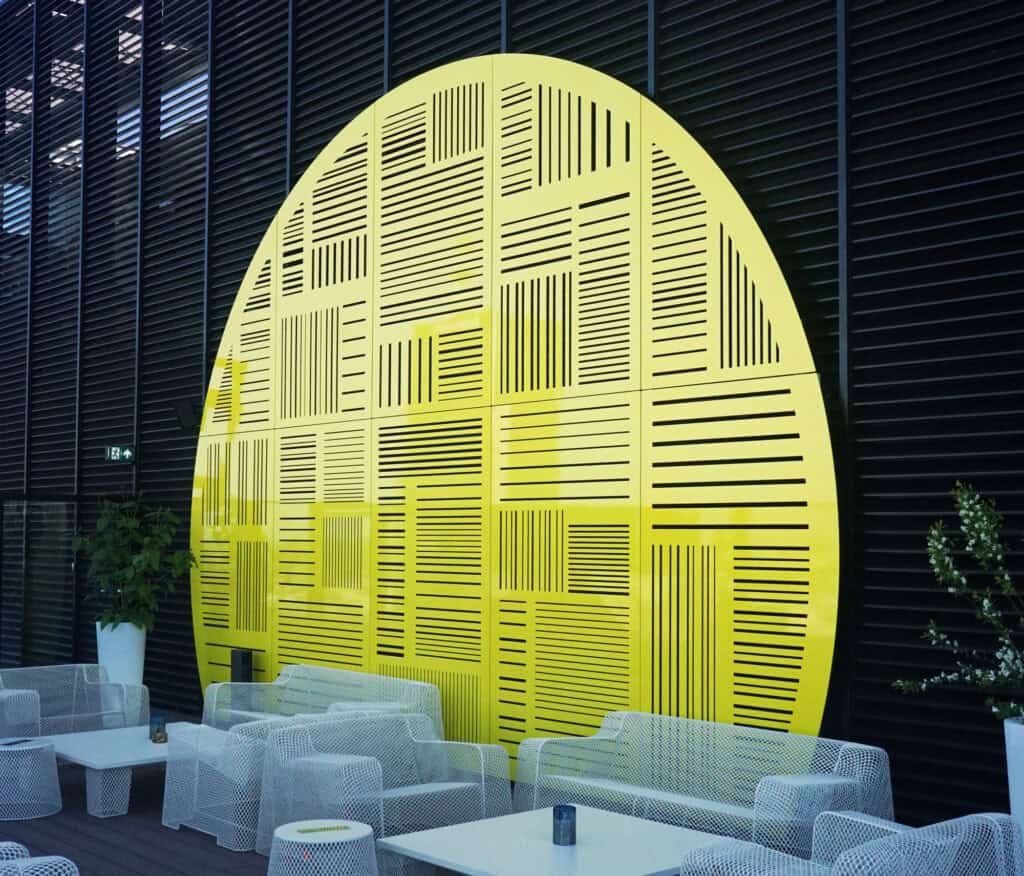
This November, Abu Dhabi Art Fair transforms Manarat Al Saadiyat into a nexus of a regional and international art hub. The exhibition centre will once again transform into the core of the fair – a lively meeting point for local and international galleries presenting visual art in its many forms.
This year’s edition is dedicated to a digital art showcase that adds an edge, while the annual Gateway exhibition spotlights the distinctive vision of curator Brook Andrew. The fair’s expansive Talks Programme will bring together curators, artists, and institutional leaders from across the UAE and beyond to explore a wide range of cultural perspectives. There’s even a Culinary Art experience – titled Frozen Forest – delving into the relationship between the visual and gastronomic arts. Beyond the fair’s main venue, artworks commissioned from renowned artists will appear across the city, accompanied by a dynamic Performance Programme unfolding in multiple locations.
Within the fair itself, a number of distinct sectors offer further depth. Focus: Modern Türkiye, Nigeria Spotlight, and The Gulf Region highlight modern masters from their respective geographies. Focus: Collectors Salon brings together manuscripts, rare books, and historical objects, thoughtfully showcased alongside modern and contemporary works. Bidaya introduces galleries younger than three years old, while Emerge spotlights works priced under USD 3,000. Special Project features artist presentations by established galleries, while Modern & Contemporary is open to international artists working across diverse disciplines.
Selecting just ten artists from the more than four hundred brilliant creatives featured at this year’s Abu Dhabi Art Fair was no easy feat. With such abundance, these creatives are offered simply as an entry point — a glimpse into the fair’s richness, and a small sample of the many singular perspectives waiting to be discovered.
Contemporary Lynx is a proud media partner of this year’s Abu Dhabi Art Fair.
Alymamah Rashed
Presented in Focus: The Gulf Region section, a Kuwaiti artist, Alymamah Rashed (b. 1994) works at the meeting point of spirituality, memory and the natural world. Her practice considers how the body moves through time – splintering, re-forming and re-emerging – as it negotiates both real and imagined landscapes. Seashells, botanical fragments and the tactile textures of her homeland become portals through which figures surface, multiply and return altered. For Rashed, the body is a shifting vessel: a presence that carries its past, anticipates its future, and remains deeply responsive to its surroundings.
Drawing from regional folklore and everyday objects, her work explores female subjecthood through perspectives shaped by both Eastern heritage and Western experience. Rather than resolve these influences, she allows them to blur into one another, creating a language that feels migratory, intuitive, and fluid.
Rashed has exhibited internationally, including presentations at Art Dubai, Art Paris and MENA Art. In 2025, she collaborated with Christian Dior for the Lady Dior Art Project and with Piaget during Art Dubai. Her work has been widely profiled, including in Harper’s Bazaar Arabia, Vogue Arabia and Architectural Digest.


Elnaz Javani
Also presented in Focus: The Gulf Region, Elnaz Javani (b. 1985), an artist and educator working across textiles, sculpture, and drawing, builds narratives from the material traces of memory. Her practice reflects on migration, identity and the shifting borders between personal and collective history. Traditional textile techniques recur throughout her work – not as ornament, but as a form of storytelling. Threads become repositories; stitches turn into fragments of time. In these layered surfaces, the body appears both present and absent, held in tension between belonging and displacement.
Born and trained in Iran before relocating to the United States, Javani brings lived experience to her approach. Her works suggest that memory is never static – it folds, frays and reconstitutes itself through touch. Whether in intimate fibre pieces or more sculptural forms, she responds to both place and history with sensitivity, tracing emotional and cultural terrains that continue to evolve.
Javani’s practice has been recognised internationally, with awards including the Terra Foundation Grant (2025), New Voices Award from Print Center New York (2024) and Chicago’s Individual Artists Program grant (2023). She has also received fellowships and residencies from institutions such as the Kala Art Institute, Hyde Park Art Center, and the Chicago Artists Coalition.


José Chambel
Born in São Tomé and Príncipe and now based in Portugal, José A. Chambel (b. 1969) is a photographer working with the quiet precision of black-and-white photography to honour cultural memory. His practice draws on a documentary sensibility, yet moves beyond observation; light becomes his central subject, revealing the poetic depth of everyday spaces and the stories embedded within them. Through long-term projects, Chambel reflects on the tangible and intangible heritage of Portugal, São Tomé and Príncipe, and Cape Verde, creating images that hold both place and history in careful balance.
Chambel is part of a generation rethinking how African cultural narratives are presented within contemporary art. In 2020, he co-founded Manga-Manga, an organisation dedicated to researching and promoting the cultural heritage of São Tomé and Príncipe through exhibitions, publications, performances and academic dialogue. His work appeared in ARCO Lisboa’s Africa in Focus (2023), the 10th Biennial of Arts and Culture of São Tomé and Príncipe (2024) and the 2nd Global Art Event in the UAE (2025). Chambel’s photographs have been shown internationally in both solo and group exhibitions, and are held in public and private collections. In Abu Dhabi, he’s exhibited in the Special Projects section.


Jiana Kim
Also shown in the Special Projects, South Korean artist Jiana Kim (b. 1972) works primarily with porcelain, treating the material as a vessel for light rather than form. With a PhD in crafts and design from Seoul and further training in the US, she bridges the disciplines of sculpture, painting and installation. Her delicately structured works test porcelain’s limits, transforming a traditional craft into a language of abstraction.
In Kim’s ongoing Inside series, porcelain fired at over 1,300°C is ground into fine powders and wafer-thin fragments. Layered across canvas, these translucent pieces react to illumination, revealing subtle shifts of rhythm, shadow and depth. What appears fragile becomes quietly enduring – a meditation on transformation through time and heat.
Rooted in the history of Korean ceramics yet resolutely contemporary, Kim’s practice balances reverence and reinvention. She has received major recognition, including the Wumin Art Award (2025) and residencies at the Boghossian Foundation in Belgium and the Gyeonggi Creation Center in Korea. Her works are held in prominent collections such as the National Museum of Modern and Contemporary Art (MMCA), the Seoul Museum of Art, and the Villa Empain Museum in Brussels.


Moslem Khezri
Iranian artist Moslem Khezri (b. 1984) creates figurative paintings and drawings that examine the quiet drama of everyday life, revealing layered narratives beneath the surface. In the series We Keep Reviewing, he investigates the all-boys school environment, transforming familiar scenes into spaces of subtle tension and introspection. In Between addresses the experiences of a generation caught between migration and rootedness, exploring how the personal and the cultural collide in moments of choice and uncertainty.
Across his work, Khezri balances intimacy with broader cultural reflection, utilising light and composition to illuminate unseen aspects of social experience. His paintings are quiet yet resonant, capturing the tensions, contradictions, and complexities of contemporary Iranian life while offering a universal meditation on identity, belonging, and the fragile spaces we inhabit between home and elsewhere.
Khezri has exhibited widely across Iran and internationally – including presentations at Art Dubai, The Armory Show, Expo Chicago, and KIAF Seoul, where his work has drawn growing critical attention. Khezri’s works appear in several major collections, including the Dubai Collection and the Abu Dhabi Royal Family. In Abu Dhabi, he’s shown in the Special Projects section.


Sahlah Davids
Exhibited in the Emerge section, Cape Town-based artist Sahlah Davids (b. 1998) uses textiles and beadwork to trace the histories embedded in personal and collective memory. Drawing on her Cape Malay heritage and the experiences of Cape Muslim communities, her practice transforms domestic craft traditions into a language of storytelling, cultural preservation, and subtle resistance.
Davids’ work explores themes of displacement, spiritual inheritance, and cultural continuity. Her pieces often combine vibrant colour with marks of fragmentation, reflecting the tension between beauty and trauma, and between preservation and loss. Through layered textures and meticulously crafted forms, she engages with the legacies of apartheid-era spatial injustice and the ongoing processes of place-making in Cape Town, inviting viewers to consider how communities inhabit, reclaim, and reshape space.


Samuel Nnorom
Nigerian artist Samuel Nnorom (b. 1990) transforms everyday materials into vivid sculptural “bubble” forms that explore connection, identity, and resilience. Working from Nsukka, he repurposes discarded Ankara fabrics, clothing remnants, foam, and fibres, stitching and rolling them into clusters that both reference the domestic and serve as metaphors for social interaction, survival, and communal belonging, blending tactile process with poetic form.
Nnorom is associated with the New Nsukka School of Art and founded the Ulo Nka Residency, supporting emerging artists through fully funded residencies and professional studio guidance. His practice has been recognised internationally, with awards including the Ettore e Ines Fico Prize at Artissima (2023), the Art for Change Global Prize, Saatchi Gallery (2022), and the Strauss & Co / Cassirer Welz Award (2021). At the Abu Dhabi Art Fair, he’s presented as part of the Focus: Nigeria Spotlight.


Samuel Olayombo
Lagos-based artist Samuel Olayombo (b. 1991) blends vibrant colour, bold draftsmanship, and gestural text to create paintings that are both personal and uplifting. Trained at the University of Benin in Fine and Applied Arts, he has developed a visual language that balances expressive figuration with optimism, inviting viewers into compositions that feel immediate and alive.
Olayombo’s practice traces a journey through landscape, still life, and figuration, culminating in character-driven works that celebrate individuality and energy. His paintings often explore human presence and narrative through confident forms and dynamic colour, combining directness with subtle storytelling. He has presented solo exhibitions in Dubai and Paris with Zidoun-Bossuyt and held his first institutional solo show at the Institute Museum of Ghana (2023). His work is held in notable collections, including The Dean Collection and the Elliot Perry Collection. In Abu Dhabi, he’s presented in the Modern & Contemporary section.


Talin Hazbar
Working between architecture, art, and design, Talin Hazbar (b. 1988) explores how natural systems shape form, material, and perception. Grounded in close observation of landscape, her practice experiments with organic processes to understand growth, decay, and the temporal nature of structures. Hazbar creates works that balance control with surrender, establishing conditions for materials to transform unpredictably over time, revealing patterns of change and resilience.
Her approach reflects a broader interest in scale and environment – how micro and macro systems intersect with cultural memory. Drawing on her background in architecture and participation in programmes such as the Salama bint Hamdan Emerging Artists Fellowship, she develops projects that merge structural understanding with aesthetic inquiry. Hazbar has exhibited internationally, including at Louvre Abu Dhabi’s Co-Lab, Art Dubai, Third Line Gallery, and Beijing Design Week. Her work has been featured in publications such as Architectural Digest and the Financial Times, highlighting her unique ability to translate environmental observation into compelling visual narratives. At the Abu Dhabi Art Fair, she’s presented in the Bidaya section.


Zayn Qahtani
Showcased in the Focus: The Gulf Region, Zayn Qahtani (b. 1997) is a Bahrain-born, London-based multidisciplinary artist merging archetypal figuration with experimental material processes to create works that are both ancestral and forward-looking. Working across drawing, painting, and sculpture, she constructs sculptural “relics” that act as portals – spaces where grief, ritual, and transformation converge, and where the personal and the universal meet.
Qahtani’s practice is defined by a radical engagement with material. Papers pulped from Bahraini date palms, bioplastics derived from plants, and pigments sourced from metals, crystals, and earth are transformed into objects that are simultaneously delicate and monumental. Through this alchemical process, her works become animistic offerings, resonating as universal archetypes and inviting reflection on memory, myth, and the potential of matter to hold story.
Qahtani’s works have been exhibited internationally at Abu Dhabi Art (Abu Dhabi, UAE), Kristin Hjellegjerde Gallery (London & West Palm Beach, USA), VITRINE (London, UK), and Foundation Boghossian (Brussels, Belgium). Her works are held in institutional collections including the Bunker Art Museum (USA) and the Ramzi & Saeda Dalloul Art Foundation (Lebanon).


Abu Dhabi Art Fair
November 19–23, 2025
Manarat Al Saadiyat, Abu Dhabi, UAE