






In an era dominated by screens, the photobook has quietly become one of the most fascinatingly radical forms of contemporary photography. Paper Photo Festival, a new international event devoted entirely to photographic publications, treats the book not as a container for images, but as an independent artistic expression.
The first edition of the Festival took place in Katowice (Poland) in October 2025. It featured two competitions (for published photobooks and dummies), four curated exhibitions, a review of publications from art academies, a photobook publishers’ fair, and many meetings with authors. A total of 329 publications were presented. Among them, Jakub Dziewit, the festival’s founder and curator, selected eleven titles you should remember.
Studio Prokopiou: Wet Paint
This visually stunning publication by Studio Prokopiou (Philip Prokopiou and Panagiotis Poimenidis) is definitely one of the most beautiful things ever published in print. Wet Paintconsciously exploits the possibilities offered by contemporary printing. It is a project that deliberately uses its appeal to address the issues of contemporary identity. Being at the intersection of colonial heritage, cultural notions of the ancient foundations of our culture, corporeality, and visual patterns makes it so exclusionary and yet so unifying.
All this is presented in a manner worthy of a trickster, reminding us that someone somewhere mentioned that ancient sculptures were not pure white, so perhaps the world does not have to be either. However, when I look at the photos of models performing as ancient sculptures, painted with pastel and neon colours, the first thing that comes to my mind is a question about the title. „Wet paint” reminds me of sweat on the skin, and I don’t know if there is more sweat of joy and desire here, or fear and anxiety. It is the sweat of our culture.
The photobook published by Sun Archive won the Paper Photo Award 2025 competition.


Weronika Gęsicka: Encyclopaedia
At first glance, the photobook is very funny, but upon closer inspection, it becomes quite disturbing, as it is probably the best project concerning AI and post-truth in some way. Weronika Gęsicka provides us with a beautifully designed encyclopedia, in which the content of the entries has been taken from other such publications, which are accompanied by her own visualisations. However, these entries do not describe reality; they do not refer to real objects or phenomena.
The starting point is the fictitious entries that were once deliberately placed in encyclopedias to prove that another publisher had copied content from them. Gęsicka’s images also present various types of hoaxes, like the ones from Wikipedia. As a result, the entire publication becomes a commentary on the nature of knowledge itself and the power that flows from it. Perhaps the main advantage of Gęsicka’s project is that from now on, we should view every encyclopedia as an artistic project rather than a revealed truth.
Published by Blow Up Press & Jednostka, the photobook was shortlisted for the Paper Photo Award 2025 competition.


Emilia Martin: I saw a tree bearing stones in the place of apples and pears
The author talks about meteorites. She begins by stating that these stones are not particularly remarkable in any way – except for their potential to convey stories about people’s relationships with perceiving something as fiction and something else as truth. For Emilia Martin, this is the starting point for spinning a poetic-documentary tale partly immersed in archives.
There is little clarification here, yet we sense themes of the beginning of the world and the apocalyptic end of humanity; the relationship between scientific, religious, and magical perceptions of the world; class divisions in society; what is culturally masculine and what is feminine; and finally, what is buried in the past and what is revealed yet invisible.
The photobook was published by Yogurt Editions and shortlisted for the Paper Photo Award 2025 competition.

Nastasiia Leliuk & Natalia Wiernik: Once a year the stick shoots
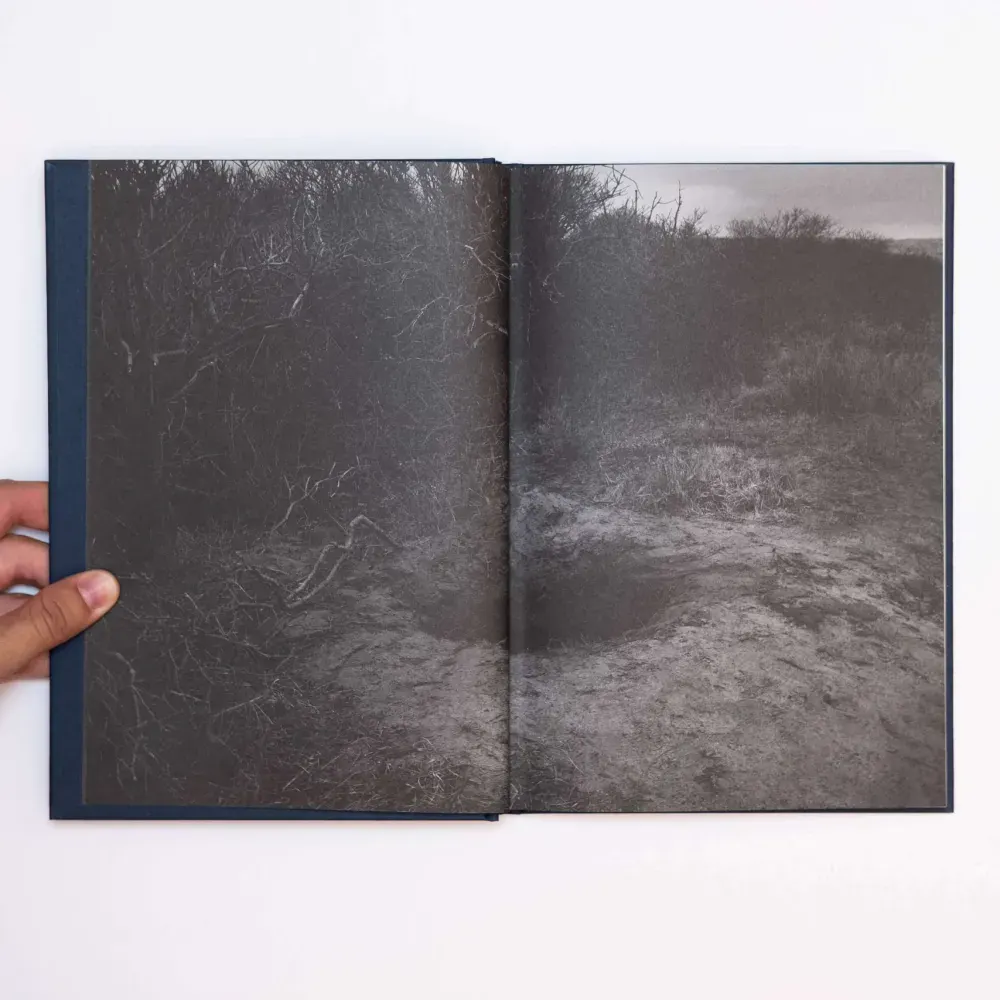
It draws us in with its surprising yet simple form. There is a round hole in the black block of paper, as if the entire book had been shot through. Inside, we find a combination that is extremely simple, yet powerful in the context of Russia’s ongoing full-scale invasion of Ukraine – side by side, there are photos of weapons (pistols and rifles) and sticks shaped like such. One is immediately tempted to ask whether they were found in Ukraine… but does it matter? After all, children all over the world play war games. Adults do too, for that matter. For those who manage wars, the front line is as abstract as play or a game – they will not return from war without arms, legs, or families.
The publication by Nastasia Leliuk and Natalia Wiernik, designed by Aneta Kowalczyk, also shows that art is marked by such a shot – every page, every image of that time will have a kind of void. It is a void we can only glimpse, as if through a keyhole, from the safe position of those who are only holding a book, not a rifle.
Photobook presented as part of the Rules of Repetition exhibition, published by Blow Up Press.

Adam Broomberg: Anchor in the Landscape
The beauty of trees peeks through the photobook’s pages, as we can admire how magnificent and dignified trees can look. However, those photographed by Adam Broomberg (and Rafael Gonzalez) cannot be viewed from a purely aesthetic or even posthumanistic perspective.
These are olive trees photographed in Palestine – often hundreds or even thousands of years old. Although the olive branch is an ancient symbol of peace and harmony, these trees are the first thing that Israeli bulldozers remove as part of their process of colonisation – not only to eliminate income opportunities, but also to uproot Palestinian culture from this land.
Broomberg’s photobook is juxtaposed in the exhibition Rules of Repetition with Wojtek Wilczyk’s photobook There Is No Such Thing as Innocent Eye. In this Polish documentary project, Wilczyk presents the remnants of Jewish culture in Poland – places of worship converted into car repair shops, discos, residential houses, shops, and restaurants. It’s about the erasure of Jewish culture from the Polish imagination that takes on a whole new meaning when juxtaposed with Broomberg’s project.
Photobook, published by MACK, was presented as part of the Rules of Repetition exhibition.


Taryn Simon: The Innocents
Taryn Simon’s project is worth knowing about for the subject matter alone. It presents the stories of exonerated individuals—people released from prison after spending long periods of time there following wrongful convictions (often even life sentences or death row). Even after a cursory glance through the book, it is clear that the victims of these unjust convictions are representatives of specific social, racial, and ethnic groups.
The project combines several key phenomena in contemporary photography, starting with the stories of particular individuals, their narratives, and their lives. For this statement, Simon took posed photographs in places that were important from the perspective of their conviction (for instance, crime scenes or places where many people saw them, so they had an alibi). The effect is often absolutely beautiful and shows the enormous documentary possibilities of staged photography.
However, the entire project is also a very in-depth research project, especially in the second edition of the book, where we can see not only photos, but also rich documentary material, transcripts of conversations, excerpts from files, and we also get a glimpse of Simon’s creative process. Finally, and perhaps most importantly, this is one of those projects where the real impact of art on reality is demonstrated. By showing examples of wrongful convictions in some parts of the world, we can try to influence changes in laws on the death penalty, among others.
Published by Hatje Cantz & MoMA, the photobook was presented as part of the Rules of Repetition exhibition.

Niels Ackermann & Sébastien Gobert: Looking for Lenin
This small book by photographer Niels Ackermann and journalist Sébastien Gobert was published by FUEL Design (which is donating 10% of the proceeds to the British Red Cross Ukraine Crisis Appeal), a London-based publishing house producing publications that go beyond the confines of the closed world of art and reach a wide audience. It is best known for Christopher Herwig’s albums Soviet Bus Stops I &II, which document bus stops in post-Soviet countries, often looking more like abstract sculptures than functional infrastructure. These books are definitely worth having on your shelf – but right next to them should be Looking for Lenin.
The book presents and shows us (not directly, of course) why Russian claims that Ukraine should be part of Russia are completely detached from reality. In 1991, there were over 5,500 Lenin monuments in Ukraine, but even before the outbreak of Russia’s full-scale invasion, not a single one remained standing on its pedestal. Ackermann and Gobert’s book shows what happened to them and how they ended up in gardens, in garbage dumps, simply forgotten.
The photobook was presented as part of the Rules of Repetition exhibition.


Maryia Karneyenka: Rattus Sapiens
In her photobook, Mariya Karneyenka, a visual artist from Belarus who has been working in Poland for several years, poses the big question of whether humanity is accompanied by a civilisation of rats. It surpassed us in its development long ago, and now only watches us closely and from a distance, knowing that we are only a short chapter in history, which may pass, while they remain. And for now, we coexist, accompany each other, sometimes passing each other by.
Looking at some of the images, we might think that Karneyenka is also talking about the space of the Belarusian regime – but she herself denies this. The book’s designer (Ania Nałęcka-Milach) points out that it is a great “love letter to Others” (whether human or animal). This photobook is therefore also an opportunity for us to look in the mirror and ask ourselves who we treat inhumanely.
The book, published by TAMAKA, premiered at the Paper Photo Festival.


Daria Izworska: God’s Children
“Raised among tongues of fire, into the Great Battle I was born. Tales of the Harlot rang in my ear, and thoughts of the seven-headed beast put me to sleep. I was in this world, but not of this world. Set and ready, for any day a great ball of fire would devour the Earth, and I, along with all God’s Children, would be taken to the Kingdom of Heaven, where the wolf shall live with the lamb.” This is an excerpt from the text accompanying the photobook by Daria Izworska, who was born in a religious sect and remained in it until the age of twelve.
Similar to the above description, the photos in the book also give the impression of being theatrical and staged. If someone were to make a film that wanted to show this phenomenon in a slightly “exaggerated” way, they could create just such images – real, but giving the impression that it is, after all, a kind of game.
However, Izworska’s project is not a staging, but a reworking of family archives, mostly photos from her childhood, accompanied by contemporary documentary photographs of objects, and enriched only by the addition of red drops to the images. They’re a little like blood, a little like wine, a little like pomegranates (full of juice, bursting with energy, alive), but also a little like tears. In this world full of a specific exaggeration of role-playing, the tears remain real.
The book is published by RUST Publishing, with pre-sales having begun at the beginning of February. The publication was presented at the Paper Photo Dummy Award post-competition exhibition and received two honourable mentions (from Adam Pańczuk and Katarzyna Zolich).

Viktoria Adamava: Czur, jestem w domku [Czur, I’m home]
A seemingly simple publication. Yet, when we pick it up, we immediately smile. It is full of photos from walks with a dog, accompanied only by screenshots of routes from Google Maps. This alone is a great, very well executed idea. But don’t be fooled. This little book tells a much more difficult story.
Viktoria Adamava is a young Belarusian artist who recently left her family home and moved to Warsaw. There, she had a problem finding herself and meaning in life. However, she couldn’t shut herself in her home and escape into her thoughts, because she had to walk her dog. This way, she slowly began to grow into her new surroundings. Afterwards, we find ourselves deeply moved, with our smile taking on a completely different dimension.
The self-published publication was shortlisted for the Paper Photo Dummy Award competition.

Adrienn Józan: Summer Cancelled
Finally, there is a beautiful, largely hand-made publication in the form of a leporello, combining three forms of expression. Visually powerful, highly aesthetic photographs are juxtaposed with overlapping photographic notes taken with a smartphone and short text fragments of stories about a summer that never happened.
The vacation was cancelled when Adrienn Józan found out she had leukaemia and had to be hospitalised overnight. The specificity of her life with the disease was compounded by the ongoing pandemic. Despite the inclusion of texts in the publication, we perceive it very affectionately. It appeals to our emotions, which we do not have to translate into intellect, because illness often has no intellectual justification. This is how visual narratives are constructed today. Only three copies of the publication were produced, so look for it at exhibitions!
The publication won the Paper Photo Dummy Award 2025 competition.


Written by Jakub Dziewit


