After three years of renovation, the Polish Institute in Paris returns to its historic headquarters in the heart of the City of Light, ahead of the Poland-France cultural season planned for 2027. The long-awaited reopening marks a moment of strengthening ties between the two countries. As the French Foreign Minister, Jean-Noël Barrot, noted at the opening ceremony attended by his Polish counterpart: “Nareszcie, enfin!” (“Finally!”).

One of the first cultural events to be held at the restored headquarters will be an exhibition of photographs by Chris Niedenthal, the iconic Polish-British photographer known for documenting life behind the Iron Curtain. We sat down with the recently appointed director of the Institute, Małgorzata Grąbczewska, and the Institute’s Head of Visual Arts, Natalia Barbarska, to discuss this new chapter in the Institute’s history and the upcoming exhibition.


Aleksandra Mainka: At the end of May, the Polish Institute returns to its headquarters on Rue Jean Goujon, in the heart of Paris, after more than three years of renovation. The building itself has a rich history connected with Polish culture and history — it was once home to the son of Napoleon Bonaparte and Maria Walewska and later housed the Consulate General of Poland. What is the symbolism of this re-opening for you, and what might be the significance of a Polish cultural institution being located in such a place today?
Małgorzata Grąbczewska: The decision to renovate the building and give it back to the cultural community — artists, authors, dancers, musicians, directors, but also, perhaps most importantly, the public — is an important signal from our governments: culture is one of the priorities and foundations of Europe! Let us recall that the Polish Institute in Paris is part of a network of 25 institutes located worldwide, operating under the aegis of the Ministry of Foreign Affairs.
The Institute’s premises have been under renovation for the past few years, but the truth is that they have not been open to the public for over 20 years. Therefore, I see its reopening as a confirmation of the commitment of Polish diplomacy to cultural dialogue and as genuine support for artists by enhancing their visibility on the bustling Parisian arts scene.
The presence of two ministers of foreign affairs, Radosław Sikorski and Jean-Noël Barrot, as well as Hubert Tardy-Joubert, diplomatic adviser to the French Minister of Culture, and Eva Nguyen-Binh, President of the Institut Français, at the official opening of the building on Rue Jean Goujon is a testament to the political significance of this event and situates it in the broader context of the strengthening of Polish-French relations that we have been witnessing for several years. Signing the treaty in Nancy in May 2025 was its essential element, and it explicitly mentions the Polish Institute in Paris as one of the most important actors.
I see its reopening as a confirmation of the commitment of Polish diplomacy to cultural dialogue and as genuine support for artists by enhancing their visibility on the bustling Parisian arts scene.
AM: The return to the renovated premises marks the beginning of a new chapter. Last year, you were appointed director of the Institute, so in a sense, this is a new chapter for you as well. How do you see the future of the Institute within the Parisian cultural landscape? What is your main priority for the Institute’s work in the upcoming years?
MG: The activity of the Polish Institute is so intense that I feel as though I have been here for several years already! In that time, we have already carried out dozens of projects. The Parisian cultural scene is one of the most challenging; however, we do not focus on competition but on building synergy.
The Institute operates across France, developing projects with leading local institutions, artists and communities. This direction will remain central to our work. Activities at the Paris headquarters will serve as a complement, providing a platform for smaller, more specific projects developed in collaboration with Polish and French institutions.
We are starting on a strong note: all through June, our audience will be able to experience Polish culture in all its forms. In our refurbished premises, we now have a cinema, exhibition spaces, and concert and workshop venues at our disposal. That said, both this year and the next will undoubtedly be dominated by the Poland-France Season 2027, a programme we have co-created from the very beginning.


Nowadays, I see culture as one of the most effective and credible means of building relations between Poland and France — precisely because it does not stem from business, but from sensitivity, imagination, and experience.
AM: In April, the agreement on the organisation of the France-Poland Season 2027 was signed. This is one of the most important initiatives in Polish-French relations in the near future. The programme is supposed to focus, among other things, on audiovisual arts, digital creation, design, and cooperation between our societies. How do you understand the current role of culture as a tool for building relations between Poland and France?
MG: Nowadays, I see culture as one of the most effective and credible means of building relations between Poland and France — precisely because it does not stem from business, but from sensitivity, imagination, and experience. Politics, the economy and security require a language of arguments; culture, on the other hand, offers a language of emotions, stories, and images, in which both sides can recognise themselves, even if they may differ in other areas.
We would like the Season’s programme to be a series of surprises, delights, and experiences, created together with the audience. Rather than presenting icons and canons, we would like to invite you to a dialogue on the role of culture in daily life, in the construction of new identities, and to a joint reflection on how we wish to live in the future — in cities, in the realm of information, and in the world of new technologies.
Here, culture becomes a space for testing solutions and raising questions about ethics, memory, ecology, and the responsible use of digital tools. In a world overloaded with information and polarisation, culture teaches us to listen attentively and look at things from the perspective of others. In the context of the relationship between Poland and France — two countries with a strong sense of their own traditions and individuality — this is invaluable, as it allows differences to become a source of inspiration rather than an obstacle.

AM: Natalia, as the manager of the Institute’s Visual Arts Department, how do you approach presenting Polish art and culture to the French public? Does this require a different language and perspective compared to presenting it in Poland?
Natalia Barbarska: In my opinion, Polish art is fairly well represented in France; Polish artists are regularly exhibited in French galleries and at major art and photography fairs, yet they are not very well known to the general public and are less present in public institutions. However, this is changing. Recently, there have been exhibitions of works by Magdalena Abakanowicz in Paris, Sara Lipska in Meudon and Poitiers, and of Mark Roefler’s collection of the École de Paris at the Montmartre Museum. Next year, further major exhibitions are planned as part of the Poland-France Season, including those of Józef Czapski, Mela Muter, Angelika Markul, and many others. The Polish Institute in Paris is a partner of these events and has been supporting curators in their preparation for several years.
I believe the language of art is universal, and the French public is very sophisticated and seeks out the finest artistic phenomena, so Polish art of the twentieth and twenty-first centuries speaks for itself here. Certainly, nineteenth-century and earlier art from Poland has yet to be discovered by French specialists and the public, but I have observed a growing interest and curiosity among French curators and museum professionals, which we strive to encourage through study visits to Poland and other initiatives.
Of course, the competition is a challenge — institutions and artists from all over the world compete for exhibitions in Paris. However, Polish art of the twentieth century holds a fascinating relevance, as demonstrated by the Abakanowicz exhibition at the Bourdelle Museum, which concluded in April. The French, if only for geopolitical reasons, are interested in different phenomena than the Poles are, and the most exciting part of my work is this intersection of perspectives and the search for points of contact.
I believe the language of art is universal, and the French public is very sophisticated and seeks out the finest artistic phenomena, so Polish art of the twentieth and twenty-first centuries speaks for itself here.


AM: One of the first events to be held at the new headquarters will be an exhibition and a meeting with Chris Niedenthal. Why did you decide that his work was an important point of departure for this new chapter in the Institute’s history?
MG: For us, Chris Niedenthal is much more than an exceptional photographer—he is a witness to history capable of portraying Central and Eastern Europe in a way that is understandable and moving even for Western audiences. At this significant moment for the Institute, we wanted to invite to Paris someone with precisely this kind of voice: one deeply rooted in the Polish experience, yet also utterly international.
We wanted our first exhibition after the renovation to be a bold gesture heralding the future of the Institute: a place that not only exhibits art, but also initiates a conversation about memory, freedom, responsibility, and the role of the image in the contemporary world. Chris Niedenthal’s photographs trigger all these themes.
We wanted our first exhibition after the renovation to be a bold gesture heralding the future of the Institute: a place that not only exhibits art, but also initiates a conversation about memory, freedom, responsibility, and the role of the image in the contemporary world.

AM: Over the years, Chris Niedenthal has documented breakthrough moments in the history of Poland and Central and Eastern Europe, paying great attention to visual composition. Does the exhibition focus primarily on the historical context and on bringing it closer to the French public, or does it also highlight the artistic dimension of his work?
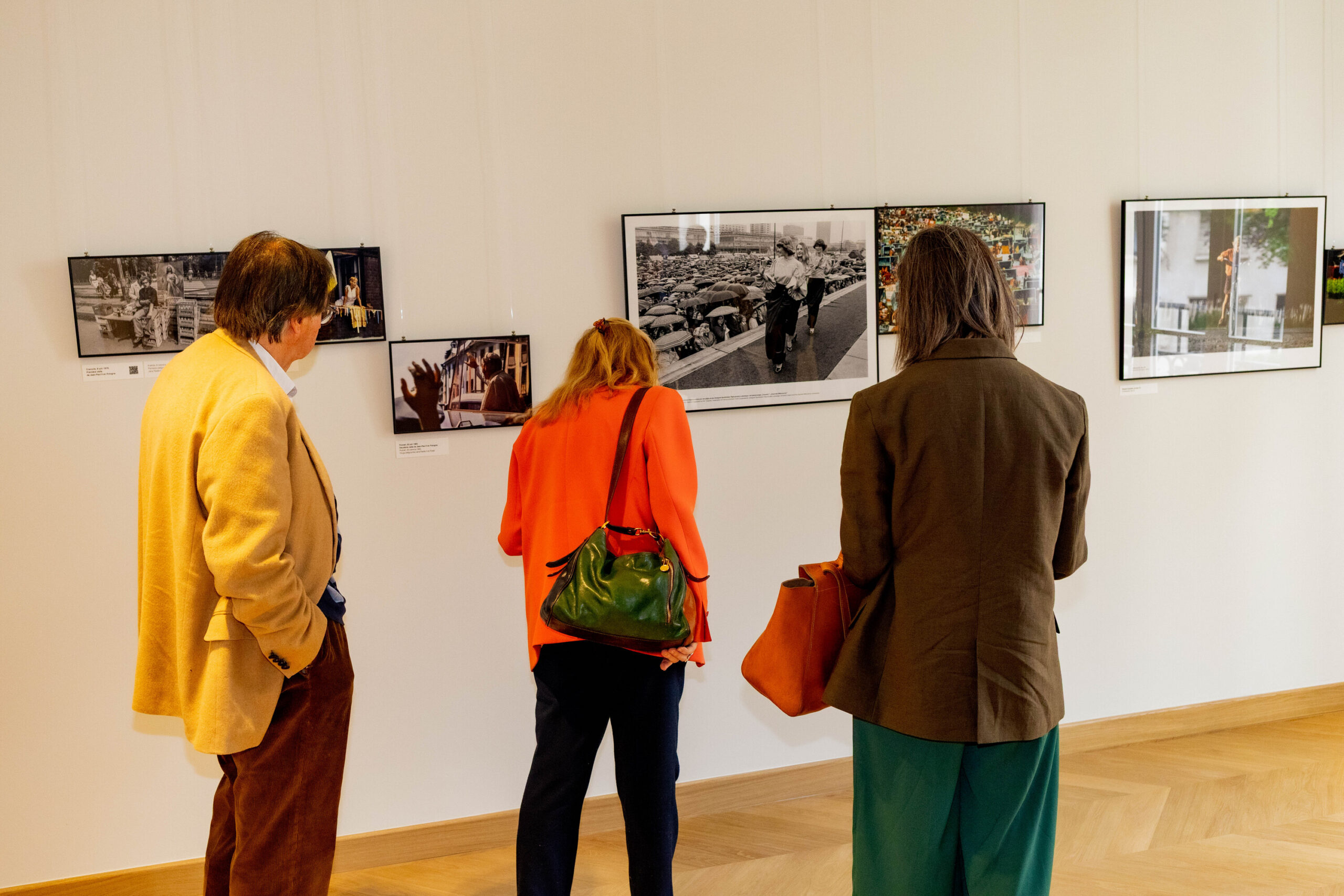
NB: The exhibition, curated by the team at the History Meeting House, a Warsaw-based cultural institution, features a selection of several dozen of Chris Niedenthal’s most iconic photographs taken between 1970 and 2020. These images have become part of the Polish iconosphere. In France, however, they are little known. Therefore, the exhibition introduces Chris Niedenthal and his work to the French public, whilst also showing the history of the transformations of our part of Europe over the last 50 years, which continues to attract and interest audiences in France.
AM: Today, many of Chris Niedenthal’s photographs are considered iconic and deeply embedded in the collective memory. How did this affect the curatorial process?
NB: This is a question for the curators of the exhibition, Anna Brzezińska and Katarzyna Puchalska, who undertook the monumental task of selecting photographs from the artist’s enormous archive. I am delighted that, besides the most iconic photos that immediately come to mind when one thinks of Chris Niedenthal, we are also able to showcase some lesser-known, reflective images that embody the very spirit of photojournalism.

AM: What is the intended role of this exhibition within the overall programme of the Institute and this new chapter marked by its return to its former premises?
NB: The exhibition serves as the reopening of the renovated Polish Institute in Paris. We invite the public to visit our exhibition (and us), especially during the opening weekend, 29-31 May. Later, throughout June, the Institute will host film screenings, meetings, and concerts. In terms of visual arts, Chris Niedenthal’s exhibition brings depth and perspective to discussions about contemporary photojournalism.
On 6 June, we are also organising a meeting with Agata Grzybowska, which is part of the official program of the Nuit Blanche festival of contemporary art, and on 24 June, we will host a meeting with Rafał Milach.