Gullterning — or Golden Dice — is but one of centuries of medieval ballads and lyrical tales that compose the musical heritage of Norwegian folk tradition. This fable follows a listless princess, who deigns to entertain herself aside the palace steps by rolling luck away in contest with a common young artisan. Two triumphant throws instil within the princess the confidence to wager all regal possessions and her hand in marriage upon the glory of a potential hat-trick. But silk gloves soon cushion her teary eyes when an unexpected twist of fate results in a dramatic finale and a lost bet. Only then does the pedestrian reveal his own disguised, yet lustrous pool of wealth. Consoling the princess’s woes, and so relieved from sorrow, they lived happily ever after.

Today, a modernised cover of Gullterning’s spellbound melody provides the soundtrack to Iri Elisabeth Kristiansen’s newly released short concept film of the same name. The entranced piece aims to integrate Norwegian folk dance with contemporary movements, alongside the creator’s candid exploration of sapphic sexuality and the historic marginalisation of queerness. Starting her career in Oslo, before further study and development in England, Iri moves now to imprint her skills as a freelance contemporary dancer on celluloid.
The entranced piece aims to integrate Norwegian folk dance with contemporary movements, alongside the creator’s candid exploration of sapphic sexuality and the historic marginalisation of queerness.
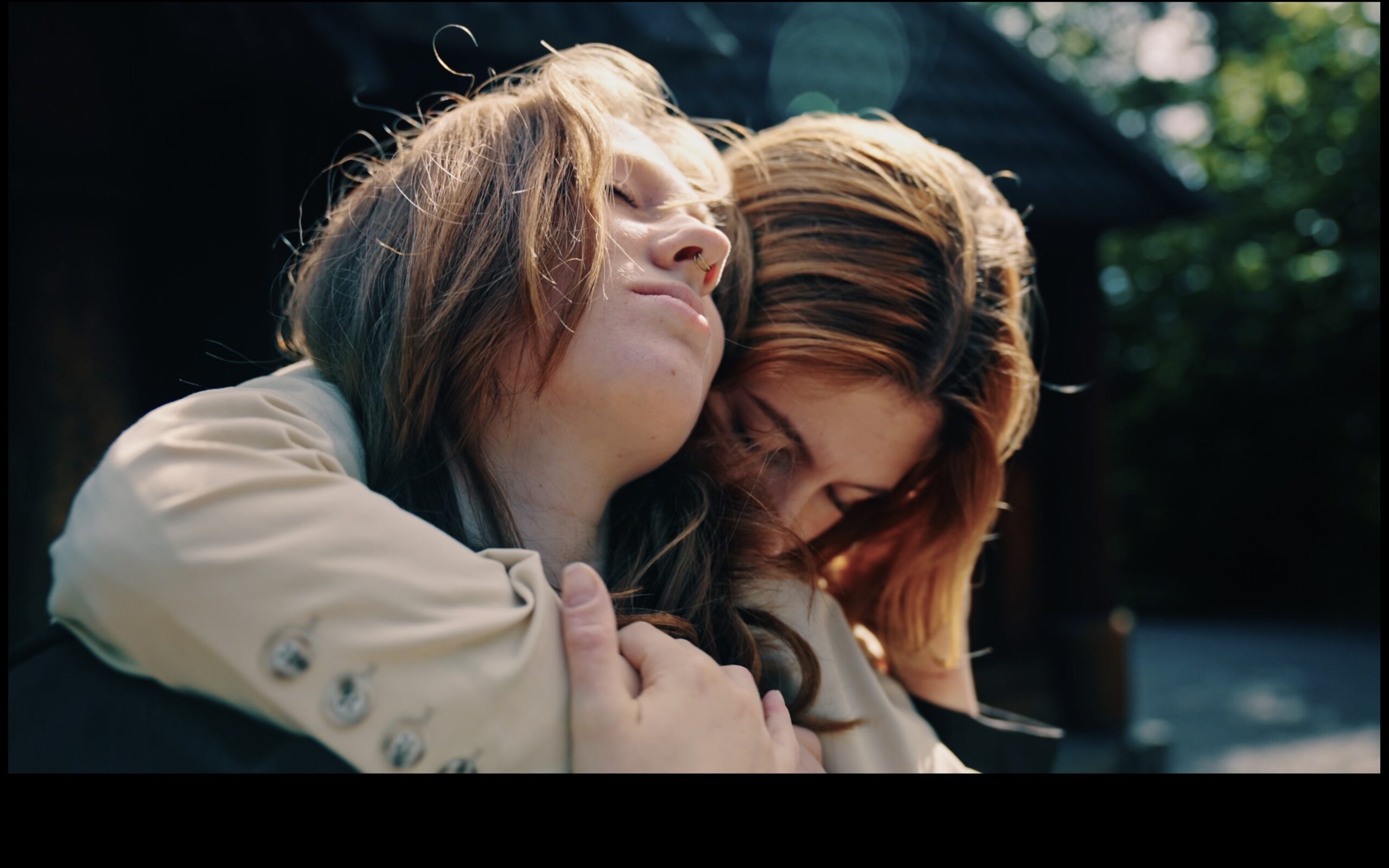
Returning to her homeland and embracing its enduring influence on her work, she uses folkloric poeticism to grapple with internalised homophobia. In Gullterning, Iri performs alongside Tiegan Doyle, exploring sapphic love against internalised shame. Throughout, the two women are coupled, longing for each other yet holding themselves back, getting closer and then pulling away again. Their relationship unfolds and develops within the captivating chapters of a video that bursts at each scene, seamed with dance excellence and artistic sophistication. They embark on a journey from intrigue to hesitation, attraction, and the allowance of pure eventual willingness. Alike yet distinct, they wear two flowing suits of white and black, accentuating the distance between them and replicating a Black Swan’s sense of split seductions. ‘I think that shame can live within the person while they try and fight to love instead. I wanted to try and capture that journey.’ Kristiansen explains. The performance is accompanied by a recent recording of Gullterning sung by Martin Steinum Brun, so emotive as to only deepen the sensitivities of the concept itself.

Kristiansen uses this project to explore the manner in which many struggle to come to terms with their sexuality in the face of shame and denial. ‘I felt the princess needed to be in control,’ she states, introspecting upon why this particular song moved her: ‘she knew what she needed, she needed to win. She loses, and she thinks that’s going to end her life, and it turns out that was what was supposed to make her happy.’ Kristansen focuses on the advantages of relinquishing stubborn control, favouring instead chance and circumstance to generate purpose. Speaking from within the folk community, she advocates a general openness to external influences, adaptation and growth. Furthermore, where Gullterning ruminates on this philosophy, intertwining contemporary dance methods and queer romanticism within a traditional Nordic landscape, so too can lessons be learnt in the UK about attitudes towards creatives and immigrants, affronted by underfunding and an exclusionary nationalism.
Giving New Shape to Tradition
Norsk Folkemuseum — the Norwegian Museum of Cultural History — houses more than 150 homes and dwellings. Originally transposed from rural locales, traditional churches and antiquated structures are preserved on Oslo’s Bygdøy peninsula. For Kristansen, who attended classes and tied together troupes there in her childhood, the setting evokes nostalgia. Growing up just outside of the capital, Kristiansen practised folk dance at the museum, uncovering opportunities to traverse rural Norway and its coast, encountering other ensembles and discovering the endless traditions of the turf. With nearly a quarter-million islands scattered off an immense shoreline, each destination has its own expression of Norwegian folkness, with its own alternate musics and rhythms that set it apart. With no sheet notations or video tutorials, ‘you just have to know,’ she modestly outlines, ‘you just have to learn from generation to generation.’

Today, folk dance presides over an ever-growing community in Oslo, gaining popularity and esteem. Flowing down through lineage and ritual, Kristiansen explains how the culture now finds a new shape, filling the pail of a more open-minded and secular urban landscape. Whilst encouraging transition, she also recognises the importance of savouring tradition, nationality and a focus on inherent identities that persist beyond the moulds of modernity. Erring on the side of adaptive usage, one must allow for slight shifts within the structures upholding essence, retaining still, the emotional core. Looking at historic Norway through a lens of art and joy, Iri uses dance to stomp out a fear of evolution without stepping on any toes; though naturally affectionate populations call for protecting the rubble which Kristiansen hopes to build upon in her new project.
The Norsk Folkemuseum also acts as the setting for Gullterning, where Kristiansen’s dance is enveloped by her memories and the country’s history. Using folk and a timeless Nordic scene to ground her story and expressions, Kristiansen further explicates the significance of embedding her message and style into this familiar landscape: ‘the project is deeply rooted in my own relationship with Norwegian folk culture. Growing up surrounded by folk dance and folk music, I spent many years feeling that these traditions, my contemporary practice and my queerness belonged in separate worlds. Gullterning is my attempt to reconcile those parts of myself, creating a space where tradition and queer identity can exist side by side.’
Looking at historic Norway through a lens of art and joy, Iri uses dance to stomp out a fear of evolution without stepping on any toes; though naturally affectionate populations call for protecting the rubble which Kristiansen hopes to build upon in her new project.
Many moments from the film capture these intentions with a notable maturity. A solo from Doyle embodies ‘a very authentic struggle in her dance’, rife with jagged bodily thrusts and facial micro expressions that speak volumes respectively. Behind the camera, Yanna Stavrakakis’ videography pans seamlessly across the colours of beauty and pain throughout. Otherwise, Iri can take full credit for the incredible choreography, as well as the costumes. Kristiansen aims to convey her personality through the design and recalls how her two-piece was bought separately, finding shades that complement each other without conforming exactly. In a similar respect, she encourages sexual realisations despite homophobic hurdles, preaching, ‘you don’t necessarily have to change anything about you, those things orbit and exist around you all the time, it’s just about accepting them.’ The video pairs convention with innovation across both dance styles and cultural commentary. Effortlessly surpassing the low ceilings of historical fortitudes to elevate her unique vision, Iri Kristiansen’s Gullterning displays femininity and feeling with a bold intimacy that touches the heart and coddles the soul in its outstretched palms.

Making Space for Queerness
The video also captures a 12th-century church — a backdrop darkened by the sap and resins of the restorative technique, which creates a menacing tone to contrast the vibrant colours of the Norwegian sunlit gardens. If Kristiansen hopes to explore dualities of folk and modernity, she also sets her focus to sharpen internalised homophobia against the intensive imagery of the country’s religious establishment.
In 1995, Hilde Raastad became the first openly lesbian theologian to be ordained to the official ministry of the Lutheran church. Yet historically, hostility surrounded the Church of Norway’s mid-century and prior condemnation of same-sex relations, consistently opposing the decriminalisation of such. Last year, however, a formal apology by the Norwegian clergy honoured the LGBTQ+ community with sincere regret, though centuries of shame and harm surely continue to entangle themselves in the conscience of the community.

Whilst in conversation with the hardships of an oppressive theology, Kristiansen is not aiming for harsh critical edges in her art, opting instead for tactful softness. ‘Religion is a very wholesome thing in Norway,’ she understands, ‘I wanted to show that this love can exist even in those spaces, that it’s not necessarily a bad space for queer people, you just have to find the right space for you.’ For her, and many others, dance provides a safe stage for expression, especially for the LGBTQ+ youth. ‘In dance, there are very many different spaces. The spaces that I am in are very inclusive, and it’s a very open and beautiful space to be. We’ll do queer nights where we’ll share queer art’ she gleams: ‘individuality isn’t just accepted, it’s celebrated.’ When something like internalised homophobia is widespread across society, nonspecific to a particular root or sect, one can only seek to find a place for themselves within what is provided, without isolating themselves from the whole. In Gullterning, Kristiansen uses the dance platforms of her childhood to uplift her emergence, shining a hope on the future against the indispensable shadows of the past.
The Value in Diversity
The balance between tradition and modernity, internal sexuality and external expression, resonates also with Kristiansen’s immigrant experience in London. The feeling that one must prove oneself when faced with economic adversity and a lack of recognition overlooks the truism that these communities do not solely stand to gain from London; London, crucially, stands to gain from them too. Dancing styles, it transpires, exist across and within countries, much like accents or cuisines. Kristiansen recognises the value of national pride and upholding the motifs of idiosyncratic patriotic charm whilst still allowing room for adaptation and addition. The pressures of national conservation that accumulate within current political discourse should never hinder ambitions for freedom or growth. Letting go of hubris and the impulse to remain within the lines of overgrown paths opens the possibility of laying new tiles, allowing the tracks and trajectories of culture, history and tradition to weave through the twenty-first century and bend towards a more hospitable course.

In Britain, where there is an undeniable feeling that something of ‘Britannia’ is lost, those who cherry-pick their nostalgia without acknowledging the harm and changes that have occurred since elucidate an imbalance that overlooks the message of Gullterning. Instead, globalisation and the undeniable present can act as a joint stronghold, allowing national pride to flirt with shared heritage and to administer the fruits of combination and collaboration. In this vein, Iri admits, ‘being in London and seeing a lot of other people bring their tradition to their artistic practice, I realised you can take whatever you have in your heritage and evolve it and not necessarily change it because I think tradition is important and you need to value it.’ She has come to accept that contemporary dance, progressive politics and patriotism can co-exist beautifully alongside its ancestry. And, though confusing at first, the opening shot of the video that traces this exact philosophy shows her spinning seamlessly around the proposition. Or ‘sveiving’ as such is referred to in Norway; she boasts, ‘I can go for ages, I don’t get dizzy anymore’.
Letting go of hubris and the impulse to remain within the lines of overgrown paths opens the possibility of laying new tiles, allowing the tracks and trajectories of culture, history and tradition to weave through the twenty-first century and bend towards a more hospitable course.
In the near future, Kristiansen plans an expanded and live performance of Gullterning. She hopes to continue the optimistic approach to sharing and focus on fun and joy when teaching other contemporary dancers the folk ‘so deep in [her] bones.’ Most contemporary dancers don’t practise folk and vice versa, but for Kristiansen, homesickness calls for ‘a combination that feels like me.’ Dance is a powerful and physical form of music — ‘it’s just magical,’ Iri enthuses, and urges everyone to watch a ‘proper, weird and wacky’ dance show, whether steeped in tradition or thrown on the potter’s wheel of modernity.
Learn more about Iri Elisabeth Kristiansen and the concept video for Gullterning through the interview here.