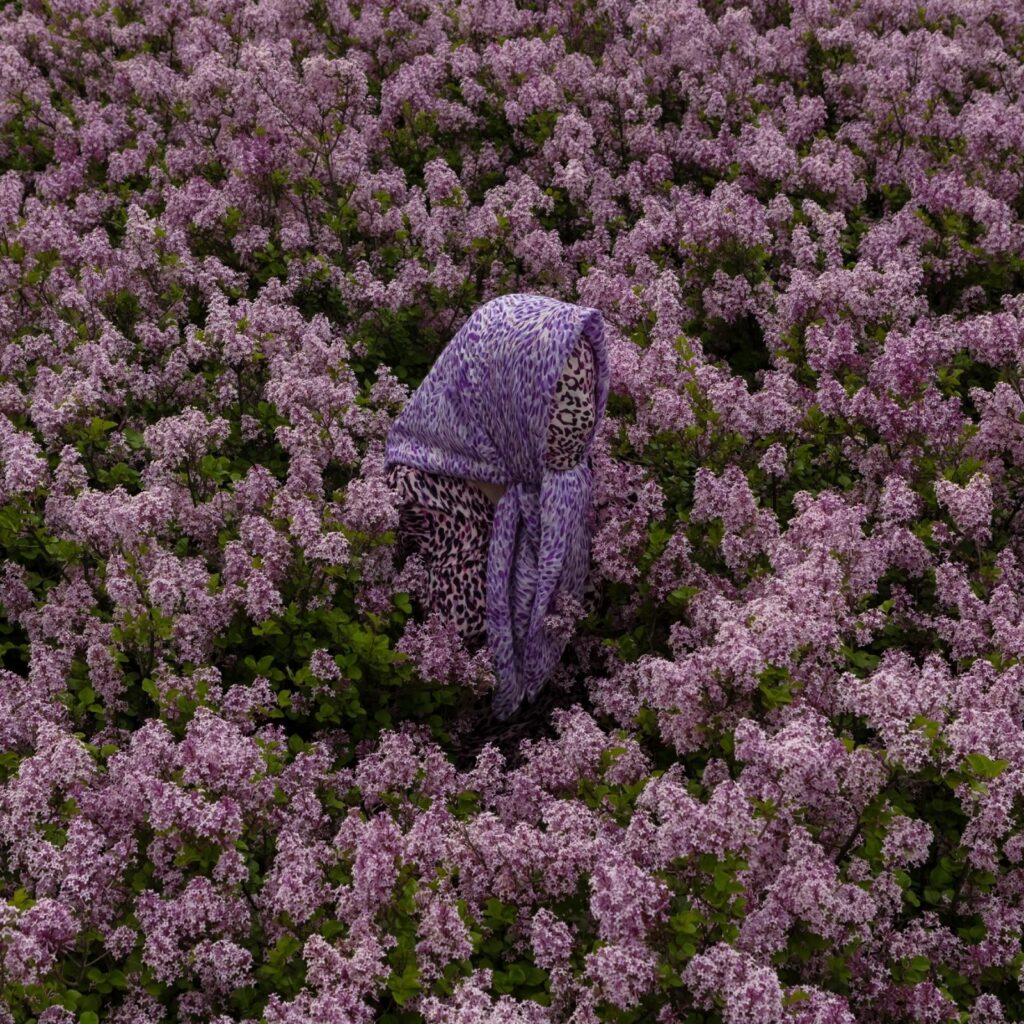
At the Crespo Foundation, After Nature. Ulrike Crespo Photography Prize 25, curated by Ben Livne Weitzman and Katharina Taschner, approaches the contemporary landscape not as scenery but as a contested field of perception, extraction, memory, and technological mediation. Across the works of Lisa Barnard and Isadora Romero, nature no longer appears as something external to human systems, but as a territory already infiltrated by military optics, ecological collapse, colonial infrastructures, machine intelligence, ancestral knowledge, and nonhuman forms of sensing.

What binds the exhibition together is its refusal to separate the environmental crisis from the technologies through which the world is seen, measured, predicted, and controlled. Barnard traces the violent legacy of military imaging systems and automated perception at California’s Salton Sea, where ecological devastation and machinic vision collapse into the same operational logic. Romero, by contrast, enters the cloud forests of Ecuador as living archives shaped by fungi, sound, Indigenous memory, agricultural resistance, and forms of intelligence that exceed human visibility. Together, the artists destabilize the fantasy of human mastery over nature and expose a world in which landscapes have become dense informational terrains — processed, extracted, surveilled, and continuously rewritten by both technological and biological forces.
Rather than illustrating “nature as a disappearing idyll, After Nature proposes something more unsettling: that the contemporary environment has already become inseparable from the systems designed to model, exploit, preserve, or militarize it.
Rather than illustrating “nature as a disappearing idyll, After Nature proposes something more unsettling: that the contemporary environment has already become inseparable from the systems designed to model, exploit, preserve, or militarize it. The exhibition asks what remains of perception when forests think, images decay biologically, and machines increasingly inherit the authority to see on our behalf.

Seeing Like a Machine
At California’s Salton Sea — a landscape of toxic evaporation, abandoned military testing grounds, lithium extraction zones, and collapsing ecologies — Lisa Barnard maps the violent afterlife of technological vision. In You Only Look Once, presented at the Crespo Foundation as part of the After Nature Prize 25, Barnard reveals how systems designed to detect, track, and eliminate have quietly migrated into the texture of everyday life. Military optics, machine learning, ecological extraction, and automated perception collapse into the same operational field. What emerges is a portrait of a world where looking has become inseparable from surveillance, prediction, and control — where even the landscape itself appears processed by the logic of targeting.
The exhibition unfolds through photography, moving-image installations, scientific diagrams, AI detection systems, military archives, and fragments of philosophical reflection. Barnard moves between seemingly disconnected subjects: toxic algal blooms at the Salton Sea, geothermal ponds glowing with mineral residue, autonomous-driving simulations, sonar systems, echolocation experiments, wartime aerial reconnaissance, Tesla’s ballistic-tested Cybertruck prototype, and infrared recordings of bats moving through darkness. Yet gradually these fragments begin to occupy the same perceptual continuum.

Military history quietly structures the entire exhibition. During World War II, the California desert surrounding the Salton Sea became a testing ground for aerial reconnaissance, bombing strategies, navigation systems, radar technologies, and remote sensing. The unstable visual conditions of the desert — heat mirages, distorted horizons, blinding reflections, and shifting terrain — accelerated dependence on machinic forms of orientation. The human eye became insufficient. Barnard suggests that contemporary artificial intelligence inherits precisely this militarized desire to see beyond bodily limitation.
One section of the exhibition juxtaposes original aerial images documenting the aftermath of Hiroshima and Nagasaki with diagrams from B-29 bomber flight manuals. These photographs, taken immediately after the atomic explosions, appear at first purely documentary. Yet Barnard reveals how aerial photography became part of a broader operational system in which vision served logistical coordination, optimization, targeting, and abstraction. Flow charts developed during the early twentieth century for industrial efficiency later migrated into military computation and eventually into algorithmic systems still governing machine learning today. The history of AI appears here inseparable from the history of warfare.
Elsewhere, Barnard photographs geothermal infrastructures surrounding the Salton Sea, where lithium extraction technologies process underground brines for electric vehicle batteries. Pipes, reservoirs, turbines, mineral ponds, and crystalline salt formations appear almost extraterrestrial. The project repeatedly exposes the contradiction embedded within contemporary “green” technologies: renewable energy infrastructures rely on vast extractive operations that transform landscapes into operational resources. One wall text notes that geothermal lithium extraction at the Salton Sea is promoted as one of the world’s lowest CO₂-emitting lithium projects, while simultaneously requiring chemical processing systems, algorithmic optimization, and large-scale environmental intervention. Ecological salvation and industrial acceleration begin mirroring one another.

The environmental dimension of Barnard’s work becomes especially intense in her images of harmful algal blooms. Waters stained red by cyanobacteria and Dunaliella salina bacteria appear almost painterly from a distance, yet the beauty quickly collapses into toxicity. The “red water” phenomenon emerges from combinations of salinity, nutrient overload, industrial runoff, bacteria, gypsum crystals, and ecological instability. Barnard repeatedly stages this tension between seduction and contamination. The landscape appears visually sublime precisely at the moment of its breakdown.
Again and again, the exhibition returns to systems attempting to perceive faster and more efficiently than humans themselves. Barnard incorporates references to YOLO (“You Only Look Once”), the real-time object detection system widely used in artificial intelligence and autonomous vehicle technologies. YOLO systems identify objects within environments almost instantaneously, transforming roads, obstacles, bodies, movements, shadows, and reflections into actionable information. Reality is no longer encountered gradually through perception; it arrives pre-segmented into operational categories.
One particularly revealing section documents autonomous driving systems trained near the Salton Sea and Davis, California. Barnard describes “full scene semantic segmentation systems” capable of parsing entire visual environments in real time. These systems do not simply see roads; they classify drivable surfaces, potential hazards, reflected light, lane divisions, obstacles, and movement probabilities simultaneously. The exhibition notes scenarios in which autonomous vehicles misinterpret reflected light, roadside mannequins, or artificial obstacles, exposing how machine perception remains haunted by ambiguity despite its promises of precision.

The spectator slowly realizes that the exhibition is not only about machines learning to see, but about humans learning to perceive according to machinic logic. Watching Barnard’s moving-image installations produces a strangely pleasurable unease. Infrared footage of bats swarming beneath bridges appears hypnotic, dense, almost cosmic in its movement. Yet software systems immediately begin tracking, labeling, and verifying their trajectories in real time. The image splits between instinctive perception and computational confirmation. One no longer simply watches; one monitors.
Barnard deepens this tension through the inclusion of Daniel Kish, a blind human echolocation expert and founder of World Access for the Blind. Kish navigates environments by producing tongue-clicks and interpreting returning sound waves, constructing what he describes as three-dimensional sensory images through echoes. Barnard places Kish beside bats, sonar systems, and machine-learning infrastructures, destabilizing the supremacy of vision itself. Echolocation appears not as a technological deficiency but as an entirely different epistemology of space.
The spectator slowly realizes that the exhibition is not only about machines learning to see, but about humans learning to perceive according to machinic logic.
The Limits of Perception
This is where the exhibition acquires its profound philosophical dimension. Barnard’s work strongly resonates with Thomas Nagel’s famous essay What Is It Like to Be a Bat?, in which Nagel argued that no scientific explanation could ever fully access another being’s subjective experience. Humans may mathematically describe sonar systems and echolocation mechanisms, yet remain fundamentally incapable of knowing what it actually feels like to inhabit such a perceptual world.

Barnard repeatedly exposes this gap between recognition and experience. One wall text explicitly notes that machine-learning systems trained on thousands of bat images can successfully identify bats in live footage while lacking comprehension, curiosity, or consciousness. The distinction is devastating. Machines may classify reality more rapidly than humans, yet they do not encounter it phenomenologically. They process without presence.
And yet the true anxiety of You Only Look Once lies elsewhere. The exhibition suggests that contemporary societies increasingly encounter reality only after machines have already interpreted it. Autonomous vehicles, predictive systems, AI classifiers, military sensors, and surveillance technologies do not merely assist human vision — they precede and structure it. The Other — animal, stranger, landscape, ecological disaster — increasingly appears through pre-classified frameworks before relation itself can begin.
Machines may classify reality more rapidly than humans, yet they do not encounter it phenomenologically. They process without presence.
Barnard reinforces this logic through bizarre yet revealing details scattered throughout the exhibition. A wall text recounts Elon Musk describing how Tesla emptied “the entire drum magazine of a Tommy gun” into a Cybertruck door during ballistic testing. Joe Rogan later fired arrows at the vehicle in a performative demonstration of impact resistance. Barnard unexpectedly links this spectacle to Paul Klee’s wartime fascination with aerial warfare and “flechettes” — small airborne darts dropped from aircraft during World War I. Across time, the arrow mutates from weapon into symbol, from military object into technological mythology, from projectile into vector.
Throughout You Only Look Once, bats, autonomous vehicles, military aviation systems, sonar technologies, AI detection models, geothermal infrastructures, lithium extraction plants, and ecological collapse begin functioning according to the same perceptual architecture: navigation through echoes, reflected signals, prediction, and informational return. Space no longer emerges through direct presence but through measurable feedback.

The brilliance of Barnard’s exhibition lies in the fact that it never simply condemns technology. Instead, it reveals something more structurally disturbing: contemporary machine culture increasingly attempts to eliminate opacity itself. Uncertainty, ambiguity, slowness, and phenomenological depth become treated as inefficiencies requiring optimization.
Nagel once asked whether humans could know what it is like to be a bat. Barnard transforms the question into something far more unsettling: what happens when humans themselves begin perceiving reality primarily like machines?
In You Only Look Once, the danger is not that machines are becoming human. The danger is that human perception increasingly behaves like infrastructure.
Forests That Remember
At the Crespo Foundation, Isadora Romero approaches the cloud forest less as a landscape than as a breathing intelligence system — unstable, humid, and constantly negotiating between memory, labor, extinction, and survival. In Notes on How to Build a Forest, the Ecuadorian artist abandons the romantic fantasy of untouched wilderness and instead constructs the forest as a social and technological organism: a territory where fungi archive images, where ancestral pathways survive beneath vegetation, and where vision itself begins to fail as the dominant instrument for understanding reality.

Romero’s work unfolds through photographs, textile books, sound, organic pigments, moving image, and sculptural installations that blur distinctions between ethnography and speculation. Across the exhibition, forests from Yunguilla and the Mache-Chindul reserve appear not as passive scenery but as repositories of agrobiodiversity and collective resistance — places shaped by centuries of extraction, colonization, migration, and ecological repair. The artist follows communities that rebuilt their relationship to land through forms of shared stewardship after histories of deforestation, transforming conservation into an act not only of ecology, but of memory.
Particularly striking are Romero’s textile books stained with turmeric, guarango, soot, earth pigments, and metal oxides. These fragile surfaces operate simultaneously as archives and living bodies. Plant knowledge threatened by disappearance is preserved materially within the fibers themselves, while several photographic prints are deliberately exposed to fungal growth until the images begin to dissolve under biological activity. The gesture is radical in its quietness: the photograph no longer documents nature from outside, but becomes metabolized by the same ecosystem it attempts to represent. The image ceases to be stable evidence and instead enters a condition of decay, reciprocity, and contamination.

Throughout the exhibition, Romero repeatedly returns to the buried histories of the Yumbo and Jama-Coaque cultures. Her research into culuncos — ancient sunken pathways carved into the forest terrain — becomes one of the conceptual anchors of the project. These infrastructural corridors once connected coastlines and mountains long before colonial occupation, facilitating trade, communication, ritual exchange, and movement across dense ecosystems. In Romero’s hands, the culuncos become more than archaeological traces: they appear as memory infrastructures still embedded within the land itself, hidden beneath roots, humidity, and vegetation. Projected imagery, suspended fabrics, AI-generated motifs, and layered soundscapes transform this research into a sensorial environment hovering between historical reconstruction and speculative fiction.
Vision becomes porous and unreliable; the spectator is asked not simply to look at the forest, but to recognize the limits of looking itself.
What emerges most forcefully in Romero’s work is the destabilization of human centrality. Collaborations with biologists, infrared imaging systems, and ecological researchers introduce visual registers inaccessible to ordinary perception. Plants, insects, birds, spores, humidity, and microorganisms begin to operate as agents within the exhibition rather than subjects observed by it. Several works imply that the forest possesses perceptual systems of its own — forms of communication, adaptation, and sensing that exceed human language and optical dominance. Vision becomes porous and unreliable; the spectator is asked not simply to look at the forest, but to recognize the limits of looking itself.

There is also something quietly political in Romero’s refusal of spectacle. Unlike ecological narratives driven by catastrophe imagery or apocalyptic rhetoric, Notes on How to Build a Forest remains attentive to slower forms of coexistence and repair. The works understand ecology not as an abstract environmental concern but as a network of material dependencies between bodies, histories, crops, sounds, labor, and climate. Even technology within the exhibition — AI pattern generation, infrared cameras, projection systems — is never presented as detached innovation. Instead, it becomes another layer through which forests are translated, mediated, and contested.
The exhibition ultimately proposes the cloud forest as a living archive whose histories are never fully visible and whose intelligence cannot be reduced to human comprehension. Romero portrays nature not as timeless purity, but as a humid terrain of continuous negotiation where ancestral memory, ecological fragility, and technological mediation remain inseparable. In her work, forests do not merely survive history — they absorb it, deform it, and continue speaking through it.