





What begins as a gesture of control rarely remains there for long. Artistic processes shaped by images, materials, tools and spaces, constantly negotiate intention — sometimes gently redirecting it, sometimes resisting it outright. The hand, while always present, is no longer a stable centre of authorship, but something that moves across systems, encountering and responding to forces that exceed it.
Every material keeps its own time. Clay must dry, textiles accumulate through repetition, drawings emerge gesture by gesture, and exhibitions take shape through negotiation with space itself. Artistic practice rarely follows a linear path; it unfolds through waiting, adjustment, uncertainty and return.
In this Art Guide, artists working across photography, textiles, ceramics, drawing, painting, sculpture and exhibition-making reflect on the conditions that shape creative practice. Their responses move beyond finished objects to consider the hand, labour, control, failure and the environments that allow work to evolve. Together, they suggest that making is less about mastering materials than about learning to work alongside them.
What does ‘the hand’ mean in your practice — not only physically, but symbolically?
Alex See
Obviously, with my hand, I touch what I make, but since my process is highly layered, it often begins with photography or found imagery, so I start digitally. In that sense, the computer becomes an extension of my body — an external organ that I reach through my hands. My hands are what allow me to communicate with this external organ. I process my imagery digitally, but then the work moves in a completely different direction. I begin working with textiles, soft surfaces, and body-like forms. Again, I reach for them with my hands, shaping forms and creating bodies out of these materials.
So for me, the hand is ultimately a means of communication — with the world, with materials, and with the tools I use.

Elise Nguyen Quoc
The hand, by taking on part of the work once done by the mouth, has contributed to the evolution of the face and of bipedal posture. There is a very close relationship between language, the hand, the tool and the brain. Its embodied technical knowledge is such that its capacity to act upon matter sometimes exceeds what can be described in words. It is a tool that thinks and that produces thought.
I made a drawing in 2021 that I am currently exhibiting at Gratin. It features this pathological hand at work, repeated, itself produced by a mechanical gesture. The represented hand then becomes ambiguous: it is both the tool of labour and its object, both what produces and what is exhausted in production itself, as if it were the impossibility of producing something new. Along the edges of the drawing remain traces of excess ink from the pen, wiped away during the process of making, like a principle of reality reminding us of the material and physical conditions of the image’s production.
Hilelmade
For me, the hand is much more than a tool. It’s the most direct way I communicate with clay. I love fingerprints, small imperfections, and the details that make it clear something was made by a person. Those traces give a piece character. It’s important to me that you can feel the presence of the maker in the work. The hand, for me, represents sincerity rather than perfection.

Kayla Dantz
I’m constantly working with my hands. Whether I’m cutting, weaving, sewing or threading a loom, my hands are always in motion. I like the idea that I’m physically connected to every piece I create — really, to every thread. Because I’m transforming photography, a medium now so often experienced digitally, into something tactile and textured, ‘the hand’ becomes a way of bringing the image back into physical space. It’s about closeness to a moment or memory, being able to engage with it not just visually, but materially.
I think ‘the hand’ also symbolises familiarity and intimacy with the work. Spending hours physically handling an image changes your relationship to it. You begin to know it differently through repetition, touch and labour. The process slows me down enough that I can’t stay detached from what I’m making.
There’s also something important to me about evidence of the hand remaining visible in the final work: slight inconsistencies, shifts in texture, imperfect stitches. These details remind both the viewer and me that a person made this — slowly and deliberately.
Marta Antoniak
‘The hand’ is, for me, above all a symbol of the artist’s physical presence in the making of a work. A painting or an object becomes a trace — and sometimes even an imprint — of the body in a specific place and moment in time. I find this particularly compelling in the context of the growing detachment from physicality that we can observe in contemporary culture. What is made by hand may be imperfect and prone to error, but it is precisely for that reason that it often feels more authentic and deeply human.

Inżynierska 3 (Jana Górska)
In the context of grassroots and independent exhibition-making, the hand is both a practical and symbolic force. Physically, it represents the often invisible labour behind exhibitions: building, installing, painting, lighting and shaping the exhibition space. Symbolically, it embodies care, vulnerability and the human element in a world increasingly defined by acceleration and automation.
The hand also functions as a connector. This is particularly evident in my exhibition series Unknown/Relations, which brought together artists exploring relationships that are difficult to define. Here, the hand symbolises a willingness to reach out to overlooked subjects, foster dialogue, encourage experimentation and create space for deeper reflection.
Ultimately, the hand in my practice bridges two poles: the work-worn hand responsible for the physical realities of exhibition-making and the creative hand that shapes visual communication, curatorial vision and artistic independence.
What kind of time does your material ask of you — and what happens when that rhythm comes into conflict with the pressures of speed, productivity and output?
Alex See
Nowadays, it’s hard to tell what is really going on, especially with AI-generated imagery and the sheer volume of images being produced every day. I find that a bit frightening, honestly, and my work is a way of processing that reality and exploring what it feels like to be alive right now. One image I often think about is looking out the window of a high-speed train: everything becomes a blur of motion. I’m trying to reflect that feeling in my work through blurred, half-recognisable images.
My process is highly layered. I might photograph a forest or other natural surroundings, and then those images can sit on my computer for five months before I feel ready to do something with them. Then I process the image, print it onto fabric, which can take up to four weeks, and only then begin assembling the work. Some pieces come together in a day, while others remain in progress, waiting for the moment when everything falls into place.
Time is not really linear in my practice because all of these processes overlap. Even after finding the final form, I work with resin and silicone, which means waiting again. After spending six months working on something slowly, step by step, even waiting another 48 hours for it to dry can feel unbearable.
At the same time, everything around us is incredibly fast. The amount of information we consume is overwhelming, and sometimes it feels as though everybody is producing things like a factory. You feel that pressure. What helps me is putting that aside and focusing on my own pace. I proceed slowly, step by step, and I’m learning to be patient with my work.
Elise Nguyen Quoc
My practice unfolds across different regimes of speed, ranging from a few days to one and a half or two months for the pigment-based works. But even my fastest technique (ballpoint pen) requires a significant physical and mental commitment. My life has therefore been quite ascetic in order to meet the demands of my work.
But a practice is not only about producing pieces. The non-productive times are an integral part of the artistic process. They are displaced elsewhere: reading, cooking meals for the week, seeing friends, hosting dinners, cleaning, exercising, doing nothing… I gradually learned that one must maintain a practice of oneself.
The pressure of production for an exhibition is double-edged. It generates energy, but it is also exhausting and sometimes traps you. I am often confronted with the contradictions between economic and production constraints and my ethics of making, especially since I have been living in New York. At times, this puts the work into crisis.
For example, right now I am working on two solo shows back-to-back, and I started a piece in a rushed way without fully realising it. When I understood where the problem came from, the only way to resolve it was to disregard the deadlines. I went back to the drawing as if time were infinite and no one was waiting for anything from me. I will do what I am able to do, and I hope it will be enough.
It may sound insignificant when said like this, but ignoring the economic and institutional structures that both sustain your life and allow you to continue your practice is not that simple.

Hilelmade
Clay constantly reminds me to slow down. No matter how rushed I feel, it has its own timeline. It needs time to dry, to rest and to be fired. Sometimes this rhythm clashes with deadlines, orders, or the pressure to constantly produce content for social media. But in the end, clay always wins. Working with ceramics has taught me to trust processes that I can’t fully control and to be more patient.
Kayla Dantz
My process is very slow. I hand-cut fabric, hand-thread a loom, weave everything back together, and then finish pieces through both machine and hand sewing. That’s all after the photographic side of the process, which can involve film development, editing and digital sampling. Every stage asks for patience and attention.
At times, I really value that pace, especially while weaving. The repetition can feel meditative. A big part of why I make this work is that it allows me to spend time with images rather than consume them quickly. Reassembling fragments by hand changes the way I experience them.
But that rhythm can feel at odds with a culture that prioritises speed and constant output, especially when much of the labour remains invisible to viewers. There are moments when I lose myself in productivity and start thinking about the next piece before I’ve fully experienced the current one. I catch myself treating the process like something to move through rather than something to inhabit.
I have to remind myself that the work only carries meaning because of the time embedded within it. If I’m not fully present while making the piece, some essential part of it gets lost.
Marta Antoniak
I work with a wide range of materials, from acrylic and oil paints to plastic and ceramic figurines. Each requires a different approach, but all of them demand patience. Most processes cannot be artificially accelerated without risking damage to the painting or object.
I try to estimate as accurately as possible how much time a work will require. I usually work on several pieces simultaneously, which allows me to move fluidly between different stages of each project. This sense of continuity helps reduce the pressure associated with deadlines.
At the same time, I feel increasingly exhausted by what I call fast art: the frantic production and consumption of art. For me, the most interesting aspect is the creative process itself, and I try not to undermine it through haste.
Inżynierska 3 (Jana Górska)
In exhibition-making, my material is the space itself. The physicality of a space becomes malleable; walls take on a sculptural quality, and the fixed format of four walls begins to feel as flexible as clay. Another material I work with is the ongoing design process, which follows a cyclical rather than linear sense of time.
The life of an exhibition extends far beyond the opening. It includes the often invisible labour of repairing, patching and repainting walls after previous shows — work that, in independent projects with limited resources, can take the longest. At the same time, the actual installation period is usually quite short. Rather than paralysing me, time pressure functions as a useful organisational tool.
Where I feel a real conflict is with the demand for productivity and efficiency. Commercial exhibition models often prioritise sales, whereas I see exhibitions as spaces for dialogue, experimentation and reflection. Many of the forms I value most — installation, video and performance — do not fit easily into a market-driven framework, yet they remain central to the way I think about curatorial practice.
Where does control end in your process, and where does the material begin to take over?
Alex See
Interestingly, this happens on two levels. It begins digitally and then continues when I work with the object itself. I use my own photographs, found photography, satellite imagery, and various image archives, which I process using a custom algorithm based on pixel sorting rather than AI. Depending on the light and the contrast between dark and bright areas, each image is distorted differently. The results are never entirely predictable, so in that sense I surrender a degree of control to the machine.
My role becomes one of curation; when I discover something that interests me, I move into the physical territory. There, fabric becomes a perfect material for collaboration. What fascinates me about it is its unpredictability: a simple fold can suddenly work with the image beneath it, or it can completely fail.
I try to let the material speak because I adore the immateriality of fabric. With the help of resin, I then freeze these fleeting forms in time. I want the material to speak and to guide me. In a way, I would love to make a work where the material does everything, and I simply watch.

Elise Nguyen Quoc
A part of my practice consists of reproducing binary writing and treating each fragment with the same level of attention. For this reason, my work is often perceived as highly controlled, with an active intention to master the process. I, on the contrary, see myself as being subjected to a ritual protocol in the act of materialisation, in the emergence of form within matter. I dissolve as a subject, but I do not control.
When drawing, part by part, flat on the surface, I never have an image that builds up in layers or reveals itself as a whole. It is closer to a printer: once the entire surface has been inscribed, I discover the piece by hanging it on the wall, and I can no longer act upon it. And regardless of the recurrence of the medium, each image remains singular in its iconography. It is impossible for me to treat them in the same way; my gestures must constantly adapt. There is no guarantee. With each new piece, I feel at risk.
A friend once told me that my images were always good copies of their immaterial supports, an argument that seems to support this idea of ‘control’. Yet I believe there is a difference between control and a state in which an event ceases to appear as an event. I think it is difficult for a viewer to project themselves into a work and perceive the subtle micro-variations that constituted an event for the artist. They are absorbed into a continuum.
When one works with a world structured at low intensity, regardless of variations in material, support, or the fatigue of the hand, there is a disappearance of the exceptional character of what happens; the world ceases to be structured by strong moments. Ultimately, this idea of faithful copying may be proof that I have managed to move forward within a field of uncertainty, responding to it in a sufficiently adequate way. And to conclude this answer to the question: I believe it will always be the matter that poses the questions, and the body that responds.
Hilelmade
I think this is one of my favourite aspects of ceramics. I usually begin with an idea and start shaping it, but as the process unfolds, the material begins to have its own voice. Sometimes a form behaves differently than I expected, and sometimes a glaze produces a completely surprising result. Total control is never really possible. At a certain point, you have to stop directing the material and start listening to it.

Kayla Dantz
I always joke with clients that ‘the material has a mind of its own,’ but it’s genuinely true. I can measure something repeatedly and still have it come off the loom an inch different. Fabric shifts as I weave, stitches aren’t perfectly aligned, wrinkles persist. There’s a balance between correcting those things and allowing the material to behave naturally. I’m interested in work that still carries evidence of being made by hand.
Conceptually and visually, the material often leads me somewhere I didn’t initially plan to go. I move image fragments around while working, and compositions evolve as I physically interact with the fabric. Sometimes those decisions are intentional from the beginning, but more often they develop through the process itself, through seeing colours, textures, and fragments start responding to one another in real space.
That’s usually the point where control starts to shift. The work becomes less about executing a fixed image and more about paying attention. Forcing the material too aggressively or ignoring the moments when the process wants to redirect me ultimately weakens the outcome.
Marta Antoniak
My work emerges from observing the material and following it. It’s somewhat like a dialogue. I respond to what the material itself ‘tells’ me. Through the process of creating, I explore the limits of what is possible to do. It is not a struggle or an attempt to dominate the material, but rather an expression of curiosity and a desire to better understand its properties.
Many new paths have opened up for me precisely through experimentation, testing and questioning the conventional uses of different materials.
Inżynierska 3 (Jana Górska)
Under time pressure, I sometimes find that constraints themselves become creatively stimulating. In that kind of working dynamic, what might appear as ‘glitches’ often turn out to be the best solutions. When arranging space, chance can be the most energising element in the process.
A good analogy for this comes from my student days, when I created a simple geometric form out of mesh. It was only after accidentally placing it against a wall that I noticed the shadow it cast — and suddenly the whole work acquired a deeper meaning.
In exhibition practice, an error becomes worth following when it ‘casts a shadow’: when it brings unexpected value, and opens up a new perspective that I would never have arrived at through purely intellectual reasoning. Without an openness to the risk of error, exhibitions would become static and predictable.

How does failure operate in your practice — as something that happens to you, or something you invite? And when does an error become worth following?
Alex See
It happens quite often that when I let go of control, I experiment — and then I just look at the work and think: ‘I don’t like it. I’m going to be honest with myself. I just don’t like it.’ Then I face this question: ‘Okay, what should I do with this?’ It’s still something I created and invested my time in. Should I throw it away? I’m never quite sure. I usually put it aside and return to it a week or a month later, and sometimes I begin to see something in it.
Occasionally, almost, miraculously, I think: “You’re not that bad, actually. We can do something here. Let’s continue.” Sometimes I start adding elements. If I don’t like the first layer, I simply add a layer on top, and then another on top of that. I once made a piece with many layers because I was never satisfied with the result. But through that process, the piece became something completely new, even if it looks different from what I usually make.
I’m learning to respect failure, even the failed pieces. In music, teachers often say that when you’re improvising within a scale, you might hit the wrong note, but if you do, you can’t just think, ‘What I did would never work.’ Instead, you can pretend it was intentional, continue, change the key, and suddenly you have jazz. I suppose I’m trying to do something similar, rather than thinking: ‘This is a bad piece.’

Elise Nguyen Quoc
I think failure happens to me more than I actually invite it, haha. Because it confronts me with the fact that I have not managed to adapt, not managed to respond to the conditions of reality. It is something I go through in a painful way. It goes beyond the fact that a piece does not work. It touches on questions of survival, somewhere in me, as a species. Coupled, of course, with my own psychic structure, my relationship to value and to existence. Over time, fortunately, this feeling becomes more manageable. Through experience, you understand that you have the capacity to bounce back, either within the piece itself or within yourself. A practice cannot be a taut thread without any slack. I think it is important to maintain a form of rigour, but also to remain humble, to accept that there will sometimes be resistance to what you had projected in your mind. That is part of the work, too: there will always be failure when you confront things.
I think that when an error is worth pursuing, you can feel it. It is a matter of perception. I do not know how else to explain it.
Hilelmade
Ceramics has taught me that failure is completely normal. Cracked pieces, broken handles, glazes that don’t turn out the way I imagined – they’re all part of the process. I still feel disappointed when a piece comes out of the kiln damaged, but I’ve learned to see it as a natural part of making. In fact, some of my favourite ideas have come from things that went completely wrong. Rather than fighting mistakes, I try to stay curious about them.
Kayla Dantz
I try to leave room in my practice for experimentation, where failure is not only accepted but necessary. Especially when something isn’t feeling right, I find it important to step back and explore without worrying too much about the outcome. In those moments, failure becomes productive. It helps me move beyond habits or expectations and often leads me towards something more compelling.
It’s a bit like in a video game — when a character falls off the map, they’re usually reset a little farther back, but closer to the correct path. In hindsight, failures can function similarly and redirect me.
Of course, there are also failures that arrive at less convenient times. It can be frustrating when a vision feels very clear internally but refuses to materialise physically, no matter how much care goes into it. Those experiences have made me more intentional and more selective about what I ultimately share. If a piece isn’t communicating what I need it to, I won’t exhibit it. There are many partially finished works in my studio because of that.

Marta Antoniak
I don’t perceive creative practice in terms of success and failure, as these concepts are always relative. Sometimes, what initially appears to be a mistake unexpectedly leads to remarkable results. It is also difficult to define failure in art in any fixed way; everything depends on perspective and on the goals one adopts. I try to remain open and respond in real time to what is happening in the studio. This does not mean that everything always unfolds as I expect, but I am far more interested in the process itself than in the destination. Perception shifts over time and through new experiences, and with it, so does the understanding of what an error is. There are instances in which a painitng that initially feels unsuccessful, years later, turns out to be the beginning of a completely new, previously unanticipated narrative.
Inżynierska 3 (Jana Górska)
In my practice, failure and error operate at two completely different levels: the artistic and the relational, and they serve distinct functions within each. On the human level, in communication and collaboration — which forms a significant part of curatorial work — mistakes and failures can be particularly difficult. I had to learn quite quickly how to accept them.
A turning point came when my goodwill and trust were taken advantage of. While organising an exhibition, I acted on the belief that the creative process was a product of teamwork, built on trust, shared commitment and a common goal. After the project ended, I was left alone with completely damaged walls and another exhibition to prepare, despite earlier agreements that the space would be restored to its original condition. This experience, which initially caused a sense of harm and deep frustration, eventually became the most important turning point in my practice.
With time, I realised this was a ‘worth following’ mistake. It led me to think about exhibition space in a more structured way and to formalise it through written agreements, contracts and deposits. Today, failures in interpersonal relationships no longer paralyse me; I treat them as a form of recalibrating. I return from them stronger, with a clearer plan and a more precise strategy. I have learned to invite even these kinds of mistakes into the process.
How does the space you work in shape what you create? What kind of environments allow your work to unfold most honestly?
Alex See
Right now I’m in my studio, but it’s also my living room — it’s basically my apartment; I live here. On the one hand, it’s a privilege: if it’s 1 a.m. and I don’t feel like sleeping, I can quickly test something. Before breakfast, I might already have a new piece standing here that I can return to, so I’m constantly in contact with my work. But the downside is that you don’t have the distance you probably should have, and it’s also technically difficult to work on bigger pieces here. I make some of my larger, more spatial works on site. I want them to interact with architecture, to become part of a space, almost as though they are growing out of its architectural features.
Last year I had an exhibition in Brussels, and it was the first time I worked only with fabric and materials, looking at the space and thinking: ‘I love this column, it looks nice. How can I approach it? How can I work with it?’ You begin to engage with the space, with its geometry, and I absolutely love that.
It’s tricky and not that comfortable, because you have to control the shape while standing on a ladder, working with resin that drips on you. It’s messy, but it feels like a performance. You’re fighting with the material in a sense — it resists taking shape, but in the end, you think: ‘We did it.’
I love limitations; I feel they actually help me a lot, especially at a time when everything feels oversaturated and incredibly fast. I need some limitations; otherwise, it’s scary to think that you can do basically anything. When working with a space, I see it, feel it and collaborate with it. There are three actors in the process: myself, the material and the space itself.
Elise Nguyen Quoc
My space never limits me, but it structures my gestures. Some of my formats are relatively large (5 to 8 meters); they are composed of several standard-sized panels that I can move on my own. The size of my studio does not allow me to work on these pieces as a single, unified surface, which leads to a serial organisation of the work (I work in pairs of panels), perceptible in the pieces through misalignments and ruptures.
These are traces of the material conditions of production, preventing the image from being perceived as a total, unified image. One cannot read the image without seeing the gestures that produced it, as well as the conditions that shaped it. This situates it within its own process of fabrication.
I think I need an environment where no one tries to interfere with my work, where I remain able to distinguish between the art world and the art market. An environment where my friends are also present — that is why I am going back to Paris.
Hilelmade
What affects me most is a sense of calm. I’m much more creative in spaces where I feel comfortable, unhurried and free to daydream a little. The time I spend in my studio isn’t only about producing work — it’s also about thinking, experimenting, and sometimes simply sitting with my ideas. I think my most honest work emerges when I give myself enough space — both physically and mentally — to explore without pressure.

Kayla Dantz
I tend to value comfort and familiarity in the spaces where I work. Most of the time I’m alone, listening to favourite albums or rewatching comfort shows in the background. I wear comfortable clothes and try to surround myself with things that feel calming but still stimulating, like a cup of tea or photographs and notes on the wall. I think that kind of environment allows me to work more honestly because I’m less distracted by self-consciousness.
I also really appreciate natural light. I love working near big windows, especially when I can observe the weather or seasons change outside. Since so much of my work is tied to memory, atmosphere and subtle shifts in colour or feeling, I think being visually connected to the outdoors keeps me grounded and observant. The light itself also changes the way fabric, texture and images appear throughout the day, which I really value.
Making art feels inherently vulnerable to me, especially because my process is messy and uncertain for long stretches of time. Pieces often move through awkward or unresolved stages before they finally come together. To work through that, I need a space where I feel free to experiment, fail and sit with uncertainty without feeling observed.
My studio is filled with fragments: strips of fabric, test weavings, loose threads and partially finished pieces. Living among those materials keeps the process open-ended, allowing ideas to continue evolving even when I’m not actively working. More than anything, I need a space that encourages slowness and attention, because the work depends on patience, repetition and presence rather than speed or polish.
Marta Antoniak
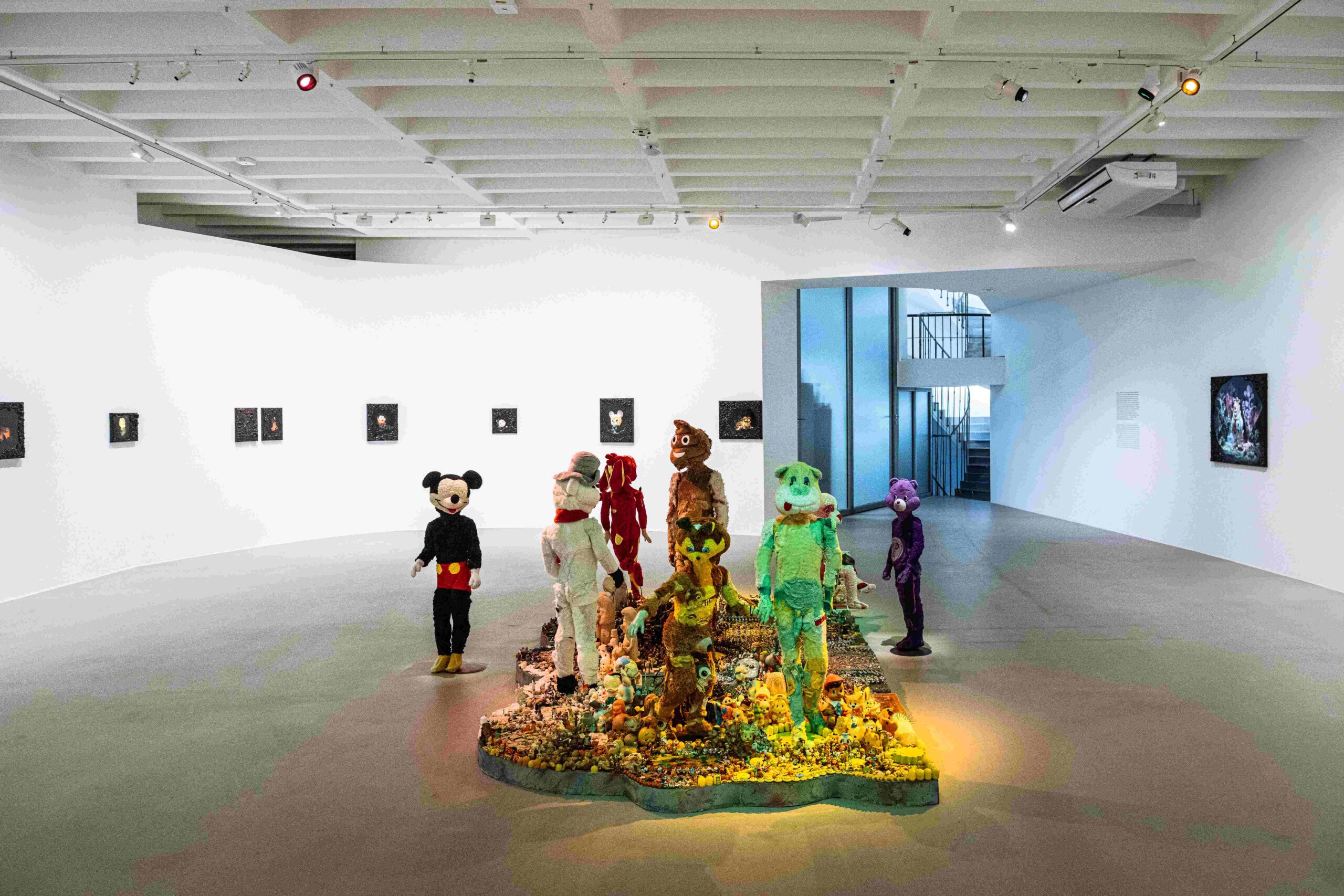
I like to surround myself with all kinds of objects. I have a large collection of old figurines, toys, anatomical models, wooden sculptures, Christmas ornaments, soft toys, fabric scraps, posters, books, colouring books and atlases. I am drawn to their variety of materials, surfaces and textures. Some things are smooth and rubbery, others hard and rough, and still others fragile and sharp.
This abundance has a calming effect on me. It also keeps me from getting bored, because in my own studio I can always discover something new. I don’t work well in sterile, austere spaces. I find it difficult to relax and concentrate in them. It simply isn’t my environment.

Inżynierska 3 (Jana Górska)
When it comes to the spaces that support creative development, I distinguish between two levels: the architectural (physical) and the environmental (social). Both directly and profoundly shape my practice.
On a physical level, my main condition for creative and aesthetic thinking is radical visual clarity: empty white walls and minimal furnishings. I learned this sense of visual hygiene partly from a former partner, who introduced me to a way of thinking about space inspired by Rick Owens or Kanye West. I realised that only empty walls allow something truly new to emerge. Visual chaos overwhelms and distracts from the essence, whereas a white, empty studio — which, in my case, is also where exhibition-making happens from concept to installation — gives me freedom to design from scratch. It gives me room to breathe and provides a clean slate for ideas.
On a social level, however, the situation is far more complex. Entering the formal world of institutions, galleries and foundations, I encountered a toxic, feudal structure in which artists are exploited by gallery owners, and gallery owners by wealthier patrons. At official openings, this hierarchy becomes visible: the artist is often treated like a performer expected to entertain, while money and influence function as the only real currency. The system relies on exploitation and precarious labour, where so-called opportunities often take the form of informal arrangements behind closed doors.
This experience affected me deeply and briefly made me question whether I wanted to continue with Unknown/Relations. Fortunately, another gathering at the Inżynierska studio reminded me how different things can be in independent contexts, where art becomes a tool for dialogue and community rather than financial calculation.
What most authentically sustains my practice are grassroots, collective spaces such as the house collective @narocz13 on Narocz Street. I need these environments in order to remain creatively strong. Working with children has a similar effect. It is contact with a pure human presence, not yet shaped by systemic structures or market logic. I work most honestly where art emerges from the need for dialogue, not financial strategy.

ABOUT THE ARTISTS
Alex See
Alex See is a Berlin-based artist working across photography, sculpture and algorithmic image processes. Using photographic, found and instrument-mediated imagery, he transforms digital images into sculptural objects that occupy a space between image and body.
His practice explores how contemporary technologies, computational systems and generative models shape perception and mediate our relationship to images. By translating digitally processed imagery into tactile, unstable forms, See gives physical presence to systems that are often experienced as immaterial. Recent presentations of his work include exhibitions at SETAREH, untitled, and Brasserie Atlas, as well as a residency at GlogauAIR in Berlin.
Elise Nguyen Quoc
Elise Nguyen Quoc is a French artist born in Trappes and currently based in New York. Working primarily with drawing, painting and image-based processes, her practice begins with what she describes as ‘remnants’ or traces of everyday life: photographs of overlooked details, marks and fragments that she collects and transforms through a meticulous process of enlargement and translation.
Drawing from these microscopic fragments of reality, Nguyen Quoc creates large-scale works that move between representation and abstraction. Through painstaking, labour-intensive techniques using materials such as pigment, graphite and ballpoint pen, she reconstructs images at monumental scale, pushing them beyond recognition and inviting sustained attention. Her work has been exhibited internationally, including solo presentations at Gratin in New York, and she was awarded the Thaddaeus Ropac Prize in 2021.
Hilal Altıparmak – hilelmade
Hilel Altıkenar is a ceramic artist based in Istanbul, Turkey. Since establishing her home studio practice in 2020, she has focused on handmade, functional pottery, creating cups, vessels, figurines and distinctive coffee drippers that bring a sense of playfulness to everyday rituals.
Characterised by bold colours, minimal forms and a whimsical approach to design, her work balances functionality with personality. Embracing the small quirks and imperfections of the handmade process, Altıkenar creates objects intended to be used, lived with and enjoyed. Alongside her studio practice, she creates and teaches ceramics at Lotus Seramik in Istanbul.
Kayla Dantz
Kayla Dantz is a photo-textile artist and designer based in Massachusetts. Drawing on her background in fashion design and education at Parsons School of Design, she works across weaving, knitting, embroidery and photography, combining handmade and digital processes to create woven photographic works.
Using both archival and personal photographs, often including family images from the 1960s and 1970s, Dantz explores the relationship between memory, identity and materiality. By translating photographs into handwoven textiles, she brings texture and physical presence to images while reflecting on how memories are preserved, fragmented and reshaped over time. Her practice is deeply informed by family history, craft traditions and a longstanding interest in photography, resulting in works that connect personal narratives with the tactile language of fibre.
Marta Antoniak
Marta Antoniak is a visual artist based in Kraków, Poland. She graduated from the Faculty of Painting at the Jan Matejko Academy of Fine Arts in Kraków in 2011 and completed her PhD there in 2017, where she now also teaches.
Working across painting, sculpture and installation, Antoniak is known for transforming everyday objects (particularly toys and plastic materials) into uncanny, hybrid forms that explore the boundaries between the human body, memory, consumption and material culture. Her work has been presented in numerous solo exhibitions, including The Elementary Particles at Bunkier Sztuki (2025), Dry Ice at UFO Art Gallery (2021) and All Dogs at Stereo Gallery, Warsaw (2019), as well as in group exhibitions at galleries and institutions including MOCAK Museum of Contemporary Art in Kraków, Fundacja Galerii Foksal, BWA Katowice, and the Jeune Création Européenne Biennial in Paris.
Inżynierska 3
Inżynierska 3 is an independent exhibition space in Warsaw’s Praga district, operating within one of the area’s historic early twentieth-century industrial buildings. As a platform for contemporary art, it supports both emerging and established artists through exhibitions, installations, screenings and interdisciplinary projects.
A key initiative developed within the space is Unknown/Relations, an ongoing grassroots contemporary art project curated by Jana Górska. Bringing together artists working across a range of media, the project explores relationships, experiences, and subjects that often resist clear definition. Rooted in experimentation, dialogue and community engagement, Inżynierska 3 continues to provide a space for critical reflection, artistic exchange and independent cultural production.


