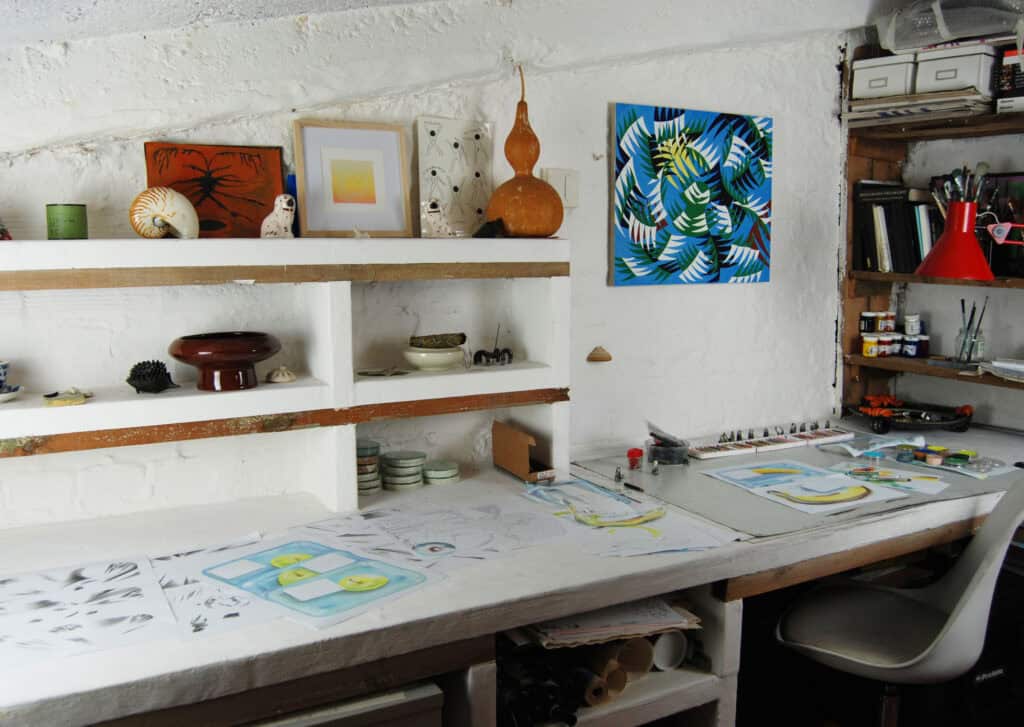
Ana Maria Szöllösi’s exhibition Ménière at Kunsthalle Bega feels less like a sequence of paintings than like entering an unfinished conversation with perception itself — a space suspended between memory, sensation, hesitation, and the slow instability through which meaning takes shape. Born in 1994 in Romania, the artist lives and works in Timișoara, where she graduated from the Faculty of Arts and Design in 2018. She continued her studies through scholarship programs at the Jan Matejko Academy of Fine Arts in Kraków and at the Aristotle University of Thessaloniki.
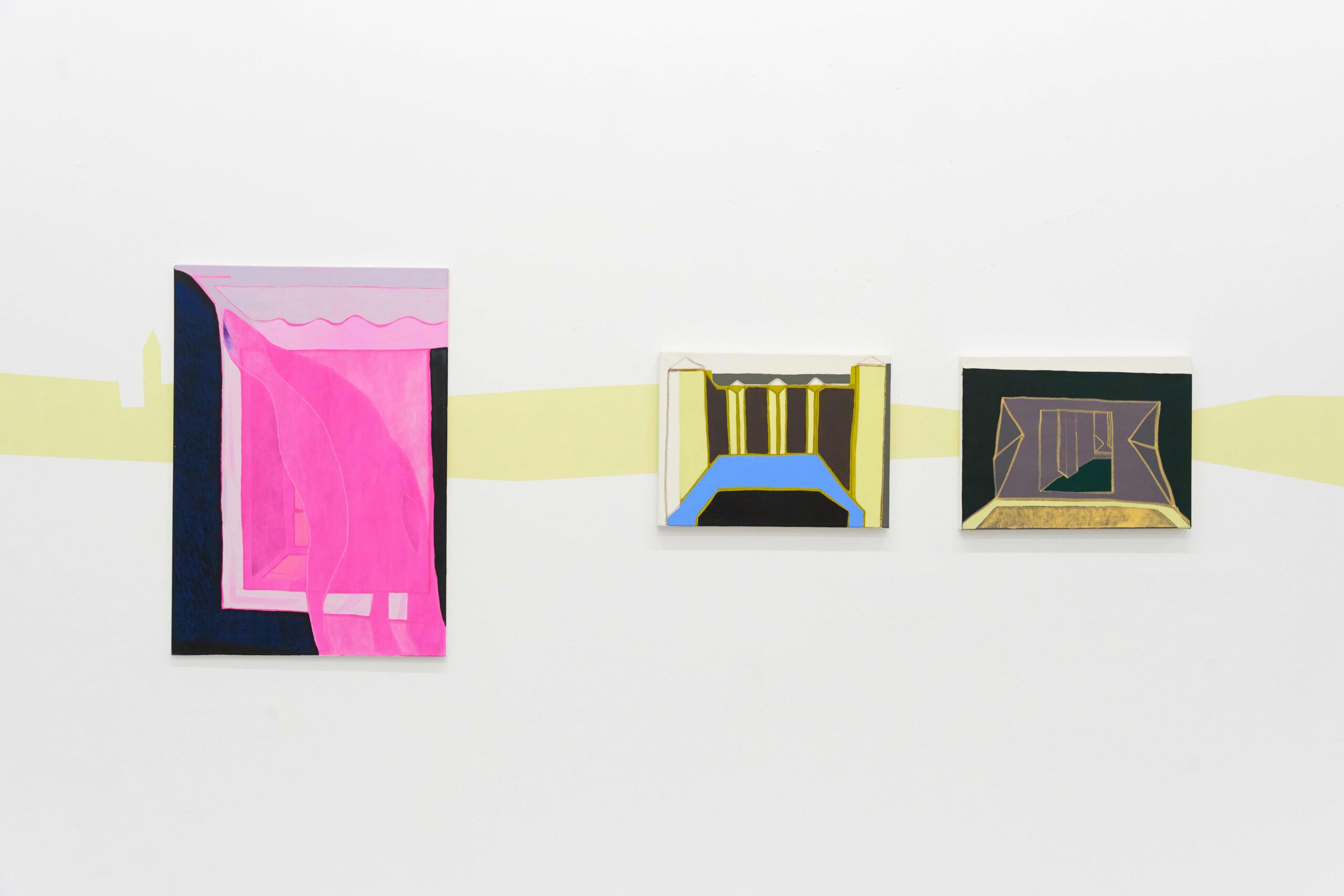
Working primarily through painting while remaining closely engaged with analogue photography, her practice explores the unstable territory between memory, perception, subconscious imagery, and spatial atmosphere. Through predominantly abstract compositions, Szöllösi constructs emotionally charged environments in which symbols, fragments, and shifting chromatic structures become subtle indicators of interior states and lived experience.
Through predominantly abstract compositions, Szöllösi constructs emotionally charged environments in which symbols, fragments, and shifting chromatic structures become subtle indicators of interior states and lived experience.

Entering Ménière
I do not move through the exhibition so much as remain within it. The works seem to continue one another quietly, as if each canvas began elsewhere and simply carried its atmosphere. Nothing fully settles. Nothing insists on a final form. Meaning appears gradually, through duration, through looking, through remaining.

There is a density of lived experience inside these paintings that resists immediate comprehension — emotional sediments and lingering atmospheres that seem to have accompanied the artist for years, difficult to fully articulate and perhaps never intended to completely disclose themselves. What moves me is the fact that Szöllösi does not attempt to stabilise these fragments of perception. She allows them to tarnish, shift, dissolve, and re-emerge. The paintings accept instability as part of their internal structure. And because of this, they feel profoundly alive. By allowing change to remain visible within the image, she also allows fragility, disappearance, and transformation to remain visible — as if painting becomes less about preserving a moment than about accompanying its slow mutation through time.

What moves me is the fact that Szöllösi does not attempt to stabilise these fragments of perception. She allows them to tarnish, shift, dissolve, and re-emerge. The paintings accept instability as part of their internal structure. And because of this, they feel profoundly alive.
When I stand in front of her works, I feel my eyes softening while my mind becomes strangely alert. The experience almost reverses itself: the mind begins to look while the eyes begin to think. There is a subtle bug introduced into perception, a productive malfunction. I sense that something inside the image escapes the usual mechanisms through which paintings are “consumed” and identified. And perhaps this is precisely why the works remain with me. They refuse the polished certainty of the “selling point.” They resist becoming fixed images or self-contained compositions. Instead, they function as unstable perceptual fields that continue to reorganise themselves in the act of looking, allowing meaning to emerge provisionally, incompletely, and always in motion.

Between memory and dissolution
The experiences in Greece through the Erasmus programme seem to have deeply transformed her relationship to painting. Initially formed through the discipline of classical training — anatomy, observation, structure — Szöllösi slowly detached herself from the logic of representation. She moved toward colour, atmosphere, and emotional perception, toward a way of working in which seeing itself becomes unstable.

When she speaks about Greece, she recalls how the light altered her sense of image entirely. The sky felt foreign. The sunsets became “almost kitsch.” What interests me here is not anecdote but rupture — the moment in which technical knowledge becomes insufficient for what one feels compelled to follow. At that point, painting no longer concerns representation alone. It becomes a way of remaining inside perception before things harden into certainty.

Although painting remains central to her practice, analogue photography continues to operate nearby, almost like a secondary nervous system for the work. Szöllösi often works through fragments of memory, subconscious associations, and oneiric sensations translated into layered spatial environments. Symbols and visual indicators appear throughout the compositions, but never as explanations. They behave more like emotional anchors — traces that orient perception without fully resolving it. Her abstraction never feels merely stylistic. It feels existential.

What gives the work its intensity is precisely this unstable balance between recognition and dissolution. Colour dissolves boundaries. Spaces remain permeable. Forms hover continuously between appearance and disappearance. The paintings do not stabilise perception; they preserve its ambiguity. I do not experience them as images to decode but as environments to inhabit slowly. They hold me in a prolonged state of attention where certainty and uncertainty coexist without cancelling one another.
What gives the work its intensity is precisely this unstable balance between recognition and dissolution. Colour dissolves boundaries. Spaces remain permeable. Forms hover continuously between appearance and disappearance. The paintings do not stabilise perception; they preserve its ambiguity.
Liminal Zones
At one point, speaking about the edges where colours meet, she refers to them as liminal zones — places where differences are not fixed but negotiated. I realise that this “in-between” condition runs through the entire exhibition. Interior and exterior no longer appear as separate realities. Observation itself ceases to be distant. To look becomes a form of involvement. The world inside these paintings does not stand before me as an object; it appears together with my gaze, within the unstable relation between perception, memory, and atmosphere.

And perhaps this is ultimately what stays with me most strongly about Ménière: not what the paintings show, but the way they continue to withhold complete resolution. They keep meaning alive by never exhausting it. They remain open, unfinished, moving. As meaning shifts, the painting stays.
Ana Maria Szőllősi’s ‘Ménière’, 6.02 – 25.04.2026, Kunsthalle Bega, Timișoara