






Art fairs are often experienced as carnivalised theatres of commerce, where the drama of acquisition meets the intimidation of the white cube. Abu Dhabi Art 2025, however, operated on a different wavelength under the direction of Dyala Nusseibeh. Galleries rejected the predictable choreography of display for something subtler: a slow, rigorous dance of space, light, and thought.
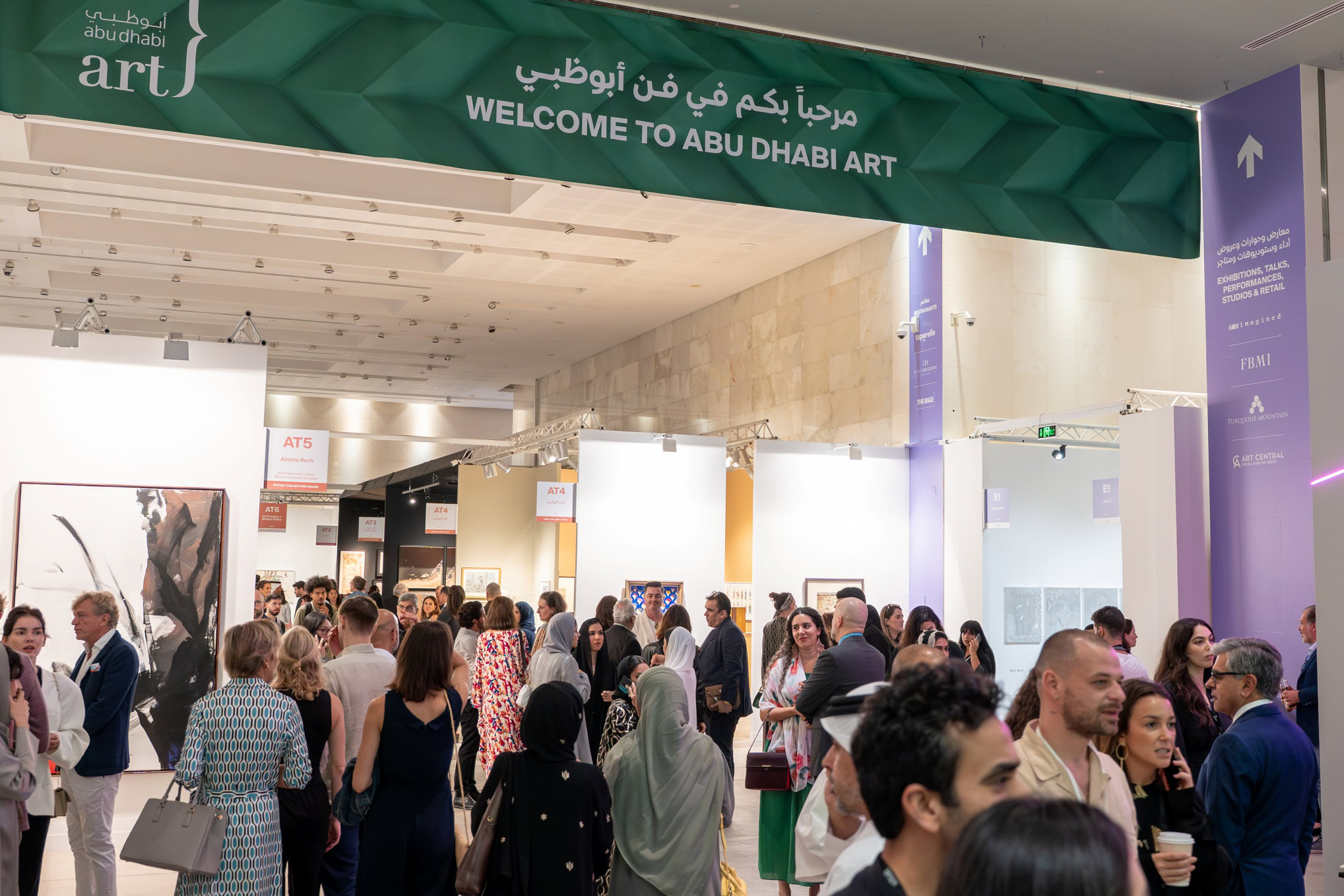
Across 140 galleries from almost 40 countries and more than 50 cities, Abu Dhabi Art 2025 unfolded as a meditation in rhythm, resonance, and care. This edition was also historic: the last Abu Dhabi Art before Frieze Abu Dhabi assumes its reign in 2026, promising global visibility, but at the cost of some of the idiosyncratic intimacy that makes fairs like this so quietly addictive. What’s the Frieze? “The platform [that] brings extraordinary global reach, while Abu Dhabi brings its distinct cultural purpose”, Nusseibeh explains and adds that his role is “to hold space for both – to welcome the new dynamism coming our way while preserving the values that have guided us thus far: regional representation, thoughtful curation, and long-term cultural investment extended to ensure meaningful returns for the creative and cultural industries in the UAE.”

In the relentless slipstream of the contemporary, where the ‘now’ is discarded before it has even finished arriving, Abu Dhabi Art 2025 felt like a necessary, if slightly defiant, deceleration.
We have spent much of the last few years braced for the roar of the spectacle – the oversized, the neon, the hyper-kinetic. Yet, walking through the fair this year, one was struck not by the noise, but by the frequency. It was a curation that stretched from the workshops of Lagos to the studios of London. The galleries treated the booths as extensions of the laboratories – spaces where research and relational thought were given the oxygen they required.

We found ourselves in a space where the viewer’s journey was as meticulously considered as the provenance of the works themselves. It turns out that the most radical thing one can do in 2026 is to offer a moment of pause – a connection in a world that has forgotten how to stop.
Here are seven gallerists who embodied the Fair’s spirit and made a lasting impression.
Contemporary Lynx was a proud media partner of the Abu Dhabi Art Fair 2025.
Ashwin Thadani, Galerie ISA – Mumbai
Galerie ISA sidesteps the sterile silence of the typical fair booth. Under the helm of Ashwin Thadani, the space is planned as a well-thought-out composition – where the ‘white cube’ gives way to a more visceral, interior sanctuary. It is a study in the dissolution of borders: between the intimate domesticity of the mind and the sprawling, technological exterior.
Thadani curates as one listens to music: intuitively, holistically. Corners, doorways, and shafts of light are interlocutors, and walls are participants. Through a curation that balances the weight of migration and memory against the slick friction of the digital age, a specific rhythm emerges. The spatial design, developed with art historian Dr Jamila Adeli, deepens this openness. You wander. You double back. You make meaning between the works.
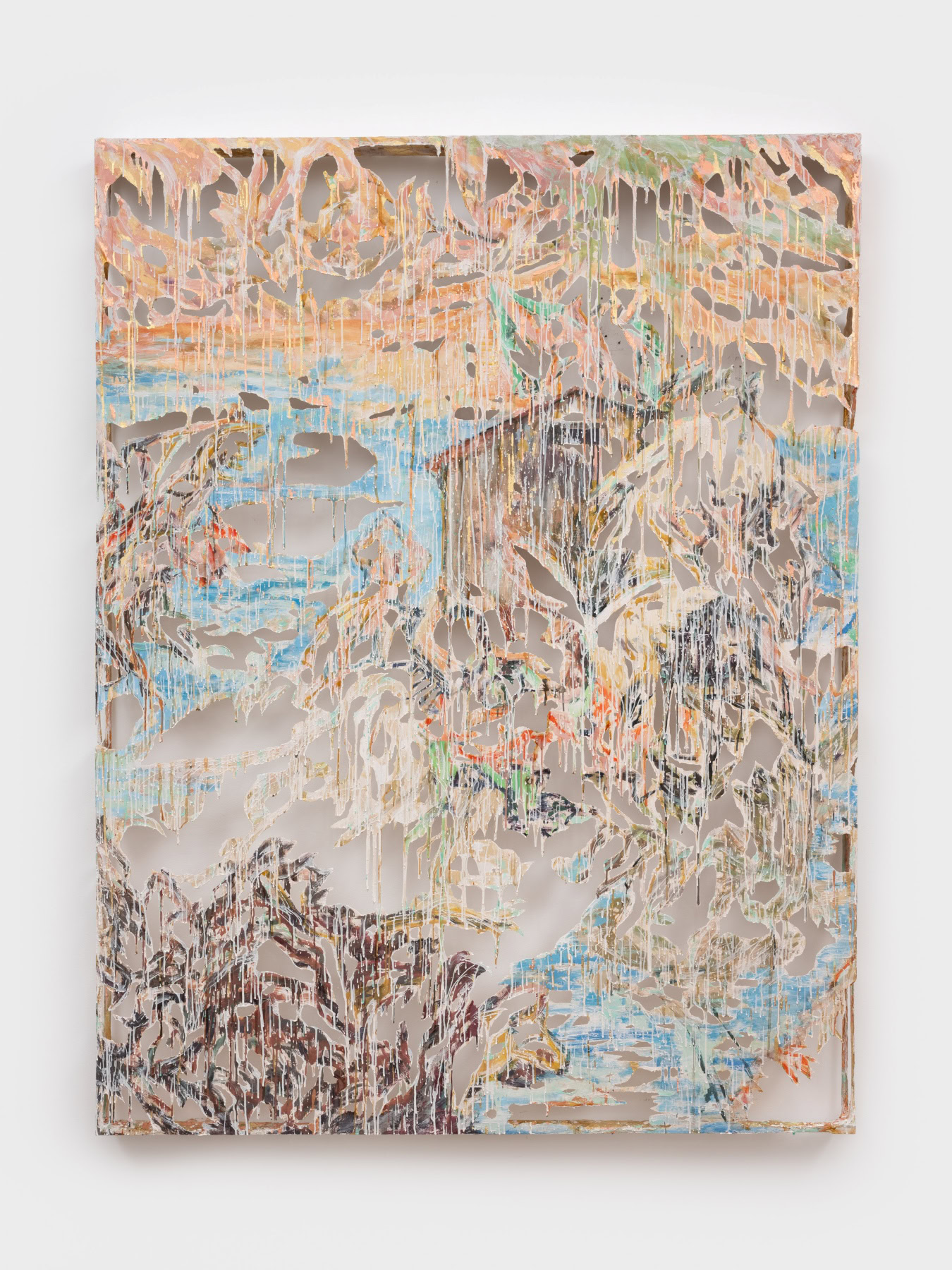
For instance, Ricky Vasan’s paintings draw the viewer into domestic interiors; their brushwork oscillating between density and release, as memory slips between presence and absence. In contrast, Diana Al-Hadid’s work does the opposite – it dissolves. Gesture, gravity, surface, and void hover. Drips and perforations suggest fresco, tapestry, ruin, and growth. History feels like something actively eroding and rebuilding itself in front of you. Where Vasan pulls memory inward, Al-Hadid lets it spill outward. And yet the two works speak to one another. Works by David Brian Smith, Eeman Masood, Ian Malhotra, Idris Khan, KP Prasad, Santiago Giralda, and Vipeksha Gupta occupy the rest of the space, their relationships forming subtly, but accruing meaning as one moves through the booth.
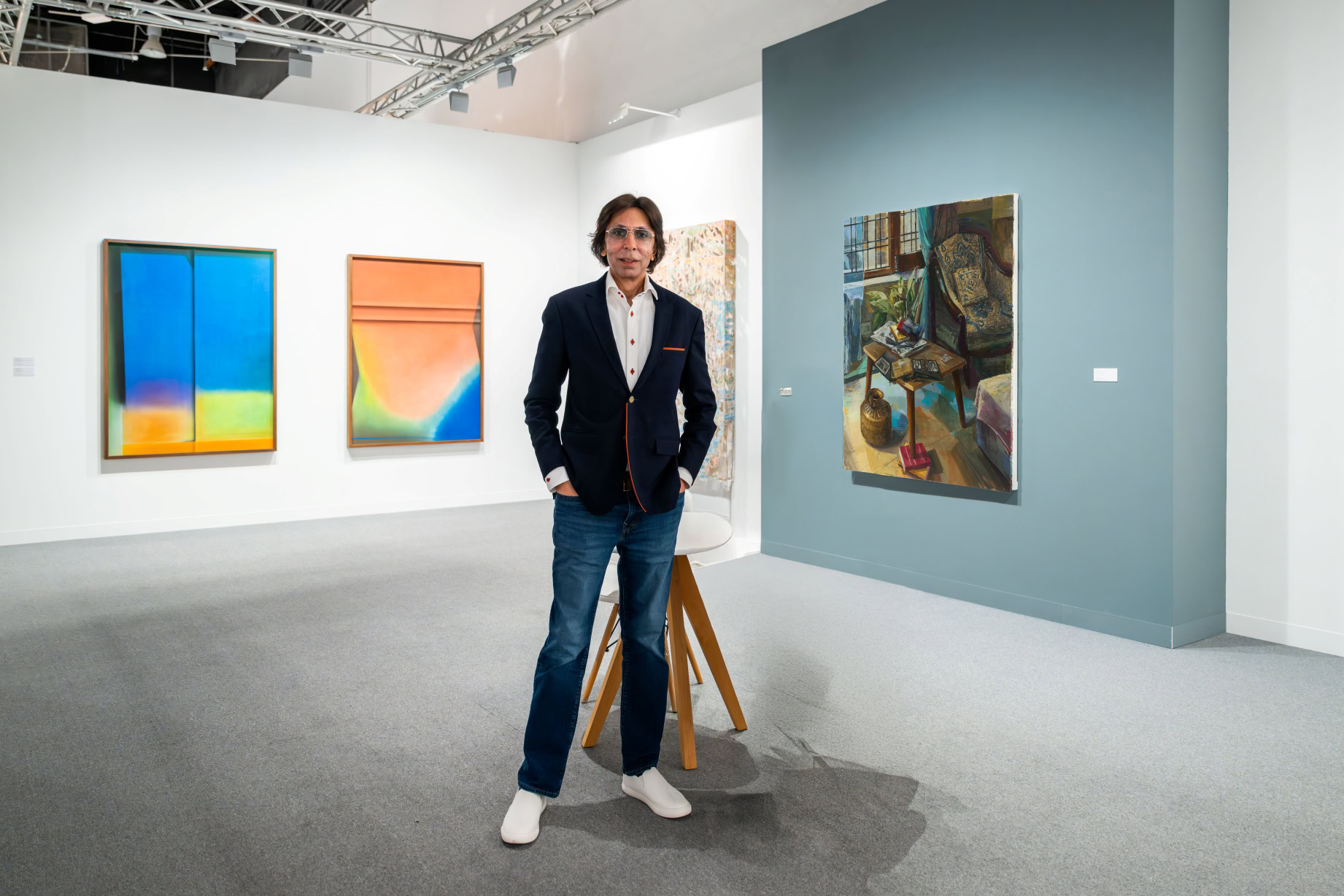
For Thadani, the real magic of an art fair happens at its margins. There’s the electric expectancy of opening day, when works first meet the world. And then there are the final days – when students arrive in numbers, asking sharp, unguarded questions. These moments matter as much as sales. “We regularly organise workshops, talks, and educational programmes with our artists. We design programming around each artist’s practice and the way they want to engage with the community beyond collectors, whether through talks, interviews, lectures, or hands-on workshops”, Thadani shares.
As such, Thadani’s sensitivity to rhythm, contrast and material is shaped by his daily proximity to art. At home, works collected since childhood coexist with those by his gallery artists, forming an environment of constant visual connection. Asked what form his practice might take were he an artist, his answer is unambiguous: space. The wall is his canvas. The eye is his tool.
Asmaa Al-Shabibi, Lawrie Shabibi – Dubai
Lawrie Shabibi Gallery presented a reflection on how material, memory, and place shape an unconventional contemporary artistic practice. Asmaa Al-Shabibi, co-founder and curator, brought together artists from diverse geographies and disciplines. The selection traced a common attentiveness to the physical world – its landscapes, architectures, rituals, and inherited forms – and the ways these are translated through sculpture, painting, photography, and mixed media. Moving between the natural and the constructed, the ancestral and the modern, the works formed a constellation of perspectives that engage in dialogue with cultural continuity, displacement, and transformation.
“We do a lot of collaboration with our artists. At the moment, we are working on three public art commissions, which we are involved with, which include site visits, sourcing materials and directing the production facilities. At Abu Dhabi Fair, our artist Timo Nasseri had an installation at the entrance of the fair in collaboration with Aldar and Alserkal Advisory”, says Shabibi.
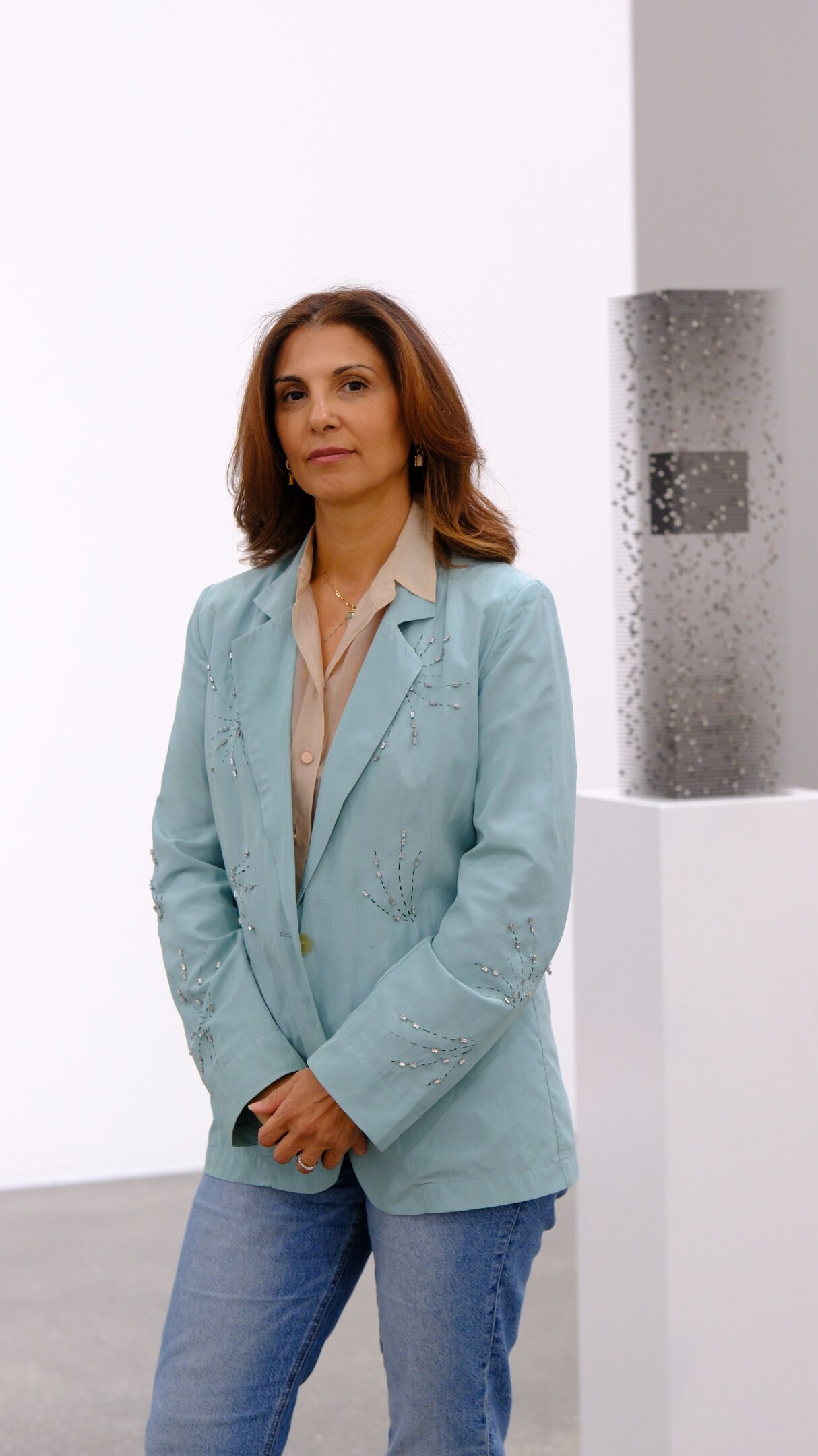
Before you register individual works, you register the atmosphere. Lawrie Shabibi’s booth carries the imprint of return. There’s an afterglow: an attention that is not forced, where nothing is overthought, yet everything has been thoroughly seen and felt. Eight artists, eight distinct presences, bound by intuition and an acute awareness of how one work sets another into motion.Across the booth, the works share a state of moving fluidly between image, material and perception.
Marwan Bassiouni’s photographs orchestrate a rhythm of looking, framing the world through architectural thresholds where light negotiates belief, landscape, and interiority. That layered attentiveness finds a different expression in Mandy El-Sayegh’s dense, collaged surfaces, where language, image, and mark accumulate and fracture, rendering information tactile, almost physical. In Omar Al Gurg’s photographs, time stretches and slows, allowing subtle ecological shifts and ephemeral moments to emerge with quiet force. Material transformation takes centre stage in the sculptural practices that follow: Elias Sime translates circuits and technological detritus into intricate expanses, reflecting global interconnection and exchange, while Ishmael Randall-Weeks reconfigures objects and architectural fragments, suspending their utility to probe survival, mobility, and the politics embedded in making.

It is in the careful curation by Asmaa Al Shabibi that these practices find dialogue and rhythm, guiding the viewer from one material and conceptual plane to the next. Rand Abdul Jabbar carries this material sensibility into memory and history, weaving archaeology and narrative into structures that hold the past in suspension, perpetually open to reimagining. In James Clar’s work, light itself becomes the protagonist, modulating perception and revealing the invisible systems through which we process and understand information. Hand-formed objects and inscriptive drawings hover between tool, relic, and language, anchoring the booth in a sense of duration – practices shaped by repetition, meditation, and a patient, sustained engagement with the world, as seen in the work of Mohamed Ahmed Ibrahim.
For Shabibi, the magic happens before the fair doors open, in the quiet aisles, when the fair is unpeopled and unperformed. In these hours, everything reveals itself: other booths, other logics, the architecture of thought that structures the fair without speaking. Preparation is meticulous – dark chocolate, and her iPad, for Shabibi: minimal preparation, yet maximum attention. She lives with art, among works by Nabil Nahas, Mohamed Melehi, Mohamed Ahmed Ibrahim, and Shaikha Al Mazrou. Asked which medium she would choose if she were an artist, her answer is “clay” – malleable, tactile, alive – a miniature manifesto of the gallery’s ethos.
Hassan Saradipour, SARAI Gallery – Tehran
Contemporary Middle Eastern art finds its global stage through SARAI Gallery, where its booth became a site of dialogue rather than mere display. The gallery fosters encounters that ripple between artists and audiences, across borders and disciplines, revealing the nuances of practice through perspective. Hassan Saradipour sees art as storytelling. He finds the idea that artists must “disrupt society entirely” absurdly overblown, a pressure that often crushes the very voice one hopes to cultivate. What draws him are the artists who inhabit their own worlds and translate them into precise, quietly powerful visual narratives.
At Abu Dhabi Art 2025, the gallery presented four artists – Hossein Mohammadi, Abbas Nasle Shamloo, Moslem Khezri, and Mehdi Chitsazha. “What connects them is a shared commitment to narrating lived experience – life as it is actually observed, remembered, and endured. None of them relies on grand, declarative themes as a shortcut. Instead, they picture the everyday reality that is shaped by larger forces, without turning the work into a headline”, Saradipour explains.

The booth’s layout and lighting were considered to allow the works to breathe individually while forming a coherent atmosphere collectively. Installation was guided by intuition: which piece arrests the eye first, where a viewer pauses, and what lingers as they leave. Light, height, and spacing are tuned so subtly that the artist’s intentions emerge naturally, guiding your eye without forcing it. One senses a rhythm – the moments where attention stops, where it drifts, where it stays – and in that orchestration, each piece speaks for itself while contributing to a larger, unspoken conversation.
When it comes to the artworks, Khezri returns to the world of school, tracing memory and discipline, unease and humour, the subtle social undercurrents that stay long after the classroom has emptied. A distinguished figurative artist, Moslem Khezri often explores the interaction between the human body and space, aiming to manifest the inner truth hidden in the daily moments of Iranian life. His works encapsulate multifaceted sentiments of impassioned, intense tenderness, yet disclose sadness and sorrow. Ultimately, they transcend space and time, manifesting a visual playground for figures to interact and transform their environments.
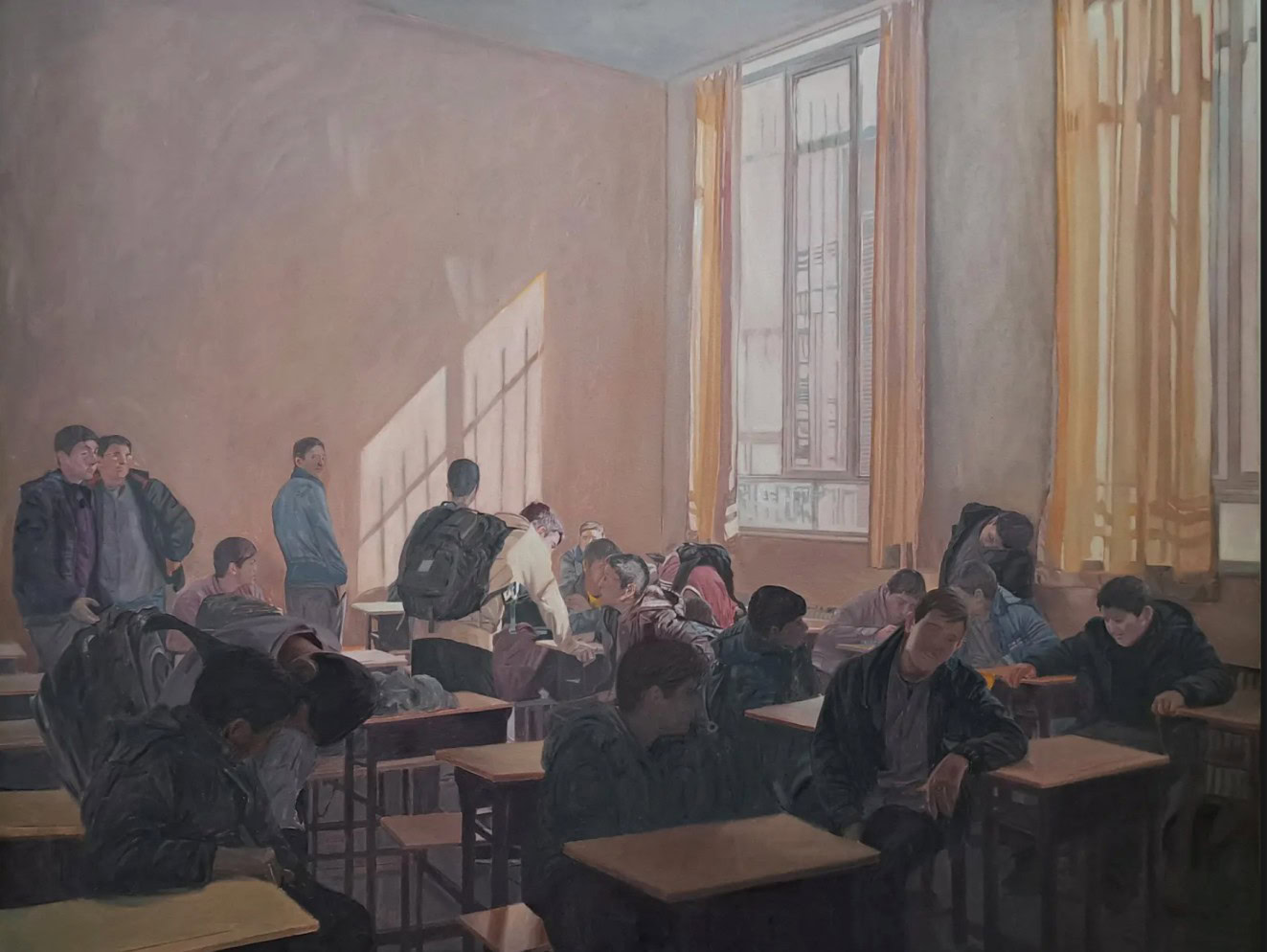
Khezri and Chitsazha, two distinct voices in contemporary Iranian figurative art, navigate the interplay between human presence and the environments it inhabits. Khezri’s practice meditates on memory, discipline, and the nuanced currents of humour and unease that linger long after the classroom empties, seeking to render the intimate truths embedded in quotidian life with a tenderness that is at once impassioned. Chitsazha, whose early love of literature and cinema was awakened to painting through a formative encounter with a teacher, captures the urban and social landscapes of Iran through the eyes of childhood. His works trace children and stray dogs moving through sunlit alleys and winding streets, revealing the world’s chaotic beauty with an innocent gaze. Early experiments – painting on newspapers and cotton sacks during military service – prefigured his ability to transform lived experience into visual stories, a sensibility that carries through his films, writings, and paintings exploring modernity, urban life, and artistic identity.
For Saradipour, Abu Dhabi carries resonance beyond logistics or geography. Situated close to southern Iran, the city evokes a sense of return, stirring memories of opening SARAI in Mahshahr – a small, remote city where risk, belief, and ambition shaped the gallery’s beginnings. At home in California, he lives among his collection, as one might in a private museum, constantly re-curating, attuned to the way light, space, and time breathe life into the work.
Leila Heller, Leila Heller Gallery – Dubai and New York
The threshold of the exhibition for Leila Heller was marked by a monumental collision: Douglas White’s seven-metre palm, a towering skeleton constructed from the scorched carcasses of blasted tyre rubber. It is a visceral opening gambit – a reclamation of industrial waste that immediately anchors the booth in a dialogue concerning the frailty of our ecology and the resilience of the natural form.
Grounded against this contemporary energy is the quiet authority of the modern masters. The abstract architectures of Wassef Boutros-Ghali, the fluid, emotive landscapes of Farideh Lashai, and the earth-bound materiality of Marcos Grigorian provide the historical weight. Together, they form a lineage of environmental consciousness. In this space, the interplay is more than thematic; it is an urgent, rhythmic reminder of the spiritual tether between the human hand and the vanishing horizon – a call for stewardship that is both poetic and absolute.

Heller structured the presentation as a deliberate dialogue between monumentality and intimacy, unfolding across two interrelated chapters. The exhibition announced its premise immediately through Douglas White’s seven-metre palm tree at the fair’s entrance, constructed from blasted tyre fragments and positioned as both marker and manifesto. Sustainability here was framed not as rhetoric, but as a lived contradiction, where industrial residue confronts organic form. Inside the booth, Heller developed this premise through a careful balance of contemporary and modern practices, allowing gestures of fragility, memory, and care to coexist with historical weight. Monumentality never overwhelmed subtlety; instead, the space encouraged attentiveness, offering room for reflection while sustaining a coherent narrative around ecology, spirituality, and stewardship.
The presentation opened with Douglas White’s Black Palm, a confrontational yet poetic sculpture that set the emotional and conceptual tone. Contemporary works by Melis Buyruk, Maryam Lamei, and Azza Al Qubaisi formed the first chapter, approaching nature through delicacy, symbolism, and place. Buyruk’s porcelain flora, recently recognised by Louvre Abu Dhabi, captured the vulnerability of organic life with forensic precision. Lamei’s roses and nightingales drew from Persian poetic traditions, evoking longing and devotion, while Al Qubaisi grounded the booth in the UAE’s landscapes through references to date palms and mangroves.

The second chapter brought together modern masters whose engagement with nature is filtered through memory, material, and architecture. Wassef Boutros-Ghali’s abstractions echoed Middle Eastern geometries, Farideh Lashai’s trees dissolved into atmosphere and gesture, and Marcos Grigorian’s hay-and-mud works recalled the vernacular architecture of the Caspian region, shaped by nostalgia and exile. Morteza Darehbaghi’s reinterpretation of the cypress—a symbol of endurance and eternity – offered a quiet counterpoint, reinforcing a shared conviction across generations: that nature is apprehended through deeply personal relationships shaped by perception, history, and transformation.
Beyond the fair itself, Heller identified the Nja Mahdaoui retrospective at the Bassam Freiha Art Foundation on Saadiyat Island as a defining highlight of the week. Managing the demands of galleries in both New York and Dubai, her days are structured by time zones and endurance, often beginning early and ending late. Wherever she is, meditation and half an hour of daily yoga provide a necessary grounding ritual. “I always travel with a picture of my two boys, Alexander and Philip, wherever I go. Looking at them gives me love and strength. I also take a gift that was given to me by a Korean colleague, a wooden block with a painting of a vase on it. It is supposed to give you strength, abundance, and prosperity in your business”, says Heller when asked about her lucky charms.
Lorenzo Fiaschi, Galleria Continua – Beijing, Havana, Les Moulins, Paris, Roma, San Gimignano and São Paulo
Galleria Continua has participated in Abu Dhabi Art Fair since its inaugural edition, cultivating over the years a deep and meaningful relationship with the region. The 2025 presentation reflects this shared history and ongoing cultural conversation, bringing together artists including Alicja Kwade, Anish Kapoor, Michelangelo Pistoletto, Leandro Erlich, Arcangelo Sassolino, Loris Cecchini, Julio Le Parc, Juan Araujo, Moataz Nasr, and Pascale Marthine Tayou, each engaging in distinct ways with ideas of transformation, identity, balance, and responsibility – themes that resonate in a country simultaneously rooted in heritage and oriented towards the future. The gallery is drawn to artists who both mirror society with precision and challenge it profoundly, valuing above all the opportunity to learn something new every day.

The presentation was conceived collaboratively by Fiaschi with Maurizio Rigillo and Mario Cristiani, treating the booth as a conversation rather than a hierarchy. Works were given space to breathe, confront, and respond to one another, allowing narrative to emerge obliquely, through movement, pause, and proximity. Intuition guided placement as much as reason, shaped by long-standing relationships with the artists and a shared belief in curating as an act of care, pleasure, and attention. The atmosphere echoed Abu Dhabi itself: calm yet intense, precise without excess. For Galleria Continua, the fair is never a transient stop but an ongoing commitment, marked by continuity, sustained dialogue, and the belief that art functions not merely as a reflection of context but as a catalyst for its evolution.


The constellation of artists engaged viewers on multiple registers. Kapoor probed the metaphysics of space; Erlich destabilised the boundary between reality and illusion; Sassolino and Le Parc tested force and perceptual limits; Cecchini speculated on organic and built systems; Tayou reflected on community and shared histories; and Nasr extended these concerns into geopolitics and spiritual life. The generous spatial layout allowed the works to converse organically, some asserting themselves immediately, others revealing meaning more slowly, rewarding sustained attention. On asking Fiaschi whose works sold at the fair, he mentions Alicja Kwade, Michelangelo Pistoletto, Pascale Marthine Tayou, and Moataz Nasr.
Beyond the works on display, Fiaschi reflected that one of the fair’s most gratifying moments was witnessing Galleria Umberto Di Marino participate for the first time – a subtle yet powerful reminder of the fair’s continual renewal and the evolving dialogue it fosters.
Niru Ratnam, Niru Ratnam Gallery – London
“Given Abu Dhabi’s emergence as a global city, we felt it was essential that our presentation reflect transnational narratives – histories of displacement, diaspora, identity, and hybridity. For this edition of Abu Dhabi Art 2025, our first participation, we selected Adham Faramawy, Baseera Khan, Jala Wahid, and Kutluğ Ataman”, explains Niru Ratnam. His approach maps a conceptual terrain where conventional measures of time are set aside, replaced by a more rhythmic, non-linear unfolding that invites reflection and engagement beyond the immediate moment.

The curatorial strategy governing the arrangement of works within the booth was informed by a careful consideration of sequence, scale, and spatial relationships, aiming to construct a coherent yet non-prescriptive narrative walkthrough. The exhibition commenced with works addressing themes of identity and diaspora, proceeded through more intimate or conceptually challenging pieces, and concluded with works designed to facilitate reflection and dialogue. Scale was employed strategically: larger, monumental works were allocated spatial autonomy to assert presence, while smaller, more delicate works were clustered to encourage close, sustained engagement, with placement reflecting intergenerational and transnational connections.
The display adopted a hybrid methodology, combining a loose narrative framework with opportunities for individual works to maintain autonomous expressive authority, producing a layered and open-ended interpretive field. The broader context of Abu Dhabi Art 2025, characterised by its cosmopolitan scope and diverse cultural voices, further informed the presentation, fostering a booth environment that privileged complexity, multiplicity, and critical engagement over reductive legibility.

Presented by the gallery were Baseera Khan, Kutluğ Ataman, Jala Wahid, and Adham Faramawy – contemporary artists whose practices explore the interwoven dimensions of identity, memory, and place. Khan engages materials, the body, and personal traditions to create immersive works that invite contemplation of both individual and collective experience. Ataman examines personal narratives and modes of self-presentation, blending reality and fiction to uncover the layered complexities of human life.
Wahid draws from historical archives and cultural memory, using sculpture, film, and sound to surface stories that might otherwise be overlooked, while Faramawy investigates the connections between people, environments, and myth, reflecting on how movement, place, and history shape identity. Under the curatorial guidance of Ratnam, the presentation brings these practices into dialogue, allowing their works to resonate with one another while preserving the distinct voices of each artist. Together, their work demonstrates how art can encompass diverse experiences, foster empathy, and open new perspectives on belonging, memory, and the subtle ways in which humans inhabit and understand the world.

Asked if a work from another booth caught their eye, the answer was shaped by the fair’s diversity, which draws attention to presentations exploring diaspora, identity, cultural hybridity, and global tensions. In particular, Richard Saltoun’s booth stood out, bringing together artists whose work is both visually striking and thought-provoking, creating a dialogue that resonates with Ratnam’s personal interests.
Sosa Omorogbe, The 1897 – Lagos
The air in Sosa Omorogbe’s 1897 Gallery booth carried a pulse of histories and memories, moving through space like a living tide. “For Abu Dhabi Art 2025, I wanted to show artists who hold both rigour and emotion in their work – people whose practices feel rooted, thoughtful, and genuinely connected to the world around them. Joseph Aina and Samuel Nnorom were an easy choice”, Omorogbe shares. “Even though their practices are different, they’re both deeply interested in connection: Joseph through these emotional, atmospheric worlds he builds, and Samuel through sculptural forms that literally bind and weave”.

Here, the clamour of the fair dissolves. Nnorom’s textiles are stretched, bound, and sculpted into forms that trace migration, social structures, and memory. Absence and shadow mark loss, yet texture and tactility thread through an insistence of hope. Light, weight, and surface create a rhythm that transforms viewing into an encounter. Nnorom and Aina converse across difference – one through the tension of binding and sculptural form, the other through the subtle play of atmosphere and light – both attuned to connection, social and material, without imposing a singular narrative.
Nnorom and Aina anchored the presentation as distinct yet complementary voices. Nnorom’s suspended sculptural “bubbles” hover between textile, painting, and sculpture, made from discarded Ankara fabrics and informed by West African matrilineal knowledge. These works carry ritual, kinship, and labour – histories stitched into cloth – without lapsing into nostalgia. They are at once local and global, rooted and mobile, a duality that resonated strongly in the Gulf’s own cultures of textile and craft. Aina’s paintings offered a luminous counterpoint: imagined landscapes suffused with light and atmosphere.

In the quiet before the fair, Omorogbe begins her day in stillness – prayer, reflection, coffee – attuning herself to the space before the crowds arrive. Pre-opening, she moves through the aisles while they are empty, savouring the moments when the works briefly exist for themselves, and cherishing the unfiltered wonder of children encountering art for the first time. Asked which artists from other galleries appealed most, she names a few: Joana Choumali, Isaac Emokpae, Gommaar Gilliams, Dr Aku Ampofo, Oh Byungwook, Inji Efflatoun, Kamrooz Aram, and Diana Al-Hadid.
Her connection to art is shaped by her upbringing in Benin – bronzes, Osogbo traditions – and by the artists she lives with now, from long-term collaborators to emerging voices she nurtures. Living with art, she explains, sharpens instinct: one learns how works hold light, shift with seasons, and linger in memory. Professionally, she is clear-eyed: a booth is never about her, but about the artist and the audience. At Abu Dhabi Art 2025, this philosophy was realised in a presentation of contemporary African art that was rigorous, emotionally resonant, and quietly assured – proof that art need not shout to be heard.
Written by Sana Krishna


