
You sense a shift in the air the moment you cross the threshold. You become acutely aware of your footsteps, each one carrying through the muted room. Voices drop instinctively, reduced to murmurs, as if in obedience to an unspoken code. Visitors nod pensively, enacting an inner transformation that seems to unfold before our eyes. An art gallery, in this sense, is not unlike a place of worship. This autumn, Johannesburg’s Gallery MOMO embraces this resemblance more overtly, as Andrew Tshabangu invites us into Communion.

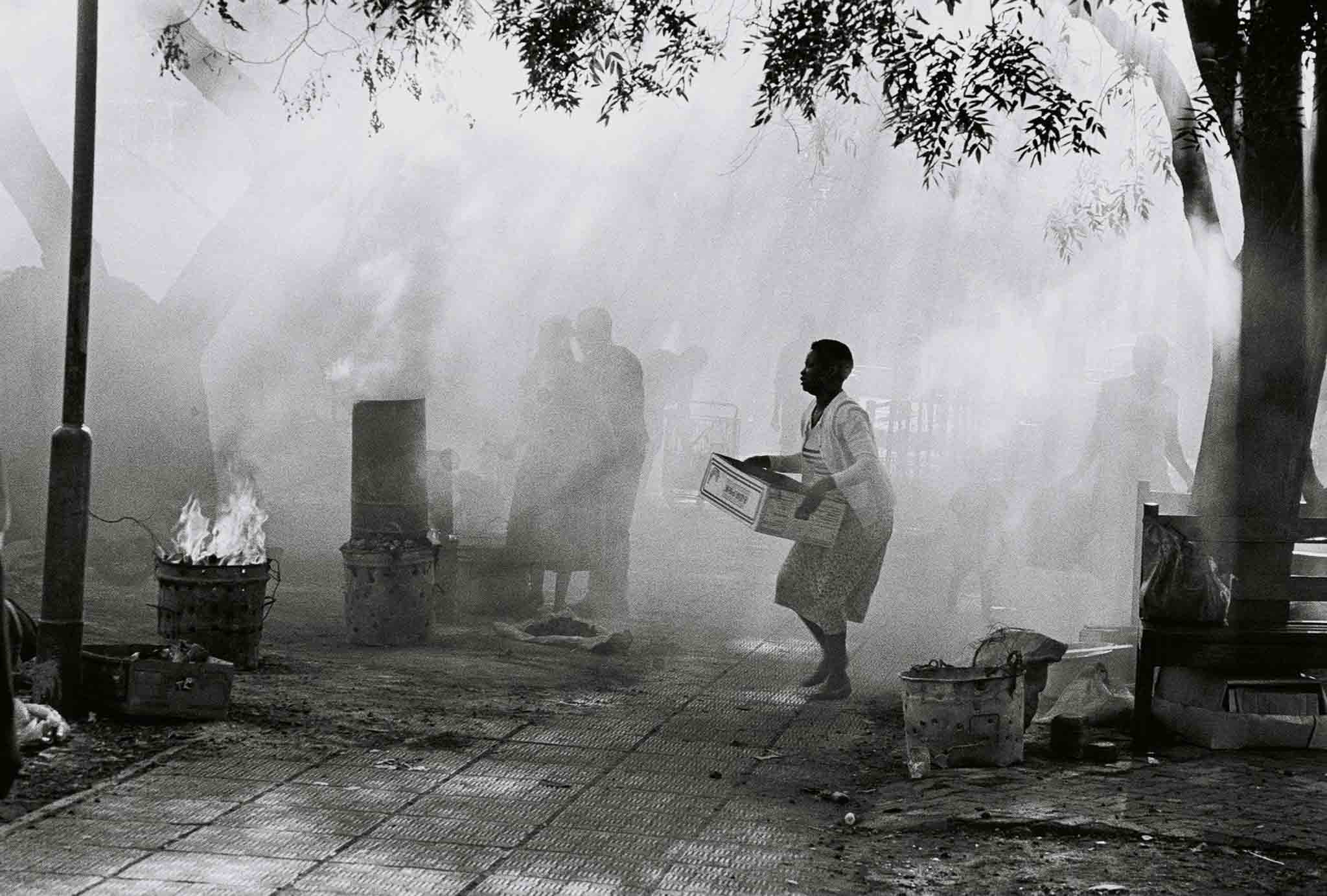
Over the more than 30 years of his career, Andrew Tshabangu (born in 1966 in Soweto) has established himself as one of the key voices in contemporary South African photography. Through his lens, urban genre scenes, rendered in black and white — a palette that heightens the dramatic interplay of light and shadow — are transformed into tableaux that venerate the profane, simultaneously striking and static, as if suspended in time. His ability to extract intimacy from everyday moments conveys a multilayered artistic sensibility and perceptiveness, perhaps forged by the richness of his formative experiences, which ranged from exploring dramatic arts and contemplating the priesthood to studying at the Alexandra Community Art Centre and the Institute for Advancement of Journalism.

In 2017, the first major survey of his oeuvre, Footprints, was released in collaboration with Gallery MOMO, which, between 9 October and 15 November 2025, will host Communion, a solo exhibition of Tshabangu’s photographs. The exhibition compiles three bodies of work: photographs from the salt fields of Matola in Mozambique, the wine harvests of Saint-Émilion in France, and the Water is Ours series, captured across southern Africa and New York — salt, wine, and water each carrying profound symbolic weight across cultures and belief systems. As Odysseus Shirindza writes in the curatorial essay for the exhibition, “Tshabangu reminds us that communion is always both material and spiritual. It is in the taste of salt on the tongue, in the raising of a cup of wine, in the immersion of hands or bodies into water. (…) Communion is not an abstraction, but a lived, bodily reality”.

In Returning to Matola, the viewer is brought back to the tangible world: a salt mountain rises in the background, while in the foreground, a salt pan worker stands with a shovel in hand. The smaller mounds of salt beside him appear entirely unremarkable on their own, yet the juxtaposition of the two images does not diminish the mountain’s majesty. Rather, it consecrates the worker in his labour, elevating the act of human toil to something quietly sacred. Neither what is transcendent nor what is immanent exists in isolation — through our perpetual communion, they become inseparable, the mundane seeping into the holy and the holy into the mundane. In Christian symbolism, water has the power to sanctify and spiritually cleanse, as well as to bring destruction – but also, Water is Ours. In Tshabangu’s photographs, it’s free to exist as at once a site of ancestral tribute and a source of earthly delight.

In Meeting of the Elders, two priests, though clad in ornate robes, are stripped of their aura of mystique, appearing instead like figures absorbed in casual conversation. Meanwhile, Prayer Before Religious Dance captures an otherwise regular-looking man overcome by intensity, his face frozen in raw, unmediated feeling, set against the restless motion of the world around him. Shrindza points out: “In Tshabangu’s hands, communion (…) becomes a broader meditation on human connectedness—to each other, to the land, and to the unseen forces that move within ritual and labour”.

Though it may be difficult not to think of communion in the context of religious terminology, stripped of its performative trappings, it emerges as a spiritual convergence — whether with a higher being or with a fellow “mortal” — where the boundaries between self and other dissolve, indicating a level of intimacy that, though amazing, comes naturally. Tshabangu himself explains that “communion is not merely about religion, it’s about the ways we come together — across generations, across thresholds of the living and the ancestral — and how photography can hold that sacred tension between presence and absence”. The artist manages to democratise the ritual while preserving all its mystique.
“The sacred and the profane”, often cast as opposites, coexist seamlessly in Tshabangu’s photographs, two halves of a single whole. Perhaps, as you participate in Communion, they are revealed to be one and the same.

Andrew Tshabangu: Communion
October 9 – November 15, 2025
Gallery MOMO, Johannesburg, South Africa