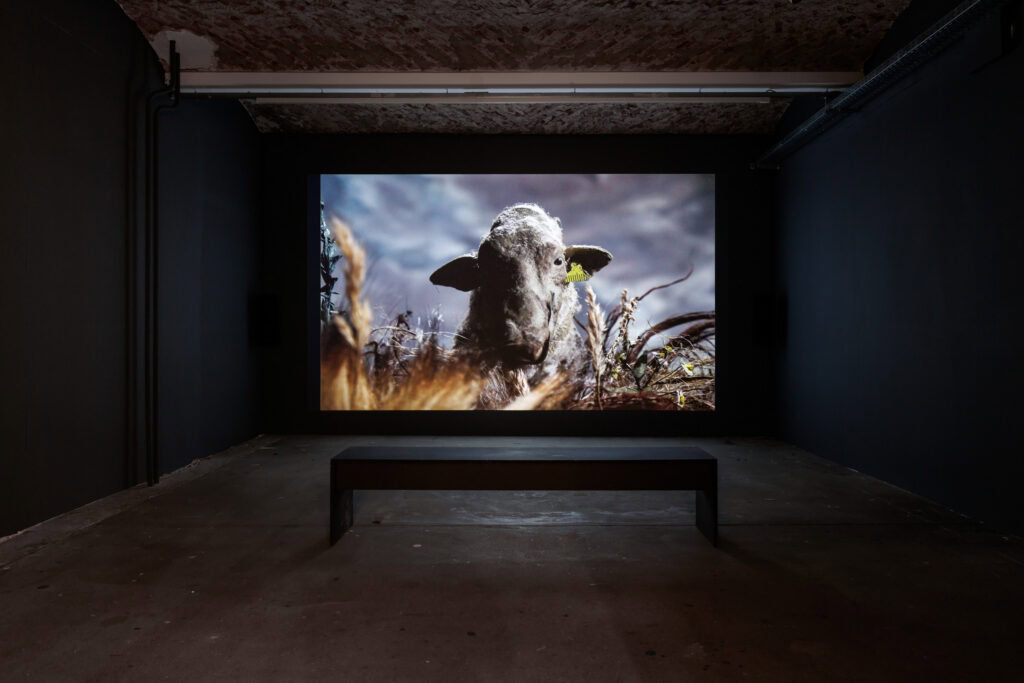
Abi Joy Samuel (b. 1993) is a London-based interdisciplinary artist working across sculpture, painting, photography, drawing and performance. She often combines and layers different media to grasp the inexplicable feeling of inhabiting the (female) body in particular social contexts. Her works — though informed by classical studies of the human form — are dynamic and visceral; they all seem to be undergoing constant reconfiguration, mimicking the inner complexities of those who perceive them.

Through the focal point of the body, Samuel explores themes of power and restraint, female subjectivity, and the monstrosity of the self. Her process is marked by relentless rearrangement — retracing silhouettes in slightly varied positions, creating plaster casts of her body parts only to attach them to industrial structures. This open-ended approach and eclectic background imbue her projects with a sense of willful experimentation that forms the basis of her distinct visual language.
Through the focal point of the body, Samuel explores themes of power and restraint, female subjectivity, and the monstrosity of the self. Her process is marked by relentless rearrangement — retracing silhouettes in slightly varied positions, creating plaster casts of her body parts only to attach them to industrial structures.
Assembling the Self
Created during the MA Sculpture programme at the Royal College of Art in London, Socially Sanctioned Prosthetics is Samuel’s most recent presentation of her body of work. Throughout the exhibition, sculptures of disjointed bodies merge with found objects, creating a disturbing atmosphere in which the flesh, soft and sensual, hangs captured — or sometimes embraced — by rough materials. A print and a painting accompany them, enriching the predominantly plaster-white palette of the collection with deep tones of blood red.

The most elaborate piece in the collection — an installation Not So Very Far Off Lie More Ruins (2026) — takes full advantage of the possibilities of three-dimensional art. Sculpted body parts are arranged in seeming chaos: some lie on the ground or hang from the ceiling, while others balance on car suspension arms and metal scaffolding. Upon closer inspection, flesh-like fragments emerge: a mouth and a nose separated from a cheek and an eyelid, breasts strewn across the concrete floor.


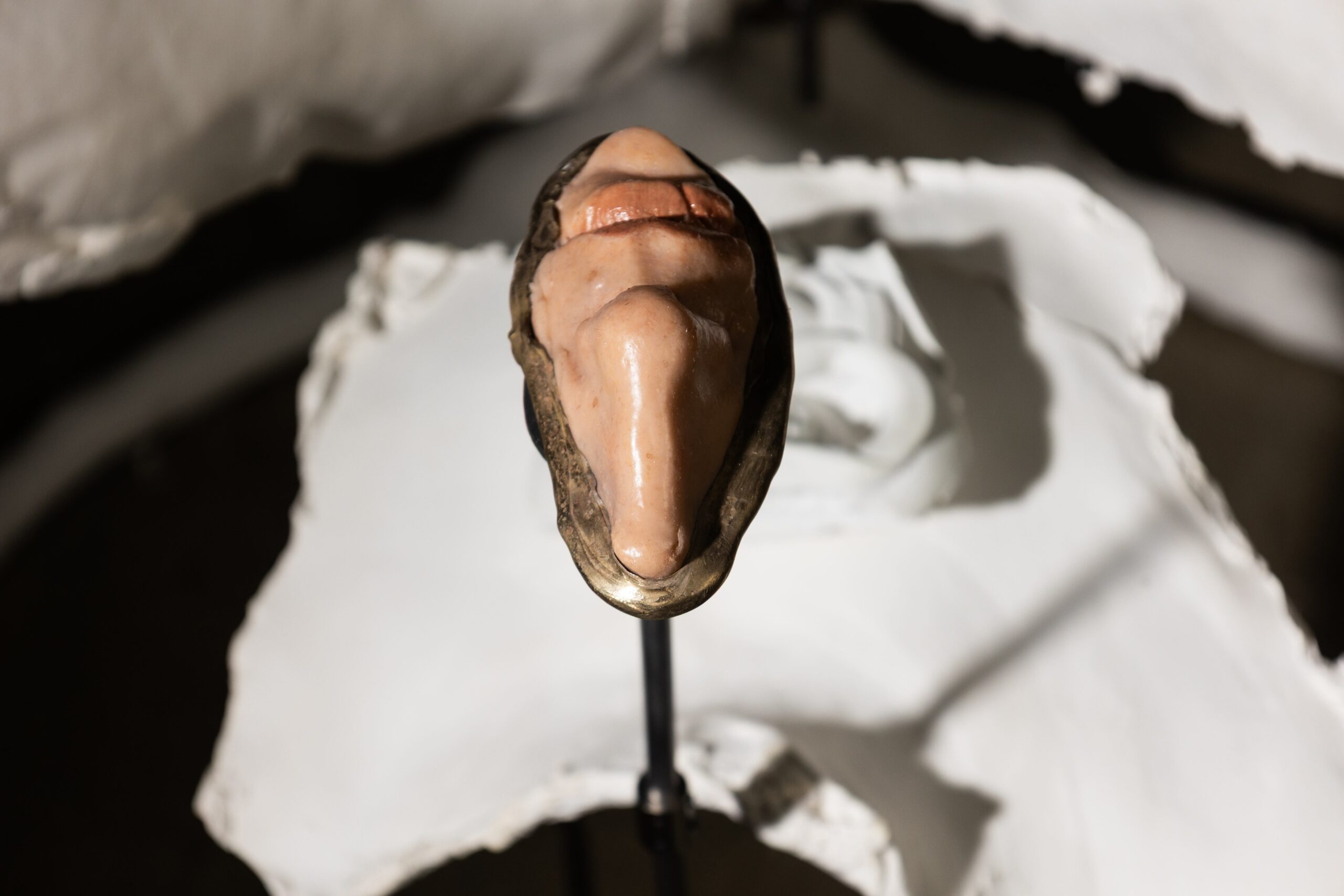
At certain angles, the scattered bundle of limbs takes shape — that of a crucifixion seen from above, or a face mask peeled away layer by layer. Movement, necessary to notice all the nuances of the piece, bestows the body with a certain agency; it becomes a site of negotiation and creation, assuming multiple identities. In this sense, Samuel’s form recalls Mary Shelley’s Frankenstein, not only because of its raw corporeality, but also the ability to reject passive objecthood and exceed the intentions of its maker.
The vulnerable body parts are juxtaposed with metal rods and wires, an image that brings to mind Donna Haraway’s cyborg — an entity only partially human, fragmented and co-created by external systems.
The cast figures evoke antiquity in their attention to detail and celebration of the human form, as in Socially Sanctioned Prosthetics I. Mounted on the wall are crossed thighs, a back, and a leg cut off above the knee, arranged lopsidedly. The vulnerable body parts are juxtaposed with metal rods and wires, an image that brings to mind Donna Haraway’s cyborg — an entity only partially human, fragmented and co-created by external systems. Rather than restoring the complete and harmonious body inherited from classical sculpture, Samuel exposes it as assembled and in need of the support of prosthetics.

The title of the exhibition borrows a line from Audre Lorde, referring to the different structures of support people develop in order to survive in a society riddled with inequalities. In Samuel’s work, flesh mutates and interacts with non-human objects, embraces monstrosity and reinvents itself in response to shifting social contexts.

Feminine Monstrosity
Since childhood, Samuel has been interested in the image of a monstrous woman. In her drawings and sketchbook practice, distorted bodies seem to express the contradictions of female identity. Only through disrupting the classical anatomical coherence could she get closer to articulating the experiences that resist contained representation.

Monster (2026) enriches the exhibition’s narrative and pays homage to the artist’s background as a painter. Created after the sculptures had been completed, it depicts an abstract, flowing figure with only a few body parts emerging from the composition: an arm, a hand, legs and feet. Close to the centre loom bared teeth — a motif present across Samuel’s work, eliciting thoughts of forced smiles so often worn by women, as well as predatory warnings — which gives the work an aura of something sensual yet threatening. The colours are warm: earthy green, intense red and soft beige, but the brushstrokes differ throughout. The limbs are sharp and distinct, while the rest of the body seems hidden behind a hazy cloud-like form, with ochre paint trailing down the canvas. The varied visibility of the silhouette gives an illusion of movement and transformation — the viewer almost expects the figure to turn, shake off the excess paint and reemerge as a completely changed monstrosity.
Since childhood, Samuel has been interested in the image of a monstrous woman. In her drawings and sketchbook practice, distorted bodies seem to express the contradictions of female identity. Only through disrupting the classical anatomical coherence could she get closer to articulating the experiences that resist contained representation.
Meanwhile, A Means of Meaning (2026) exudes a feeling of seduction and control rather than liberation. The sculpture shows a bare female torso, supported horizontally by a steel pipe and a found rolling cart frame, shielded by dried plants from one side. The details are what carry the piece, with the sharp, rounded tip of a metal rod pinching the chest right below the nipple

The restrictive essence of societal norms is palpable here; the body contained in metal frames feels unnatural, reformed. This and other works evoke what Julia Kristeva describes as the abject: matters which blur the line between self and other, eliciting eerie reactions to what should be familiar, but seems foreign and threatening. Yet rather than presenting these unstable structures as something to recoil from, Samuel seems to embrace the rejection of wholeness and firm physical boundaries. She allows her imagined bodies to continually mutate, in search of new and exciting forms.

BIO
Abi Joy Samuel was born and raised in London, where she continues to live and work. She graduated from the University of Westminster in 2017 with a degree in Fashion Design, before working in the industry for brands such as McQ Alexander McQueen. She later completed a Graduate Diploma in Fine Art at the Royal College of Art and has undertaken a number of artist residencies, including KYTA, Quinn Emanuel, and Joya. Samuel is currently pursuing an MA in Sculpture at the Royal College of Art, supported by the Leverhulme Arts Scholarship.